- 252 pages
- English
- ePUB (mobile friendly)
- Available on iOS & Android
eBook - ePub
About this book
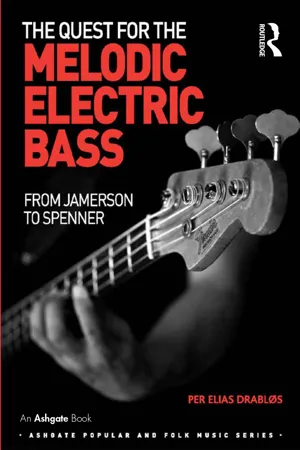
The double bass - the preferred bass instrument in popular music during the 1960s - was challenged and subsequently superseded by the advent of a new electric bass instrument. From the mid-1960s and throughout the 1970s, a melismatic and inconsistent approach towards the bass role ensued, which contributed to a major change in how the electric bass was used in performance and perceived in the sonic landscape of mainstream popular music. Investigating the performance practice of the new, melodic role of the electric bass as it appeared (and disappeared) in the 1960s and 1970s, the book turns to the number one songs of the American Billboard Hot 100 charts between 1951 and 1982 as a prime source. Through interviews with players from this era, numerous transcriptions - elaborations of twenty bass related features - are presented. These are juxtaposed with a critical study of four key players, who provide the case-studies for examining the performance practice of the melodic electric bass. This highly original book will be of interest not only to bass players, but also to popular musicologists looking for a way to instigate methodological and theoretical discussions on how to develop popular music analysis.
Information
Setting the Pace
Chapter 1
Getting to the Base of Things
Back when I was 12 years old, I looked through my LP collection of children’s music and decided I was ready for a musical change. “Stian med sekken,” “Colargol,” and “Simen i Tegneland”1 just did not compare to my friends’ collections of Gasolin’,2 Uriah Heep, and Abba. I convinced my father, a high school lecturer with a limited interest in popular music, to take me to the local supermarket to expand my record collection—I had heard of a band called “Bitls” and saw it as a ticket out of my musical purgatory. After a few minutes in the store, there I was, looking at four bearded hippie pedestrians in a crosswalk: it was the cover of Abbey Road.3 It was music I’d never heard before—“Oh! Darling” with its repeating piano figure, powerful drums, and raw, hoarse vocals; the somewhat peculiar and childlike “Octopus’s Garden”; the lovely “Here Comes the Sun.” And the opening cut of “Come Together”—what a song! But the music that really made an impression on me was “Something,” the beautiful George Harrison ballad. I didn’t pay much attention to the lyrics or to the vocals, or even to the guitar solo—among Harrison’s finest work—but instead to the dark, subtle, dancing bass line that wove the chords together so naturally. From that moment on, I was completely taken with the bass guitar.
Even if, at the time, I had never seen the instrument and knew nothing about it, I nevertheless started to listen to music in a different way from that moment, distinguishing the instruments in the soundscape and paying most of my attention to the bass. So what was so special about Paul McCartney’s bass playing on “Something”? How can a bass line attract the attention of a 12-year-old kid and make him memorize and sing the whole thing? At the time, knowing nothing about bass playing, I had no idea what a bass player was “supposed to play” either. For me, then, it made perfect sense that the bass should play its own melody, together with the vocals, because it sounded great! I wasn’t aware of the original role of the bass instrument, or of its history, development, and constant style changes. I was a tabula rasa, ready for anything.
The next time I heard a bass line that made such an impact on me was 1985, when I stumbled over another game-changing record, this time in my high school music room. The record was a double LP with a yellow cover and a picture of something that looked like the sun: it was called Jesus Christ Superstar. I put it on and was promptly transported. By that time I had started playing the electric bass, and what captured me most, in addition to the intriguing libretto and fantastic vocals, was the varied, purely musical bass playing of Alan Spenner. Spenner was in fact not credited on the cover, so I did not discover his name until years later, when I also learned that he had died in 1991. But the sheer joy of his bass playing came through as if he were smiling at me from across the room.
These two memorable electric bass listening experiences, both by English musicians born in the 1940s who started on guitar, frame my interest to this day. In the time since I encountered them, however, that interest has grown and deepened considerably.
The Melodic Approach
In a rather short period of time, from the middle of the 1960s to the end of the 1970s, an unorthodox role for the electric bass guitar in popular music rose and fell. As late as the early 1960s, the convention for electric bass playing involved simple bass lines focused on the root and fifth of the given chord (occasionally, the performer might also introduce repeated eighth notes into a song’s texture). This function had been long dictated by players of the double bass,4 the bass instrument of choice in Western popular music during the first part of the twentieth century. This instrument was hard to hear, hard to play, and hard to carry around; given the extremely low frequencies it produced, it was generally meant to be sensed rather than actually listened to.5 As popular music transitioned from strictly live situations to the ever-more-popular phonograph record, the double bass stayed in the background, even as drum sets became louder and guitar players began to amplify their instruments. When the Fender Precision bass entered the market at the beginning of the 1950s to relieve the aching backs of upright bass players around the world, a new moment was at hand—here was a bass one could listen to. Still, nothing changed right away, at least according to the music charts.6 It would take a full decade for the new instrument to acquire a voice of its own in the popular music of an entire era.
A melodic approach on the double bass has much of its historic origins in the jazz domain, especially within the contexts of smaller combos, trios, and quartets, where the individual musician has a greater responsibility for improvisational lines, and where the roles are seen as freer than in bigger band settings. Slam Stewart, Jimmy Blanton, and Oscar Pettiford in the 1930s and 1940s, and Paul Chambers, Charles Mingus, and Scott LaFaro in the 1950s and 1960s were all excellent soloists and highly influential in their melodic approach on the double bass. But despite the jazz tradition of performing improvised solos on the instrument, its role as an accompanying instrument in popular music, providing either the root and the fifth or walking lines on the chords, did not change until the beginning of the 1960s, when four players from two different continents started to treat the new Fender Precision bass very differently from what was considered the convention.
One of these players spent most of his time in a basement studio facility in Detroit, Michigan, as a member of Motown’s recording band the Funk Brothers. James Jamerson, originally a jazz upright bass player, started to record for the relatively newly founded record company in the late 1950s.7 In the early 1960s, he switched to a Fender Precision, on which he recorded almost exclusively for the next two decades, even as his career began its decline. In the same period, a studio guitar player in Los Angeles picked up a Precision bass during a recording session when the bass player failed to appear. Carol Kaye quickly demonstrated an ability to both read and invent very distinctive bass lines on the spot, and she soon became one of the most sought-after studio bass players in Los Angeles. Her busy, Latin-inspired, funky playing was like Jamerson’s in many ways, but her sound was different, and she used a pick. She even played several Motown recording sessions, when the Detroit record company started to cut tracks in Los Angeles in the mid-1960s.8 At the time, record companies did not credit studio players on their album covers, so Jamerson and Kaye remained invisible to the public eye. In England, on the other hand, a left-handed bass player did his part to bring the instrument to the masses. Paul McCartney was probably the most famous bass player in the world at the time, and he was always quick to credit the “Motown bass player” as his biggest influence;9 by 1965 or so, one can clearly hear that his bass lines are far busier and more melodic than the standard pop bass at the time. The last player in this “quartet” of innovative bass players was also based in England, playing for the band Cream. Given the band’s record sales of approximately 35 million copies,10 Jack Bruce clearly did his share of bringing busy bass playing out to the world.
Each of these players, first and foremost, broke with the bass’s traditional role in the pop song’s soundscape. Instead of playing the root and the fifth and repeating a one-bar motif or locked pattern, they played the instrument more capriciously—note values, pitches, and placements were executed differently all the time. No second verse, bridge, or chorus bass line was played as a strict imitation of the previous one, and because of this simple fact, the instrument came alive in recordings in comparison to the staid bass of the preceding decades. This is a very demanding style of bass playing; one needs to know the fingerboard very well and to be fast, technically proficient, and well-versed in music theory, at least in terms of what notes relate to what chords. One also needs a high level of coordination between right and left hand and, above all, a great sense of time.11 The best performers in this particular era of bass playing were instrumentalists of a very high caliber.
Throughout this book I will attempt to identify, isolate, and finally define a style of electric bass playing that I refer to as the melodic electric bass. I am fully aware of the term’s potential artificiality and questionable logical construction, but relay on it in this book in order to properly emphasize the stylistic features that bass players used during the 1960s and 1970s as part of a whole concept of playing.
I will approach the challenges of this topic via the following assumptions:
1. something new happened with electric bass playing at a particular time, and this new style of playing had a profound impact on musical styles, as well as on the instrument’s development, role, and use in popular music genres;
2. a consensus gradually arose and then dissipated around this specific way of playing as a new way to fill the bass guitar’s role; and
3. this style eventually disappeared, paving the way for yet newer approaches to bass playing.
When I tried to define the beginning and end of the melodic era during the course of this book, I inevitably ran into certain problems. The rise and fall of musical genres and style preferences generally result from transitions that take place over years of performance practice; they are also informed by generally unanticipated social and cultural changes that affect music consumers and their interest. Nevertheless, we are able to mark some rather significant changes in bass performance in the mid-1960s. James Jamerson’s signature style arrives at this time on a great number of Motown record productions, which in turn regularly appeared on the Billboard hit lists.12 In 1965, the Beatles came out with Help13 and Rubber Soul,14 and Paul McCartney breaks new ground on both with the electric bass. It is at this time, then, that I locate the beginning of the era of the melodic electric bass.
At the end of the era, many things were happening stylistically as the 1970s drew to a close. Disco music had its big breakthrough via the movie Saturday Night Fever, which opened in 1977; here, bass players were expected to perform more repetitive, cyclical parts, and the “disco bass” became known for the octave pattern heard in many of the genre’s songs.15 An ironic ally in disco’s crushing of the melodic bass was the punk band Sex Pistols, whose 1977 album Never Mind the Bollocks16 appeared to advocate for a much more straightforward style of bass playing in rock as well. Lastly, the bass guitar’s role in the pop song grew simpler in response to the introduction of drum machines and synthesizers in the recording process. Producers could now record entire albums without the help or input of session musicians, which naturally gave some popular music genres a whole new instrumental character. A few years later, the creation of MIDI (Musical Instrument Digital Interface) in 1983 allowed for yet other sounds—and, ultimately, a new sort of compositional thinking—that would serve to conspire against bass players who were interested in the “roaming” style. Even the development of the “slapping” technique tended to de-emphasize the melodic content of the bass part in favor of its rhythmic function. This confluence of events, together with the perpetual fluidity of styles and genres in popular music, led to the (temporary) demise of the melodic electric bass. There were, of course, bass players who still focused on this melodic approach, especially within the genre of jazz, where melody has always bee...
Table of contents
- Cover Page
- Half Title Page
- Title Page
- Copyright Page
- Contents
- List of Figures
- List of Tables
- List of Music Examples
- List of Transcriptions
- Acknowledgments
- General Editors’ Preface
- Introduction
- Part I Setting the Pace
- Part II The Melodic Electric Bass Establishing Style as Performance
- Part III Toward a Performance Aesthetic
- Appendix
- Bibliography
- Index
Trusted by 375,005 students
Access to over 1.5 million titles for a fair monthly price.
Study more efficiently using our study tools.
Frequently asked questions
Yes, you can cancel anytime from the Subscription tab in your account settings on the Perlego website. Your subscription will stay active until the end of your current billing period. Learn how to cancel your subscription
No, books cannot be downloaded as external files, such as PDFs, for use outside of Perlego. However, you can download books within the Perlego app for offline reading on mobile or tablet. Learn how to download books offline
We are an online textbook subscription service, where you can get access to an entire online library for less than the price of a single book per month. With over 1.5 million books across 990+ topics, we’ve got you covered! Learn about our mission
Look out for the read-aloud symbol on your next book to see if you can listen to it. The read-aloud tool reads text aloud for you, highlighting the text as it is being read. You can pause it, speed it up and slow it down. Learn more about Read Aloud
Yes! You can use the Perlego app on both iOS and Android devices to read anytime, anywhere — even offline. Perfect for commutes or when you’re on the go.
Please note we cannot support devices running on iOS 13 and Android 7 or earlier. Learn more about using the app
Please note we cannot support devices running on iOS 13 and Android 7 or earlier. Learn more about using the app
Yes, you can access The Quest for the Melodic Electric Bass by Per Elias Drabløs in PDF and/or ePUB format, as well as other popular books in Media & Performing Arts & Classical Music. We have over 1.5 million books available in our catalogue for you to explore.