eBook - ePub
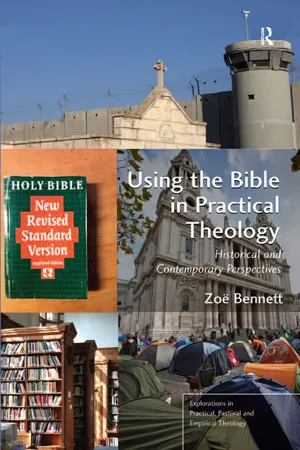
Using the Bible in Practical Theology
Historical and Contemporary Perspectives
- 160 pages
- English
- ePUB (mobile friendly)
- Available on iOS & Android
eBook - ePub
About this book
Exploring how the Bible may be appropriately used in practical and public theology, this book looks at types of modern practical theology with specific emphasis on the use of the Bible. Bennett juxtaposes the diversity of modern practical theology with the work of leading nineteenth-century public 'theologian', John Ruskin, and then assesses the contribution of this analysis to some modern issues of public importance in which the Bible is used. The final chapter offers a framework for a biblically informed critical practical theology which draws on the writer's experience and invites the readers to engage their own.
Information
PART I
Using the Bible – the Reader of Multiple Texts
The Bible itself offers a paradigmatic story of struggle to us: Jacob wrestling with God all night at the ford of the Jabbok.
Jacob was left alone; and a man wrestled with him until daybreak. When the man saw that he did not prevail against Jacob, he struck him on the hip socket; and Jacob’s hip was put out of joint as he wrestled with him. Then he said, ‘Let me go, for the day is breaking.’ But Jacob said, ‘I will not let you go, unless you bless me.’ (Gen. 32.24–6)
Two chapters earlier in this story we hear of one of Jacob’s wives, Rachel, also wrestling:
Rachel’s maid Bilhah conceived again and bore Jacob a second son. Then Rachel said, ‘With mighty wrestlings I have wrestled with my sister, and have prevailed’; so she named him Naphtali. (Gen. 30.7–8)
The word ‘wrestle’ translates two different Hebrew words, one evoking ground or dust, the other evoking entwined-ness and tortuousness. Jacob wrestles with God and alone, the night before he meets his brother; the story of Rachel’s wrestlings with her sister is more communal and down to earth, in the daily pain of infertility and of a polygamous marriage, and of childbirth in which she eventually dies. Two human stories, a man’s story and a woman’s story, which together bring out the struggle of human life as we come to understand it and begin to be able to live with ourselves, with our sisters and brothers and with God. Wrestling with the Bible, I will argue, is for Christians a normal experience in communal and individual discipleship – even if it is not always recognised as such. Jacob wrestling with God is a poignant symbol of this struggle for many of us, men and women, though perhaps Rachel’s wrestling with her sister and co-wife, and her infertility, is an image more pertinent to others, less heroic and more embedded in daily life.
In this book I have deliberately chosen to enter the hermeneutical circle of text and life, at the point of struggle. I have begun with the contemporary human interpreters, in places of struggle – struggle to make sense of the Bible in the midst of our lives and in relationship to others – places where people reach an impasse, individually or communally, and where they question.
In Chapter 2 I follow this up by examining our situation as readers of these texts, recognising our struggle and exploring the nature of our self-involvement.
Chapter 3 introduces the tension, indeed sometimes the struggle, in our different approaches to the text of the Bible and the ‘text’ of life, examining the places of critique and of commitment, of suspicion and of trust.
By beginning this book with the struggles readers have with the text of the Bible I place myself on a well-used map, which delineates three key areas in the territory ‘biblical interpretation’: the author, the text and the reader, or the world behind the text, the world in the text and the world in front of the text.1
The author area of the map includes questions such as date and authorship of the text, historical information and the contemporary world view at the time of writing, or of the oral tradition represented in that writing. This area of the map is the traditional terrain of the biblical historical critic. It has been the staple diet of biblical scholars and their students in the western world since the nineteenth century and has its roots in the rise of scientific and historical understanding in the Enlightenment. The reader area of the map covers the contemporary world of the reader rather than the ancient historical world of the writer, focusing on how the text is read and interpreted, by whom, and what the world looks like from their point of view. It includes interest in how a reader responds to the text, and in how a reader applies the text in their own situation. Taken together these two areas of the map are often known as the ‘two horizons’ of interpretation. It is in the relationship between these, the fusion of them or in the creative tension between them that meaning-making and practical application takes place. The third area of the map is the text itself. For example, in literary criticism of the Bible or in Canonical Criticism, the text itself as it stands is the focus of attention.
1 See further Craig Bartholomew, Colin Greene and Karl Möller, Renewing Biblical Interpretation (Carlisle: Paternoster, 2000); John Barton, ‘Classifying Biblical Criticism’, Journal for the Study of the Old Testament, 29 (1984): 19–35; David A. Holgate and Rachel Starr, SCM Study Guide to Biblical Hermeneutics (London: SCM Press, 2006); Manfred Oeming, Contemporary Biblical Hermeneutics: An Introduction, trans. Joachim F. Vette (Aldershot: Ashgate, 2006); Andrew Village, The Bible and Lay People: An Empirical Approach to Ordinary Hermeneutics (Aldershot: Ashgate, 2007).
Chapter 1
The Text of the Bible and the Text of Life
What Happens When We Read the Bible?
I want to start with real people. Each of the cameos in this section is from the lives of ordinary people. I have chosen them to illustrate how Christians struggle to find their way as they seek with real and often painful seriousness to understand how the Bible shapes their life, and the lives of others, and conversely how their life shapes their understanding of the Bible. The first is my own story.
Cameo One – What Can I Believe?
In 1988 I was sitting in the vicarage front room, my own front room, excited and a little shy and unnerved. This was one of my first days of ‘freedom’, as my youngest child had just started school. Fourteen years previously I had graduated from Cambridge with a degree in Classics and Theology. Since then I had been a vicar’s wife and a mother – happy in these roles, and using my theological understanding and my teaching gifts in the service of the church in a voluntary capacity. I had begun to be disturbed by that debate between the inerrancy and the infallibility of the Bible. Brought up an open evangelical, how did I cope with the challenge that if you did not believe the Bible was verbally absolutely accurate and trustworthy in all matters, geographical and historical as well as ethical, how could you be sure of anything? Until this point I had operated with a de facto infallibility position, a pragmatic approach to living informed by daily devotional reading of the Bible and trying to live by its commands and promises as interpreted to me by the evangelical culture I inhabited. But now I began to think more deeply. I was very much attracted by the inerrancy argument, that a belief in a sovereign God who was utterly trustworthy implied belief that He was competent and willing to reveal Himself without error, and to enable us to receive that revelation.1 By contrast, the ‘infallibility’ position, that the Bible was infallible in matters of ethics and belief but not necessarily inerrant in matters of history, geography and science, felt as if it left me open to a domino effect – once I stopped believing one thing all the rest would tumble. Existentially I found this very frightening indeed. Though now, as I write this in my late fifties, I find it difficult to access the level of fear I felt then, I know that my 35-year-old self was terrified, and felt on the edge of mental breakdown, by the threat to my sense that I could be sure of anything. It was a religious crisis, an epistemological vortex in which everything I trusted felt threatened. While the trigger varies, the experience is common: the beliefs that sustained our young selves are inadequate for the adult self. This is not just about our intellect but also about our emotions, and even our sense of identity. ‘God’ who seemed so like a rock now felt like a floating island in a storm. The ‘seasickness’ was appalling.
I had begun to study theology again, back in Cambridge, to which I had recently moved. This compounded the sense of terror in one way, but in another way it gave me a language in which to order my thoughts and feelings. And so I return to that early afternoon seminar in the sunny vicarage lounge, surrounded by my colleagues and friends, about a dozen of us, discussing our work as evangelical-identified postgraduate students with a great guru of the evangelical movement. My moment had come to ask an evangelical guru my burning existential question: ‘since all knowledge is received by us as human beings, processed by us, understood and shaped by our human minds, what does it mean to talk about revelation from God? Doesn’t it all come from us? Don’t we construct knowledge? Or at the very least, isn’t it all apprehended by our faculties and given meaning by how we understand it?’
His answer has never left me: ‘I thought we were all evangelicals here.’
Reflection
This cameo highlights several key issues about reading the Bible. First, we change and grow. We are nurtured in a certain way of understanding our faith, including what the Bible means to us, and as we change, grow older and experience more of life, our understanding grows too, otherwise we burst out of it like the wine out of old wineskins or as we do out of our old clothes. That is emphatically not to say that our faith or our understanding of the Bible will become less deep, less strong or less important to us; it is just to say it will change. If it does not, we will experience either cognitive and emotional dissonance, in which part of us feels uncomfortably out of step with another part of us, or ‘splitting’, in which we suppress, ignore and hide away a part of us we cannot face up to. How we manage this growth is fundamentally important.
Second, we manage this growth and wrestle with these questions in relationship to the communities of faith that have nurtured us, that have taught us how to read the Bible and to which we belong. It is of those we trust, and in the company of those we trust, that we can ask questions. Sometimes that is extremely difficult and painful and may result in exclusion. My exclusion has been after many years partially redeemed, but not all such stories have a happy ending. It is also with the tools, intellectual, spiritual and emotional, that we have acquired through what we have learned thus far that we can make the next moves and take the next steps.
Third, questions about the Bible matter to us; they are existentially important, not just ‘academic’. In this case my question mattered to me as an all-embracing question about how I could trust the word of God to me, indeed, how I could be sure of anything. Sometimes our questions are ethical and practical, about sexual ethics or political violence for example; sometimes they are deeply emotionally important, what do we believe has happened to a loved one who has died?
Fourth, this incident crystallized for me the centrality of the question of revelation. Twenty years of teaching theology and working in the church have not changed my view that whether anything is revealed by God, if so how and if so what, are fundamental issues for theology and for Christian belief and practice.
Finally, the BIAPT Special Interest Group which I mentioned in the Introduction was for me a kind of recapitulation of this incident – a coming home. I told the story in these words as my contribution to the symposium. It was not a coming home in the sense of a return to where I was then, but a spiralling, as is appropriate for a practical theologian, to a new place, in which the polarisations of that time had given way to a more fluid engagement, more able to accept contraries – contraries within myself and contraries within a group, and indeed within the Bible itself. It was a place where this story was accepted, along with other people’s stories, and critically reflected on, with the purpose of moving forwards collaboratively.
Cameo Two – Violence and the Bible
My class was discussing whether the injunction in Colossians and 1 Peter that wives should be obedient to their husbands was a contributory cause of domestic violence in some Christian households. Most of the people in the room found it incredible. Then a woman spoke up quietly and said, ‘For seventeen years my husband used these verses to justify beating me.’ In the silence that ensued, a beam spread across her face: ‘But the Holy Spirit told me he was wrong!’
Reflection
There are two crucial issues raised by this cameo. In the first place, there are portions of the Bible that have been used to justify actions that many Christians, on grounds they would see as in themselves essentially Christian, abhor. This raises two further questions. One, would it be true to say that some parts of the Bible, for example those that seem to justify violence, are in tension with other parts? Is the Bible itself a site of struggle?2 Two, is it right to think that here the Bible itself carries the blame or is it that people, such as this woman’s husband, have wrongly interpreted it and the Bible itself is exonerated?3 How many people have to make that wrong interpretation for the original text to carry some blame?4
Then there is the question of the Holy Spirit. This woman was giving living testimony to that interaction between the written text and the living presence, indeed voice, of God in human life, which is of the essence of Christianity, Calvin’s ‘testimonium internum’.5 She was also offering her witness, and that witness was being corroborated by the community that heard her, that her husband’s interpretation had violated not only herself but the spirit of the Christian gospel of love. This is to assume there is a ‘canon within the canon’; that it is possible to identify, within the scriptures and the Christian tradition, a ‘heart of the gospel’, to which other interpretations are subject.
This cameo gives a specific and startling instance of our claim that we read the Bible through and in the Spirit of God, that the Bible was written through the inspiration of the Spirit of God, and that the individual is part of the interpretative community inspired by the same Spirit of God. It also causes us to recognise that alternative and contradictory interpretations will arise and be enac...
Table of contents
- Cover Page
- Half-Title Page
- Title Page
- Copyright Page
- Dedication
- Table of Contents
- Acknowledgements
- Introduction
- Part I: Using the Bible — the Reader of Multiple Texts
- Part II: John Ruskin: ‘To see Clearly ... is Poetry, Prophecy, and Religion All in One’
- Part III: The Bible and Theology in the Public Sphere
- Bibliography
- Index
Trusted by 375,005 students
Access to over 1.5 million titles for a fair monthly price.
Study more efficiently using our study tools.
Frequently asked questions
Yes, you can cancel anytime from the Subscription tab in your account settings on the Perlego website. Your subscription will stay active until the end of your current billing period. Learn how to cancel your subscription
No, books cannot be downloaded as external files, such as PDFs, for use outside of Perlego. However, you can download books within the Perlego app for offline reading on mobile or tablet. Learn how to download books offline
Perlego offers two plans: Essential and Complete
- Essential is ideal for learners and professionals who enjoy exploring a wide range of subjects. Access the Essential Library with 800,000+ trusted titles and best-sellers across business, personal growth, and the humanities. Includes unlimited reading time and Standard Read Aloud voice.
- Complete: Perfect for advanced learners and researchers needing full, unrestricted access. Unlock 1.5M+ books across hundreds of subjects, including academic and specialized titles. The Complete Plan also includes advanced features like Premium Read Aloud and Research Assistant.
We are an online textbook subscription service, where you can get access to an entire online library for less than the price of a single book per month. With over 1.5 million books across 990+ topics, we’ve got you covered! Learn about our mission
Look out for the read-aloud symbol on your next book to see if you can listen to it. The read-aloud tool reads text aloud for you, highlighting the text as it is being read. You can pause it, speed it up and slow it down. Learn more about Read Aloud
Yes! You can use the Perlego app on both iOS and Android devices to read anytime, anywhere — even offline. Perfect for commutes or when you’re on the go.
Please note we cannot support devices running on iOS 13 and Android 7 or earlier. Learn more about using the app
Please note we cannot support devices running on iOS 13 and Android 7 or earlier. Learn more about using the app
Yes, you can access Using the Bible in Practical Theology by Zoë Bennett in PDF and/or ePUB format, as well as other popular books in Theology & Religion & Christianity. We have over 1.5 million books available in our catalogue for you to explore.