- 254 pages
- English
- ePUB (mobile friendly)
- Available on iOS & Android
eBook - ePub
About this book
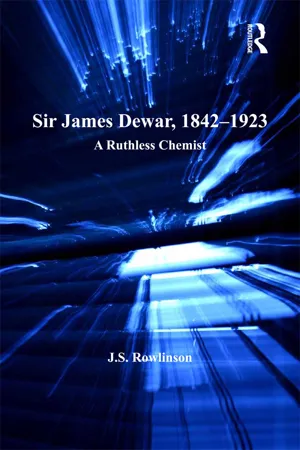
Sir James Dewar was a major figure in British chemistry for around 40 years. He held the posts of Jacksonian Professor of Natural Philosophy at Cambridge (1875-1923) and Fullerian Professor of Chemistry at the Royal Institution (1877-1923) and is remembered principally for his efforts to liquefy hydrogen successfully in the field that would come to be known as cryogenics. His experiments in this field led him to develop the vacuum flask, now more commonly known as the thermos, and in 1898 he was the first person to successfully liquefy hydrogen. A man of many interests, he was also, with Frederick Abel, the inventor of explosive cordite, an achievement that involved him in a major legal battle with Alfred Nobel. Indeed, Dewar's career saw him involved in a number of public quarrels with fellow scientists; he was a fierce and sometimes unscrupulous defender of his rights and his claims to priority in a way that throws much light on the scientific spirit and practice of his day. This, the first scholarly biography of Dewar, seeks to resurrect and reinterpret a man who was a giant of his time, but is now sadly overlooked. In so doing, the book will shed much new light on the scientific culture of the late-nineteenth and early-twentieth centuries and the development of the field of chemistry in Britain.
Chapter 1
Boyhood
The original Dewar was a pilgrim or wanderer, deoradh in Gaelic, a word in which the last two consonants are silent.1 He cannot, however, have wandered far, for throughout the second half of the nineteenth century the name was restricted largely to the central belt of Scotland, that is, to the triangle formed by Glasgow, Edinburgh and Perth, with the greatest number always being in the county of Perthshire.2 By then the most widely-known member of the tribe was John Dewar who had set up his whisky business in Perth in 1846. The James Dewar of this book was, as far as is known, no direct relation of John, although his family was in a similar line of business.
Thomas Dewar, of Overtoun, near Dumbarton on the Clyde, moved in the 1760s to Kincardine-on-Forth.3 This was then a small fishing and trading town where he established or took over the Unicorn Inn on Excise Street.4 The business flourished and his grandson, also called Thomas, who described himself as vintner and innkeeper, married Ann (or Anna or Agnes) Eadie, the daughter of Hugh Eadie, a local shipbuilder – reportedly ‘a very charming and clever’ lady.5 They were to have seven sons, but in 1841, just before James was born, the family was not living together. In the census for that year the three eldest boys, Thomas (13), Ebenezer (10) and Robert (7) were living nearby in Kilbagie Street with Margaret Dewar (30), a dressmaker, and presumably the younger sister of Thomas, the father. At the Unicorn Inn were the parents, both 35, with Alex[ander] (6), Hugh (2) and John (8 months). Nothing more is heard of John and it may be presumed that he was sickly, that the trouble of caring for him had led to the temporary division of the family, and that he died some time after the census had been compiled. The next year James, the youngest son, was born on 20 September 1842. There is now a Dewar Avenue on the north side of the town of Kincardine, named in his honour.
He was brought up according to the beliefs of the Auld Licht, a conservative branch of the established Presbyterian Church in which his father was on the local Board of Management. He went to the New Subscription School, a non-denominational school where the level of teaching varied according to the abilities of the one teacher. At first this was a Mr Hogg but from 1855 it was for three years his elder brother Alexander. Under his guidance the school flourished and was commended in the summer of that year at an inspection by the local Presbytery. Unfortunately for James, Alexander left in 1858 to go to Edinburgh to study medicine. His successor, a Mr Dow of Culross, was not a success, but James left the school that year before his education could suffer much. His family life was blighted by two tragedies. In March 1852, when he was nine, his mother died. At around this time he was soaked by a fall through the ice, after which he wandered about outside for some time in his wet clothes until they were dry, so that his family might not know of the accident.6 As a result of this escapade he contracted a rheumatic fever, and was forced to go around on crutches for two years. He retained a limp for the rest of his life. The fever forced him to give up playing the flute, at which he was becoming adept, but his father engaged a local fiddler who taught him to play his instrument. His skills were enhanced when a joiner then showed him how to build a violin – surely a formidable achievement for a boy of 12? One of his instruments, marked James Dewar – 1854, survived to be played at the celebration of the jubilee of his wedding in 1921, and again after Kurt Mendelssohn’s Friday Evening Discourse at the Royal Institution in 1966; it is still there. It is, however, surprising that the dexterity he showed in making this instrument, and later in life, in his experiments, did not result in more legible handwriting.
His father was a man of unusual abilities. He was a keen naturalist who therefore catered for the annual dinner of the local Horticultural Society, and of many other of the town’s organisations. More remarkably, when he realised that the scale of his operations was restricted by his facilities, he constructed a plant to generate gas with which he illuminated his inn, or ‘Dewar’s Hotel’ as it was now often called. A few years later the Kincardine Light and Gas Company was set up and he transferred his equipment to their services, taking care, however, to become also a shareholder in the Company. The father’s business sense and engineering skills, and the tuition from the fiddle-maker, showed James the importance of cultivating abilities and tastes beyond those of the academic learning he was taught at school; it is not too fanciful to see his whole career so presaged in his early experiences.
The death of his mother was followed by the death of his father on 2 September 1857, a few days before James’s 15th birthday. None of the brothers was interested in or able to continue the business which was therefore put on the market at the end of the month. His father had appointed as trustees: his brother Alexander, a wine and spirit merchant in Leith; the local minister, Andrew Gardiner; and a lawyer, Ebenezer Mill. His estate was substantial; it comprised the Inn, some other properties in Kincardine, his shares in the Gas Company, the crops of several fields, and £1657 in cash. It was divided equally between the six sons, with those who were still minors having their share administered by the trustees. Gardiner, himself a classical scholar, was able to persuade his colleagues that James was clearly an able lad on whom they should spend the money to send him as a boarder to Dollar Institution (now Dollar Academy). This was a fee-paying school in the village of that name, some eight miles from Kincardine, where he was at last able to receive an education that his abilities justified. Meanwhile, when not at school, he lived with his then unmarried brother Robert who had set up shop as a draper in the town. At Dollar Institution he boarded with one of the masters, a Dr Lindsay, who was a fine mathematician. He and James found an old sundial in the garden which they restored and calculated the right orientation for its remounting. When Dewar returned to speak at the school in 1907 he said of him: ‘It was entirely due to his influence and under his direction that the bent of my life was directed toward the side that it has been, and probably the only side where I should have succeeded.’ Lindsay also taught chemistry although without the benefit of a laboratory. Naturally the school taught the classical languages that were then held to be the foundation of a gentleman’s education, but it also offered a wider range of modern languages than most schools of the day. It was, however, on the mathematical and scientific side that James shone. When he left the school in August 1859 he received the first prizes for geometry, experimental philosophy, chemistry, and mineralogy and geology; second prizes for algebra and human physiology; and the third prize for mechanical drawing. He missed a share in the mathematical medal since the rules required that the pupil who received it must have attended the school for two years and James had been there only for one. The external examiner, Philip Kelland, the Professor of Mathematics at Edinburgh, singled out James in his report as ‘one lad who had scarcely any knowledge of mathematics, yet, through only one session at the school he showed abilities that might have been the labour of three years’.
Chapter 2
Edinburgh
James Dewar matriculated at the University of Edinburgh for the start of the session in the autumn of 1859. His brother Alexander had started on his medical course and they took lodgings with two elderly ladies. James stayed with them until his marriage at Bristo United Presbyterian Church on 8 August 1871 to Helen Rose Banks, the eldest surviving daughter, born in 1849, of the late William Banks, an Edinburgh engraver and printer.1 James had cut short his attendance at the British Association for the Advancement of Science, which met in Edinburgh that year from 2 to 9 August, in order to get to his wedding on time. Here, after the ceremony, he played on his juvenile fiddle. The married couple made their home at 15 Gilmour Place.
The University2 was then an institution run by the city of Edinburgh which offered degrees in Arts, Law, Divinity and Medicine. The last was a necessary qualification for an aspiring medical man, but any other degree was an expensive luxury for most of the students. In the year that Dewar entered the University, 42 men received the MD, but in all other subjects only 25 took the MA. Most men simply attended those professors’ lectures in which they were interested and obtained a certificate at the end of the course which vouched for their attendance, for their performance in any tests they had taken, and for any prizes or medals that they had been awarded. When Dewar arrived the Professor of Natural Philosophy was James David Forbes with whom he worked briefly as a laboratory assistant. Forbes left that year to become Principal of the University of St Andrews, but he gave to Dewar the travelling chemical case that he taken on his Alpine travels. He was succeeded by [Peter] Guthrie Tait,3 the Professor of Mathematics at Queen’s College, Belfast. Tait had published little at that time but the city fathers were looking for a good teacher and chose him in preference to James Clerk Maxwell,4 the Professor at Marischal College, Aberdeen, who was to prove the more brilliant man but was not so good a lecturer. The Professor of Chemistry was also a new arrival; Lyon Playfair5 was a Scots chemist who had made his reputation in the last 10 years as a public servant in London, notably when he was a leading organiser of the Great Exhibition of 1851. His return to academic chemistry was a surprise to many and he used it not to promote any research but to improve the organisation of science teaching in the University and to emphasise there the importance of chemistry to British industry. This was a time when industrial developments were first starting to depend directly on scientific advances, particularly in chemistry and electricity, and Playfair was one of those who were conscious that Britain was falling behind its Continental competitors in the extent and depth of its scientific education.
He wrote: ‘Before entering upon my duties as a professor, a considerable sum had to be spent in equipping the laboratories and chemical museum with the full appliances for teaching.’ He did not say that the ‘considerable sum’ came from his own salary for the first two years. Chemistry was a necessary subject for the medical students; it was they who accounted for the large numbers at Playfair’s lectures. In his programme of reform he was helped by the passing of the Universities (Scotland) Act of 1858. This provided for a body called the Curators of Patronage to replace the Town Council as the appointing body for university professors, although the Council was still represented by four members of the seven-man board. The Act also provided for the appointment of paid assistants to those professors who needed to run practical classes. Playfair described the position when he arrived as: ‘The old tradition of classes prevailed. The number of students was too large in each class for effective teaching. I introduced a tutorial system, like that of répétiteurs in France. The tutors followed my course of lectures, and drilled the students in practical exercises upon the subjects which I had discussed.’ These posts replaced those of the privately-paid assistants that some professors, including Playfair, had taken on previously. Perhaps Playfair’s most far-reaching university reform was his persuading the Senate to introduce a science degree in 1864, but it was some years before it became popular; two students qualified for the B.Sc. in 1866. From 1863 there was also a post of Extra-Academical Lecturer in chemistry which was occupied by Alexander Crum Brown (1838–1922),2, 6 an Edinburgh medical graduate but also the first holder of a London University D.Sc.
Dewar attended the classes of Tait and Playfair, and the mathematics classes of Kelland, obtaining prizes from Tait and Kelland in 1860 and 1861.7 His inclination was at first more to physics than to chemistry but, as Cargill Knott wrote, ‘There was then no physical laboratory, and I have heard Tait lament that he was unable to make use of Dewar’s ability in those very early days. Tait was also in the habit of saying that one of the greatest services he did to experimental science was in recommending Dewar to Lyon Playfair as demonstrator and assistant’.3 The chemistry chair was then in the Faculty of Medicine and for a time it seems that Dewar thought of following his brother into a medical career, but he decided against it and finally threw his lot in with the chemists. He held the post of assistant to the Professor of Chemistry, under Playfair, until Playfair’s resignation in 1869 to become the Member of Parliament for the Universities of Edinburgh and St Andrews. He was succeeded by Crum Brown, whom Dewar served until 1874.2, 6 He was paid a salary of £100 a year from the University. His colleague John Young Buchanan,8 who was later to be the chemist on the Challenger oceanic expedition, was assigned to those students who were not intending to follow a medical career, and Dewar to the more numerous medical men. He carried out his duties well; he was, a former student wrote, ‘brimful of energy and enthusiasm, which he communicated to his class – always lambent, sometimes flashing brilliantly’. Meanwhile his brother Alexander had acquired a similar assistantship under James Syme, the Professor of Clinical Surgery.
A leading British industry of the day was the spinning, weaving and printing of cotton goods. Glasgow was then the second city of the kingdom and the central belt of Scotland was a thriving centre of these and many other industries. The Scottish universities produced a high proportion of the scientific and technically trained men and throughout Dewar’s career many of those he worked with, or argued against, were the products of Scotland’s universities and technical colleges. Playfair, who soon became convinced of Dewar’s ability, recommended that he and Peter Griess, a chemist at a brewery, seek employment with the dyestuffs firm of Simpson, Maude and Nicholson, the proprietors of which (and Griess himself) had all trained at the Royal College of Chemistry in London. Nicholson, never a fit man, finally retired in 1868.9 The salaries they then offered to Dewar and Griess were derisory and neither accepted the post. Dewar, moreover, now had other aims and began casting around for a topic of research.
The 1860s were a time when the chemical confusion of the previous decade was being resolved, with the increasing adoption of the ‘new’ atomic weights of C = 12, O = 16 etc., after the Karlsruhe Conference of 1860, which Crum Brown had attended at a time when he was preparing his thesis. The tetravalency of carbon was soon accepted, but the tetrahedral distribution of these valencies, although discussed in these years, had to wait until 1874 for a convincing defence. The linking of chains of carbon atoms in organic molecules was advocated by Archibald Scott Couper and August Kekulé from 1857–8 onwards. Couper was a Scots chemist who became Playfair’s assistant in December 1858 at a time when Crum Brown was finishing as a student, although there is no evidence of any meaningful discussion between them.10 Couper fell ill soon after his appointment and withdrew from active chemistry thus unfortunately leaving all the credit to go to Kekulé.11
It is unlikely that Dewar received much enlightenment from Playfair on the rapid unfolding of these new ideas although he always held him in high esteem. Playfair had given a lecture, ‘On the constitution of salts’ to the Chemical Society on 7 May 1863, but it had an old-fashioned air about it and he was still using the old atomic weights.12 A more likely source of inspiration for Dewar was the work of Crum Brown who had come back to Edinburgh in 1863. His Edinburgh MD thesis of 1861 was on the unusual topic of the theory of chemical combination.13 It was not printed at the time but much of its contents appeared in a paper14 of 1865. In it he introd...
Table of contents
- Cover Page
- Title Page
- Copyright Page
- Contents
- List of Figures
- Preface
- Nomenclature and Units
- Abbreviations
- 1 Boyhood
- 2 Edinburgh
- 3 Cambridge
- 4 Demonstrators
- 5 Spectroscopy
- 6 London
- 7 Commerce
- 8 Cryogenics
- 9 Argon and Helium
- 10 The Davy Faraday Research Laboratory
- 11 Decline
- Chronology
- Appendix: Liquefying a Gas
- Notes and References
- Name Index
- Subject Index
Trusted by 375,005 students
Access to over 1.5 million titles for a fair monthly price.
Study more efficiently using our study tools.
Frequently asked questions
Yes, you can cancel anytime from the Subscription tab in your account settings on the Perlego website. Your subscription will stay active until the end of your current billing period. Learn how to cancel your subscription
No, books cannot be downloaded as external files, such as PDFs, for use outside of Perlego. However, you can download books within the Perlego app for offline reading on mobile or tablet. Learn how to download books offline
Perlego offers two plans: Essential and Complete
- Essential is ideal for learners and professionals who enjoy exploring a wide range of subjects. Access the Essential Library with 800,000+ trusted titles and best-sellers across business, personal growth, and the humanities. Includes unlimited reading time and Standard Read Aloud voice.
- Complete: Perfect for advanced learners and researchers needing full, unrestricted access. Unlock 1.5M+ books across hundreds of subjects, including academic and specialized titles. The Complete Plan also includes advanced features like Premium Read Aloud and Research Assistant.
We are an online textbook subscription service, where you can get access to an entire online library for less than the price of a single book per month. With over 1.5 million books across 990+ topics, we’ve got you covered! Learn about our mission
Look out for the read-aloud symbol on your next book to see if you can listen to it. The read-aloud tool reads text aloud for you, highlighting the text as it is being read. You can pause it, speed it up and slow it down. Learn more about Read Aloud
Yes! You can use the Perlego app on both iOS and Android devices to read anytime, anywhere — even offline. Perfect for commutes or when you’re on the go.
Please note we cannot support devices running on iOS 13 and Android 7 or earlier. Learn more about using the app
Please note we cannot support devices running on iOS 13 and Android 7 or earlier. Learn more about using the app
Yes, you can access Sir James Dewar, 1842–1923 by J.S. Rowlinson in PDF and/or ePUB format, as well as other popular books in History & 19th Century History. We have over 1.5 million books available in our catalogue for you to explore.