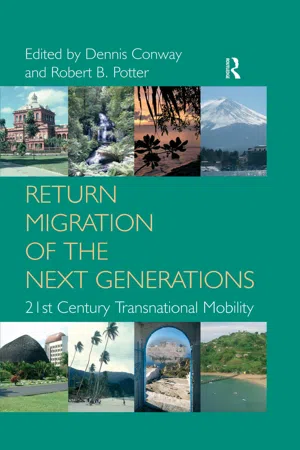
eBook - ePub
Return Migration of the Next Generations
21st Century Transnational Mobility
- 264 pages
- English
- ePUB (mobile friendly)
- Available on iOS & Android
eBook - ePub
Return Migration of the Next Generations
21st Century Transnational Mobility
About this book
There is renewed interest in return migration among researchers of global movement patterns. Until recently, it was overlooked, regarded as the result of failure by emigrants, or related to the return of retired, elderly migrants. This important study looks at the one-and-a-half and second generation migrants, the youthful contract workers and the 'prolonged sojourners' and the consequences of their return to source communities.
Chapter 1
Return of the Next Generations: Transnational Migration and Development in the 21st Century
Dennis Conway and Robert B. Potter
In the global and transnational world of the first decade of the 21st century, people, capital, information, and cultural traits are circulating globally at increasing rates. International circuits of migration are no longer bi-polar and more of them are developing as multi-local transnational networks of movement. The resultant diasporas are far flung and multi-nodal and the cross-border social spaces that are being formed are serving to define, more and more, the social worlds of those involved. Such networks, once established, are themselves serving as facilitators of new waves of migration, of return, moving on and re-return. Indeed, the growing complexity of contemporary international migration pathways, nodes, moorings and way-stations, as well as their wider global reach, is without precedence.
To this point, extant scholarship on international return migration has commonly focused on elderly, first-generation retirees who have consummated their long-held desires and intentions to return to the global South homelands from which they emigrated in their youth. During the post-World War II era, there were appreciable outflows and emigrations of colonial and post-colonial ‘hopefuls’ who sought better lives abroad, better educational opportunities for themselves and their children, or the better opportunities that they were initially denied in their global South source societies. They left behind impoverishment or inequality of opportunity, impenetrable glass ceilings because of gender, race or educational shortcomings, and a dearth of opportunities in their peripheral homelands. In going abroad, they contributed to the rebuilding and reconstruction of war-torn economies, joining the staff of rapidly enlarging public service sectors in Europe and North America and working as ‘replacement’ labour in the modernizing metropolitan economies of their respective colonial ‘mother countries’ or neocolonial partners. They set off to seek their fortunes, conducting ‘rights of passage’ as inquisitive and adventurous youth, though future plans differed in respect of whether they left with an intention to return, to perhaps return when they had become successful, to return on retirement, or indeed, never to return.
These first generations did not always emigrate in waves, nor did they all go abroad at the same time, because differing immigration legislation and policies in the host destinations influenced entry timing. Equally, different conditions in sending societies across the global South – peripheral nations, islands, dependent colonies, and neocolonial or subordinate, occupied or administered territories – obviously served as instigating environments. Recruitment efforts in specific countries, also played their part, so that the first-generation’s experiences would always be varied, in relation to the contexts of the sending and receiving societies – the ‘welcome’ or ‘unwelcome’ messages host societies portrayed and the workplace and societal niches such new immigrants found themselves in, climbed out of, or in which they remained. We can generalize, however, that regardless of the exact timing of the initial sortie, the resultant emigration of the first generations began the international, and later, transnational migration ‘cycles and circuits’ of the families and generations that followed. The resultant transnational diasporas would remain connected as networks consolidated, as intra-generational mobility became more possible, and as circuits of people, knowledge and resources became commonly-practiced exchanges between multi-local nodes in ever-widening, spatially-diversified social fields ‘across borders’ (Conway 2007). At the same time, the life courses, further migrations and circulations of the first generations would play out, while remaining an influential part of the next generations’ migration calculations.
On retirement, in preparation for retirement, or on the death of their partner, many (though far from the majority) among the first-generations left the metropolitan global North destinations to which they had emigrated and returned to their ancestral homelands to live out their days. Others might have intended to return on retirement, but their children’s assimilation into their adopted new home, and unwillingness to accompany them, changed their minds. Some others will have just procrastinated until it was too late, so that they were too firmly settled in their new home to view return on retirement as a viable option. Ageing and infirmity might also intervene, with health service provision becoming extremely influential in the decision to stay in the metropolitan, host destination. So, many of these first generation ‘new immigrants’ stayed away ‘for good’, their temporary stay or sojourn became a permanent relocation, their children and grandchildren transferred national allegiances, and became assimilated, while others – usually a comparative minority – returned on retirement. Shorter-term stays abroad and pre-retirement returns were often characterized as ‘failed-migrations’, or impromptu returns because of adjustment difficulties – employment disappointments, failure to reach target earnings, dropping out of school, and often scarcely-hidden racist and anti-immigrant opposition and hostility in the ‘host societies’ they had dared to enter with the cherished hope to succeed that characterizes such new immigrants.
The first-generations’ children and grandchildren are the next generations who until recently have remained relatively invisible as a return migration cohort. They are the second generation (born overseas to an emigrant parent or parents), one-and-a-half (1.5) generation (those born at home, but who emigrated with their parent(s) at an early age), or other relatively young or youthful pre-retirement ‘returning nationals’, who followed the paths of the earliest wave(s) of emigrants to metropolitan North America, Europe and beyond (Asia, Oceania global cities, for example) from their global South countries of origin, but who then returned after lengthy sojourns overseas. In a few cases, where the first-generation’s emigration or temporary labour recruitment occurred considerably earlier in the nineteenth century, the returning second generation will be parents who do or do not return with their ‘third generation’ children, so second- and third- generations’ lives and livelihoods factor strongly in the return and re-return calculations. As Chapter 4 demonstrates, the Japanese-Brazilians, who were encouraged to return to Japan from Brazil in the 1980s, are an example of this situation. In other cases, second-generation parents often have their third-generation young children’s welfare and education very much in mind, but most of the latter dependents will be returning as ‘involuntary’ movers, where their intentions and wishes concerning such moves are not likely to be as influential as their parents’ motives and decisions on their behalf. Lee’s examination of Tongan youths’ return assessments in Australia reflects this, and other examinations of family return among Trinidadian and Australian returnees in Chapters 9 and 10 respectively, also allude to the immediate family’s mobility decisions, which concern the future of the third generation. Though they are not a particular cohort of interest in this collection, what we can assert, however, is that as time passes, the third generation’s return will soon factor into the return, re-return or stay conundrum as a new, and significant ‘next generation’.
Much more on the relatively recent ‘discovery’ and examination of young pre-retirement return migrants throughout the Caribbean region is provided in this collection’s concluding Chapter 11. This summary of the collection’s work refers back to the authors’ predecessor of this collection, The Experience of Return Migration: Caribbean Perspectives, which was co-edited with Joan Phillips and published in 2005, and the account starts with a synopsis of initial findings as a point of departure for this more global treatment. Chapter 11 then proposes several general themes that emerge from comparisons of the transnational and return migration experiences and practices detailed in this collection; namely, that geographical contexts, age and life-course stages, family demographics and experiences, and transnational mobility are influential ‘determining’ characteristics of the new circuits of return migration in the 21st century.
An exception to the general observations offered above, might be the special case of young and youthful deportees, who have been forcibly returned, often against their will and in ever increasing numbers, by US Homeland Security immigration officials and judges. Many deportees had been arrested and charged with criminal offences, served their jail sentences and have then been promptly sent back. Other deportees had been arrested and when their immigration status or work status was found to be illegal or undocumented, they too were deported promptly without much recourse to further legal procedures or hearings. Deportations in Europe of failed asylum-seekers, who then stayed on and worked in the burgeoning informal sectors as irregular migrants constitute a similar exception, though their numbers are comparatively small by comparison to the US deportation surge. Both of these forced repatriation flows have warranted attention and critical commentary in global and local media, over the internet and in policy circles; both in the deporting countries – the US, Australia and European Union members – and in the returnees’ countries of origin. Except for one case – a small sample of young Tongan deportees in Chapter 3 – the special experiences of this particular group of return migrants are not featured in this collection. In large part this is due to the impromptu and coercive nature of their return migration experience, and also because their return was institutionally managed and executed. It was, therefore, rarely their own decision, not voluntary planned nor accomplished with forethought and with sufficient resources to assure its success, socially and economically.
In many cases, the invisibility of the Next Generations who voluntary return is due to the relatively small numbers involved in comparison to the larger and more familiar emigration outflows that emanate from countries of the global South and which flow into the metropolitan countries of the global North. On the other hand, one country Australia appears to stand out as an exception in terms of its relatively large number of young and youthful pre-retirement returnees. Australia also stands apart because of its government’s exceptional performance in collecting comprehensive data on the country’s emigration and return migration patterns. As is shown in Chapter 10, the coverage of Australia’s diaspora, emigration and return migration sub-populations is without parallel, making both the country’s transnational migration patterns and the data collection protocols that have been instigated an exemplary case to be imitated and replicated by other countries seeking to better manage (and measure) their international migration systems.
Some among the Next Generations are Returning
The next generations of young and youthful return migrants who are in our spotlight are returning in the early- to mid-career phases of their life-paths. Many are in the early family-formation stages, and their active participation in the social, cultural, political and economic ‘spaces’ of their ancestral homelands is the rule not the exception. Many have ‘first-generation’ transnational migrant parents, or a parent, who to varying degrees have initiated them to transnational practices and experiences. Many have transnational experience and worldly backgrounds, with or without direct parental guidance, help and encouragement, so that their return is part of their strategically flexible decision-making which is concerned with operationalizing their social, economic and mobility options to their own advantage, or that of their dependent children – the third generation. Many are also ‘agents of change’ by intention and persuasion, by example and exploits, and by praxis.
Looking to the future, as first-generation migrant cohorts reach retirement age and beyond, the second (and possibly third) generations are poised to become an ever more important group, likely serving as transnational cohorts, who will forge further links between the peripheral homelands in the global South and the metropolitan global North (and emerging Southeast Asia, for example). In addition, there are a growing number of young and youthful transnational migrants returning ‘home’ in their 30s and 40s, who left the global South in their late teens and 20s to acquire higher education, added skills and professional experience abroad. These ‘prolonged sojourners’ (Chapter 9) or ‘returning youthful nationals’ (Chapter 10) grew up and acquired secondary education in their homelands, then sought advancement and better opportunities via international circulation, but are now, like the ‘one-and-a-half (1.5)’ and second generations, returning while still in the prime of their working life – in mid-career and mid-family formation stages. A fourth cohort of youthful returnees originates from the global recruitment of relatively young and youthful circulating professionals and skilled workers, who undertake limited-term, contract work in the global North and global South, or other transnational fields of economic opportunity – the skilled employment sectors of health services, resource exploration, extraction and delivery, corporate commerce, trade and international communications. Again, the return flows of these global skilled and professional workers, albeit selective and numerically small in most cases, deserves our attention for their potential to serve as ‘brain gains’, or ‘brain circulations’, which go some way to offset the ‘brain drain’, of which they were part when they were recruited, or enticed, away.
Notably, all of these cohorts of young returnees, many or most of whom have acquired higher education, professional skills, business acumen, IT and computing experiences while abroad, have more information at their disposal via the internet, telephone and other global networked systems. And, as a direct consequence, they are more directly aware of the opportunities that are open to them, and also perhaps to the adjustments they may have to make in their new environments. They are likely to be more skilled and better endowed with stocks of social and cultural capital than their more elderly returnee counterparts were in the past. Some might very well be moving back and forth, trying out strategies to see if they can enhance their standards of living and the quality of their lives. Some may be content enough, or adventurous enough to experience a new, global life and livelihood ‘between two or more worlds’. Some may re-return, after adjustment problems overwhelm their return intentions.
By means of comparative studies set in the context of new global migration experiences, the chapters of this volume ponder vital issues such as the sociocultural adjustment faced by these transnational return migrants and the degree to which they are able to settle in, establish a satisfactory life for themselves, their partners and dependent children both in work and society, renew ties to family and contribute to local and/or regional development. How are the transnational networks of these returnees contributing to their adjustments; are they changing their situations, making them more mobile or more settled in their new homes? Are they living multi-local transnational lives to the extent that they retain multiple identities and view their global life-world as part and parcel of their new status as strategically flexible, global citizens? Are they the ‘agents of change’ that their retiring parents were unable to be? Are they contributing to societal development or helping mobilize changes in the workplace? How permanent are their return intentions? If they are truly transnational, and living between two or more worlds, what might be their influences and experiences ‘back home’? Have some, many, or only a few, re-returned disappointed and disenchanted? How difficult are their social and economic adjustments? How influential can such small cohorts be in terms of guiding societal development, or contributing to development? Are the health, modernization, and expanding diversity of local economies and availability of wider sets of economic opportunities for such skilled professionals, important contextual factors in the effectiveness of these returnees’ contributions? Is it the collective power of return migrants’ agency or institutional, structural factors in their home societies that determine outcomes in the challenges return migrants take on to contribute positively and achieve their goals? These are some of the unknowns, representing questions that need to be answered.
Global Perspectives: Transnationalism and Return
The chapters that follow convey research by leading authors in the field from the UK, USA, Australia, Canada, the Caribbean and New Zealand. Many of the contributing authors are well-known ‘first-generation’ migration scholars, while the others are ‘up-and-coming scholars’, who rely on fieldwork and micro-level investigations to inform their theoretical conclusions. All the authors are ‘internationalists’ in their scholarly perspectives and academic agendas. The original chapters1 commissioned for this collection are all built upon the contributors’ most recent field investigations and inquiries, yet over half of these contributions are informed by decades of internal and international migration research. The authors talk ‘across disciplines’ – predominantly between geography, anthropology and sociology, – so, the topic is interdisciplinary, the empirical methodologies utilized are a mix of quantitative and qualitative analyses, and generalizations of relevance to social science are an attainable goal.
Return migration has recently been ‘re-discovered’ as a significant emerging dimension of today’s global labour patterns (King 2000). It is no longer the forgotten or overlooked dimension in international circuits of emigration and immigration. It is no longer disparaged as the mobility response of the unsuccessful, the failed immigrant, or the retired. Going beyond examinations of the return of first-generation, elderly, international migrants whose return to their source communities on retirement has dominated the literature to date, the present collection of essays expands the research frontier into the realms of the one-and-a half and second generations and accompanying new cohorts of youthful global contract workers and ‘prolonged sojourners’, and examines their return and its consequences.
Transnationalism, however, builds global networks in which return, circulation and other temporary or more permanent strategies of migrants and their family members, including the next generations, are highly salient components. Choosing to return to the home society of their parents then becomes an option, an opportunity, or an experiment, an initial ‘testing of the waters’, or a ‘try-out’. The return of youthful migrants better endowed with stocks of human social and cultural capital than previous cohorts, and the flows of remittances that also form an essential part of the circuits of transnational exchanges, together constitute a global re-alignment of human and capital resources that promises much in terms of the global South’s ‘development future’. Return Migration of the Next Generations, therefore, deserves our attention, as much as the next generations’ adaptation and assimilation experiences in the overseas, metropolitan destinations in which they were born, or in which they grew up, were educated and acculturated.
Given the n...
Table of contents
- Cover Page
- Title Page
- Copyright Page
- Contents
- List of Figures
- List of Tables
- Notes on Contributors
- Preface
- 1 Return of the Next Generations: Transnational Migration and Development in the 21st Century Dennis Conway and Robert B. Potter
- PART 1 SECOND-GENERATION RETURN MIGRANT EXPERIENCES
- PART 2 YOUNG AND YOUTHFUL RETURN MIGRANT EXPERIENCES
- PART 3 THEORETICAL GENERALIZATIONS
- Index
Trusted by 375,005 students
Access to over 1.5 million titles for a fair monthly price.
Study more efficiently using our study tools.
Frequently asked questions
Yes, you can cancel anytime from the Subscription tab in your account settings on the Perlego website. Your subscription will stay active until the end of your current billing period. Learn how to cancel your subscription
No, books cannot be downloaded as external files, such as PDFs, for use outside of Perlego. However, you can download books within the Perlego app for offline reading on mobile or tablet. Learn how to download books offline
We are an online textbook subscription service, where you can get access to an entire online library for less than the price of a single book per month. With over 1.5 million books across 990+ topics, we’ve got you covered! Learn about our mission
Look out for the read-aloud symbol on your next book to see if you can listen to it. The read-aloud tool reads text aloud for you, highlighting the text as it is being read. You can pause it, speed it up and slow it down. Learn more about Read Aloud
Yes! You can use the Perlego app on both iOS and Android devices to read anytime, anywhere — even offline. Perfect for commutes or when you’re on the go.
Please note we cannot support devices running on iOS 13 and Android 7 or earlier. Learn more about using the app
Please note we cannot support devices running on iOS 13 and Android 7 or earlier. Learn more about using the app
Yes, you can access Return Migration of the Next Generations by Dennis Conway, Robert B. Potter in PDF and/or ePUB format, as well as other popular books in Physical Sciences & Geography. We have over 1.5 million books available in our catalogue for you to explore.