- 328 pages
- English
- ePUB (mobile friendly)
- Available on iOS & Android
eBook - ePub
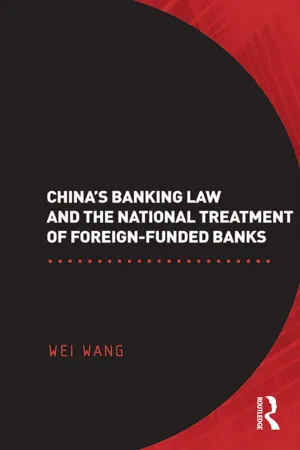
China's Banking Law and the National Treatment of Foreign-Funded Banks
About this book
This book assesses new developments in and reform of China's banking law system following its accession of the WTO. It focuses on the relationship between GATS/WTO national treatment obligations and China's banking law. Tracing the history of national treatment in China, the book compares the treatment of foreign-funded banks with the treatment of Chinese-funded banks and examines the structure and shortcomings of the existing banking law framework in China. Offering suggestions as to how the framework could be restructured and analysing the economic and political bases of an integrated banking law framework, the book argues that reorganization would bring about greater consistency with GATS/WTO national treatment requirements. The book also explores the ambiguous definition of prudential carve-out, the subtle relationship between GATS national treatment and market access based on WTO cases, national treatment clauses in China's bilateral investment treaties, and special treatment on banking in China's free trade agreements. This volume is a valuable resource for academics and students as well as professionals and policy-makers working in the field of banking, WTO, Chinese law and foreign trade.
Trusted by 375,005 students
Access to over 1.5 million titles for a fair monthly price.
Study more efficiently using our study tools.
Information
Topic
JuraSubtopic
Internationales HandelsrechtCHAPTER 1
History of National Treatment in China
Historically and internationally, national treatment originated from treaties,1 which is also the case for China. In the search for an understanding of treatment of foreign-funded banks in today’s China, an exploration of the history of national treatment in China, especially in China’s treaties, can be of immense value.2 To study the history of national treatment in China is useful, and in many instances indispensable. Through the historical analysis, one can discover the origins and the evolution of national treatment in China and the reasons for its fall and rise, thus developing an historical interpretation of national treatment in China’s present, which lays a foundation for further study of the relations between national treatment and China’s existing banking law.
I. Pre-1840
In general, China was an open country before the Ming Dynasty (1368–1644). Normal foreign communication and foreign trade had been continuous for more than one thousand years after the Silk Road was made in the Han Dynasty (206 BC–220 AD). During that period, China did not exclude outsiders, but treated them equally without discrimination.3 There were so many foreign merchants in China that the Tang Dynasty (618 AD–907 AD) even made special rules to deal with foreign-related cases.4 However, the Ming Dynasty officially banned maritime trade with foreign countries,5 and this closed-door policy was maintained by the Qing [Ch’ing] Dynasty (1644–1911). Under the closed-door policy,6 the Qing Dynasty, which was able to support itself in an autarky system, formulated many rules, most of which were excessively strict, to restrain foreigners and foreign trade.7 This situation continued till 1840.
1840 is a watershed year in China’s history. It was the beginning of modern Chinese history, and the end of traditional relations between China and foreign countries. From the fourteenth century to 1840, the relationship between China and foreign countries was a tribute [chaogong] relationship.8 China was the receiver of foreign tribute, foreign countries were the tributary countries, and foreigners were usually considered barbarians [yi].9 With traditional prejudice, the last feudal dynasty in Chinese history, the Qing Dynasty, regarded itself as superior to foreign states and foreigners, and was not willing to provide equal treatment to them.
II. 1840–1911
A. Prerogative Treatment
In 1840, the First Opium War (1840–1842) broke out between China and Britain.10 After China’s defeat, foreign countries were unwilling to provide equal treatment to China.11 The Western powers obtained a large number of special rights in China through a series of unequal treaties with the Qing Dynasty. For example, the Treaty of Nanjing [Nanking] (1842) provided that China should negotiate with Britain regarding China’s tariffs and charges, the so-called “negotiated tariffs” [xieding guanshui], under which China was deprived of its tariffs autonomy.12 Furthermore, China partly lost its jurisdiction by the imposition of “consular jurisdiction” [lingshi caipanquan],13 i.e., extraterritoriality.14 In total, there were nineteen countries which enjoyed “consular jurisdiction” in China.15 In most situations, foreign defendants in China were not subject to Chinese laws and jurisdiction, but to those of their home state, and foreign-related litigation was dealt with by foreign consuls in China,16 or by mixed courts [huishen gongxie] composed of foreign consuls and Chinese judges.17 Britain and the United States even established courts in China, i.e., His Britannic Majesty’s Supreme Court for China (1865) and the United States Court for China (1906).18 Under the unequal treaty system, China’s superior status under the old tribute system was reversed completely. During the late Qing Dynasty, foreigners in China enjoyed prerogatives beyond Chinese law and were, in most cases, granted more favourable treatment than that accorded to the native Chinese.
B. Unilateral National Treatment
Throughout the Qing Dynasty, there were few national treatment articles in Sino-foreign treaties, and a clear concept of national treatment had not been developed. For instance, the term “national treatment” does not appear in an authoritative book on the status of foreigners in China during the late Qing Dynasty.19 It was virtually unnecessary for foreigners to demand equal status with the Chinese because of their already superior position. Nevertheless, the superior status of foreigners was not absolute or omnipresent, and neither the extraterritoriality nor the “negotiated tariffs” forbade the Chinese government to levy inland taxes and charges on foreigners in China. As an offset of the prerogatives enjoyed by foreigners, the Qing Dynasty tried to restrict the activities of foreigners as much as possible.20 For example, although the Western powers obtained inland navigation rights in China, China levied more taxes on cargoes carried by foreign commercial ships on China’s inland rivers than on cargoes carried by Chinese domestic ships.21 Thus, the Western powers found that, under some circumstances, they needed to obtain equal rights with the Chinese, which gave rise to national treatment content in Sino-foreign treaties.
The first Sino-foreign treaty including national treatment content is the Supplemental Treaty between the United States and China concluded on November 17, 1880,22 providing that China and the United States shall not levy higher duties on vessels and cargoes of the other party than those imposed on its own vessels and cargoes.23 This national treatment article was once successfully used by the British Minister at Beijing as a reason to protest at an exemption measure adopted by the Qing Dynasty to subsidize China’s domestic merchants.24 National treatment obligations in this treaty were bilateral and reciprocal, but the reciprocity did not spread to other treaties during the late Qing Dynasty. In other treaties with national treatment content, national treatment obligations were unilateral and only in favour of foreign countries.
First, the Sino-Japanese Protocol (1896) provided that the tax China imposed on the articles manufactured by the Japanese subjects shall neither be other than that payable by the Chinese subjects, nor higher.25 Second, according to the Sino-British Treaty for the Extension of Commercial Relations (1902),26 and the Sino-Japanese Treaty for the Extension of Commercial Relations (1903),27 houses and small piers rented by British merchants and Japanese merchants were to be taxed on an equal footing with the Chinese.28 Third, according to the Sino-US Treaty for the Extension of Commercial Relations (1903),29 machine-made cotton yarn and cloth manufactured in China, whether by foreigners or by Chinese, was to be taxed on an equal footing.30 Fourth, in the Sino-British Conditions on Banning Opium concluded in 1911,31 there was an article about uniform tax on the opium trade before its final elimination, requiring that the tax on the British opium trade should be the same as the tax on the Chinese domestic opium trade.32
Three main characteristics ...
Table of contents
- Cover Page
- Dedication
- Title Page
- Copyright Page
- Contents
- List of Tables
- List of Abbreviations
- Foreword by Sir Ross Cranston FBA
- Foreword by Professor Joseph J. Norton, SJD, DPhil., LLD
- Preface
- Acknowledgments
- Introduction
- 1 History of National Treatment in China
- 2 WTO National Treatment and China’s Banking Commitments
- 3 Market Access, Forms, and Legal Status of Foreign-Funded Banks in China
- 4 China’s Banking Law Framework: Different Positions of Foreign-Funded Banks and Chinese-Funded Banks
- 5 More Favourable Treatment of Foreign-Funded Banks
- 6 Less Favourable Treatment of Foreign-Funded Banks
- 7 Identical Treatment between Foreign-Funded Banks and Chinese-Funded Banks
- 8 Integrating China’s Banking Law Framework
- Conclusion
- Bibliography
- Index
Frequently asked questions
Yes, you can cancel anytime from the Subscription tab in your account settings on the Perlego website. Your subscription will stay active until the end of your current billing period. Learn how to cancel your subscription
No, books cannot be downloaded as external files, such as PDFs, for use outside of Perlego. However, you can download books within the Perlego app for offline reading on mobile or tablet. Learn how to download books offline
Perlego offers two plans: Essential and Complete
- Essential is ideal for learners and professionals who enjoy exploring a wide range of subjects. Access the Essential Library with 800,000+ trusted titles and best-sellers across business, personal growth, and the humanities. Includes unlimited reading time and Standard Read Aloud voice.
- Complete: Perfect for advanced learners and researchers needing full, unrestricted access. Unlock 1.5M+ books across hundreds of subjects, including academic and specialized titles. The Complete Plan also includes advanced features like Premium Read Aloud and Research Assistant.
We are an online textbook subscription service, where you can get access to an entire online library for less than the price of a single book per month. With over 1.5 million books across 990+ topics, we’ve got you covered! Learn about our mission
Look out for the read-aloud symbol on your next book to see if you can listen to it. The read-aloud tool reads text aloud for you, highlighting the text as it is being read. You can pause it, speed it up and slow it down. Learn more about Read Aloud
Yes! You can use the Perlego app on both iOS and Android devices to read anytime, anywhere — even offline. Perfect for commutes or when you’re on the go.
Please note we cannot support devices running on iOS 13 and Android 7 or earlier. Learn more about using the app
Please note we cannot support devices running on iOS 13 and Android 7 or earlier. Learn more about using the app
Yes, you can access China's Banking Law and the National Treatment of Foreign-Funded Banks by Wei Wang in PDF and/or ePUB format, as well as other popular books in Jura & Internationales Handelsrecht. We have over 1.5 million books available in our catalogue for you to explore.