eBook - ePub
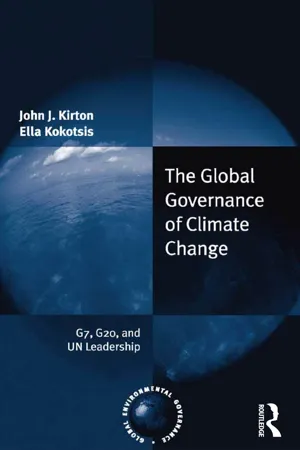
The Global Governance of Climate Change
G7, G20, and UN Leadership
- 420 pages
- English
- ePUB (mobile friendly)
- Available on iOS & Android
eBook - ePub
About this book
Climate change control has risen to the top of the international agenda. Failed efforts, centred in the United Nations, to allocate responsibility have resulted in a challenge now reaching crisis stage. John J. Kirton and Ella Kokotsis analyse the generation and effectiveness of four decades of intergovernmental regimes for controlling global climate change. Informed by international relations theories and critical of the prevailing UN approach, Kirton and Kokotsis trace the global governance of climate change from its 1970s origins to the present and demonstrate the effectiveness of the plurilateral summit alternative grounded in the G7/8 and the G20. Topics covered include: - G7/8 and UN competition and convergence on governing climate change - Kyoto obligations and the post-Kyoto regime - The role of the G7/8 and G20 in generating a regime beyond Kyoto - Projections of and prescriptions for an effective global climate change control regime for the twenty-first century. This topical book synthesizes a rich array of empirical data, including new interview and documentary material about G7/8 and G20 governance of climate change, and makes a valuable contribution to understanding the dynamics of governing climate change. It will appeal to scholars, researchers, and policy makers interested in the dynamics behind governance processes within the intergovernmental realm.
Information
Introduction
Chapter 1
The Global Challenge of Climate Change
Climate change is arguably the most compelling global issue of our time. Along with nuclear war, it is the world’s only challenge that could conceivably threaten the continuation of human life on the planet as a whole. Its negative effects are already evident in the increasing frequency, severity, and unpredictability of deadly heat waves, fires, droughts, floods, hurricanes, tsunamis, dying coral reefs and other deteriorating ecosystems, melting ice, and infectious disease from insects invading long immune domains. Growing evidence suggests it could submerge the coastal cities of major powers, or even extinguish some small island states beneath the warming and thus expanding and rising seas. Because climate is a complex adaptive system, driven by only partly understood, path-dependent processes, cumulative effects, non-linear dynamics, multiple feedback mechanisms, and abrupt system shifts, it is especially difficult to predict its precise course and consequences. It is equally difficult to control through the galaxy of intergovernmental organizations inherited from the 1944–1945 order with their selective, siloed, slow-moving structures and the mechanistic management models and approaches at the core.
Yet the global community showed long ago that, through visionary leadership, it could take the prescient, preventive, ambitious steps to control climate change before its major and perhaps irreversible harmful effects arrived and moved beyond human control. On June 28, 1979, at the conclusion of their Tokyo Summit, the leaders of the Group of Seven (G7) major market democracies called for “alternative sources of energy” that would “help to prevent further pollution” caused by the “increases of carbon dioxide and sulphur oxides in the atmosphere” (G7 1979). They thus acknowledged through this voluntary consensus the need to halt immediately, at 1979 levels, the concentration of carbon dioxide in the world’s climate. In the following five years, they and the other countries in the Organisation for Economic Co-operation and Development (OECD) moved in this desired direction, as their emissions into the atmosphere declared (Sustainable Energy Development Center 2006, 48; Barnes 1994, 42).
In acting so boldly in 1979, G7 leaders were forwarding the more general carbon-controlling environmental principles embedded in their group from its very start. At the conclusion of their first summit at Rambouillet, France, on November 15–17, 1975, the six leaders of France, the United States, the United Kingdom, Germany, Japan, and Italy declared that “our common interests require that we continue to cooperate in order to reduce our dependence on imported energy through conservation and the development of alternative sources” (G7 1975). In 1976, now with Canada’s leader present, they noted the need for the rational use of energy resources (G7 1976). In 1977, with the European Community added, they affirmed the principle of “more efficient energy use” (G7 1977). At the first summit Germany hosted, at Bonn in 1978, they directly declared: “in energy development, the environment and human safety of the population must be safeguarded with greatest care” (G7 1978). And then, in Tokyo in 1979, they took up the issue of carbon emissions directly and concluded that its concentration in the atmosphere must stabilize right away.
The central role of the G7, and the Group of Eight (G8) with Russia added after 1998, in global climate governance stands in sharp contrast to the historic absence of any powerful broadly multilateral intergovernmental organization dedicated to the control of climate change.1 The charter of the United Nations is silent about the existence, let alone the value, of the natural environment. The UN system lacks any specialized functional organization to deal with either energy or the environment overall, instead relying on the fragile United Nations Environment Programme (UNEP) created in 1972 (Kirton 2004a; Biermann and Bauer 2005; Lesage et al. 2010). The Atlantic system of international organizations, centred in the North Atlantic Treaty Organization (NATO) and the OECD, generated only the International Energy Agency (IEA) in 1974, from which France—one of the G8’s original members—at first stood aloof. The global community thus was institutionally defenceless as the oil shocks of 1973 and 1979 from the Arab members of the Organization of Petroleum Exporting Countries (OPEC) assaulted the world economy, and as the trees dying from acid rain in North America and Europe showed that the increasing use of coal and other hydrocarbons polluted the atmosphere and killed living things. When George Kennan (1970), one of the world’s pioneers of the post-World War II order, called for a new powerful plurilateral international institution to meet these ecological challenges, only the G7 responded to the call. The UN followed a different approach, establishing the weak UNEP in 1972, adding a few issue-specific conventions with their small, fragmented secretariats in 1992, and periodically holding summits on sustainable development (Strong 1973; Kirton 2004a). At the dawn of the twenty-first century, at its development-oriented Millennium Summit in New York in September 2000, the UN recognized at the highest level in a comprehensive context the existence and value of the natural environment in general terms (Kirton, Kulik, Bracht, et al. 2014). But it still took no major actions to put its new principle into effect through the Millennium Development Goals launched there (Kirton, Kulik, Bracht, et al. 2014). Nor did it do so with the required ambition at its Rio+20 Summit in June 2012.
The Debate among Competing Schools of Thought
It thus matters how, how well, and why the G8 and its related plurilateral summit institutions (PSIs) led by the Group of 20 (G20) since 2008 have led global climate governance during the 40 years in which they have been engaged in this task. To date, however, accounts of the G8’s involvement and leadership in climate governance have been inconclusive, whether referring to that involvement directly or as part of the G8’s broader environmental performance, and its relationship with the broader G20 and the UN. They range widely from judgements of harmful through irrelevant to effective and beneficial, and differ on why the G8 and G20 performed as they did and what their proper role should be.
The first school of thought considers G8 climate governance to be little more than domestically oriented deliberation and delegation (Bayne 2000b, 65). In this view, G8 leaders discuss pressing, high-profile environmental issues such as climate change for domestic political management, to satisfy attentive audiences back home. But they are otherwise anxious to delegate direction setting, decision making, and delivery to lower levels of the G8 system, including to the ministerial, official, and multistakeholder bodies they created for this task. A variant of this school adds that “though G7 environment ministers began meeting regularly each year, this was not due to instructions from the summit, and it was not clear that the leaders paid much attention to their findings” (66).
Other schools see the G8 as far more effective, in more far-reaching ways, but with vastly different results. A second school, focusing on principled and normative direction setting, views the G8 as the centre of ecologically destructive disciplinary neo-liberalism. Stephen Gill (2000, 18, 1) argues that the G7 acts in a “deliberate and strategic manner” at the centre of a disciplinary neo-liberalism that “tends to atomise human communities and destroys the integrity of the ecological structures that support all life forms,” thereby generating a “crisis of social reproduction on a world scale, a crisis that is ecological as well as social.”
A third school, led by Steven Bernstein (2000, 2001), argues in a similar if less far-reaching fashion that the G8 has been complicit in converting the ecological values that flourished at the birth of the UNEP in 1972 into a new doctrine of “liberal environmentalism” in which economic and market values took pride of place. Bernstein asserts that the G7 began in 1985 with a legitimation of the market norms of liberal environmentalism, then moved by 1988–1989 to the more state interventionist, Keynesian approach of the Brundtland Commission Report, but shifted in 1990 to market mechanisms once again. The cause was the preference of Margaret Thatcher’s United Kingdom and Ronald Reagan’s United States, with an implantation of the latter’s policies coming when the administration of George H. Bush arrived in 1989.
A fourth school argues, in contrast, that the G8 continually asserted and progressively developed the principles and norms of “embedded ecologism” (Kirton 2002a; Hattori 2007). Here the values of environmental enhancement, trade liberalization, and social cohesion occupied an equal and integrated place, even though market-oriented neo-liberalism flourished in the early 1980s and trade values dominated from 1994 to 1998. The latter was due to a G8 deference and delegation to the new, heavily legalized and organized, “hard law” but ecologically unfriendly World Trade Organization (WTO) (Kirton 2002d, 2004a; Abbott et al. 2000). A very strong version of this school from Takashi Hattori (2007, 78–9, 91) argues that the G8 at its 1988 and 2005 summits developed ever expanding and interlinked environmental norms within Japan’s public and its government, led to pro-environmental institutional innovation in the latter, and educated a future Japanese prime minister whose government led on climate change at the third Conference of the Parties (COP) to the United Nations Framework Convention on Climate Change (UNFCCC). The G8’s domestic political and direction-setting performance was thus powerful, in part because of Japan’s emerging domestic policy by 2005 of integrating environment, economy, and international cooperation.
A fifth school emphasizes institutionalized international interdependence as driving the G8 to ever greater performance on critical issues such as climate change and biodiversity, through its decisional, delivery, and development of global governance tasks (Kokotsis 1995, 1999). Here higher levels of G8 commitment and compliance came from the availability of the multilateral UN institutions after its Rio summit in 1992, the growing array of G8 environmental institutions, and more powerful environmental bureaucracies in G8 member governments to help those governments transform their collective commitments into implementing action. This school suggests that G8 governments were also inspired to do so due to the personal commitment and political capital of individual G8 leaders, perhaps as they presciently and responsibly recognized that international interdependence required collective action to address emerging ecological problems that were inherently global, even if these problems currently harmed outsiders far more than G8 members and citizens themselves.
A sixth school claims, in contrast, that the G8 was a growing environment and climate governor but an implementation failure, due to its lack of a secretariat, the changing agenda of each host, and its trusting, unmonitored delegation of environmental issues to the World Bank and International Monetary Fund (IMF). James Barnes (1994, 1–2) writes:
Not until environmental organizations began to put forward initiatives to the G-7 in the mid-1980s were environmental topics addressed seriously. Since 1985, environmental and development issues have been featured with increasing prominence. Yet, as with many other G-7 issues, there has been little follow-up by the member Governments. This is partially because there was no “secretariat” for the Summits, and the tendency of each host Government to focus upon the current year’s agenda rather than reviewing the commitments and concerns of prior years … [and] the continual referral of responsibilities by the G-7 to the World Bank and International Monetary Fund without simultaneously developing accountability mechanisms or reviewing how the Bretton Woods institutions have carried out their duties.
A seventh school sees the G8 more generally as a UN supporter, with varying effects. Joseph Aldy and Robert Stavins (2008) view the 2007 G8 Heiligendamm Summit, with its five invited guests of Brazil, China, India, Mexico, and South Africa (Group of Five, or G5, also sometimes referred to as “Plus Five”), as supporting the UN’s climate governance by calling for a continuation of the UN approach in the post-Kyoto years. Others agree but judge the G8 too ambitious, due to its inappropriate adoption of the Kyoto approach of setting long-term targets and pressing to produce a similar, post-Kyoto regime. Andrew Green (2008) thinks that the G8 was wrong in 2007 to set a target of reducing emissions by 50 percent by 2050, as it should have focused on actions that could be done in the near term. Similarly José Goldemberg (2007) notes that the 2007 summit endorsed a Kyoto-like cap and trade approach, which was potentially very effective. Soledad Aguilar (2007) also notes that the G8 simply supported the UNFCCC as the appropriate forum for post-Kyoto negotiations, and did not do much by itself on climate change.
An eighth school presents the G8 as a UN supporter first, and fall-back governor should the UN fail. James Sebenius (1991, 111) notes that the 1990 G7 Houston Summit “endorsed expeditious framework negotiations” to produce the convention on climate change called for by the UN General Assembly in a unanimous resolution in December 1988. But he concludes that if this convention was unsuccessful, a small group of industrial states that had unilaterally committed to greenhouse gas control—the EU, European Free Trade Area, Japan, Australia, Canada, and others with stabilization or reduction targets—could produce a smaller-scale convention among themselves.
A ninth school, in contrast, points to the G8’s informal governance as being appropriate from the start, due to the need for commitments to be voluntary and the refusal of the United States and other G8 partners to accept the sanctions that hard law regimes bring. Thomas Schelling (2002) argues that “neither the United States nor the other major developed countries will likely accept serious sanctions for missing emissions targets.” A variant from George Kennan (1970) argues that a small group of 10 or so powerful and committed states, including the Soviet Union, had to act plurilaterally from the start to produce a badly needed global climate regime. Another variant from Peter Haas (2002, 77–80) suggests that G8 summits are effective on environmental and climate issues due to their small, ongoing, private nature, the nesting of G7 finance and trade ministers within international organizations such as OECD, IMF, and Bank for International Settlements, their lack of “profound political schisms,” and the presence of popular concerns and perceived links to national interests. Similarly Manfred Milinski and his colleagues (2008) see the G8 as potentially creating climate cooperation because it embodies the small, non-anonymous groups that best preserve the common good.
A tenth school sees the G8 summit providing promising political leadership due to its members’ mobilization of political will, in contrast to the pessimism that experts bring. Ruth Greenspan Bell (2006) notes that “many politicians are more optimistic. In July 2005, leaders of the group of eight highly industrialized states (G-8) pledged to put themselves ‘on a path to slow and, as the science justifies, stop and then reverse the growth of greenhouse gases’.”
The arrival of the G20 as a forum of finance ministers and central bank governors in 1999 and then as a leaders’ summit in 2008 led to a focus on this broader plurilateral body and gave rise to a new debate about how and why the G20 did and could govern climate change.
Here the first school sees G20 failure. Jing Huang (2009, 439) argues that the G20 as an ad hoc, crisis-driven institution for networking and consensus formation has “yet to come up with any long-term plans or strategies for major global issues such as climate change, poverty eradication, water crisis, energy security, and food supply.”
The second school sees potential effectiveness due to the G20’s size, capability, leaders’ prescience, issue linkage, and transparency. David Victor concluded that the G8 would not induce effective climate cooperation unless it included all the major carbon-producing powers (Victor et al. 2006; Victor 2006b). Victor (2006a, 101) suggested that Paul Martin’s proposal for a leaders’ twenty (L20) was “the most interesting idea” to cope with climate change because it offered the required small group, non-binding institution, and bottom-up approach. In the same spirit of broadening beyond the G8, from the political world Hillary Clinton (2007) held that “we must create formal links between the International Energy Agency and China and India and create an ‘E-8’ international forum modeled on the G8. This group would be comprised of the world’s major carbon-emitting nations and hold an annual summit devoted to international ecological and resource issues.” Peter Haas (2008b) saw the G8 plus China successfully creating technology cooperation for climate change mitigation. Once the G20 summit had arrived, Barry Carin and Alan Mehlenbacher (Carin and Mehlenbacher 2010a, 33) argued that the G20 is “as good as it gets” as a group with the potential to take effective action on climate change as it has the right number of members and amount of capability, and can be farsighted, create issue linkage, and fully disclose the values and interests of its members.
The third school sees G20 promise crowded out by financial crisis. David Victor and Linda Yueh (2010) assert that the G20, which “played the pivotal role in crafting new financial regulations after the Asian financial crisis, seemed to be a promising forum for addressing energy and climate issues as well, but topics such as the global economic meltdown of 2008 have crowded them out at the top of the agenda.”
The fourth school sees the G20 as a proven performer in particular places. Joy Kim and Suh-Yong Chung (2012) argue that the G20 has effectively delivered on financing, phasing out fossil fuel subsidies, and engaging business stakeholders and has much potential to facilitate UN climate change negotiations. This potential is due to the G20’s ability to bu...
Table of contents
- Cover Page
- Title Page
- Copyright Page
- Contents
- List of Figures
- List of Tables
- About the Authors
- Preface
- Abbreviations and Acronyms
- PART I INTRODUCTION
- PART II CREATING THE EXCLUSIVE G7 REGIME
- PART III SHAPING THE DIVIDED UN REGIME
- PART IV PIONEERING THE INCLUSIVE GLOBAL REGIME
- PART V CONCLUSION
- Appendices
- Bibliography
- Index
Trusted by 375,005 students
Access to over 1.5 million titles for a fair monthly price.
Study more efficiently using our study tools.
Frequently asked questions
Yes, you can cancel anytime from the Subscription tab in your account settings on the Perlego website. Your subscription will stay active until the end of your current billing period. Learn how to cancel your subscription
No, books cannot be downloaded as external files, such as PDFs, for use outside of Perlego. However, you can download books within the Perlego app for offline reading on mobile or tablet. Learn how to download books offline
Perlego offers two plans: Essential and Complete
- Essential is ideal for learners and professionals who enjoy exploring a wide range of subjects. Access the Essential Library with 800,000+ trusted titles and best-sellers across business, personal growth, and the humanities. Includes unlimited reading time and Standard Read Aloud voice.
- Complete: Perfect for advanced learners and researchers needing full, unrestricted access. Unlock 1.5M+ books across hundreds of subjects, including academic and specialized titles. The Complete Plan also includes advanced features like Premium Read Aloud and Research Assistant.
We are an online textbook subscription service, where you can get access to an entire online library for less than the price of a single book per month. With over 1.5 million books across 990+ topics, we’ve got you covered! Learn about our mission
Look out for the read-aloud symbol on your next book to see if you can listen to it. The read-aloud tool reads text aloud for you, highlighting the text as it is being read. You can pause it, speed it up and slow it down. Learn more about Read Aloud
Yes! You can use the Perlego app on both iOS and Android devices to read anytime, anywhere — even offline. Perfect for commutes or when you’re on the go.
Please note we cannot support devices running on iOS 13 and Android 7 or earlier. Learn more about using the app
Please note we cannot support devices running on iOS 13 and Android 7 or earlier. Learn more about using the app
Yes, you can access The Global Governance of Climate Change by John J. Kirton,Ella Kokotsis in PDF and/or ePUB format, as well as other popular books in Politik & Internationale Beziehungen & Internationale Beziehungen. We have over 1.5 million books available in our catalogue for you to explore.