- 210 pages
- English
- ePUB (mobile friendly)
- Available on iOS & Android
eBook - ePub
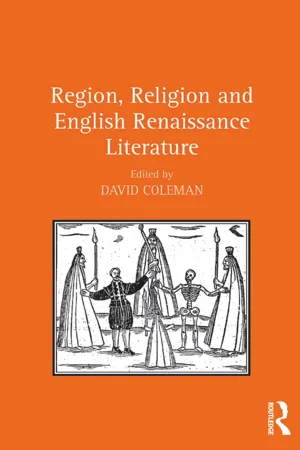
Region, Religion and English Renaissance Literature
About this book
Region, Religion and English Renaissance Literature brings together leading scholars of early modern literature and culture to explicate the ways in which both regional and religious contexts inform the production, circulation and interpretation of Renaissance literary texts. Examining texts by a wide variety of early modern writers - including Edmund Spenser, Lodowick Lloyd, Richard Nugent, Thomas Middleton and John Webster, Richard Montagu, and John Milton - the contributors to this volume enhance our understanding of the complex cultural contexts of early modern Anglophone writing.
Information
Chapter 1
Introduction: Regional Religions and Archipelagic Aesthetics
David Coleman
Archipelagic English? Waller and Cromwell
If Karl Marx considered Edmund Spenser to be Elizabeth’s arse-kissing poet, it is tempting to speculate as to what his response might have been to Edmund Waller, a poet who composed verses in praise of three Stuart monarchs and – in the opportunity offered by the Interregnum – their republican replacement, Oliver Cromwell (Marx 305). Despite the profligacy of his praise, though, it is too easy to see Waller simply as a fawning poodle, offering his versified subservience to whoever happens to be in power (and whatever type of power they happen to wield); in fact, as I will suggest below, his poem in praise of the regicidal regime does not necessarily mark a break from his more frequently-assumed, high-Anglican Royalism. It is, by a quirk of historical fate, the poem to Cromwell – A Panegyrick to my Lord Protector – which is the best-known example of Waller’s political praise-poems, and it is that poem which also provides the most significant expression of Waller’s archipelagic aesthetic (Waller 1655). If Spenser – as a New English Protestant writing English poetry and serving as an English colonial official in Munster – was always acutely aware of the cultures and contradictions of the various peoples of the Atlantic archipelago, Waller seems, on the basis of his poetry, only to have entertained serious consideration of such affairs at times of heightened political crisis. If Spenser’s career witnesses the process whereby ‘English’ moves towards becoming the dominant culture in the archipelago, Waller’s poem seems to give voice to a more recognisably modern sense of English culture, secure of its superiority in the three kingdoms:
Your drooping Countrey torn with Civil Hate,
Restor’d by you is made a Glorious State;
The seat of empire where the Irish come,
And the unwilling Scotch to fetch their doom. (Waller 1655, ll. 13–16)
Restor’d by you is made a Glorious State;
The seat of empire where the Irish come,
And the unwilling Scotch to fetch their doom. (Waller 1655, ll. 13–16)
Waller’s poem, with its vision of an English imperialism within the archipelago, enunciates an identifiably Anglocentric perspective on the politics of the three-kingdoms question, particularly as they were understood in the kingless decade of the 1650s.
Central to Waller’s interpretation of archipelagic politics is a stress on the power and strength of England, as synecdochically represented in the figure of Cromwell. The 20-line passage 81–100 presents this argument in some detail. In this passage, it is Cromwell, not James VI and I, who forges a modern Britain. The ‘Caledonians’ have, up to this point, been ‘A Race unconquer’d’, ethnically and geohumourally distinct from the English, ‘by their Clyme made bold’ (81–2). Yet it is Cromwell who has been chosen by ‘Fate’ to ‘tame’ the Scots, a feat ‘from all Ages kept for you’ (83–4). In a self-conscious image of the translatio imperii, Hadrian’s ‘Old Roman wall’ will be replaced with ‘a new chain of Garrisons’, a chain made not of ‘foraign Gold’ but of ‘English iron’ (85–8). The Scots are not, as they were in the Jacobean vision, to be at the heart of a new British administration; instead, they ‘henceforth must be content to know, / No warmer Region than their hills of snow’ (89–90). And yet, in a revitalisation of ancient Roman practice, they are to be accorded political representation despite their geographical enclosure:
Preferr’d by Conquest happily overthrown,
Falling you rise to be with us made one;
So kinde Dictators made, when they came home,
Their vanquisht foes, free Citizens of Rome. (93–6)
Falling you rise to be with us made one;
So kinde Dictators made, when they came home,
Their vanquisht foes, free Citizens of Rome. (93–6)
Timothy Raylor has argued that Waller’s approach to the archipelagic question should encourage us to view A panegyrick as ‘a Machiavellian poem of empire’ (Raylor 407). In three-kingdoms terms, this can be seen in the poem’s ‘adherence to Machiavelli’s advocacy of imperial expansion by the incorporation of foreign citizens and the establishment of unequal leagues’ (407). For Waller, one might add, if the Anglo-Scots relationship is to be an alliance based on English primacy, much the same can be said for the Anglo-Irish relationship:
Like favour finde the Irish, with like fate
Advanc’d to be a Portion of our State,
While by your valour and your bounteous mind
Nations divided by the Sea are joyn’d. (97–100)
Advanc’d to be a Portion of our State,
While by your valour and your bounteous mind
Nations divided by the Sea are joyn’d. (97–100)
Ireland, like Scotland, is to be paternalistically ‘advanced’ by Cromwell’s ‘bounteous mind’, but to no more than ‘a Portion of our State’ (a remarkable mystification, it should go without saying, of the political and military policies enacted in the Cromwellian reconquest of Ireland). There is, of course, an intriguing distinction enacted by Waller in referring to Ireland as a ‘Nation’, Scotland as a ‘Region’. It may be that Ireland, like Holland (‘our Out-guard on the Continent’; 102), is a greater prize for Waller because it suggests that Cromwellian imperialism is not to be restricted by the sea. This would accord with Raylor’s assertion that ‘the ultimate perspective towards which A Panegyrick works is not constitutional but imperial, not domestic but international’ (392).
To appropriate some terminology from Raymond Williams, then, if Waller’s poem can be seen to give voice both to a dominant discourse of English archipelagic imperialism, and an emergent discourse of English/British maritime imperial expansion, nevertheless the apparently ‘residual’ discourse of the poem – that of divine monarchy – has not been sufficiently examined by critics. I would suggest, in fact, that this discourse is residual in A panegyrick largely by virtue of political necessity, and that in Waller’s own world-view a monarchy claiming divine legitimation, on the one hand, and an archipelagic imperialism, on the other, could conceivably be seen as co-dominant discourses. Indeed, the desire among many in the 1650s for Cromwell to assume the title of monarch suggests that Waller was not alone in this interpretation of culture.1 Thus Cromwell is praised not just for his Machiavellian nous, or his Alexandrian insight, but also because he is, like his Stuart predecessors, a divinely-inspired, perhaps even quasi-divine figure:
To pardon, willing: and to punish, loath;
You strike with one hand, but you heal with both.
Lifting up all that prostrate lie, you grieve
You cannot make the dead again to live.
You strike with one hand, but you heal with both.
Lifting up all that prostrate lie, you grieve
You cannot make the dead again to live.
When Fate or Errour had our Age misled,
And ore this Nation such confusion spred:
The onely cure which could from Heaven come down,
Was so much power and piety in one. (117–24)
And ore this Nation such confusion spred:
The onely cure which could from Heaven come down,
Was so much power and piety in one. (117–24)
This appropriation of Stuart imagery, then, is both religious and political (fittingly, given his interest in Machiavelli’s theories of imperialism, Waller seems to have had a healthy scepticism towards religion in private, supported by a façade of public obeisance; cf. Chernaik). Cromwell is both a type of Christ – but not blasphemously so, as he does not possess the Messianic power of revivification – but also a vision of a Stuart monarch, healing through the laying-on of divinely infused hands.2 As much as anything else, then, the poem can be seen as a (Machiavellian) plea for a high-church Anglicanism in political and in religious affairs. A high-church theology of divine engagement is present in the image of a cure coming down from heaven; and the religious image works politically – that is to say, archipelagically – as well, by virtue of the poem’s established relationship between Cromwell and England: ‘the poem falls roughly into two halves: one demonstrating the greatness of the Nation, the other that of his Highness, while all the time insisting on their interdependence’ (Raylor 399; summarising Chernaik). In this sense, the panegyric is not simply praise for Cromwell, but is more akin to an attempt at political persuasion on Waller’s part: English political dominance goes hand-in-hand with a religiously inspired sense of English exceptionalism. As an English protector, rather than a British monarch, Cromwell can use the religious politics of the archipelago – not just the secular politics of union, partition or commonwealth – to his, and England’s, advantage.
Regions, Religions and Critical Readings
The past decade has witnessed the growth to maturity of two novel ways of interpreting Renaissance literature, both of which emerged from the historical materialist criticism of the late twentieth century, and both of which should be seen as informing the analysis of A panegyrick above. The ‘religious turn’ has emphasised the importance of considering early modern England as a culture in the throes of a long Reformation, and of seeing the literary output of that culture as informed by, and engaging with, the processes of reform. The ‘archipelagic turn’, on the other hand, has sought to challenge the ‘Englishness’ of English literature, by emphasising the complex politics of national, regional and localised identities which inform writing produced throughout the Atlantic archipelago. Only a handful of critics, however, have begun to explore in detail the complex nature of the relationship between ‘region’ and ‘religion’ in the literary culture of the period. Among these should be listed Lloyd Edward Kermode, whose recent study of ‘aliens and Englishness’ outlines ‘religious questions’ – of ‘the Catholic military and ideological threat, the acceptability of immigrants’ radically reformed Protestantism, the strength of supra-national fellowship with Continental Protestants, and the real or imagined presence of Jews and “Jewishness”’ – alongside ‘ethnic and “racial” questions’ (Kermode 9). Despite this promising formulation, religion is not as central to Kermode’s thesis as it might have been; neither is it at the core of the most impressively sustained study of early modern archipelagic culture to date, John Kerrigan’s Archipelagic English. Despite Kerrigan’s claim that ‘the fraught, bloody, but often creatively productive relations between different ethnic and religious groups around the islands are deeply installed in the culture’ (1), and despite both his and Kermode’s general sensitivity to matters of religious difference, neither study makes the link between religious and ‘ethnic’ (or regional) identity central to their thesis. Christopher Highley’s recent study of Catholicism and Britishness does make this link explicit, although it necessarily has much less to say about Protestantism than about Catholicism.
Although no recent study, then, covers the ground which this volume seeks to excavate, nevertheless the essays collected here are all indebted to the work of recent critics exploring religious, national, and ethnic identities in the early modern period. Some indication of where this volume stands in relation to the contemporary critical field may be gained by examining recent work on Protestant, Catholic, English, Scottish, Welsh and Irish identities. Highley’s work on Catholicism, for example, is in part a reaction against a dominant mode of literary criticism – best exemplified, perhaps, by the influential work of Richard Helgerson – which associates the development of an English national consciousness in early modern literature with the effects of the Protestant reformations in the country. Thus for Highley, ‘ideas of England as essentially Protestant have dominated academic narratives of the nation as well as popular consciousness’ (2008: 12). The Reformations had different effects across the archipelago, of course, and even in England, as much revisionist historiography has shown, the spread of Protestantism was regionally diverse (Duffy). Early reformers, according to Highley, were quick to realise that any equation of Englishness with Protestantism was going to entail a good deal of selective propagandising: ‘Protestants thus fused their much-trumpeted devotion to England with their still unpopular religious ideas, even though, ironically, these ideas themselves were largely derived from reformist sources outside England’ (Highley 2008: 12). Patrick Collinson has suggested that ‘we may legitimately talk of ecclesiastical patriotism’ when discussing the relationship between early modern Englishness and Protestantism (Collinson 2009: 76); to do so, of course, one must be very aware of what such a discourse of ‘ecclesiastical patriotism’ necessarily occludes.
Part of what such a discourse occludes, of course, is the relationship between Catholicism and an English – and later a British – national identity. Although Collinson stresses that ‘increasingly the Elizabethan state was a confessional state’, nevertheless he allows that there existed ‘a plurality of Catholic communities of different sorts’, who must necessarily have considered their ethnic, regional, or national identity in a different way from their Protestant compatriots (Collinson 2009: 86, 80). Highley’s focus is on exactly this ‘perspective neglected by previous accounts of the period’: ‘early modern Catholic imaginings of the nation’, or ‘the Catholic preoccupation with “national self-imagining”’ (2008: 1, 4). Highley shares with Collinson a sense that there are many different types of early modern Catholics: ‘The category of “Catholic”, as my references to exiles, martyrs, and Church Papists suggests, is a broad one, covering an array of heterogeneous identities, subgroups, and factions’ (2008: 5). Like Protestantism in its various forms, Catholicism operated in different political ways in different parts of the archipelago; the obvious distinction, of course, is between England and Ireland. If the former adopted Protestantism as its official religion, the latter bore witness to the bitterness of divisions between Catholic and Protestant, grafted as they were onto complementary discourses of dominant and subordinate cultures, plantation and colonialism, and property-ownership and labour-exploitation. If Irish Catholics came eventually to define themselves against English – and to some extent Scottish – Protestants, English Catholics had to adopt a more nuanced attitude to reconciling faith and fatherland: thus, ‘Catholics who remained in England constructed their national-religious identities (or had them constructed by others) out of a rich tapestry of often competing traditions, doctrines, and imperatives’ (Highley 2008: 9).
Too much focus on the English situation, of course, can blind us to the complex interactions of region and religion taking place in other parts of the archipelago. Before leaving England behind, however, it is worth drawing attention to one of the features of early modern English culture which is notable for its impact on both religious and literary culture; that is, the growing tension between voices claiming regional distinctiveness and a diametrically opposed will to centralise political authority. The early modern period, of course, has long been seen as an important moment in the nation-based centralisation of political authority in European culture. As Collinson notes, that centralisation of political power has almost always been seen to involve a treatment of religion as politics: ‘In all parts of Europe, whether confessionally Catholic or Protestant (which further subdivided into Evangelical, or Lutheran, and Reformed, or Calvinist), the growing crystallisation of the religion upheld by the state … was one of the building blocks of state formation’ (Collinson 2009: 76). Collinson notes that in cases such as France or Scotland, religion could divide states rather than unite them. In England, however, even leaving aside for a moment the issue of English cultural expansion throughout the archipelago, there existed an ongoing tension between state centralisation and regional – often shirebased – distinctiveness. Although it is late in the seventeenth century (1683) when ‘what is generally regarded as the first self-consciously English dialect poem to get into print, George Meriton’s A Yorkshire Dialogue’ appeared from the presses, nevertheless the importance of regional English identities even to Elizabethan and Jacobean drama should not be understated (Kerrigan, Archipelagic 68). In addition to the regional specificity highlighted in titles such as Arden of Faversham and A Yorkshire Tragedy, one could also recall Middleton’s Sir Bounteous, claiming that ‘the honestest thieves of all come out of Lincolnshire’ (Middleton 2.4.21). One might also consider the implication of Jonathan Bate’s recent claim, discussing Shakespeare’s Warwickshire origins, that ‘Elizabethans were as loyal to their county as they were to their country’ (30).
If English culture of the period was the site of a tension between local and national allegiances, Scottish culture faced not just its own internal tensions and alliances (primarily that between Highland Gaelic- and Lowland Inglis-speaking Scots), but also a construction of Scottish identity as distinct from Englishness, a negotiation of Scottish identity within the post-1603 rhetoric(s) of Britishness, and at least two markedly distinct ways of relating to the neighbouring north of Ireland. On the one hand, centuries of cultural interaction between Gaelic Ireland (particularly Ulster) and Gaelic Scotland were still vibrant in the late sixteenth century; on the other hand, the flight of the Ulster Gaelic aristocracy in 1607 and the plantation of Ulster by lowland Scots Presbyterians in the years after 1609 meant that Scotland and Ireland entered a radically reconfigured relationship in the early seventeenth century. Scotland in the period resembles Ireland more than England in the complex nature of its ethnic and religious constitutions. As Kerrigan explains, ‘Scotland … was a jigsaw of Gaelic, Saxon/Norman/Lowland, and Scandinavian-derived peoples, while continuities that ran from Kerry to Inverness meant that the affinities of the Gaedhil still cut across the demarcations of multiple monarchy, though with declining potency over the course of the [seventeenth] century’ (Archipelagic 36). Kerrigan does not here mention the differences between the Scottish Kirk and the Church of England (and its Irish offshoot) which would be central to the military and constitutional crises of the mid-seventeenth century; even within Scotland, as Collinson argues above, religious and national identity were far from securely aligned for much of the population.
Wales has not attracted as much attention among critics of Anglophone literature as has Scotland. This is surprising for a number of reasons. One is that the much-vaunted ‘Welshness’ of the Tudors meant that their accession to the crown of England enacted a form of British union, one which seems to have interested critics to a lesser degree than the later Anglo-Scottish union enacted by the Stuart accession. The other reason why a comparative silence on Wales is intriguing is that the Shakespearean dominance still enacted in Anglophone literary criticism of the early modern period might, one would have thought, have led to much further exploration of the crucial role played by Wales in the Shakespearean imagination (there are, of course, a number of very significant exceptions to this general trend, among which the work of some contributors to this volume should be included). Wales and the Welsh are represented on the Shakespearean stage in a number of ways, most notably in the Henry IV plays, Henry V, and Cymbeline (and also, perhaps, King Lear). While these plays have garnered considerable attention, non-Shakespearean Welshness has been oddly neglected by many literary critics (honourable exceptions including the work of Kerrigan and Schwyzer, among others). Thus Mary-Ann Constantine’s description of the occlusion of Wales in critical discussions of Romantic-era writing might suggest some ways of thinking about a similar lacuna in critical discussions of early modern literary cultures: ‘Wales, it seems, has suffered from a chronic in betweenness, being either too exotic (an unfamiliar language and a literature which rarely appears on any English syllabus) or not exotic enough (politically subsumed and – language apart – not as challengingly ‘other’ as the Scottish Highlands or Ireland)’ (577). To this one might add that the characteristic religious zeal – whether Catholic or Presbyterian – of early modern Scotland and Ireland finds much less vigorous expression in early modern Wales.
If discourses of regional and religious difference marked political and literary discourses throughout the archipelago, nevertheless it is clearly in Ireland that those discourses remain of most pressing concern. By the end of the seventeenth century, the religious ethnicities of Ireland had begun to coalesce recognisably towards the form in which they would survive until the twentieth-century crises: a Catholic Gaelicism, often rural and dispossessed, contrasted with a land- and power-holding ‘British’ Protestantism. Although in 1916, 1921 or even 1969 these identities may have seemed to many to have existed for untold centuries – to be, as it were, a timeless binary opposition – nevertheless the forging of each identity from pre-existing pairs (Gaelic Catholicism largely subsuming Old-English Cath...
Table of contents
- Cover Page
- Title Page
- Copyright Page
- Contents
- Notes on Contributors
- Acknowledgements
- 1 Introduction: Regional Religions and Archipelagic Aesthetics
- 2 Protestant Propaganda and Regional Paranoia: John Awdeley and Early Elizabethan Print Culture
- 3 ‘Not Professed Therein’: Spenserian Religion in Ireland
- 4 The ‘Bardi Brytannorum’: Lodowick Lloyd and Welsh Identities in the Atlantic Archipelago
- 5 Richard Nugent’s Cynthia (1604): A Catholic Sonnet Sequence in London, Westmeath and Spanish Flanders
- 6 Purchasing Purgatory: Economic Theology, Archipelagic Colonialism and Anything for a Quiet Life (1621)
- 7 ‘Arminian is like a flying fish’: Region, Religion and Polemics in the Montagu Controversy, 1623–1626
- 8 The Aston-Thimelby Circle at Home and Abroad: Localism, National Identity and Internationalism in the English Catholic Community
- 9 ‘Is this the Region … That we must change for Heav’n?’: Milton on the Margins
- 10 Reading Conversion Narratives as Literature of Trauma: Radical Religion, the Wars of the Three Kingdoms and the Cromwellian Re-conquest of Ireland
- Bibliography
- Index
Trusted by 375,005 students
Access to over 1.5 million titles for a fair monthly price.
Study more efficiently using our study tools.
Frequently asked questions
Yes, you can cancel anytime from the Subscription tab in your account settings on the Perlego website. Your subscription will stay active until the end of your current billing period. Learn how to cancel your subscription
No, books cannot be downloaded as external files, such as PDFs, for use outside of Perlego. However, you can download books within the Perlego app for offline reading on mobile or tablet. Learn how to download books offline
Perlego offers two plans: Essential and Complete
- Essential is ideal for learners and professionals who enjoy exploring a wide range of subjects. Access the Essential Library with 800,000+ trusted titles and best-sellers across business, personal growth, and the humanities. Includes unlimited reading time and Standard Read Aloud voice.
- Complete: Perfect for advanced learners and researchers needing full, unrestricted access. Unlock 1.5M+ books across hundreds of subjects, including academic and specialized titles. The Complete Plan also includes advanced features like Premium Read Aloud and Research Assistant.
We are an online textbook subscription service, where you can get access to an entire online library for less than the price of a single book per month. With over 1.5 million books across 990+ topics, we’ve got you covered! Learn about our mission
Look out for the read-aloud symbol on your next book to see if you can listen to it. The read-aloud tool reads text aloud for you, highlighting the text as it is being read. You can pause it, speed it up and slow it down. Learn more about Read Aloud
Yes! You can use the Perlego app on both iOS and Android devices to read anytime, anywhere — even offline. Perfect for commutes or when you’re on the go.
Please note we cannot support devices running on iOS 13 and Android 7 or earlier. Learn more about using the app
Please note we cannot support devices running on iOS 13 and Android 7 or earlier. Learn more about using the app
Yes, you can access Region, Religion and English Renaissance Literature by David Coleman in PDF and/or ePUB format, as well as other popular books in Literature & Literary Criticism. We have over 1.5 million books available in our catalogue for you to explore.