Since 1997 when Hong Kong became a Special Administrative Region of the People's Republic of China, a string of education reforms have been introduced to improve the quality of education and maintain Hong Kong's economic competitiveness in the age of globalization. This book provides a comprehensive and critical analysis of major issues and challenges faced by the education system, ranging from pre-school to higher education. It analyses the prospects for educational development in Hong Kong. It further addresses how the Hong Kong government has responded to the perceived challenges of the external environment and internal forces and explains the rationales for the actions taken. Not only does it review how the reform initiative challenges have been dealt with, it also reviews how effective these initiatives are and its implications on future directions.
eBook - ePub
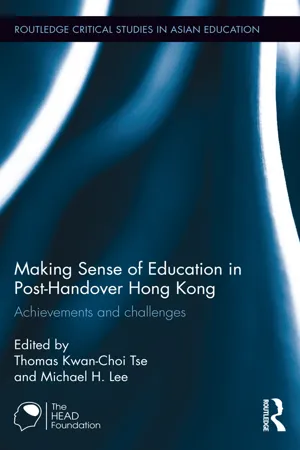
Making Sense of Education in Post-Handover Hong Kong
Achievements and challenges
- 238 pages
- English
- ePUB (mobile friendly)
- Available on iOS & Android
eBook - ePub
Making Sense of Education in Post-Handover Hong Kong
Achievements and challenges
About this book
Information
1 Introduction
Setting and issues
“Those who stand on tiptoe will not stand firm.
Those who walk with long step will not walk well.”
— Laotze
“Striving to better, oft we mar what’s well.”
— William Shakespeare
Preamble
The year 1997 is undoubtedly one with historical significance for Hong Kong, mainly because it marked the end of the over 150-year British colonial rule with the transfer of sovereignty to the People’s Republic of China. Hong Kong then became a Special Administrative Region (hereafter, HKSAR) entitled to a high degree of autonomy in governance in all areas but foreign affairs and national defence in line with the “one country, two systems” framework as stipulated in the Basic Law. The HKSAR government was enthusiastic to demonstrate its strong determination, commitment and ability to bring about sustainable social progress and developments in order to convince the general public that Hong Kong would be governed more effectively and efficiently than under the colonial administration. Therefore, the first chief executive, Tung Chee-Hwa, pledged to launch a series of reforms covering a range of public policy areas, such as health care, public housing, social welfare and also education (Scott, 2005; Tung, 1997). A comprehensive review of the education system in Hong Kong was carried out subsequently in 1999–2000 with the aim to identify development strategies and reform measures to be adopted to deal with changes and challenges arising from globalisation and the emergence of a knowledge-based economy (Education Commission, 1999).
A string of education reforms have been introduced since the handover of sovereignty to improve the quality of education and maintain Hong Kong’s economic competitiveness in the age of globalisation. While the Hong Kong education system has experienced some changes and challenges subject to effects of globalisation, it is internationally recognised as among the most successful for its outstanding performance in international comparisons and rankings, as validated by top rankings achieved by Hong Kong in international comparative studies like the Trends in International Mathematics and Science Study (TIMSS) and the Programme for International Student Assessment (PISA) for primary and secondary education, and the ones conducted by Times Higher Education Supplement and QS World University Rankings for university education (Information Services Department, 2012, 2013; OECD, 2011).
What happened in Hong Kong is very similar to other countries which have been actively learning and borrowing policies and practices being widely promoted by such international institutions as the World Bank, the Organisation for Economic Co-Operation and Development (OECD) and UNESCO in order to maintain and strengthen the competitiveness of the education system across the globe (Cheng, 2009, 2015; Taylor, Rizvi, Lingard, & Henry, 1997).
Moreover, a strong and competent education system has been widely considered as indispensable to achieving competitiveness for national economies, as both innovation and creativity are viewed as the keys of economic success. Therefore, it is not surprising for Hong Kong to be internationally perceived as having one of the most successful education systems. However, while there has been a consensus that education should be a priority of public policy in Hong Kong, there have been inevitable controversies over what and how reforms should be proposed and implemented because it is difficult to have the interests of diverse stakeholders being well taken care of or even compromised as similar as most of other countries. This edited volume provides a comprehensive and critical analysis of major issues and challenges facing the education system in Hong Kong since 1997.
In the subsequent twelve chapters in this volume, each will review a particular sector or issue of the Hong Kong education system, addressing respectively: 1) the background or development of the particular policy initiative or educational problem; 2) the roles and reactions of different stakeholders involved; 3) the outcome or emerging issues and problems related to the policy implementation; as well as 4) reflections on the implications or future directions of education reforms and developments.
Contributors to the volume focus on various aspects of the Hong Kong education system, ranging from preschool education to higher education, and the various domains including curriculum, civic education and national identity, medium of instruction, school management, parents and home-school relationships, students of marginal groups, shadow education and student performance.
Together we examine how effective the education policies have been implemented to respond to problems and challenges arising from globalisation and to changing local political, social and economic contexts. Controversies over the issues such as voucher system in kindergartens, medium of instruction policy, direct subsidy scheme schools, public reporting of school performance, national education and inclusive education have been our foci. In view of the new scenario, we need a more comprehensive account that critically analyses the impacts of the reforms on educational development and also explores how the education system in Hong Kong should tackle the problems that inhibit the effective implementation of education reforms and policies and cope with the emerging challenges arising from globalisation and the ever-changing socio-economic environment. Moreover, at a time when it has passed the first twenty years of the new regime under the Hong Kong SAR government, it is appropriate to “take stock and look forward” on Hong Kong education by providing critical and analytical accounts more systematically in this edited volume.
The overall concern of this volume is threefold. First of all is the perceived challenges of external environment, like globalisation and national re-integration, and internal forces, such as changing demographic composition driving the government to undertake education reforms, and the effectiveness of reforms addressing those challenges. Second, it concerns the consequences and impacts of education reforms on stakeholders and their acceptance or resistance to the implementation of education policies and reforms. Finally, it probes into major factors affecting the future directions of education reforms and development in Hong Kong, with special reference to the role of the government as well as the relationship and possible tension between the government and stakeholders. This volume not only serves as an up-to-date reference on the development of education reforms and policies in Hong Kong but also contributes to the wider academic literature and systematic analysis of the territory’s educational development strategies (Cheng, 2009, 2015; Ho, Morris, & Chung, 2005; Marsh & Lee, 2014; Postiglione & Lee, 1997; Sharma, 2013; Sweeting, 2004; Tsang, 1998, 2006, 2011).
Internal and external contexts of changes
Providing an overview of the Hong Kong education system, Table 1.1 lists the total population of Hong Kong, the numbers of education institutions and student enrollments at different educational levels, and the total government expenditure on education respectively in 1997 and 2014.
Table 1.1 shows that the total Hong Kong population grew from 6.5 million in 1997 to 7.2 million in 2014. In terms of the number of education institutions, the number of primary and secondary schools decreased slightly whereas that of kindergartens increased more significantly between 1997 and 2014. The number of students enrolled in the early childhood, primary and secondary levels dropped, with a more significant decrease for both the primary and secondary sectors, amounting to a quarter of the original size of school population. This coincides with the phenomenon of low birth rate in Hong Kong during the same period of time. While the number of UGC-funded institutions remained intact, there has been an increase in that of privately-funded higher education institutions, which reached 11 in 2014. This denotes the expansion of the privately-run or self-financed higher education sector in Hong Kong, together with a more significant growth of students enrolled in self-financed programmes offered by the UGC-funded institutions at the same time. Moreover, the HKSAR government has kept increasing expenditures on education over years, with an increase of about 57 per cent from HK$47 billion in 1997 to HK$74 billion in 2014. Nevertheless, both the ratios of total government expenditure on education to the total government expenditure and to Gross Domestic Product (GDP) decreased from 24.2 per cent to 18.7 per cent and from 3.5 per cent to 3.3 per cent between 1997 and 2014 respectively. This probably points to growing competition between education and other policy areas, such as health care, housing and social welfare for larger shares of public financial resources in face of social problems related to poverty and ageing society in Hong Kong.
| Year | 1997 | 2014 |
|---|---|---|
Hong Kong population | ||
Total Population | 6,502,100 | 7,241,700 |
Education institutions | ||
Number of kindergartens | 740 | 978 |
Number of primary schools | 606 | 571 |
Number of secondary schools | 523 | 509 |
Number of UGC-funded institutions | 8 | 8 |
Number of privately-funded higher education institutions | n.a. | 11 |
Student enrollments | ||
Kindergarten students | 177,462 | 176,397 |
Primary education students | 461,911 | 329,300 |
Secondary education students | 458,118 | 375,603 |
UGC-funded institutions students | 86,202 | 190,573 |
Government expenditure | ||
Total government expenditure on education | HK$47 billion | HK$74 billion |
Ratio of total government expenditure on education to total government expenditure | 24.2% | 18.7% |
Ratio of total government expenditure on education to Gross Domestic Product (GDP) | 3.5% | 3.3% |
Sources: (Census & Statistics Department, 1998, 2015; Education Commission, 2004).
The education reform programme launched by the HKSAR government after 1997 was unprecedented in a sense that it covered all aspects of the education system simultaneously with the introduction of a huge number of policy recommendations and reform measures to be carried out at a rapid rate within a short period of time (Law, 2007; Morris & Scott, 2005). The education reform blueprint, which was released in September 2000 by the Education Commission (2000a), embraces a wide range of critical issues, including academic system for secondary and university education, curriculum reform and development, student assessment mechanisms and public examinations, medium of instruction and language education, teacher professionalism, school admission system, school-based management, private education, civic and national education, and post-secondary educational opportunities.
In order to grasp a better understanding about education reforms in Hong Kong, Table 1.2 summarises major reform policies across different stages of education implemented since 2000, when the education reform blueprint was formally launched by the HKSAR government.
Table 1.2 Education reforms in Hong Kong since 2000


In the subsequent years, different measures of the education reform blueprint have been put in place accordingly, together with other important new initiatives like the voucher scheme for kindergartens, prioritising education services as one of the six local major industries and facilitating the internationalisation of the education sector, the 12 years of free education policy, a formal introduction of the Qualifications Framework and strengthening of national education with a number of financial and curricular support (Tse, 2013).
Among many factors involved, this volume highlights two pressures on policy-making and practice, namely external forces as represented by globalisation and Hong Kong’s re-integration into mainland China, and internal forces pointing to the changing demographic and socio-economic changes and needs in society, on shaping the development of education reforms in Hong Kong since 1997.
In the tide of intense global competition, many countries wanted to provide a ready supply of skilled labour and to enhance their competitive edge through the development of the knowledge-producing institutions and industries. Education reform also becomes a derivative of labour and economic policy. As examined by Lam and Wong in Chapter 7, the major curriculum reform initiatives, such as the emphasis of generic skill development, learning to learn, information technology in education, life-long and life-wide learning, have been strongly influenced by the trend of curriculum changes in other developed countries. This package of reform was a reaction of the HKSAR government in the new political arena, to strengthen economic competitiveness, fix social problems and enhance educational quality.
Being a crucial aspect of cultural capital, language acquisition is another important aspect of education reform. Medium of instruction and language enhancement continue to be the foci of curriculum concern for the HKSAR government. Two language policies, namely the compulsory Chinese-medium instruction policy and the “biliterate/trilingual policy”, were put forward right after the handover. The former is meant to rectify the previous English-dominant medium of instruction policies with a view to enhance the quality of learning through using the first language of most students. The latter aims at raising the standard of two written languages (Chinese and English) and three spoken languages (Cantonese, English and Putonghua) in order to enhance the global competiveness of Hong Kong.
As for the development of higher education, which is more concerned about the process of internationalisation, the notion of developing Hong Kong as a regional education hub has been put forward by the government in line with its notion of promoting Hong Kong as Asia’s world city. It also implies the need for strengthening Hong Kong’s higher education institutions’ international competitiveness and also their enrolment of more non-local students.
Since 1978 when the policy of nine-year compulsory education was implemented, the development of the Hong Kong education system, which is still predominantly financed by the governm...
Table of contents
- Cover
- Title
- Copyright
- Contents
- Acknowledgements
- Contributors
- 1 Introduction: setting and issues
- 2 Vouchers in early childhood education: market still? What to choose next?
- 3 Parental choice in the new education market: aided-turn-direct subsidy scheme schools in focus
- 4 Unlocking the dilemma of language policy in the post-1997 era
- 5 In search of equal and excellent basic education in Hong Kong: insights from programme for international student assessment
- 6 Shadow education: features, expansion and implications
- 7 Curriculum reform: why, how, what and where it is headed for
- 8 Civic education in Hong Kong: from the colonial era to the post-occupy movement era
- 9 Changing governance, accountability and leadership: Hong Kong education meets neo-liberalism
- 10 Should there be public reporting of school performance?: the lessons from the school inspection reports disputes
- 11 Parent and home-school relationships: issues and challenges
- 12 Changing student diversity, changing cultures and changing education policies: cross-boundary students, Chinese immigrant students and non-Chinese speaking students in focus
- 13 Excellence without a soul?: higher education in post-1997 Hong Kong
- Index
Trusted by 375,005 students
Access to over 1.5 million titles for a fair monthly price.
Study more efficiently using our study tools.
Frequently asked questions
Yes, you can cancel anytime from the Subscription tab in your account settings on the Perlego website. Your subscription will stay active until the end of your current billing period. Learn how to cancel your subscription
No, books cannot be downloaded as external files, such as PDFs, for use outside of Perlego. However, you can download books within the Perlego app for offline reading on mobile or tablet. Learn how to download books offline
Perlego offers two plans: Essential and Complete
- Essential is ideal for learners and professionals who enjoy exploring a wide range of subjects. Access the Essential Library with 800,000+ trusted titles and best-sellers across business, personal growth, and the humanities. Includes unlimited reading time and Standard Read Aloud voice.
- Complete: Perfect for advanced learners and researchers needing full, unrestricted access. Unlock 1.5M+ books across hundreds of subjects, including academic and specialized titles. The Complete Plan also includes advanced features like Premium Read Aloud and Research Assistant.
We are an online textbook subscription service, where you can get access to an entire online library for less than the price of a single book per month. With over 1.5 million books across 990+ topics, we’ve got you covered! Learn about our mission
Look out for the read-aloud symbol on your next book to see if you can listen to it. The read-aloud tool reads text aloud for you, highlighting the text as it is being read. You can pause it, speed it up and slow it down. Learn more about Read Aloud
Yes! You can use the Perlego app on both iOS and Android devices to read anytime, anywhere — even offline. Perfect for commutes or when you’re on the go.
Please note we cannot support devices running on iOS 13 and Android 7 or earlier. Learn more about using the app
Please note we cannot support devices running on iOS 13 and Android 7 or earlier. Learn more about using the app
Yes, you can access Making Sense of Education in Post-Handover Hong Kong by Thomas Kwan-Choi Tse,Michael H. Lee in PDF and/or ePUB format, as well as other popular books in Education & Education General. We have over 1.5 million books available in our catalogue for you to explore.