- 426 pages
- English
- ePUB (mobile friendly)
- Available on iOS & Android
eBook - ePub
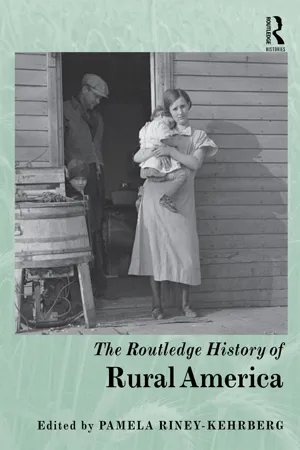
The Routledge History of Rural America
About this book
The Routledge History of Rural America charts the course of rural life in the United States, raising questions about what makes a place rural and how rural places have shaped the history of the nation. Bringing together leading scholars to analyze a wide array of themes in rural history and culture, this text is a state-of-the-art resource for students, scholars, and educators at all levels. This Routledge History provides a regional context for understanding change in rural communities across America and examines a number of areas where the history of rural people has deviated from the American mainstream. Readers will come away with an enhanced understanding of the interplay between urban and rural areas, a knowledge of the regional differences within the rural United States, and an awareness of the importance of agriculture and rural life to American society. The book is divided into four main sections: regions of rural America, rural lives in context, change and development, and resources for scholars and teachers. Examining the essays on the regions of rural America, readers can discover what makes New England different from the South, and why the Midwest and Mountain West are quite different places. The chapters on rural lives provide an entrée into the social and cultural history of rural peoples – women, children and men – as well as a description of some of the forces shaping rural communities, such as immigration, race and religious difference. Chapters on change and development examine the forces molding the countryside, such as rural-urban tensions, technological change and increasing globalization. The final section will help scholars and educators integrate rural history into their research, writing, and classrooms. By breaking the field of rural history into so many pieces, this volume adds depth and complexity to the history of the United States, shedding light on an understudied aspect of the American mythology and beliefs about the American dream.
Part 1
REGIONS OF RURAL AMERICA
1
THE NORTHEAST
Dona Brown
Few images of rural life are as closely entwined with national myth as those associated with New England: the Pilgrim forefathers celebrating their harvest at the first Thanksgiving, the iconic New England village, nostalgic Currier and Ives depictions of the old New England farm. Even the land itself has been appropriated as a symbol. Generations of American scholars have taken it for granted that New England’s cold climate and thin soils imposed stern limits on the society that took root there. Pundits and wits have gone farther, asserting that New England’s weather and soil defined the character of its people, whose alleged flintiness, coldness, and propensity for hard work were the natural product of their stony ground.
Yet by the time the first Europeans set foot on the shores of North America, the people of the northeastern woodlands had been growing food in that reputedly harsh land for hundreds of years. The classic American configuration of corn, beans, and squash was well established in southern New England, where it helped to support a relatively large indigenous population. Even in the more thinly populated north, horticulture could be a significant supplement to foraging, hunting, and fishing. On the coastal plains and especially in the rich alluvial river valleys (areas that would come to be called “intervals” or “intervales” in New England parlance), farming offered the greatest rewards; it was there that English settlers first encountered the productive farmlands of the Massachusett, Pequot, Wampanoag, and Narragansett people.1
The first English observers did not view those farmlands as uninviting. Although they frequently overlooked important features of the environment, or misunderstood what they saw, one thing they did understand was the richness of the cultivated (or recently abandoned) fields they soon took for their own: nearly all the English towns settled before 1650 were situated directly on land that had previously been farmed by native people.2
Immigrants viewed the land they saw in “New” England through the lens of their experiences in “old” England, but English society itself was undergoing dramatic transformation in these years, as the medieval legal and cultural order confronted population explosion, global trade, and religious conflict. New England’s settlers imported some of that turmoil with them. Those who were part of the “Great Migration” to Massachusetts Bay (over twenty thousand migrants between 1630 and 1640) reflected the demographic profile of the English Puritan movement in general. More than half of Puritan immigrants were craftsmen and artisans from market towns and provincial cities; fewer than a third had been living on farms when they left England. The majority of those who did come directly from the countryside were from East Anglia (an old term including most of southeastern England), an area where the manorial open field system was relatively uncommon. Many farmers in East Anglia were livestock specialists who had extensive contact with markets and town life. Instead of the closely settled villages typical of the open-field regions of England, they often lived on dispersed farms.3
At the same time, however, most of the “Great Migration” settlers also shared a religious viewpoint that drew them toward what they perceived as the simpler, purer ways of the English past. Puritan leaders attempted to replicate in New England the stability and community they believed had once existed in old England, and to avoid the freewheeling mobility and innovation they associated with England’s present corruption. By careful control over speculative land markets and by generous distribution of land to almost all household heads, they hoped to attach their people to the godly, stable communities they trusted would appear. While they were not wholly successful in meeting these goals, they did create a society distinctly marked by their effort.
Some of the first towns did establish common field systems on the medieval pattern, with large, cooperatively controlled plots of tillage, meadow, and pasture. Other towns distributed land in individual plots. In all towns, however, most of the land was held as common property until the coming-of-age of new generations prompted its division. Nor did individual ownership end the need for cooperation. Town committees attempted to grant each family access to key resources. Upland meadow, rough forage, cedar swamps—all were important assets that were unlikely to be found in close proximity to one another. A family’s landholdings might be scattered widely across town lands, making continued community oversight a logical choice; in some towns, pastures, meadows, and woodlands would continue to be managed cooperatively into the nineteenth century.
The single most valuable resource of the early settlements was meadowlands (salt marshes on the coast and fresh-water “intervale” meadows along rivers). These wet, frequently flooding native hay meadows were essential to farm productivity, even more in New England than they had been in old England: hay kept livestock alive over the (much longer) winter season, allowing farmers to support enough livestock to provide adequate manure for their tilled fields. And it was management of the meadows, above all else, that demanded cooperation: the endless work of clearing brush, erecting and maintaining fencing, and building and maintaining extensive ditching systems was beyond the ability of single families.4
By the late 1600s, New England settlers had created a distinctive pattern of land use and a hybrid form of rural community. Over a hundred towns were closely settled along the coast and the rivers. Upland areas at a distance from the major rivers and wetlands held fewer attractions for the first generations of farmers (and much of that land was controlled by native people until their defeat in King Philip’s War in 1676 ended their ability to resist). The layout of the fields might still have looked familiar to an English observer, but freehold tenure and the widespread ownership of land reflected New England’s far more egalitarian distribution of resources. Settlers had replaced their English wheat and barley with American corn, and English beer with cider. Household work was still divided in familiar patterns: men worked in the fields at a distance from the homestead, women generally closer to house and yard. But even more than in old England, children’s work was critically important in New England households, where few crops brought in enough cash to justify investment in hired or slave labor.5 Fortunately, children were in plentiful supply.
After 1640, civil war in England abruptly ended the English “great migration.” Few immigrants from other parts of Europe were attracted to a region that was already acquiring a reputation for insularity and clannishness. Instead, the original population reproduced itself with amazing speed. Widespread land ownership made for earlier marriages than were customary in England, resulting in extremely high birth rates. Relative prosperity (and cold weather) probably also contributed to the impressive longevity of adults. By the end of the seventeenth century, New England’s population had reached over ninety thousand, and was still doubling in size every twenty-five or thirty years.6
It was clear by then that New Englanders were not about to discover a lucrative export commodity like tobacco or sugar. Still, farmers were not cut off from markets: they drove surplus cattle to market near Boston as early as the 1640s. From the earliest years, ships left New England ports for the Grand Banks and whaling fisheries. To provision those ships, farmers across the settled parts of New England supplied everything from dried beef and tallow, to cheese and bread, to live chickens and pigs.
Nevertheless, the economic lives of early New Englanders revolved mainly around the household and the town. Few families in the seventeenth century owned enough animals or tools to be truly self-sufficient; they relied instead on a dense network of neighborhood exchange that lightened their workload and afforded flexibility in responding to changing circumstances. The great majority of household heads in the second and even the third generation still owned an enviable amount of land by English standards, but the average size of holdings was dwindling as population pressures increased. Diversification of crops and careful husbanding of limited resources were keys to survival; marketing the surplus was part of that strategy.
By the early eighteenth century, New England was expanding both geographically and commercially. The Atlantic trade became an increasingly powerful engine of economic growth. Provisioning the slave plantations of the Caribbean and the southern English colonies afforded many New England farmers more frequent opportunities to market their surplus or, in some cases, to specialize in items specifically intended for that market. Every port town, large or small, continued to pack ships with beef, pork, candles, cloth, and hay. Ports in Maine and New Hampshire trafficked lumber from the northern interior; Rhode Island traded in horses and dairy products. In return, consumer luxuries like tea, pewter, and ceramic goods were increasingly brought within the reach of even modest rural households.7
At the other end of the region, far from the bustling seaports, lay the northern frontier. There, New Englanders were caught up in a generation-long struggle fueled by British and French imperial ambitions. Abenakis and Mohawks, their numbers strengthened by refugees from the broken southern New England tribes, formed partnerships with the French in Quebec to resist English expansion. They carried out lightning raids on New England’s border towns, taking captives, destroying villages, and effectively preventing any substantial expansion northward for decades. But when the English defeated the French at Quebec City in 1760, the ability of the Native American alliance to resist English power was fatally undermined. The ink was hardly dry on the peace treaty when hundreds of New Englanders headed north into inland Maine, northern New Hampshire, and the territory that would ultimately become Vermont.
Southern New Englanders eagerly snatched up dubious land titles to unseen lands in the north, providing eloquent testimony that life in New England was becoming difficult for many. Buyers took a tremendous gamble when they purchased those suspiciously inexpensive deeds. New England farmers had become experts in making the most of limited resources, but two or three generations of high birth rates had combined with a regional preference for partible inheritance to create a serious land shortage. Families saw their security gradually declining, and along with it the social status and political power that accompanied land ownership. They wagered their own and their children’s hard labor, isolation, and hardship on the hope of acquiring land for the next generation.
The new northern settlements would not reflect the same degree of social engineering that went into the southern New England towns. Surveyors laid out the land in straight lines, virtually disregarding natural features. (With many thousands of acres on their hands, land speculators cared little for the location of the cliffs, ravines, and swamps that would ultimately be divided up and sold to some unwary buyer.) Land was sold in contiguous square plots; no town committee oversaw its equitable distribution.
Many northern migrants were leaving behind bitter religious conflicts that had divided communities as the Great Awakening swept New England in the 1740s. The frontier towns were therefore more religiously diverse, the settlers perhaps more individualistic and inclined to go it alone. But the northern frontier was no Wild West; settlers willingly re-established many of the social arrangements of the original New England communities. They frequently settled in groups of like-minded neighbors and kin, often re-naming their new towns after the ones they had left behind. They established town meetings, built schools and meetinghouses (often accommodating more than one denomination this time). Seaport and backcountry were recognizably part of the same cultural world: nearly all New Englanders—a million strong by the time of the Revolution—were descended from the original settlers and shared a remarkably homogeneous social legacy.
Not surprisingly, however, given the speculative free-for-all of northern land distribution, the Revolutionary years witnessed prolonged and intense struggles over land tenure—more than enough to earn the north country a reputation for frontier lawlessness. The best-known of these conflicts occurred in the area that would ultimately become Vermont, where a violent struggle erupted between settlers who held titles derived from New Hampshire Governor Benning Wentworth’s “Hampshire Grants” and New York authorities attempting to take administrative control over the area. The vigilante Green Mountain Boys arose to resist the “Yorkers” and enforce solidarity among the settlers in t...
Table of contents
- Cover Page
- The Routledge History of Rural America
- The Routledge Histories
- Title
- Copyright
- Dedication
- Contents
- List of Contributors
- Acknowledgments
- Introduction: What, and Where, is Rural America—and Why Should We Care?
- PART 1 Regions of Rural America
- PART 2 Rural Lives in Context
- PART 3 Change and Development
- PART 4 Resources for Scholars and Teachers
- Suggested Reading
- Index
Trusted by 375,005 students
Access to over 1.5 million titles for a fair monthly price.
Study more efficiently using our study tools.
Frequently asked questions
Yes, you can cancel anytime from the Subscription tab in your account settings on the Perlego website. Your subscription will stay active until the end of your current billing period. Learn how to cancel your subscription
No, books cannot be downloaded as external files, such as PDFs, for use outside of Perlego. However, you can download books within the Perlego app for offline reading on mobile or tablet. Learn how to download books offline
Perlego offers two plans: Essential and Complete
- Essential is ideal for learners and professionals who enjoy exploring a wide range of subjects. Access the Essential Library with 800,000+ trusted titles and best-sellers across business, personal growth, and the humanities. Includes unlimited reading time and Standard Read Aloud voice.
- Complete: Perfect for advanced learners and researchers needing full, unrestricted access. Unlock 1.5M+ books across hundreds of subjects, including academic and specialized titles. The Complete Plan also includes advanced features like Premium Read Aloud and Research Assistant.
We are an online textbook subscription service, where you can get access to an entire online library for less than the price of a single book per month. With over 1.5 million books across 990+ topics, we’ve got you covered! Learn about our mission
Look out for the read-aloud symbol on your next book to see if you can listen to it. The read-aloud tool reads text aloud for you, highlighting the text as it is being read. You can pause it, speed it up and slow it down. Learn more about Read Aloud
Yes! You can use the Perlego app on both iOS and Android devices to read anytime, anywhere — even offline. Perfect for commutes or when you’re on the go.
Please note we cannot support devices running on iOS 13 and Android 7 or earlier. Learn more about using the app
Please note we cannot support devices running on iOS 13 and Android 7 or earlier. Learn more about using the app
Yes, you can access The Routledge History of Rural America by Pamela Riney-Kehrberg in PDF and/or ePUB format, as well as other popular books in History & Historiography. We have over 1.5 million books available in our catalogue for you to explore.