eBook - ePub
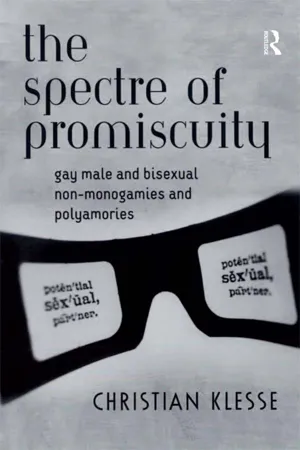
The Spectre of Promiscuity
Gay Male and Bisexual Non-monogamies and Polyamories
- 216 pages
- English
- ePUB (mobile friendly)
- Available on iOS & Android
eBook - ePub
About this book
Wide-ranging research suggests that partners in gay male and bisexual relationships do not necessarily expect monogamy, or see it as an important issue. Although the frequency of gay male and bisexual non-monogamous partnerships tends to be widely acknowledged in social science literature, these relationships have rarely been explored in more detail. By providing rich empirical data, thoughtful analysis and theoretical debate, this book makes a significant contribution to the sociological literature on sexual and intimate relationships. More specifically it explores the diversity of gay male and bisexual relationship practices in the context of heteronormative citizenship and intra-social movement conflict, and highlights the complexity of power relations that circumscribe queer people's relationships and sexual lives. Written in an accessible and engaging manner, The Spectre of Promiscuity provides important insights for further studies on sexual culture, discourse, citizenship, politics and ethics.
Information
1 The State of the Law: Heteronormative Citizenship and Sexual Counterpublics
DOI: 10.4324/9781315552538-2
The injustices of gay lifestyle annoy me. The fact that there are these ancient laws which discriminate against gay people, more than two men can't have sex together, it's illegal. That sort of thing really annoys me. (…) When I read, in the gay papers (…) about the Bolton Seven1 – as they've been called. The reaction of the Establishment against them makes my blood boil. And when I read those articles, I can feel my blood pressure rising. It annoys me. (…) And quite often I will not listen to the news or things on the radio and TV (…) because I get so emotionally involved with it, that it upsets me and I would rather not know about it, so I can't get upset. But it's that side of the gay world which does annoy me and I wish I knew what I, as an individual, could do to get things like that changed. Since I've left work I no longer have to conform myself. (Lee)
Scholars and activists alike have emphasised the privileged role of the state in the regulation of sexualities and genders (Duggan 1995, Smart 1995). Despite internal contradictions and the contestation of particular legal politics between and within different state institutions and its major actors, the state has remained a key obstacle to progressive sexual politics in Britain (Pringle and Watson 1992, Cooper 1995, Stychin 1995). This is not only because of the state's prohibitive functions, but also because of its ability to construct sexualities, social formations, ‘the public’ and its constituents. From within a Foucauldian perspective on the law a close interrelation exists between legal discourse and sexual identities and the conditionality for the emergence and development of erotic cultures (Herman and Stychin 1995, Moran et al. 1998). Some have argued that the particularly enhanced effectivity of the law to construct and regulate sexuality rests in its ability to present itself as a superior form of truth. This particular authority of the law is derived from its ability to incorporate or to ally itself with other scientific discourses, such as medicine, psychology or social work (Smart 1989: 96). Legal practice and the emerging space of its contestation, consequently, are important aspects of the creation of heteronormative hegemony.
The definition of the division between public and private has been central to the state's ambition to regulate sexual and gender cultures. Through the discussion of some key events in the legalisation of sexualities in Britain, I demonstrate how the law works to banish queer sexualities from the public sphere. I argue that it is largely through the containment of queer sexualities and identities in the private that full citizenship has been withheld to gay men, lesbians, bisexuals and other queers. Legal practice thereby works as a productive form of power that privileges hegemonic heterosexualities and delegitimises queer sex, relationships and identities. In the last part of the chapter, I suggest framing the attempts of the lesbian and gay, bisexual and feminist movements to challenge heterosexist state politics as a construction of counterpublics. I argue that a theory of multiple, intersecting publics that are related in hierarchy and based in struggle is helpful for understanding complicated processes of normativity, resistance and hegemonic conflict around alternate relationship practices.
The Regulation of the Public/Private Distinction
The distinction between the private and the public sphere is deeply embedded in our understanding of intimacy and sexuality, the social, and the political. In its manifold and distinct theorisations, the public/private dichotomy tries to take account of the complex interrelations between the state, civil society and the personal (Squires 1999, Young 2000). Feminists have shown that the public/private dichotomy has been inserted in political discourse in a way that justifies the exclusion, disenfranchisement and subordination of women. Often backed by essentialist discourses on sexual difference, women's lives, work, roles and ‘virtues’ have been constructed as private (Moller Okin 1991/1998). In dominant political discourse the private tends to have no meaning and is supposed to add nothing to the understanding of society in general. For women, the civil freedoms supposed to flow from the social contract have always been undermined by a sexual contract that has defined the public and private in gendered terms and subordinated women in both spheres (Pateman 1988, Walby 1994). Feminists have consequently politicised and contested the dominant construction of the public/private divide. The slogan ‘the personal is political’ is based on a discursive strategy that attempts to shift the parameters of the traditional definition and stresses the interrelation and inseparability of the two spheres. It further highlights the constructed character of the boundary between them (Phillips 1993, Cooper 2001). ‘The private/public division is fluid, historically and contextually determined, contested and constantly struggled over and redefined’, argue, for example, Werbner and Yuval-Davis (1999: 29). They foreground the classed, gendered, racialised and culturally specific character of the divide, which tends to be drawn against the back drop of nationalist discourses. Moreover and most important for my argument in this chapter, the dichotomy is also sexualised (N. Duncan 1996, Richardson 2000).
The Regulation and Contestation of Sexualities
The flexible operationalisation of the public/private draws on the articulation of myriad connotations around sexuality, gender, race and class. These connotations render the distinction an effective tool for regulating access to certain social spheres and to police forms of behaviour possible therein. The transgression of the boundaries drawn by the hegemonic articulations of the public/private division may result in serious consequences for the ‘transgressors’, ranging from stigmatisation to physical violence (Myslik 1996, Valentine 1996). This is because transgressions are often experienced ‘not as merely theoretical, but as violation of deep instincts about sex and gender’ (Warner 2002: 23). The exclusive mechanisms that are activated in the public/private distinction revolve around a common sense of what is considered to be ‘appropriate’ behaviour in the context of a particular public sphere context (Cooper 2001). It also establishes differential criteria of entitlement (to presence, participation, certain forms of interaction, and so on). While many have highlighted the potential of the public sphere in enhancing participatory democracy, others have directed attention to the mechanisms by which the public sphere fosters discourses which exclude certain groups of people and styles of interaction (Cooper 1994). Among others this works through the construction of the public sphere as the arena of proper politics and critical-rational discourse (Habermas 1969, Calhoun 1993). Feminists have shown that the assumption of a single, universal public sphere dedicated to a rational debate and the enhancement of the ‘common good’ has been used to question the legitimacy of certain demands with the argument that they would be either particularistic or irrational in form or content. This way the body, sex, affection, feeling and passion could be marginalised in public realms. The same applies to certain groups of people that have been associated with physicality or sexuality (Young 1990a, 2000, Fraser 1997). However, if we want to fully understand the normative processes that work through the public/private divide, we should pay attention to the fact that it tends to be particular sexualities and bodies which are scrutinised in the public sphere. These have been in particular lesbigay, gender-queer, racialised and interracial sexualities, and so on (cf. N. Duncan 1996, Dawson 1995, Steinbugler 2005). From this perspective it becomes very obvious that, far from being static, the public/private divide is mediated by discourses on gender, race, ethnicity, class and sexuality.
Heteronormativity and Citizenship
Hegemonic interpretations of the public/private distinction have had an enormous impact on the conceptualisation of citizenship (Turner 1990). In the British debate on citizenship the work of T.H. Marshall has been extremely influential, if not paradigmatic. Marshall has defined citizenship as ‘a status bestowed on those who are full members of a community. All who possess the status are equal with respect to the rights and duties with which the status is endowed’ (1950: 14). Marshall's primary concern was with social class and he stressed civil, legal, political and social rights as the basic components of a historically evolving citizenship status. Contemporary citizenship debates have gone far beyond Marshall's framework by stressing the gendered, racialised and sexualised dimensions of citizenship discourses and practices. Marshall's historical account has been criticised as androcentric (Lister 1997a, Yuval-Davis 1997). Moreover, more recently a range of authors has shown that the practices of citizenship are profoundly sexualised (Evans 1993, Carver 1998, Weeks 1998, Plummer 2001a, Richardson 2000, Johnson 2002). Marshall's theory has further been challenged for equating civil society with the national community (Werbner and Yuval-Davis 1999). Moreover, globalisation, post-war national migration flows, the growth of international organisations and agencies (such as UN and UNESCO), the gaining strength of human rights discourse and the emergence of multi-state polities (such as the EU) have resulted in the growth of postnational modes of citizenship (Soysal 1994, Turner 1993). National and postnational (or transnational) modes of citizenship coexist in interrelation. According to a widely held criticism, Marshall's definition of citizenship as ‘full membership in the community’ fails to acknowledge that people are in fact involved in manifold communities or identity-based projects. This insight challenges the universalism at the heart of dominant citizenship discourse (Yuval-Davis 1997). It is only through an emphasis of the multi-layered character of citizenship that politics in the name of citizenship can take account of these complexities. In order to realise its full democratic potential, many argue, we have to sever the exclusive ties of the concept to the terrain of the nation state and need to accept that ‘full membership’ in any particular ‘community’ exceeds questions of legal entitlement and tends to be defined in much more subtle ways (cf. Werbner and Yuval-Davis 1999, Richardson 2000). In general, I agree with such a broad interpretation of citizenship. At the same time, I hold the position that the nation state and its legal practice continue to have crucial weighting in determining the degree to which people can access resources, participate in democratic processes, and communicate or realise their cultural and sexual identities (cf. Erel 2002). I use the concept of citizenship in this chapter as a primarily analytical concept in a mode of analysis first set out by David Evans (1993, 1995).2 Evans has shown that the boundaries of the national community is also constructed in moral terms and correspond with ethical codes associated with hegemonic heterosexualities. Moral disapproval on the level of public discourse and state politics results in a graduated and hierarchical system of citizenship in which certain sexualities and genders are confined to the margins of the social space of proper citizenship and respectability (cf. Carver 1998, Richardson 2000).
In the following sections I provide a selective discussion of the legalisation of queer sexualities in the UK in order to show that the state through its legal practice constructs both the public sphere and the conditionality for citizenship in heteronormative terms. I strategically focus on significant legal ‘events’ in the history of UK law to illustrate ‘the intimate relationship between state form and practices and the organisation of sexuality’ (Cooper 1993: 191). I develop my argument along a critical analysis of (a) strategies within the practice of criminal law as they have been articulated in Wolfenden and the Sexual Offences Act 1967 and (b) the centrality of heteronormative family values expressed in the implementation of Section 28. Both acts of legislation aimed at shoring up a definition of the public sphere as heterosexual. The self-identification of the state in heterosexual terms is further evidenced in the stubborn denial (until very recently) to recognise queer relationships and families in British civil law.
The Wolfenden Strategy: Permissiveness and Control
The Wolfenden Report and the Sexual Offences Act 1967 (which was drafted in the spirit of the former) established a legal double-standard of privacy for male same-sex and heterosexual (and lesbian) sexuality. Only with the introduction of the Sexual Offences Act 2003 the provisions within criminal law regarding the offence of ‘public sex’ were formally equalised with regard to (male) same-sex and heterosexual behaviours (Bainham and Brooks-Gordon 2004). Benjamin (the pseudonym of a Jewish gay male activist whose life story I recorded in a previous research project) wrote in an unpublished essay in 1983:
‘For those who remember far back enough, pre-Wolfenden was a time of no hope for homosexuals. Keeping out of trouble and enjoying oneself, maybe as a couple, was the aspiration. Lily law, bosses, landlords and all were liable to persecute one with virtually no redress: after all you were a criminal pariah. This was the common expectation. All homos had to consider the possibility of a knock at the door by police or blackmailers. A low-level totalitarian situation’ (Benjamin, quoted in Klesse 1997: 60).
As a result of this existential threat many homosexual men were forced to lead a double life or to retreat into ‘the closet’, as this condition of life was later described in gay liberationist language (Chauncey 1995). Although Benjamin talks of a widespread aspiration of many homosexual men to have a long-term partnership, the threat of a jail sentence and a shameful loss of respectability made it extremely difficult, if not impossible, for many men to build such a relationship (Porter and Weeks 1991).
Many of my interview partners who have lived through the pre-1967 period remember it as a time of total repression, shame and anxiety. The risk of criminalisation enforced years of celibacy for some of them. During the 1930s an average of 500 men a year were arrested on the grounds of consensual same-sex activities. A set of partially very old penal laws which criminalised certain bodily, sexual or social acts provided the framework for an increasingly escalating police repression. During the years after W.W.II homosexuals suffered a new scale of police persecution. Arrests on the grounds of ‘bugger...
Table of contents
- Cover Page
- Half-Title Page
- Dedication Page
- Title Page
- Copyright Page
- Table of Contents
- Acknowledgements
- Introduction Beyond the Myth of Equality and Democracy
- 1 The State of the Law: Heteronormative Citizenship and Sexual Counterpublics
- 2 Researching Non-monogamies: Stories on Positionality, Intersubjectivity and Power
- 3 Sex and Assimilation: Gay Male Non-monogamies and the Question of Equality
- 4 Gender Troubles: Bisexuality and Non-monogamy
- 5 Polyamory: Different Kinds of Love Stories
- 6 Negotiating Non-monogamy: Difference, Power and Intimacy
- 7 Between Resitance and Normalisation: Non-monogamy, Sexual Politics and Ethics
- Appendix The Study: Research Design and Methodology
- Bibliography
- Index
Trusted by 375,005 students
Access to over 1.5 million titles for a fair monthly price.
Study more efficiently using our study tools.
Frequently asked questions
Yes, you can cancel anytime from the Subscription tab in your account settings on the Perlego website. Your subscription will stay active until the end of your current billing period. Learn how to cancel your subscription
No, books cannot be downloaded as external files, such as PDFs, for use outside of Perlego. However, you can download books within the Perlego app for offline reading on mobile or tablet. Learn how to download books offline
Perlego offers two plans: Essential and Complete
- Essential is ideal for learners and professionals who enjoy exploring a wide range of subjects. Access the Essential Library with 800,000+ trusted titles and best-sellers across business, personal growth, and the humanities. Includes unlimited reading time and Standard Read Aloud voice.
- Complete: Perfect for advanced learners and researchers needing full, unrestricted access. Unlock 1.5M+ books across hundreds of subjects, including academic and specialized titles. The Complete Plan also includes advanced features like Premium Read Aloud and Research Assistant.
We are an online textbook subscription service, where you can get access to an entire online library for less than the price of a single book per month. With over 1.5 million books across 990+ topics, we’ve got you covered! Learn about our mission
Look out for the read-aloud symbol on your next book to see if you can listen to it. The read-aloud tool reads text aloud for you, highlighting the text as it is being read. You can pause it, speed it up and slow it down. Learn more about Read Aloud
Yes! You can use the Perlego app on both iOS and Android devices to read anytime, anywhere — even offline. Perfect for commutes or when you’re on the go.
Please note we cannot support devices running on iOS 13 and Android 7 or earlier. Learn more about using the app
Please note we cannot support devices running on iOS 13 and Android 7 or earlier. Learn more about using the app
Yes, you can access The Spectre of Promiscuity by Christian Klesse in PDF and/or ePUB format, as well as other popular books in Social Sciences & Anthropology. We have over 1.5 million books available in our catalogue for you to explore.