- 246 pages
- English
- ePUB (mobile friendly)
- Available on iOS & Android
eBook - ePub
About this book
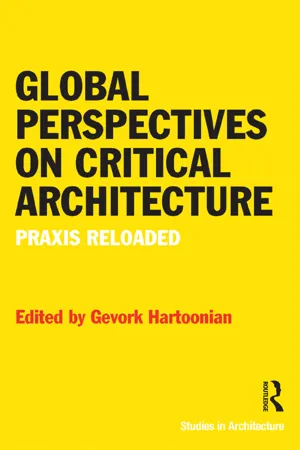
Judging from the debates taking place in both education and practice, it appears that architecture is deeply in crisis. New design and production techniques, together with the globalization of capital and even skilled-labour, have reduced architecture to a commodified object, its aesthetic qualities tapping into the current pervasive desire for the spectacular. These developments have changed the architect's role in the design and production processes of architecture. Moreover, critical architectural theories, including those of Breton, Heidegger and Benjamin, which explored the concepts of technology, modernism, labour and capital and how technology informed the cultural, along with later theories from the 1960s, which focused more on the architect's theorization of his/her own design strategies, seem increasingly irrelevant. In an age of digital reproduction and commodification, these theoretical approaches need to be reassessed. Bringing together essays and interviews from leading scholars such as Kenneth Frampton, Peggy Deamer, Bernard Tschumi, Donald Kunze and Marco Biraghi, this volume investigates and critically addresses various dimensions of the present crisis of architecture. It poses questions such as: Is architecture a conservative cultural product servicing a given producer/consumer system? Should architecture's affiliative ties with capitalism be subjected to a measure of criticism that can be expanded to the entirety of the cultural realm? Is architecture's infusion into the cultural the reason for the visibility of architecture today? What room does the city leave for architecture beyond the present delirium of spectacle? Should the thematic of various New Left criticisms of capitalism be taken as the premise of architectural criticism? Or alternatively, putting the notion of criticality aside is it enough to confine criticism to the production of insightful and pleasurable texts?
Information
1
Three Easy Fragments: Towards the Formation of Critical Architecture
To undertake adorning the interior walls of a ship with paintings can be an utterly insane thing to do if the ship has already started to sink precipitously.
Bertolt Brecht
ARCHITECTURE
Prior to the Venturisque idea of both/and, architecture had a different rapport with the cultural. There was a time when architecture was considered an autonomous phenomenon, meaning that the building art renewed itself – aesthetically and technically – primarily in reference to its own traditions. These traditions, which can be called the “culture of building”, were accumulated through years of using materials such as wood, brick, stone, concrete, and steel, and using skills of detailing according to the constructive qualities of these materials. Not only was there a correspondence between materiality, detailing, and purpose, but all formal and tectonic articulations were also articulated in reference to elements such as columns and the place of window openings, sills, parapets, and slabs. Architecture was innocent, if you will; it enjoyed the fruits of an ongoing dialogue between architect and craftsperson, and a shared understanding of the scope of architecture’s formal and spatial possibilities. This accumulated common,1 however, neither put a cap on the architect’s world of imagination nor limited the builder’s creative use of his/her skills, even though the organic dialogue between thinking and making was interrupted by the introduction of division of labour. Addressing these issues from a historical perspective, the following three sections will expand on the question concerning the concept of critical, and map the operative agency of capitalism as it impinges on contemporary architecture.
It is well known that Filippo Brunelleschi’s design for the dome of the Basilica di Santa Maria del Fiore (Il Duomo di Firenze) exceeded the available technical knowledge and labour skills. He had to design not only the form of the dome but its construction process as well. We can trace the schism between form and construction in Leon Battista Alberti’s discourse. For Alberti, lineamenta suggested an image of the work in advance, and independent of construction. During the Renaissance, architecture was perceived through a complete set of drawings and models that preceded construction. The conceptual link between conceiving and building was sustained through notations, including those prepared in reference to materiality.2 Without pursuing the full implications of materiality for architecture, Mario Carpo presents the algorithms of digitally reproduced architecture as the third stage in the Humanist history of design, preceded by artisanal authorship (Brunelleschi) and intellectual, or notational, authorship (Alberti).
Carpo’s suggested third stage – which, following Walter Benjamin, should be coined the age of digital reproducibility – promotes architecture that has abandoned the matrix of the previous two stages, at least for now. Even though architecture still has to respond to the forces of gravity and the convergence of land into platform, there are many critics who, in the traditions of early modernism, still index architecture in reference to the universal dimension of technology. Equally noteworthy are those critics who either misunderstand Walter Benjamin’s discourse on the same subject, discussed in his famous essay “The Work of Art in the Age of Mechanical Reproduction”, or take Martin Heidegger’s ideas on dwelling to be an oppositional discourse.3 These two camps dismiss the fact that throughout history architecture has maintained the closest ties with the prevailing production and consumption systems. History also teaches us that after a certain period of time, certain forms of art and artefact either vanish or are pushed into the realm of pure consumption. Particular to architecture, however, is a mode of appropriation that is cultural through and through. Therefore, while construction is essential for the realization of architecture, in order to be part of the existing Symbolic order architecture needs to deliver something more. The implied excess (here I am recalling my own interpretation of the Semperian discourse on the tectonic of theatricality)4 equates to image, as noted by Carpo, and aesthetics that intertwines image with technique.
In the remainder of this section, I would like to further pursue the above remarks in two “directions”, theoretical and historiographic – if these two areas of research can or should be contemplated separately. And yet I will argue that the converging point(s) of these two directions took place in modern times before the emergence of Carpo’s designated third stage. I am reminded of the 1930s and 1960s, for two different yet interrelated historical reasons. The 1968 student uprisings in France should be seen today as a reaction against its immediate past: the “culture industry” (mass consumer society) and the rise of institutions that had already internalized the instrumental logic of technology. This modernization theory had already been critically addressed by a number of thinkers during the 1930s, famously Andre Breton’s Crisis of the Object (1932); Walter Benjamin’s The Work of Art in the Age of Mechanical Reproduction (1936); and Martin Heidegger’s The Question Concerning Technology (written earlier but first presented in 1949). It is beyond the objectives of this chapter to fully elaborate on these texts here, but for now suffice it to recall Antonio Negri’s recognition of three historical periods which are definitive of how the work of art relates to capitalism.5 The first two periods, roughly 1848–70 and 1871–1914, were essential for the formation of the working class and the rise of the historical avant-gardes, respectively. Within this epochal transformation artists claimed their emancipation from ideology. This break, however, was symbolic; its advocacy of art for art’s sake disguised its acknowledgement of the merging ideology of “negativity”, meaning the negation of everything worldly. In France, the surrealists “forced negativity into the last bastion that had survived the absolute negation of their immediate predecessors”.6 The third period, starting from 1929, further expanded the operative realm of abstraction, a phenomenon already grafted into the general structure of the capitalist production process and, interestingly enough, integrated into the artistic productions of the early avant-garde. By 1968, Negri writes, we arrived at an:
interweaving between the abstraction of the present mode of production and the representation of other possible worlds, at the abstraction of the image and the use of more and more diversified materials, at the simplification of the artistic gestures and at the expense of geometrical destructuring of the real …7
Negri concludes that from now on “we are faced with a new subject – a subject capable of demystifying the fetishized destiny that capital imposes on us – and with an abstract object”.8 Negri’s periodization is more useful than Carpo’s as far as the issue of critical praxis is concerned. Negri discusses the work of art within the fundamentals of the capitalist production system: capital, labour, and class struggle. My intention in the remainder of this section is to map critical developments in architecture, the historicity of which is intertwined with the events unfolding during the 1930s and 1960s.
In the light of these considerations, I would like to argue that postmodern architecture did not do much except unconsciously internalize the aesthetic connotations of Andy Warhol’s prophesy that everyone in the future might have the chance of 15 minutes of fame. In putting together various idioms of the past, all that postmodernism in architecture accomplished was to pump new blood into the blasé attitude, or the affect of Modernity as discussed in George Simmel’s famous essay “The Metropolis and the Mental Life”. I would argue, further, that this blasé attitude corresponds to a state of objectivity, a phenomenon resurfacing throughout the long history of Modernity, including during the post-war era, when the nihilism of technology expanded its operative domain to include the cultural realm.9 This raises questions concerning architecture’s relation with the Real, the Symbolic order wherein architects/artists produce meaningful work “legitimizing the dominant political power”.10 I am reminded of a few American artists of the 1950s who emulated the landscape of consumer goods as subject matter for their work. In addition to Andy Warhol and others, mention should be made of Robert Venturi’s advocacy of “Learning from Las Vegas”. This rather controversial analogy can be explained as follow: whereas the 1950s artwork was criticized in the light of the contesting project launched by the historical avant-garde, the political dimension of these works, paradoxically, could not be recognized today without their direct encounter with the culture industry.11 This judgement, however, cannot be passed on postmodern architecture because it was instrumental in paving the way for the present digitally reproduced architecture. How did this work?
In hiding the modernist constructive potentialities of the Dom-ino frame beneath its dressed-up garments of history, postmodern architecture could not tally with a capitalism that was badly in need of reinventing itself. To mobilize and expand itself globally, capitalism had to deconstruct architecture, the most visible and tangible artefact of everyday life. With its ultimate references to historical languages, the postmodern garment was not able, even in the Venturisque collage version of both/and, to satisfy an emerging agile capitalism. It is indeed to the credit of digital architecture that it opened the path for turning the postmodernist garment into abstract, smooth, and playful shapes. However, one consequence of this transgression was to defuse the tectonic tension between skin and bone evident in the later work of Mies van der Rohe. Another was to reduce the modalities of the culture of building primarily to that of surface. I would insist not only that the aforementioned tensions should be revisited today, but also that tectonics should be approached as the political agency of architecture. This is important because the dialectics between autonomy and heteronomy has resurfaced once again. Jacques Rancière writes that in the first instance art is political, but neither because of the messages and sentiments it propounds nor because of the manner in which it chooses to deliver a particular message. Rather, art is political “because of the very distance it takes from these functions”.12 Rancière might be right about the arts as such. As far as architecture is concerned, however, the aesthetics of abstraction overshadows the tectonic implications of various forms of labour, material, and craftsmanship. These ontological aspects of architecture, I argue, should be rethought in the light of the present experience(s) of the nihilism of technology.
THE ARCHITECT
In an interview, Kenneth Frampton relates the eclipse of a genuine left and critical position in architecture to the victory of fascism in the Spanish Civil War (1936–39).13 In the same petrifying political climate, surrealist artists encapsulated the schizoid state of the modern mind in Daphne, a mythical figure who turned herself into a laurel to escape from, or perhaps to further seduce, the god Apollo pursuing her. Juxtaposing Daphne with a bleeding swastika, the image was later used for the cover of Salvador Dalí’s novel entitled Hidden Faces (1944). The image represented “a model for an anachronistic history that juxtaposes in a single frame what ...
Table of contents
- Cover Page
- Half Title page
- Series page
- Title Page
- Copyright Page
- Contents
- List of Figures
- Notes on Contributors
- Acknowledgements
- Introduction
- 1 Three Easy Fragments: Towards the Formation of Critical Architecture
- 2 Globalization and the Fate of Theory
- Kenneth Frampton Interviewed by Gevork Hartoonian
- Mary Mcleod Interviewed by Gevork Hartoonian
- Bernard Tschumi Interviewed by Gevork Hartoonian
- Mark Wigley Interviewed by Gevork Hartoonian
- Index
Trusted by 375,005 students
Access to over 1.5 million titles for a fair monthly price.
Study more efficiently using our study tools.
Frequently asked questions
Yes, you can cancel anytime from the Subscription tab in your account settings on the Perlego website. Your subscription will stay active until the end of your current billing period. Learn how to cancel your subscription
No, books cannot be downloaded as external files, such as PDFs, for use outside of Perlego. However, you can download books within the Perlego app for offline reading on mobile or tablet. Learn how to download books offline
Perlego offers two plans: Essential and Complete
- Essential is ideal for learners and professionals who enjoy exploring a wide range of subjects. Access the Essential Library with 800,000+ trusted titles and best-sellers across business, personal growth, and the humanities. Includes unlimited reading time and Standard Read Aloud voice.
- Complete: Perfect for advanced learners and researchers needing full, unrestricted access. Unlock 1.5M+ books across hundreds of subjects, including academic and specialized titles. The Complete Plan also includes advanced features like Premium Read Aloud and Research Assistant.
We are an online textbook subscription service, where you can get access to an entire online library for less than the price of a single book per month. With over 1.5 million books across 990+ topics, we’ve got you covered! Learn about our mission
Look out for the read-aloud symbol on your next book to see if you can listen to it. The read-aloud tool reads text aloud for you, highlighting the text as it is being read. You can pause it, speed it up and slow it down. Learn more about Read Aloud
Yes! You can use the Perlego app on both iOS and Android devices to read anytime, anywhere — even offline. Perfect for commutes or when you’re on the go.
Please note we cannot support devices running on iOS 13 and Android 7 or earlier. Learn more about using the app
Please note we cannot support devices running on iOS 13 and Android 7 or earlier. Learn more about using the app
Yes, you can access Global Perspectives on Critical Architecture by Gevork Hartoonian in PDF and/or ePUB format, as well as other popular books in Architecture & Architecture General. We have over 1.5 million books available in our catalogue for you to explore.