eBook - ePub
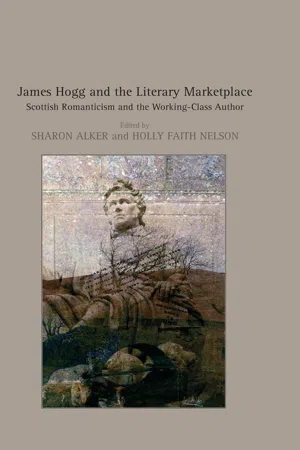
James Hogg and the Literary Marketplace
Scottish Romanticism and the Working-Class Author
- 278 pages
- English
- ePUB (mobile friendly)
- Available on iOS & Android
eBook - ePub
James Hogg and the Literary Marketplace
Scottish Romanticism and the Working-Class Author
About this book
Responding to the resurgence of interest in the Scottish working-class writer James Hogg, Sharon Alker and Holly Faith Nelson offer the first edited collection devoted to an examination of the critical implications of his writings and their position in the Edinburgh and London literary marketplaces. Writing during a particularly complex time in Scottish literary history, Hogg, a working shepherd for much of his life, is seen to challenge many of the aesthetic conventions adopted by his contemporaries and to anticipate many of the concerns voiced in discussions of literature in recent years. While the essays privilege Hogg's primary texts and read them closely in their immediate cultural context, the volume's contributors also introduce relevant research on oral culture, nationalism, transnationalism, intertextuality, class, colonialism, empire, psychology, and aesthetics where they serve to illuminate Hogg's literary ingenuity as a working-class writer in Romantic Scotland.
Information
Chapter 1
Hogg and Scott’s ‘First Meeting’ and the Politics of Literary Friendship
‘He was the sought, not the seeker – the host, not the guest of the noble’. In such terms the reviewer of James Hogg’s Domestic Manners of Sir Walter Scott (1834) in Fraser’s Magazine for August 1834 vindicated Scott from Hogg’s charge of having over-strong leanings to aristocracy. Yet the same review (probably by William Maginn) had already by this point reproduced much of Hogg’s account of his own ‘first meeting’ with Scott in Ettrick, in which Scott to all intents and purposes is the seeker and the singularly non-aristocratic Hogg the sought after. That the incident was fairly well known by this time is evident from the manner of its introduction in the magazine: ‘The account of Hogg’s first meeting Sir W. is the opening anecdote: it has been often told before, and we doubt not is considerably dressed up for effect; but it is pleasant enough, and has some foundation of truth’. The review then quotes directly two passages from the Domestic Manners: the first relating to Scott’s entry into the cottage at Ettrickhouse, accompanied by William Laidlaw, and the famous remark there by Hogg’s mother that her songs ‘were made for singing an’ no for reading’; and the second an excursion to Rankleburn, including among other things Hogg’s depiction of Scott on his fine mount ‘everlastingly bogging himself’.1
There can be no question about the appeal of the core description for later biographers of both Hogg and Scott, most of whom follow the main outline, as well as taking on some of the spirit, of Hogg’s account. In particular, the apparent assault by Hogg’s mother (Margaret Laidlaw) on Scott’s enterprise of ballad-collecting for his Minstrelsy of the Scottish Border, the continuation of which had brought him to Ettrick, has been quoted in full, acquiring a larger currency as an assertion of the value of orality in the face of encroaching print culture. As Gillian Hughes remarks in James Hogg: A Life, the Hogg first meeting account is ‘one of the great moments of Romantic myth-making’;2 and it might be claimed that this constitutes the one clear instance of an account of literary influence involving Scott as constructed by Hogg emerging relatively unscathed amidst the body of set-piece incidents which attached themselves to ‘the author of Waverley’ in the Victorian period.
It is also a version of events which has been vulnerable to scrutiny and later discoveries. One apparent internal inconsistency, the dating of the event by Hogg in the summer of 1801 – that is, before the publication of the first two volumes of Scott’s Minstrelsy in Spring 1802 – was noted as early as George Allan’s Life of Sir Walter Scott (1834), in an account which is otherwise generally favourable to Hogg and the concept of an abiding friendship between the two writers.3 Further discrepancies also came into view as a result of the publication of the recollections of William Laidlaw, as first relayed in a series of articles in Chambers’s Edinburgh Journal in 1845, and then brought together under the heading ‘Abbotsford Notanda’ in Robert Chambers’s Life of Sir Walter Scott (1871). In Laidlaw’s version of the Ettrick visit,4 Scott and he went first to the Brydens’ (his cousins’) farmhouse at Ramseycleuch, with Hogg then being ‘sent for’ that evening; and no mention is made of any intervention by Hogg’s mother on the visit to the cottage, which is placed on the following morning. Notwithstanding the appeal of Hogg’s account of his mother’s chanting of ‘Auld Maitland’, literary scholars have expressed concern over the oral credentials of such a piece, the sceptical John Sutherland for instance suspecting a degree of stage-managing in the whole situation.5 On another front, the fairly common assumption that Hogg is recounting a literal first meeting has been complicated by his surviving correspondence, especially a letter to Scott of 30 June 1802, in which Hogg refers to the Minstrelsy as ‘the first book I ever perused which was written by a person I had seen and conversed with’.6 In the fullest survey of the evidence to date, Richard Jackson points to the likelihood of Hogg and Scott coming at least twice into contact prior to the Ettrick meeting, which compelling secondary evidence now allows us to place with some certainty in early September 1802. Faced with these inconsistencies, however, Jackson has little to offer in terms of explanation, other than the importance of the Ettrick moment to Hogg’s literary ambitions and ‘what is sometimes perceived as Hogg’s tendency to self-aggrandisement’.7
To comprehend more fully Hogg’s signification of events in his account, it is worth switching from his priorities in 1802 to those at the time of publication, in the later 1820s and early 1830s: a period characterized by a cult of literary personality, which also can now be viewed as having been crucial in the formation of the literary canon of Romantic writers. In fact, the account had three distinct lives, in different literary contexts, all of which reflect the fluidity of Hogg’s situation as a literary figure at this time. It first appeared under the heading ‘Reminiscences of Former Days. My First interview with Sir Walter Scott’, in the Edinburgh Literary Journal for 27 June 1829, this following on from a similar piece on Hogg’s first meeting with Allan Cunningham, in the issue for 16 May 1829. In each instance, Hogg is sought out by the other figure, the working-class Cunningham and his brother locating him when working as a hired shepherd in Nithsdale, and a natural brothership of poets immediately being forged. Seen sequentially, the Scott/Hogg interview celebrates a similar bonding of kindred spirits, with class differences (marked only by the announcement of Scott as ‘the Shirra’) minimized and rendered irrelevant. The recently founded Edinburgh Literary Journal, one of a new breed of popular weekly magazine, represented to Hogg a potentially liberating vehicle for expression. In the first number, for 15 November 1828, his ‘A Letter from Yarrow’ welcomes the possibility of a new literary fraternity, liberated from the shackles of Blackwood’s Edinburgh Magazine, and its editor Christopher North (John Wilson), ‘a greater aristocrat in literature than he is in politics’.8 As Gillian Hughes observes, the Edinburgh Literary Journal proved to be an especially inviting outlet for Hogg’s work, and the cultivation of his literary personality, praising his far-reaching ‘genius’, and publishing an engraving of him with its issue for July 1830.9
Hogg is likely to have felt similarly confident when introducing the same account, virtually unchanged, into an extended ‘Memoir of the Author’s Life’ at the start of his Altrive Tales (1832). Here it appears as the first item in the sequence of literary sketches which concludes ‘Reminiscences of Former Days’, some of distinguished contemporaries, others of those who might be considered as literary protégées. As Alker and Nelson have suggested, one effect is to place Hogg at the centre of current literary activity, with a special emphasis on his ability to recognize and promote talent.10 Another consequence of this positioning is that the Scott meeting account comes after a new passage introduced into the preceding ‘Memoir’, in which Hogg describes the advent of a ‘new epoch’ in his literary life on hearing for the first time Robert Burns’s ‘Tam o’ Shanter’, through the medium of ‘a half daft man’, John Scott, who visited him on a hill while he was working as a shepherd in 1797.11 In this light, it is possible to trace three crucial stages in Hogg’s path to literary recognition: an imaginative apotheosis as a result of hearing Burns; his introduction to the world of letters through Scott; and a broadening out to become a literary figure in his own right.
The final public manifestation of the account came in much changed circumstances, after Scott’s death, and when Hogg probably recognized that he was fighting a losing battle in a struggle as a memorialist with Scott’s son-in-law, John Gibson Lockhart. After the effectual blocking of the first version of Hogg’s ‘Anecdotes of Sir Walter Scott’, which does not include this material, Hogg inserted a significantly revised account of the first meeting near the beginning of his Familiar Anecdotes of Sir Walter Scott, as first published in New York in April 1834, then in Glasgow as The Domestic Manners and Private Life of Sir Walter Scott the following June. This last version of the ‘First Meeting’ includes a number of revisions, some of which serve to accentuate a sense of opposition in the interplay of the participants. Perhaps significantly, it is the only version to state explicitly that the occasion represented the ‘first time’ that Hogg saw Scott, though it might be claimed that such is strongly implied by the ‘First Interview’ titling of the original Magazine article. In his earlier ‘Lines to Sir Walter Scott, Bart.’, end dated 24 April 1820, Hogg had also referred to the passage of twenty years since ‘we first met’, the chronology in this case evidently representing an even more transparent triumph of art over reality.12
While Hogg’s prose versions exude an air of plain speaking, it would be mistaken to underestimate the highly stylized nature of much of the narrative. Just as Hogg’s account of his discovery of Burns follows the pattern of moments of personal revelation in spiritual autobiographies, so the ‘First Interview’ and its successors employ a number of techniques common to what has been called ‘the diffuse and largely hidden tradition of oral story telling’.13 In such a discourse, individual details, sometimes seemingly idiosyncratic in nature, can have the dual effect of inducing a sense of veracity and conveying an emblematic kind of significance. One example occurs in the original first sentence, which supplies the detail of Wat Shiel coming over the field to announce to Hogg the arrival of ‘some gentlemen’ wishing to speak with him.14 No particular Ettrick inhabitant has been identified, though the name is common in the district. Seen one way, the detail might be taken as a sign of undesigning veracity (why else bother to include such an individual?); viewed differently, it serves to convey a sense of Scott and Laidlaw emerging into Hogg’s presence through the fabric of his own community. In this sense, comparison might be made with ‘daft’ John Scott (also unidentified), who brought Burns into Hogg’s view, and who in one later account of the incident is characterized as ‘a great original’.15 The same expression is used in the ‘First Interview’ to describe Walter scott’s ‘liveryman’, ‘a far greater original than his master’, who, as Hogg enters the stable-yard at Ramseycleuch, engages him in a short exchange about ballad-making, bristling with a kind of diplomatic agility honed to perfection in the folk world.16
Similar ambiguities might also reside in the exchange involving scott and the two Brydens on the origin of the terms long and short sheep, later incorporated into the first chapter of Scott’s The Black Dwarf (1816), where the protagonist matching Scott’s part is clearly naïve in asking his question. While in Hogg’s version Scott is accorded a more knowing role, taking part in a deliberate quiz before losing his straight face, there are some unsettling elements in the process...
Table of contents
- Cover Page
- Title Page
- Copyright Page
- Contents
- dedication
- List of Figures
- Notes on Contributors
- Preface
- Acknowledgements
- 1 Hogg and Scott’s ‘First Meeting’ and the Politics of Literary Friendship
- 2 National Discourse or Discord? Transformations of The Family Legend by Baillie, Scott, and Hogg
- 3 Fanaticism and Enlightenment in Confessions of a Justified Sinner
- 4 Robert Wringhim’s Solitude
- 5 The Labourer and Literary Tradition: James Hogg’s Early Reading and Its Impact on Him as a Writer
- 6 James Hogg and the Authority of Tradition
- 7 James Hogg: Scottish Romanticism, Song, and the Public Sphere
- 8 Singing ‘more old songs than ever ploughman could’: The songs of James Hogg and Robert Burns in the Musical Marketplace
- 9 Hogg’s Bardic Epic: Queen Hynde and Macpherson’s Ossian
- 10 The Perilous Castle(s) of The Three Perils of Man
- 11 ‘Perfectly Ludicrous’:The Game of National Meaning in The Three Perils of Man
- 12 James Hogg and Blackwood’s Edinburgh Magazine: Buying and Selling the Ettrick Shepherd
- 13 Empire and the ‘Brute Creation’: The Limits of Language in Hogg’s ‘The pongos’
- 14 Hogg and the American Literary Marketplace
- Bibliography
- Index
Trusted by 375,005 students
Access to over 1.5 million titles for a fair monthly price.
Study more efficiently using our study tools.
Frequently asked questions
Yes, you can cancel anytime from the Subscription tab in your account settings on the Perlego website. Your subscription will stay active until the end of your current billing period. Learn how to cancel your subscription
No, books cannot be downloaded as external files, such as PDFs, for use outside of Perlego. However, you can download books within the Perlego app for offline reading on mobile or tablet. Learn how to download books offline
Perlego offers two plans: Essential and Complete
- Essential is ideal for learners and professionals who enjoy exploring a wide range of subjects. Access the Essential Library with 800,000+ trusted titles and best-sellers across business, personal growth, and the humanities. Includes unlimited reading time and Standard Read Aloud voice.
- Complete: Perfect for advanced learners and researchers needing full, unrestricted access. Unlock 1.5M+ books across hundreds of subjects, including academic and specialized titles. The Complete Plan also includes advanced features like Premium Read Aloud and Research Assistant.
We are an online textbook subscription service, where you can get access to an entire online library for less than the price of a single book per month. With over 1.5 million books across 990+ topics, we’ve got you covered! Learn about our mission
Look out for the read-aloud symbol on your next book to see if you can listen to it. The read-aloud tool reads text aloud for you, highlighting the text as it is being read. You can pause it, speed it up and slow it down. Learn more about Read Aloud
Yes! You can use the Perlego app on both iOS and Android devices to read anytime, anywhere — even offline. Perfect for commutes or when you’re on the go.
Please note we cannot support devices running on iOS 13 and Android 7 or earlier. Learn more about using the app
Please note we cannot support devices running on iOS 13 and Android 7 or earlier. Learn more about using the app
Yes, you can access James Hogg and the Literary Marketplace by Holly Faith Nelson, Sharon Alker in PDF and/or ePUB format, as well as other popular books in Literature & English Literary Criticism. We have over 1.5 million books available in our catalogue for you to explore.