eBook - ePub
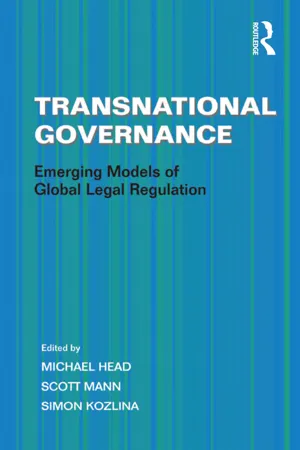
Transnational Governance
Emerging Models of Global Legal Regulation
- 280 pages
- English
- ePUB (mobile friendly)
- Available on iOS & Android
eBook - ePub
About this book
As globalization continues to spread and evolve, so nation-states attempt to govern financialization, tax evasion, corruption, terrorism, civil and military conflicts and environmental dangers, social polarization and the complexities in human rights implementation, by institutional and transnational means. This volume discusses these issues from different legal perspectives and highlights the challenges of governing human activity in an age of remarkable interconnectedness. Covering a broad range of policy areas and analysis of emerging forms of governance from liberal to critical and Marxist, the chapters are legal in their approach and form an important contribution to the growing study of emergent forms of authority, coordination and power developing in response to the challenges presented by some of the key contemporary governance issues in the first half of the twenty-first century.
Chapter 1 Origins of Transnational Governance in the Nineteenth Century
DOI: 10.4324/9781315549842-2
The last century has seen the growth of an interconnected world. Diplomatic, economic and social conversations now take place across national borders to an unprecedented extent. Economic pressures, social and political movements, and military engagements are recognised as having both a local and also a global impact. Attempts to regulate and govern the effect of these movements and pressures are increasingly conducted on a global level, either led by international organisations that transcend nation states, or brought about through a coordinated international response. The fact that this trend has increased in pace over the past few decades is well-recognised. David Levi-Faur and Jacinta Jordana have noted that ‘In recent decades, regulatory reforms have spread around the globe, accompanied by new institutions, technologies, and instruments of regulation that have had a profound impact on the social and economic fabric’ (Levi-Faur and Jordana 2004:6). Similarly, Marie-Laure Djelic and Kerstin Sahlin-Anderson discuss the ‘rise’ of transnational regulation and state that ‘The proliferation of regulatory activities, actors, networks or constellations leads to an explosion of rules and to the profound re-ordering of our world’ (Djelic and Sahlin-Andersson 2006:1). As the following chapters indicate, the increased importance and prevalence of transnational governance clearly raises unique challenges. However, the obvious, and growing, interconnectedness of the twentieth and twenty-first centuries should not mask the fact that transnational governance has a long history. That history provides an important context within which to consider the growth of transnational institutions and transnational governance in the twentieth and twenty-first centuries.
The history of transnational governance stretches back as far as ancient and mediaeval times. Communities of states were regulated by law in ancient Greece, and more recently by the modern ‘law of nations’ that developed in Europe in the sixteenth and seventeenth centuries. This history has been the subject of much academic discussion. Less explored, and more relevant to the rise of transnational governance over the last century, are the transnational connections and exchanges that occurred between nations throughout the nineteenth century. The transnational influence of the common law, the impact of various law reform movements that crossed international boundaries, and the adoption into national law of legal ideas that circulated internationally meant that regional and national legal systems in the nineteenth century converged towards certain legal norms and methods of governance. In many respects, this form of transnational governance was not ‘self-conscious’, but ‘informal’ in the sense that a sharing of legal norms resulted in systems of regulation that were shared across national borders. In this way, the nineteenth century saw the birth of some of the types of transnational governance that operate today. This history provides important context for two reasons. On one level, there are obvious similarities between the informal ways in which transnational systems of governance developed in the nineteenth century, and the way in which transnational governance has continued to develop in the twentieth and twenty-first centuries (as discussed in subsequent chapters). On another level, the ‘interconnectedness’ of the nineteenth century provided the bedrock on which more formal institutions of transnational governance were built in the following century.
Transnational systems of governance developed in different and varied ways during the nineteenth century. National or regional legal systems were part of wider transnational networks, but the nature of those networks and their international influences depended on the type of law (statute, common law, civil, criminal) and the subject matter of the law. This chapter illustrates some of the various systems of transnational governance that existed in the nineteenth century, such as the transnational application of the English common law, the international movement to reform the content and enforcement of the criminal law, and the development of a transnational commercial law. For ease of illustration, this chapter concentrates on the Anglo-American experience, drawing in particular on two legal regimes that were established in the middle of the nineteenth century: the American state of California, and the Australian colony of Queensland.
At the outset, it must be recognised that the examples provided in this chapter are certainly not the only ways in which legal regimes were connected across time and space during the nineteenth century, or provide an exhaustive overview of all the ways in which international legal norms were shared, exchanged and adopted. Rather, the examples have been chosen to illustrate the ways in which transnational governance operated in the nineteenth century to enable parallels to be drawn with the twentieth century, and to describe the legal and political context in which transnational governance in the twentieth century developed. Further, although there is still much work to do in order to provide a more synthesised account of the development of transnational governance in the nineteenth century (particularly in relation to the transnational connections and exchanges with and among Asia, Africa and South America), it is hoped that this analysis may contribute to the small but growing scholarship that considers the transnational reach of law and governance in the nineteenth century.
A Transnational Approach to Governance in the Nineteenth Century
Compared to the burgeoning literature that discusses internationalisation and globalisation in the twentieth century, scholars have neglected the systems of transnational governance that emerged in the nineteenth century. This is partly because nineteenth-century legal systems did not, of themselves, have a transnational dimension, and partly because their ‘interconnectedness’ is not immediately obvious. To a large extent, national legal systems operated within geographic boundaries that expanded and contracted depending on the subject matter of the law. Rarely did these boundaries expand beyond the nation-state. Consider, for example, the nineteenth-century legal regime of California in the United States of America and the legal regime that operated in the Australian colony of Queensland. In California, cases were decided in regional, state and federal courts, and legislation was drafted in local, state and national legislatures. In Queensland, cases were decided in regional and colonial courts, and legislation was drafted in the colonial legislature. For this reason, the story of law in California and Queensland is often told within particular regional and national boundaries. It is unsurprising, therefore, that legal historians tell stories that implicitly entrench the distinctive nature of regional and national legal regimes. Even the eminent American legal historian Lawrence Friedman, who has acknowledged the possibility and importance of highlighting connections between regions, argues that American law is a product of American culture that is peculiar to the United States (Friedman 2005: xi). This is not to say that all legal scholars fail to look beyond the nation-state; scholars such as Stuart Banner, Lauren Benton and John Weaver have published important transnational work.
The primacy of the nation-state does not mean that transnational governance did not exist in the nineteenth century. Instead, the story of transnational governance in the nineteenth century can be recovered by conceiving of law and its history simultaneously in different geographic scales in order to go outside the boundaries of any one national legal story. Such an approach involves consideration of the importance of international global pressures, such as international economics or immigration, the exchange of ideas across national boundaries, and the study of international organisations or movements (Saunier 2008: 163; Thelen 1999: 971; Tyrrell 1991: 1033). Put another way, the content of a particular law might appear to have had local origins, but it also derived its meaning from a range of local, regional, national and international sources. Laws were received into legal systems (by cession, settlement, or conquest), or adopted by legal systems (where a legislature chose to copy the law of another nation, or a local court chose to follow a decision of a foreign court). These legal principles sometimes flowed in only one direction (in the case of a direct transfer of legal ideas from one nation to another), but could also flow in multiple directions (in the case of an exchange of legal ideas between nations). Laws evolved organically in response to particular social, economic, or political conditions, and were also enacted in response to geographic or geologic conditions that were shared across national boundaries. In this way, any one particular law could be (and often was) part of a wider global circulation of legal ideas. Viewed globally, these laws formed part of (sometimes informal) systems of transnational governance.
Systems of Governance and the Hegemony of the Common Law
The spread of the English common law around the world, particularly during the eighteenth and nineteenth centuries, meant that not only did Anglo-American nations share important legal principles, but also that their similar legal histories facilitated the exchange of legal ideas across national boundaries. When the argument is put at its strongest, those legal regimes that were touched by the legal legacy of the British Empire formed part of an informal nineteenth-century common law hegemony. A more realistic statement perhaps is that each legal regime evolved independently (to varying degrees), but continued to apply fundamental common law rules, giving the common law the character of a tool of transnational governance.
The transnational influence of the common law is well illustrated by reference to the Californian and Queensland experiences. The legal systems of the American and Australian colonies were both moulded by the tentacles of the English common law that reached out from London and across the world’s great oceans. Across these vast distances, the law floated in the pages of Blackstone, the English law reports, and the remembered legal experience of settlers themselves. The law that arrived in the English colonies was not an exact replica of the law that existed in London, nor did it operate the same way in every colony. Colonies inherited English law at different stages of the law’s development and sophistication, and colonial law was moulded by the local circumstances, economics, politics, society and historical context. Nevertheless, despite differences in the process of the adoption of English law, the legal regimes of each colony shared substantial similarities.
The American legal system of the nineteenth century was constructed on a bedrock of English law. British authorities clearly contemplated that English law would apply in the first American colonies. Early colonial charters allowed the governing authority to make its own laws, but these were to mirror, as close as possible, the laws that existed in England (Hall 1950–51: 791). Nevertheless, the law in these colonies did not replicate English law directly. In 1829, Justice Joseph Story wrote that ‘the common law of England is not to be taken in all respects to be that of America. Our ancestors brought with them its general principles, and claimed it as their birthright; but they brought with them and adopted only that portion which was applicable to their situation’ (Van Ness v Pacard, 27 US (2 pet.) 137, 143–4 (1829)).
The American War of Independence represented a radical break with the old legal order. It marked the end of English royal authority and the development of a new political system (Handlin and Handlin 1947: 3). By the end of the eighteenth century, however, the common law had gained a strong enough foothold in America to withstand hostility to England, and Americans in the post-revolutionary period maintained a strong commitment to English law (Hall 1950–51: 797; Friedman 2005: 66–7). When the original colonies became states in their own right, their commitment to English law was reflected in the formal adoption of that law in their constitutions and early legislation. At the same time, American law continued to be anglicised by the absorption of English rules through English legal texts. Daniel Boorstin has argued that Blackstone’s Commentaries provided ‘ambitious young Americans’ with all the tools that they needed in order to make a living from the law and noted that the Commentaries sold nearly as many copies in the American colonies as they did in England (Boorstin 1996: xiii). Lawrence Friedman suggests that ‘only from England was there a source and supply of law that American lawyers could use without translation’ (Friedman 2005: 3). Most legal literature was sourced from England and an early American lawyer’s library was filled with English texts. American jurisprudence was nurtured by English precedent. The first American casebook on contracts by Christopher C. Langdell cited 310 English cases and only 22 from America (Kimball 2007: 353). In the late eighteenth century when Blackstone’s Commentaries was published, ‘Americans were among his most avid customers.’ For American lawyers, ‘England was the standard. English books, judges, ideas, were more available than the older colonial tradition’ (Friedman 2005: 59).
At a more local level, the legal system of nineteenth-century California illustrates the pervasive influence of the English common law that linked California to a wider transnational story. It was not inevitable that English law would be adopted in California. In December 1849, in his first address to the legislature after California was ceded by Mexico to the United States, Governor Peter Burnett recommended that California adopt the English law of evidence, commerce, and crimes and misdemeanours, but adopt the civil code of Louisiana and the Louisiana Code of Practice. The governor argued that ‘these codes, it is thought, would combine the best features of both the Civil and Common Law, and at the same time, omit the most objectionable portions of each’ (Journal of the Senate of the State of California 1850: 33). Nevertheless, J.C. Brackett introduced the following resolution into the legislative assembly:
That the Committee on the Judiciary be and they are instructed to report to this house a brief and comprehensive act, substantially enacting that the Common Law of England, and all statutes and acts of Parliament down to a certain reign, which are of a general nature … which common law and statutes are not repugnant to or inconsistent with the constitution of the United States, the constitution of this state, and statute laws that now are or hereafter may be enacted, shall henceforth be the rule of action and decision in the State of California. (Ibid.: 723)
On 27 February 1850, the Senate Judiciary Committee, chaired by Elisha Crosby and assisted by Nathaniel Bennett and Thomas Vermeule, reported that ‘nowhere do all great branches of national wealth thrive as vigorously and prosper to so great an extent as they do under the countenance and protection of the Common Law’ (Appendix to the Journal of the Senate of the State of California 1850: 469). The report referred to the political history of the United States, the fact that the common law operated in 29 of the 30 states in the Union, and the practical problem of obtaining the necessary texts if civil law was adopted in California. After the Senate and Assembly received the report, Brackett presented his common law bill to the house. It provided that ‘the Common Law of England, so far as it is not repugnant to or inconsistent with the Constitution of the United States, or the Constitution or laws of the State of California, shall be the rule of decision in all the Courts of this State’ (Act adopting the Common Law 1850). It was accepted and signed into law by the governor on 17 April 1850.
It is an oversimplification to suggest that the English common law was adopted in Anglo-American jurisdictions in its entirety, or reflected exactly the state of the law on the other side of the Atlantic. For example, the common law that operated in California was based on English precedent, but also paid homage to early American decisions. That is, the English common law provided the foundation of the legal regime, but did not defi...
Table of contents
- Cover Page
- Halftitle Page
- Title Page
- Copyright Page
- Table of Contents
- List of Contributors
- Preface
- Introduction Michael Head, Scott Mann and Simon Kozlina
- 1 Origins of Transnational Governance in the Nineteenth Century
- 2 Challenging Neoliberal Ideology in a Global Financial Crisis
- 3 Trade Governance: Legal Institutionalism as a Magnet for Non-trade Issues. A study of the mixed benefits of WTO dispute settlement for enforcing international obligations
- 4 Taxation Governance: Could the Tobin Tax Assist in Democratising Globalisation?
- 5 Corruption, International Business Transactions and the OECD
- 6 Human Rights and International Environmental Governance
- 7 Global Governance Implications of Terrorism: Using UN Resolutions to Justify Abuse of Basic Rights
- 8 International Criminal Governance: Will the International Criminal Court be an ‘Effective’ Mechanism for Justice?
- 9 Governing Humanitarian Intervention: Time for Change
- Index
Trusted by 375,005 students
Access to over 1.5 million titles for a fair monthly price.
Study more efficiently using our study tools.
Frequently asked questions
Yes, you can cancel anytime from the Subscription tab in your account settings on the Perlego website. Your subscription will stay active until the end of your current billing period. Learn how to cancel your subscription
No, books cannot be downloaded as external files, such as PDFs, for use outside of Perlego. However, you can download books within the Perlego app for offline reading on mobile or tablet. Learn how to download books offline
Perlego offers two plans: Essential and Complete
- Essential is ideal for learners and professionals who enjoy exploring a wide range of subjects. Access the Essential Library with 800,000+ trusted titles and best-sellers across business, personal growth, and the humanities. Includes unlimited reading time and Standard Read Aloud voice.
- Complete: Perfect for advanced learners and researchers needing full, unrestricted access. Unlock 1.5M+ books across hundreds of subjects, including academic and specialized titles. The Complete Plan also includes advanced features like Premium Read Aloud and Research Assistant.
We are an online textbook subscription service, where you can get access to an entire online library for less than the price of a single book per month. With over 1.5 million books across 990+ topics, we’ve got you covered! Learn about our mission
Look out for the read-aloud symbol on your next book to see if you can listen to it. The read-aloud tool reads text aloud for you, highlighting the text as it is being read. You can pause it, speed it up and slow it down. Learn more about Read Aloud
Yes! You can use the Perlego app on both iOS and Android devices to read anytime, anywhere — even offline. Perfect for commutes or when you’re on the go.
Please note we cannot support devices running on iOS 13 and Android 7 or earlier. Learn more about using the app
Please note we cannot support devices running on iOS 13 and Android 7 or earlier. Learn more about using the app
Yes, you can access Transnational Governance by Scott Mann, Michael Head in PDF and/or ePUB format, as well as other popular books in Law & International Law. We have over 1.5 million books available in our catalogue for you to explore.