- 160 pages
- English
- ePUB (mobile friendly)
- Available on iOS & Android
eBook - ePub
About this book
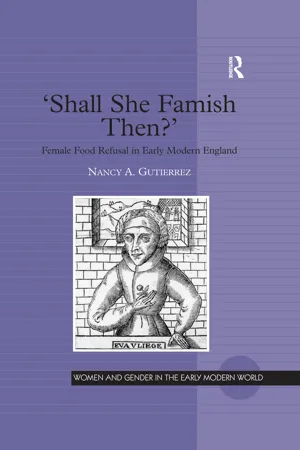
Nancy Gutierrez's exploration of female food refusal during the early modern period contributes to the ongoing conversation about female subjectivity and agency in a number of ways. She joins such scholars as Gail Kern Paster, Jonathan Sawday, and Michael Schoenfeldt, who locate early modern ideas of selfhood in the age's understanding of the body and bodily functions, that is, the recognition that behavior and feelings are a result of the internal workings of the body. Exploring the portrayals of the anorectic woman in the work of Ford, Shakespeare, Heywood and others and arguing that the survival of these women undermines regulatory policies exercised over them by those in authority, Gutierrez here demonstrates how female food refusal is a unique demonstration of individuality. The chapters of this book reveal how the common cultural association of women and food manifests itself in the early modern period-not as religious expression, which is the medieval representation, and not as an expression of dysfunctional adolescence and maturation, our own contemporary view, but rather as a trope in which the female body is a site of political apprehension and cultural change. This study is neither a history nor a survey of the anorectic female body in early modern England, but rather individual yet related discussions in which the starved female body is seen to signify certain (un)expressed tensions within the culture.
Information
Chapter 1
Contexts and Methodologies
From a certain point of view, the Jailer’s Daughter in William Shakespeare and John Fletcher’s Two Noble Kinsmen comes across as a strikingly modern figure. A teenage girl just approaching marriageable age, she lives in a single-parent household and, notwithstanding her father’s counsel, falls madly in love with a man both unsuitable and unattainable. Finally grasping the impossibility of her desires, she loses her reason and her behavior becomes unruly and uncontrollable. She runs away from home and becomes a ‘street’ person, calling attention to herself through wild and unconventional dress, overly friendly overtures to strangers, and public exhibitionism. A particular mark of her indecorum is her refusal to eat. As her anxious father describes her, ‘She is continually in a harmless distemper, sleeps little, altogether without appetite, save often drinking, dreaming of another world and a better; and what broken piece of matter soe’er she’s about, the name of Palamon lards it, that she farces ev’ry business withal, fits it to every question’ (IV. iii. 3–8).1 If the plot of generational conflict, with the stock figures of the fretful father and the hormonally-driven teenage girl, seems predictable and familiar up to this point, the next turn of this plot categorically demonstrates to us that we have entered a culture far different from our own, with curious notions regarding the scope of parental authority, the nature and makeup of female sexuality, and the relationship between private and public arenas. We discover that, on the advice of a learned doctor consulted by the father, one of the suitors of the daughter ‘cures’ her by pretending he is the man she loves. He sleeps with her, and the last we hear of the Jailer’s Daughter in the play is that she is soon to be wed, presumably to the suitor.
This story of the Jailer’s Daughter foregrounds the basic issues of authority and subjectivity that are central to a discussion of representations of female food refusal in the early modern period. In the story’s resolution, the powerful male authority figures of father, doctor, and future husband decide the girl’s fate and intrude into her very body, without her permission, in order to stabilize her actions and return her to her conventional social role. While it is clear that the symptoms experienced by the Jailer’s Daughter are those of chlorosis or green sickness, a recognizable female adolescent disease of the time,2 it is also clear that her character functions as an emblem of ‘rebellion contained’. The story, linking the symptom of food refusal with issues of gender, human agency, communal social practices, and institutional power, epitomizes the revolutionary anxiety that characterizes seventeenth-century English culture and politics. The body of a starving woman, made so through deliberate food refusal, is a political paradigm of this age’s crisis of authority, for it brings to light explicit and subliminal cultural pressures within family and marital structures.
My discussion of female food refusal in early modern England assumes that commensality, the sharing of a meal, signifies communal bonding. ‘[I]n all societies, both simple and complex’, assert Peter Farb and George Armelagos, ‘eating is the primary way of initiating and maintaining human relationships’.3 It is a strategy by which an individual becomes part of a collective. Conversely, if sharing a meal provides the opportunity for an individual to ‘[connect] oneself with the world, [to open] one’s body and one’s self to the dynamic influence of properties, vital essence, and emotions of other organisms’, then it would seem that ‘to refuse to eat a food is an emotional and mystical as well as an economic, social, and nutritive event: it is to refuse a certain kind of participation between self and other’.4 Food refusal, by this definition, apparently enacts an individual’s valuation of self over and above public values.
Such strict dichotomization, however, can easily overlook both individual intent and communal interpretation: the intent of the person refusing food may, in fact, be congruent with certain cultural values, or outside observers may interpret the action of food refusal in such a way that its inherent resistance is contained. Interpretation is even more problematic when food refusal is depicted discursively, for authorial intent may be thwarted by the text’s material production and reception. Thus, the meaning of an individual act of food refusal, in any given cultural context, may be unknowable, or may be multiple rather than discrete. In the story of the Jailer’s Daughter, for example, while it is clear that the young girl’s behavior is disruptive and abnormal and that the community of the play desires that it be made normative, it is not at all clear from the play’s language what meaning the young girl herself ascribes to her actions, nor is it clear what her response is to her ‘cure’.
This possible gap between intention and interpretation, and likewise between text and subtext and between production and reception, creates a fissure in which the individual may become separated from her culture in such a way as to show herself as autonomous. If one kind of subjectivity is an entity’s detachment from the objective elements of existence, a person’s distinction or distinctiveness from his or her surroundings and the ability to act because of an inward intention, then it appears that the literary representation of female food refusal in early modern texts shows subjectivity, since being removed from commensality is clearly a severance of an individual part from a social ‘whole’. However, while such detachment obviously occurs, the reason for the detachment, as I have indicated, is not always apparent. As Megan Matchinske notes, ‘trying to integrate notions of individual agency and structural control without essentializing a total subject who exerts a single and consistent consciousness or imposing some sort of social determinism is a difficult … endeavor’.5 Unless historical figures or literary characters that become the subject of news or fictional narratives explicitly note their intentions, the reason for their actions cannot be assumed—and even if they do, such assertion can be suspect. If a female character removes herself from her social world by denying herself food, she may be a resistant subject or she may be a subject actively (or passively) endorsing larger ideological values, or she may take a stance somewhere in between.
My exploration of female food refusal during the early modern period contributes to the ongoing conversation about female subjectivity and agency in a number of ways.6 I join such scholars as Gail Kern Paster, Jonathan Sawday, and Michael Schoenfeldt, who locate early modern ideas of selfhood in the age’s understanding of the body and bodily functions, that is, the recognition that behavior and feelings are a result of the internal workings of the body. In his revisionist Bodies and Selves in Early Modern England, Schoenfeldt takes a stance opposing those scholars who have located subjectivity wholly in unruly bodies. He argues ‘that selves emerge not just in heightened moments of carnivalesque inversion and excess, but in mundane activities of eating and defecating’ and ‘that self-control … authorizes individuality’.7 If we accept this statement, then we must consider female food refusal, the most extreme interpretation of moderating diet, as a unique demonstration of individuality. As I argue later in this chapter, self-control has a different meaning for women than it does for men. Although men are able to fashion selfhood through the careful monitoring of diet and physical regimen, women’s opportunities for such behavior are both limited and understood in distinctly different ways. The reasons for this disparity rest fundamentally on the subordinate position of women to men in all areas of life. Because their physiology and mental capabilities are identified as inherently weaker than those of men, women are deterministically acknowledged as inferior to men in family, social, and political hierarchies.
In addition, since it is the case that men, not women, generally author the dramatic and narrative texts in which the fasting woman is depicted,8 we can say that she is ‘created’ by the discourse that the male authors employ: indefinition is inherent in such a female figure because her voice has been appropriated by her male author.9 While it can be argued that ‘the ideological aim of representation is the construction of fixed identities in an ordered world’,10 we cannot assume that this aim is always realized, either in the execution of the representation or in its reception. Again, this gap between intention and interpretation and between production and reception challenges the literary historian.11 In the printed text, the woman’s deviation from culturally expected behavior takes her out of the ‘private’ world women normally inhabit into the ‘public’ arena, where she becomes the object of the community’s ‘gaze’. The publication of the woman’s private world is an exploitative act, but it is also one that frees her from her culturally prescribed role. It is this troubled negotiation of male-authored discourse with its subject and with its audience that provides for us a map of the culture’s crisis of authority. In making this assertion, I join such critics as Catherine Belsey, Carol Thomas Neely, and others, who oppose the cultural determinism put forward most conspicuously by Michel Foucault and Stephen Greenblatt and who argue that subjectivity is revealed ‘in conflict and contradiction’.12
The early modern period is not distinctive in its incidence of female food refusal, for this phenomenon, which occurs out of individual, not group, need, seems endemic to Western cultures.13 Within the last twenty years, several influential books have appeared that address this widely pervasive cultural phenomenon; some of these works focus only on the medieval period and others discuss topics ranging from the medieval to the present time. These historical analyses have been supplemented by both sociological and medical texts.14 However, even when these studies take as their subject female food refusal across a range of historical periods, the early modern period is largely neglected.15 One reason for the absence of scholarly attention in this area is that the early modern period, unlike the modern and medieval periods, lacks the exemplar of the lone individual who refuses food, for this period is inhabited by neither the medieval saintly woman denying herself food out of religious devotion nor the modern, middle-class teenage girl starving herself to attain the cultural ideal of female beauty. Instead, female food refusal in the early modern period is embedded in a maze of social, medical, and religious practices that reveal persistent cultural tensions regarding the individual’s relationship to institutional authority. The account of the Jailer’s Daughter, in which food refusal is part of a more comprehensive pathology, is one example. Other examples often include representations of abnormal behaviors resulting from such maladies as melancholy, madness, or various permutations of frustrated or unlawful sexual union.16 The current focus on the relationship between bodily interiority and selfhood in such studies as Paster’s The Embarrassed Body, Sawday’s The Body Emblazoned, Schoenfeldt’s Bodies and Selves in Early Modern England and the essays in The Body in Parts, for instance...
Table of contents
- Cover
- Half Title
- Title
- Copyright
- Contents
- Acknowledgements
- Dedication
- 1 Contexts and Methodologies
- 2 The Public Rendering of Margaret Ratcliffe's Death
- 3 Fasting and Prayer in A Woman Killed with Kindness: Religious Salvation and Political Resistance
- 4 'Starved! starved!': Anatomy and Food Refusal in John Ford's The Broken Heart
- 5 'The Maiden neither eate nor drank one morsel or droppe': Miracle Maidens as Colonial Obiects
- Epilogue: 'What, sir, ... can I do? I have no appetite'
- Appendix I: Inscription on the Tomb of Margaret Ratcliffe at Westminster
- Appendix II: The Deaths of Queen Elizabeth I and Lady Arbella Stuart
- Appendix III: Chronological Listing of Descriptions of Miracle Maidens, published in England, 1589-1677
- Bibliography
- Index
Trusted by 375,005 students
Access to over 1.5 million titles for a fair monthly price.
Study more efficiently using our study tools.
Frequently asked questions
Yes, you can cancel anytime from the Subscription tab in your account settings on the Perlego website. Your subscription will stay active until the end of your current billing period. Learn how to cancel your subscription
No, books cannot be downloaded as external files, such as PDFs, for use outside of Perlego. However, you can download books within the Perlego app for offline reading on mobile or tablet. Learn how to download books offline
We are an online textbook subscription service, where you can get access to an entire online library for less than the price of a single book per month. With over 1.5 million books across 990+ topics, we’ve got you covered! Learn about our mission
Look out for the read-aloud symbol on your next book to see if you can listen to it. The read-aloud tool reads text aloud for you, highlighting the text as it is being read. You can pause it, speed it up and slow it down. Learn more about Read Aloud
Yes! You can use the Perlego app on both iOS and Android devices to read anytime, anywhere — even offline. Perfect for commutes or when you’re on the go.
Please note we cannot support devices running on iOS 13 and Android 7 or earlier. Learn more about using the app
Please note we cannot support devices running on iOS 13 and Android 7 or earlier. Learn more about using the app
Yes, you can access 'Shall She Famish Then?' by Nancy A. Gutierrez in PDF and/or ePUB format, as well as other popular books in Literature & Literary Criticism. We have over 1.5 million books available in our catalogue for you to explore.