eBook - ePub
The Early Modern Italian Domestic Interior, 1400–1700
Objects, Spaces, Domesticities
- 288 pages
- English
- ePUB (mobile friendly)
- Available on iOS & Android
eBook - ePub
The Early Modern Italian Domestic Interior, 1400–1700
Objects, Spaces, Domesticities
About this book
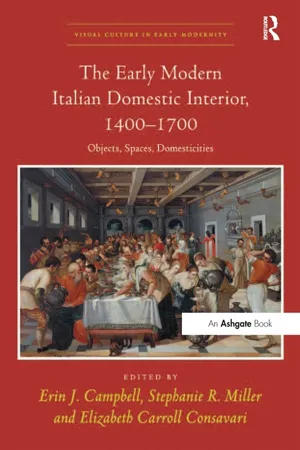
Emphasizing on the one hand the reconstruction of the material culture of specific residences, and on the other, the way in which particular domestic objects reflect, shape, and mediate family values and relationships within the home, this volume offers a distinct contribution to research on the early modern Italian domestic interior. Though the essays mainly take an art historical approach, the book is interdisciplinary in that it considers the social implications of domestic objects for family members of different genders, age, and rank, as well as for visitors to the home. By adopting a broad chronological framework that encompasses both Renaissance and Baroque Italy, and by expanding the regional scope beyond Florence and Venice to include domestic interiors from less studied centers such as Urbino, Ferrara, and Bologna, this collection offers genuinely new perspectives on the home in early modern Italy.
Information
Domesticities
1
“Uno palaço belissimo”:
Town and Country Living in Renaissance Bologna1
In a description of 1511, the Bologna palazzo of the Casali was said by Fileno dalla Tuata, a chronicler of the city, to be most beautiful (uno palaço de Chaxali belissimo).2 This chapter explores some contrasts between that palazzo and a fifteenth-century house in the Bolognese hills owned by the same family. Based on a close reading of the 1502 post-mortem inventory of Francesco Casali, a merchant, banker and papal treasurer, it argues for an image of the domestic interior that is dynamic rather than static. It shows how the domestic life of the Casali family shifts from house to house, and shifts within each house. The interior spaces of their palazzo and villa can be transformed and adapted; the objects within them can be recycled and remade. Their “domesticities” change across days, seasons and years to accommodate child-rearing, entertaining, business transactions and religious devotion.
By comparison to their counterparts in Florence and Venice, the patrician palaces of Renaissance Bologna have been little studied. The principal exception is the Bentivoglio palace, seat of the city’s ruling family in the second half of the fifteenth century.3 Yet, as the second city of the Papal States, Bologna was an important center and was far from isolated from cultural developments on the peninsula. In terms of the city’s patrician housing, from the middle of the fifteenth century, Florentine influence was apparent, mixing with vernacular style to produce some vibrant examples of palazzo architecture.4 However, in the course of the papal-Bentivoglio conflict of the early sixteenth century, not to mention the broader Italian wars, the city fabric of Bologna suffered considerable damage. The impact of warfare was exacerbated by an earthquake in 1505. This may go some way towards explaining why architectural historians of early modern Bologna have tended to focus on those palazzi constructed after that conflict was over, during the period of extensive property redevelopment in the later sixteenth century and after, many of which survive to this day.5 Interest in the Casali palazzo follows much the same pattern, lying primarily in the family’s patronage of the Carracci in the later sixteenth or early seventeenth centuries.6 That interest reflects another tendency in histories of Bologna: to focus on the house as a site of architectural and artistic endeavor rather than, as this chapter seeks to describe it, a place for everyday living.
Neither of the properties under consideration here survives in its original form: the palazzo was demolished in the nineteenth century when the present Via Farini was constructed, while the country house was rebuilt beginning in the later sixteenth century following wartime damage. Fortunately, the two Casali family archives are a rich source of documentary evidence with which to reconstruct these homes and their uses.7 The inventory alone runs to 25 folios and nearly 10,000 words in length, with a total of over 500 entries for the townhouse, over 180 for the country property, and a further 86 for a house apparently used by tenant farmers. Drawn up by Alessandro Paleotti, a Bolognese notary, on August 31, 1502 and written in a late Latin heavily dependent on contemporary Italian vocabulary, it is a relatively early surviving example of a room-by-room inventory and lists not only furniture but also textiles, clothing and kitchen equipment.8 Other family documents, in particular a Donatio (gift, or donation) of 1497, add contextual information about the three properties,9 and it has been possible to reconstruct them in some detail, offering a remarkable illustration of the types of domestic spaces inhabited by the city’s patrician families, their tenants, and households. By their nature, inventories present a snapshot, and sometimes a partial one, of the goods present in homes at any one time. They are valuable indeed for the historian, but their problems as a source are well known: they are produced by interested informants, who may not have been telling the whole truth, and their snapshot effect can hide processes such as the repair of goods, or their removal from one family house to another, not to mention the impact over time of property improvement and refurbishment.10 However, as this chapter demonstrates, a close reading of inventories can in fact reveal much about the dynamic nature of domestic environments, about property development and about the seasonal nature of living arrangements. The chapter further raises questions about town and country living and about distinctions relating to social status and gender. Overall, it aims to add to our understanding of how members of the Bolognese patriciate lived at the start of the sixteenth century, in the latter days of Bentivoglio rule of the city. It begins, however, with an introduction to the family and homes under consideration.
When, in 1502, the post-mortem inventory of Francesco Casali was drawn up, his family was already well on its way up the social ladder.11 By comparison to some patricians they were relatively recent immigrants to Bologna. Francesco’s father, Andrea, a merchant, had moved there from Imola in 1434, becoming a citizen 20 years later.12 Andrea was married to Camilla Tartagni, daughter of a prominent Imola jurist, whose brother Alessandro lectured in law at the University of Bologna.13 They had at least five children. In 1456 they bought the land on which the family’s country house would be built; they also owned a house in Via Castiglione, near Piazza Maggiore and the Duomo, the Piazza della Mercanzia, and the family bank.14 When Andrea died in 1465, his estate was divided between his three sons: Michele, Catellano, and Francesco.15 In 1475, Michele, probably the eldest of the three, paid 3,000 lire to purchase three houses adjoining the Via Castiglione property from the widow (Elisabetta Bentivoglio) and heirs of Romeo Pepoli. Buying up older contiguous properties with the intention of incorporating them into a new family palazzo was by no means unusual: the Bentivoglio rulers of Bologna had done the same in the 1450s, and it was common practice in Florence too.16 In 1497, the three Casali brothers, when they were in Bologna, all lived in one main family house bounded by Via Castiglione, Via Miola and Via de’ Vivaro.17 In 1503, the family paid another 2,000 lire to purchase from the family of Francesco’s wife, the Aldrovandi, a further house with an oratorio in this block.18
Michele and his brother Francesco followed their father into trade, dealing, among other commodities, in salt; the third brother, Catellano, studied law and pursued an ecclesiastical career at the Roman curia, rising by the end of the century to be a secretary to Pope Alexander VI.19 In this he may well have been assisted by his Tartagni relatives and was certainly patronized by Cardinal Raffaele Riario. Michele, too, moved to Rome, where he married Antonina Caffarelli, a member of an influential noble family. Their sisters Giovanna and Caterina married into the Sampiero and Lupari families of Bologna,20 and that left Francesco as head of the Casali household in Bologna. Francesco was a papal treasurer, an office that could be highly advantageous in terms of social mobility,21 and was married to Ginevra, daughter of Niccolò Aldrovandi. Her family held a number of city offices under the Bentivoglio regime, and in 1488, Gianfrancesco Aldrovandi, probably Ginevra’s brother, was appointed to the ruling Council of Sixteen, although he is better known for his role as Michelangelo’s host during the artist’s 1494–5 sojourn in Bologna. The family owned property in Via de Vivaro adjoining the Casali houses.22 While the Aldrovandi had already reached senatorial rank, the Casali did not hold this office in Bologna until 1525: Francesco had married well. The three Casali brothers died in relatively quick succession: Catellano in 1501, Francesco in 1502, and Michele in 1506. The latter were survived for many years by their wives, and their sons made names for themselves as mercenaries and diplomats during the Italian wars of the 1520s. At the time of this inventory, the members of the family were therefore relatively recent arrivals in the city, upwardly mobile, with contacts in Rome via Catellano and Michele, and engaged primarily in mercantile business.
The Casali house in Via Castiglione was a property well adapted to entertaining and in 1506, when the papal court came to Bologna to celebrate Pope Julius II’s victory over the Bentivogli, was considered suitable accommodation for Cardinal Raffaele Riario. It was a substantial building arranged around a courtyard with what may have been a double loggia, for the inventory refers separately both to a courtyard loggia (logia cortillis) and a lower loggia (logia inferiori). Such two-tier arrangements (which did not necessarily extend to all four sides of the courtyard) featured in several contemporary Bologna palazzi, including those of the Bentivoglio and Poeti families.23 Underneath the courtyard loggia, which was decorated with 15 painted shields (targoni), were a walnut trestle table, 12 braccia (7.68 m) long for dining, and two pine tables, one described as “small, for the household.” However, the inventory commences with some ground-floor rooms, itemizing property in an antechamber (guardacamera) adjoining the courtyard of a neighboring house. There follows a chamber (camera), adjoining the same house, which has two beds, one with a gilded Virgin Mary at its head, and a truckle-bed. In his De re aedificatoria, Alberti had recommended that guests “should be accommodated in a section of the house adjoining the vestibule,” and the young men over the age of 17 opposite them,24 and it is certainly possible that this was either a guest room or accommodation for young male members of the household (related to this point is Stephanie Miller’s “Parenting in the Palazzo” in Chapter 4 of this volume). Next comes a large lower chamber (camera magna inferiori) looking on to the courtyard. Also containing a bed and mattresses, this room corresponds to the Florentine camera terrena, which might function as either a guest room or the master’s summer accommodation.25 This was evidently a room where visitors might be received, and the first of two studies to be found in the palazzo is located here. This lower study was equipped with a number of items related to business affairs. There were two walnut tables for counting money, one described as inlaid with white bone in the Turkish style, and a little box, similarly inlaid, for writing, in which were letters and other writings. There was a gilded pottery inkwell, decorated with a Turk (or a Trojan) on a horse,26 and a second inkwell covered in red leather in the style of a little box. A worn courier bag (bolzietta corij usitata) was decorated with the family arms. The second study apparently adjoined Francesco’s room upstairs, and the presence of two such rooms conforms to contemporary prescriptions that the merchant should have one study on the ground floor for business, and another, upstairs, for more leisurely study.27 The Casali camera magna inferiori contained none of the entertainment objects that Maria DePrano’s chapter in this volume identifies in the equivalent room of the Tornabuoni palazzo, but, as we will see, this is perhaps because they had been relocated for the summer season.
The notar...
Table of contents
- Cover Page
- Half Title page
- Series page
- Title Page
- Copyright Page
- Contents
- Figures
- List of Contributors
- Acknowledgments
- Introduction Early Modern Domesticities: Integrating People, Spaces, Objects
- Domesticities
- People, Spaces, and Objects
- Domestic Objects and Sociability
- Objectifying the Domestic Interior
- Selected Bibliography
- Index
Trusted by 375,005 students
Access to over 1.5 million titles for a fair monthly price.
Study more efficiently using our study tools.
Frequently asked questions
Yes, you can cancel anytime from the Subscription tab in your account settings on the Perlego website. Your subscription will stay active until the end of your current billing period. Learn how to cancel your subscription
No, books cannot be downloaded as external files, such as PDFs, for use outside of Perlego. However, you can download books within the Perlego app for offline reading on mobile or tablet. Learn how to download books offline
Perlego offers two plans: Essential and Complete
- Essential is ideal for learners and professionals who enjoy exploring a wide range of subjects. Access the Essential Library with 800,000+ trusted titles and best-sellers across business, personal growth, and the humanities. Includes unlimited reading time and Standard Read Aloud voice.
- Complete: Perfect for advanced learners and researchers needing full, unrestricted access. Unlock 1.5M+ books across hundreds of subjects, including academic and specialized titles. The Complete Plan also includes advanced features like Premium Read Aloud and Research Assistant.
We are an online textbook subscription service, where you can get access to an entire online library for less than the price of a single book per month. With over 1.5 million books across 990+ topics, we’ve got you covered! Learn about our mission
Look out for the read-aloud symbol on your next book to see if you can listen to it. The read-aloud tool reads text aloud for you, highlighting the text as it is being read. You can pause it, speed it up and slow it down. Learn more about Read Aloud
Yes! You can use the Perlego app on both iOS and Android devices to read anytime, anywhere — even offline. Perfect for commutes or when you’re on the go.
Please note we cannot support devices running on iOS 13 and Android 7 or earlier. Learn more about using the app
Please note we cannot support devices running on iOS 13 and Android 7 or earlier. Learn more about using the app
Yes, you can access The Early Modern Italian Domestic Interior, 1400–1700 by Erin J. Campbell, Stephanie R. Miller, Elizabeth Carroll Consavari, Erin J. Campbell,Stephanie R. Miller,Elizabeth Carroll Consavari in PDF and/or ePUB format, as well as other popular books in Art & History of Art. We have over 1.5 million books available in our catalogue for you to explore.