Mediation of International Conflicts
eBook - ePub

Mediation of International Conflicts

A Rational Model

  1. 242 pages
  2. English
  3. ePUB (mobile friendly)
  4. Available on iOS & Android
eBook - ePub

Mediation of International Conflicts

A Rational Model

About this book

This book examines the use of third-party mediation as a conflict resolution method.

In an attempt to explain why some, but not all, conflicts are mediated, this work argues that diverse conflict structures are inherently different in their susceptibility to mediation attempts. By offering a systematic method for measuring the transformability of conflict structures, this book contributes to our understanding of the sufficient and necessary conditions for mediation. In addition, the study offers an analytical framework for the examination of mediation as a trilateral rational bargaining process. Although the general concept of mediation as a three-person game is not new, most studies focus on either the disputants' perspectives or the mediator's perspective. In contrast, this study integrates the perspectives of all three parties. The framework links the different stages involved in the whole process of mediation, from the onset of mediation, through the mediation strategies used, to the outcome, rather than focusing on one particular aspect. The book applies the framework to two case studies – the conflict between Israel and Egypt and the conflict between India and Pakistan – and provides new insights into these conflicts from a mediation perspective. In general, the model developed here provides a framework for systematically assessing conflicts and the options available to those involved in the mediation process.

This book will be of much interest to students of conflict resolution, mediation, war and conflict studies, Asian politics, Middle Eastern politics and IR in general.

Trusted by 375,005 students

Access to over 1.5 million titles for a fair monthly price.

Study more efficiently using our study tools.

Information

Publisher
Routledge
Year
2016
Print ISBN
9781138205093
eBook ISBN
9781315467757

1
Introduction

The essence of international mediation

The earliest case of mediation in documented history took place between the two Sumerian city-states of Lagash and Umma in ancient Mesopotamia. After centuries of violent clashes over possession of the fertile fields along the Tigris River, the rivals finally resolved their dispute peacefully in 2500 BC through the mediation efforts of the King of Kish. According to the settlement reached, the disputed band of territory would be cultivated by the people of Umma, while part of the grain harvested would be returned to Lagash as rent and interest (Cooper 1983). Through this innovative ‘land-lease’ agreement, the mediator helped forge a solution that both sides could live with and that both preferred over continuation of the conflict. The record of this world’s oldest mediated treaty is on display at the Louvre Museum in Paris.
Disputing parties have turned to or accepted the services of external mediators since the advent of conflict. The mediation of the border dispute between Umma and Lagash in 2500 BC is testimony to the long history of mediation in the global arena. The ancient Greeks and city-states of the Roman Empire resorted to mediation to avert violent conflict. With the rise of nation-states, diplomats and envoys were often called upon to clarify problems, transmit information and reconcile conflicting interests when disputes arose. Well into the second decade of the twenty-first century, mediation in conflicts between and within states has become, more than ever, a prevalent method of conflict resolution. The significant rise in the use of mediation, especially since the end of the Cold War, is the result of an increase in both the demand and supply of mediation. As the fall of the bipolar order thrust many states into old antagonisms and new conflicts, calls for mediation rose dramatically, and in many cases mediation proved the only way out of conflict. The end of the Cold War also freed many states and international organizations from bipolar constraints, allowing them to take on new roles in mediation and conflict management.
And yet, while efforts to mediate peaceful solutions to conflicts seem to be on the rise, the fact remains that many of these efforts end in failure. Moreover, it seems that far too frequently mediation is offered but not accepted by the disputing parties or that requests for mediation are put forth only to be ignored or rejected by third parties. This book sets out to investigate why this is the case. The following chapters seek to explain within one theoretical framework, when, why and with whom disputing parties will engage in a mediation process; when, why and with whom third parties will be willing to intervene; the conditions that must be met in order for all those involved to stay in a mediation process; and, finally, the conditions that promote mediation success.

Defining international mediation

Mediation in the international arena entails a wide range of activities carried out by actors not directly involved in a conflict between two or more disputants that are designed to manage or resolve conflicts by peaceful means. Mediators may be individuals, large or small states or nonstate actors, such as the Church or international intergovernmental or nongovernmental organizations. The act of mediation focuses on the reliance on nonviolent means by the third party and excludes forceful intervention by outside parties – even if the use of force is intended to terminate conflict between principals. Notwithstanding, the distinction between force and nonforce often constitutes a fine line when third-party intervention entails the exer tion of elements of soft power. In the face of threats (explicit, veiled or simply implied in the power balance) made by a mediator, disputants may perceive themselves as having little choice but to comply with the mediator’s demands. The approach taken in this book is that as long as they do not constitute the threat to use physical force or the actual use of physical force and as long as their goal is to end the conflict peacefully, elements of soft power are a legitimate part of mediation. Thus, the threat to use military force against a disputant would not constitute mediation, but the threat to provide economic assistance to the rival (which might in turn be used to strengthen the rival militarily) is not outside the realm of mediation activities. Since instruments of political, diplomatic and economic pressure constitute methods for peacefully resolving a conflict and the players facing such measures have the free choice to cooperate or not (even though the cost of non-cooperation may be intolerable), such activities are included in mediation. This is in line with Touval (1982:6), who argues that the mediator “may restructure the situation in order to raise the costs of an uncompromising stand, and promise rewards in return for flexibility.”
Although mediation is also practiced in many other contexts that exist outside the realm of international politics, such as marital or labor-management disputes, international mediation is a distinct field of practice and study. Unlike other social systems, the international system is not characterized by a formal and binding authority. Constituting sovereign entities, actors in the international system enjoy exclusive autonomy in internal affairs as well as in foreign policy decisions; they are thus largely independent in their conduct of the two most fundamental activities that characterize relations among actors in the system, cooperation and conflict. In contrast, mediation in the civilian sphere largely entails some formal framework and procedures of legal binding power. Some court systems, for example, by law require disputing parties involved in marital or neighbor disputes to participate in mandatory mediation before being allowed to take their case to trial. Likewise, arbitration, a process in which the third party’s decision is legally binding, is commonly used in labor-management disputes as an alternative to the right to strike.1
These principles imply that international mediation requires the presence of two closely related factors: voluntary acceptance by both the rivals and mediator and the employment of peaceful intervention methods. This suggests that for a mediation process to prevail, there must be a congruence in the perceptions of all three sides in favor of mediation, relative to their main alternative strategies – such as continuing the conflict or bilateral negotiations (for the disputants) or staying away from the conflict (for potential mediators). Any attempt to understand the onset and process of mediation must therefore entail an attempt to identify the conditions under which the interests of all three sides will converge in a given conflict to precipitate a mediation process.

Why and why not mediation

Conflict as the point of departure

To understand the factors that drive parties to engage in – or refrain from – mediation, we must first think about conflict. For without conflict there is no need for mediation. According to Fearon (1995), given the high costs entailed in armed conflict, states that are rational actors will avoid conflict in the first place and resolve their differences through peaceful means.2 Yet conflicts occur and may constitute a rational strategy that is preferred to a negotiated agreement for several reasons: (1) poor information or incentives to misrepresent information. Actors in the international system typically operate under conditions of incomplete information, especially when engaged in conflict. Rivals know their own capabilities and intentions but need to speculate about those of the opponent. Moreover the incentive to misrepresent information is particularly high during conflict. In May 1973 Anwar Sadat launched a bellicose mass-media campaign, leading Israel to mobilize reserve units and prepare for war. The Egyptians, however, did not attack, and the Israeli chief of staff came under harsh criticism for the economic cost of the mobilization. Sadat would later admit that this was all part of his strategic deception plan, to lull the Israelis into inaction when less than six months later Egypt moved its forces in preparation for a real attack (Sadat 1978). Incomplete information and misinformation often make it difficult for rivals to identify possibly acceptable settlements. (2) Commitment problems. A second obstacle to a negotiated settlement entails commitment problems – actors may be reluctant to commit to a settlement that entails concessions due to concerns that the opponent will defect from the settlement. Thus, rivals may prefer to be in conflict rather than risk future defection by the opponent from a settlement. (3) Audience costs. A third factor that may keep actors in a state of conflict are political considerations. Leaders may be unable to switch to a more conciliatory strategy due to concerns that they will be punished politically.
As they remain in conflict and continue to accumulate the human, military, political and economic costs involved, the disputing parties may realize that there might be some agreement out there that could end their conflict. Yet, they may not know what that agreement is because of incomplete information or hesitate to propose one due to commitment or domestic political costs. At this point they may consider inviting a third party to serve as a mediator or respond to a third party’s offer of mediation. The mediator, who is outside the emotional and physical sphere of the conflict but who has direct access to both disputants, can supply important information about the intentions, capabilities and preferences of the opponent. In the face of domestic obstacles, mediators can serve as legitimizing agents, good for persuading the other side of one’s rightful position; when compromise is necessary, they can help persuade one’s constituency of the necessity of concessions. Once an agreement is reached or as a prerequisite for agreement, mediators can also serve as guarantors of an agreement, reducing the likelihood of future costly conflicts.

Benefits and costs of mediation

Mediation of a conflict offers numerous potential benefits to disputants. As discussed, disputing parties often turn to mediators or accept mediation offers because they are not able to reach an agreement by themselves. Yet, there also exist other potential benefits to mediation. First, expectations that mediation will deliver the other side and help each party in a dispute secure a more favorable outcome than would otherwise be possible may induce disputants to prefer a mediated negotiation. Additionally, mediators can “enlarge the pie” and provide side payments in return for the parties’ cooperation or concessions made. For example, the United States provided Israel and Egypt with billions of dollars in military and financial assistance in return for signing the peace treaty in 1979. Yet another benefit of mediation might be improvement in a party’s relations with the third party. Both Egypt’s signals in the early 1970s that it sought US involvement in the Arab–Israel conflict and Syria’s willingness in the 1990s to negotiate with Israel through the United States can be interpreted as attempts to become closer to the United States.
Third parties as well are driven to mediate by a variety of motivations. International standing and the opportunity to continue to have a role in future relations in the region is one benefit mediators stand to gain if their mediation efforts bear fruit. Another driving force may be the mediator’s desire to improve relations with one or both disputants. Soviet mediation between India and Pakistan in 1965 was partly inspired the Soviet Union’s desire to improve its relations with Pakistan, a country that had hitherto been on better terms with the United States and China than with the Soviet Union. A national interest in a conflict or in the conflict region is a possible motivation for the third party’s involvement. As discussed in the empirical chapters of this book, after 1973, to the extent that American peace efforts helped prevent Arab–Israeli warfare, they also helped prevent oil boycotts by Arab states. Protection or expansion of the mediator’s sphere of influence is another potential driving force for intervention, especially if the mediator is a major power. These two objectives, together and separately, motivated the US intervention in the Arab–Israeli conflict at different times with varying degrees of success. In the 1950s the United States failed to achieve its objective and the Soviet Union gained the upper hand in the region because Egypt and Syria believed that American mediation would restrict their ability to act against Israel. In the 1970s, mediation was a constructive instrument in the American competition with the Soviet Union and contributed to the distancing of Egypt from the Soviets. A mediator may also have an interest in bringing about a specific end to a conflict. In this sense, the mediator’s ‘ideal point’ may fall between the disputants’ ideal points, closer to one than to the other or near neither of the parties’ ideal points.3
Yet, mediation is not only about prospective gains. If it were, we would probably see mediation in every dispute. Mediation also entails certain costs and risks for all parties involved. Indeed, there are probably as many reasons for parties’ rejection of mediation as there are for acceptance. Interestingly, the literature deals extensively with the potential benefits of mediation, yet pays little heed to the potential costs.
Whether a mediator provides important information, promises one or both of the disputants rewards for their cooperation or sanctions players that do not cooperate, all of these activities require that the mediator expend resources. Additionally, like other activities in the international arena, mediation entails the risk of failure, and the cost of mediation failure may be a highly significant one. From the mediator’s perspective, the cost of failure may be intolerable – in terms of personal or national prestige, damage caused to a state’s or an organization’s political standing, as well as tangible resources spent. The mediator’s relations with one or both disputants may be damaged as the result of mediation failure.
Mediation is not only costly when it fails. Relations between the mediator and one or both parties may be damaged by the end of a mediation process even when it succeeds in bringing about an agreement. For settlements over disputed issues, even when cushioned by incentives provided by a generous mediator, often include some painful concessions and thus some feeling of dissatisfaction, possibly harming the bilateral relationship between the disputant and the party that pushed for the agreement – the mediator. Mediation of a conflict between two parties may have a negative effect on the mediator’s relations with other players in the international system as well, players that are in no way connected to the dispute. Such a potential cost led the United States to initially turn down India’s requests to mediate between India and Pakistan in the Bangladesh crisis (1971) due to concerns that intervention would jeopardize its secret but budding relations with China in which Pakistan was playing a pivotal role.
From the perspective of the disputants as well, mediation carries many potential costs. A main concern of the disputants is that by agreeing to mediation, they yield to the third party some degree of control over how the negotiations will proceed. Likewise, acceptance might signal weakness to the rival. By accepting mediation, a disputant sends out a clear message to an opponent that it is ready to negotiate, that it is prepared to make concessions. It is not hard to imagine the deleterious effect such a declaration might have on one’s bargaining position. Additionally, the fact that a third party is involved in a state’s affairs may also entail certain side costs for the state. Costly alliance ties are a possible side cost that disputants may expect to pay (Gartner & Bercovitch 2006:822). Thus, in return for mediation assistance, a state might be – implicitly or explicitly – forced to subscribe to certain policy guidelines set down by the mediator. Finally, mediation failure usually means going back to a costly conflict, possibly a more costly one because of the failure of negotia...
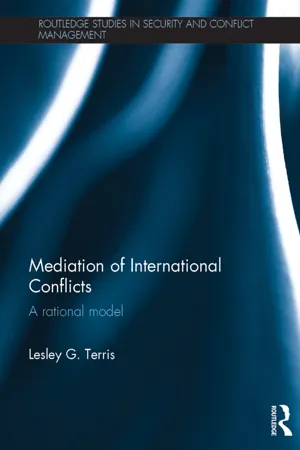
Table of contents

  1. Cover
  2. Title
  3. Copyright
  4. Contents
  5. List of figures
  6. List of tables
  7. Acknowledgments
  8. 1 Introduction
  9. 2 The Rational Model of Mediation
  10. 3 The Rational Model of Mediation: a quantitative analysis
  11. 4 The Rational Model of Mediation: the Egyptian–Israeli conflict, 1948–1979
  12. 5 The Rational Model of Mediation: the Indian–Pakistani conflict, 1947–2002
  13. 6 The Rational Model of Mediation and the Egyptian–Israeli and Indian–Pakistani conflicts: a comparative analysis
  14. 7 Conclusions
  15. Appendix
  16. Index

Frequently asked questions

Yes, you can cancel anytime from the Subscription tab in your account settings on the Perlego website. Your subscription will stay active until the end of your current billing period. Learn how to cancel your subscription
No, books cannot be downloaded as external files, such as PDFs, for use outside of Perlego. However, you can download books within the Perlego app for offline reading on mobile or tablet. Learn how to download books offline
Perlego offers two plans: Essential and Complete
  • Essential is ideal for learners and professionals who enjoy exploring a wide range of subjects. Access the Essential Library with 800,000+ trusted titles and best-sellers across business, personal growth, and the humanities. Includes unlimited reading time and Standard Read Aloud voice.
  • Complete: Perfect for advanced learners and researchers needing full, unrestricted access. Unlock 1.5M+ books across hundreds of subjects, including academic and specialized titles. The Complete Plan also includes advanced features like Premium Read Aloud and Research Assistant.
Both plans are available with monthly, semester, or annual billing cycles.
We are an online textbook subscription service, where you can get access to an entire online library for less than the price of a single book per month. With over 1.5 million books across 990+ topics, we’ve got you covered! Learn about our mission
Look out for the read-aloud symbol on your next book to see if you can listen to it. The read-aloud tool reads text aloud for you, highlighting the text as it is being read. You can pause it, speed it up and slow it down. Learn more about Read Aloud
Yes! You can use the Perlego app on both iOS and Android devices to read anytime, anywhere — even offline. Perfect for commutes or when you’re on the go.
Please note we cannot support devices running on iOS 13 and Android 7 or earlier. Learn more about using the app
Yes, you can access Mediation of International Conflicts by Lesley G. Terris in PDF and/or ePUB format, as well as other popular books in Política y relaciones internacionales & Historia militar y marítima. We have over 1.5 million books available in our catalogue for you to explore.