eBook - ePub
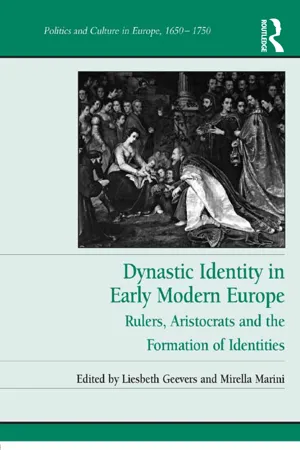
Dynastic Identity in Early Modern Europe
Rulers, Aristocrats and the Formation of Identities
- 310 pages
- English
- ePUB (mobile friendly)
- Available on iOS & Android
eBook - ePub
Dynastic Identity in Early Modern Europe
Rulers, Aristocrats and the Formation of Identities
About this book
Aristocratic dynasties have long been regarded as fundamental to the development of early modern society and government. Yet recent work by political historians has increasingly questioned the dominant role of ruling families in state formation, underlining instead the continued importance and independence of individuals. In order to take a fresh look at the subject, this volume provides a broad discussion on the formation of dynastic identities in relationship to the lineage's own history, other families within the social elite, and the ruling dynasty. Individual chapters consider the dynastic identity of a wide range of European aristocratic families including the CroÃs, Arenbergs and Nassaus from the Netherlands; the Guises-Lorraine of France; the Sandoval-Lerma in Spain; the Farnese in Italy; together with other lineages from Ireland, Sweden and the Austrian Habsburg monarchy. Tied in with this broad international focus, the volume addressed a variety of related themes, including the expression of ambitions and aspirations through family history; the social and cultural means employed to enhance status; the legal, religious and political attitude toward sovereigns; the role of women in the formation and reproduction of (composite) dynastic identities; and the transition of aristocratic dynasties to royal dynasties. In so doing the collection provides a platform for looking again at dynastic identity in early modern Europe, and reveals how it was a compound of political, religious, social, cultural, historical and individual attitudes.
Identity, Ethnicity and Monarchy
Chapter 1
Aristocratic Identity Formation in Seventeenth-Century Ireland1
In early modern Ireland the peers were a class of nobility who enjoyed a title (as duke, marquis, earl, viscount and baron), awarded to them by the English monarch, and had the privilege of sitting as temporal lords in the House of Lords, alongside the protestant archbishops and bishops. The greater peers also formed the ruling aristocracy and quickly established themselves as the dominant social group in Irish society. During the early decades of the seventeenth-century the Stuart crown trebled the number of Irish peers. With this inflation of honours, itself an exercise in social engineering, the monarch created a peerage that comprised, in roughly equal numbers, catholic and protestant lords who were charged with making Ireland English. When analysed from an ethnic perspective, the aristocracy was now a mongrel body, combining several distinct groups: the native or Gaelic-speaking Irish; the Old English, as the descendants of the English-speaking Anglo-Norman invaders were known; the New English, as those who had migrated to Ireland from England since the 1530s were labelled; the Scots and the Welsh.
Clearly the ranks of the aristocracy were neither fixed nor impermeable. Some dynasties fell from royal favour and were attainted and their lands forfeited. Upward social mobility also occurred as ‘new’ lineages joined the established ones, especially with the creations of the 1610s and 1620s. The social background of the peers was varied. By 1641 52 (out of 91) houses were of ancient lineage or noble blood, including the Bourkes of Clanricarde, Butlers of Ormond, FitzGeralds of Kildare, MacDonnells of Antrim and O’Briens of Thomond. The remaining 39 families, like the Annesley, Boyles and Hamiltons, were soldiers or from the gentry or mercantile classes and thus regarded as arrivistes or upstarts. Whatever their background, these titled families, especially the ancient houses, held a disproportionally large amount of Irish land, at least 18 per cent in 1641 rising to 26 per cent by c.1670. They controlled a significant element of the country’s wealth and the richest aristocrats in Ireland were on a par with the most prosperous English or Scottish lords.2 Men of money, power, prestige and privilege, the peers lived nobly, conspicuously and according to shared notions of honour. They acted as cultural brokers, dressing in the latest London fashions, speaking English (though a significant number would have been native Irish speakers or bi-lingual), and living in ‘great houses’. As landlords, developers, entrepreneurs, politicians, and military commanders, they served as the regional and national powerbrokers, exercising influence in Ireland and beyond.
The seventeenth century was a transformational period in Irish history. Years of intense colonisation and Anglicisation characterised the early decades, followed, during the 1640s, by bloody civil warfare. A revolution in landholding and English conquest defined the 1650s, before ushering in the relative peace and prosperity of the Restoration era. By 1688 a bitter sectarian conflict once again engulfed the country and out of this emerged the Protestant Ascendancy of the eighteenth century. This chapter examines the factors that shaped aristocratic identity during this particularly tumultuous period. The fundamental importance of honour, itself closely linked to loyalty to the person of the monarch, cannot be overstated and is a recurring and dominant theme explored here. Irish aristocrats, like their counterparts across early modern Europe, used a variety of devices – genealogy, heraldry, funeral monuments and sermons, along with biographies and family histories – to create illustrious pedigrees and strong dynastic identities for their lineages, to demonstrate their loyal service and to flaunt their Englishness. Yet, given the nature of the times, these developments were often contested and shaped by religious belief, notions of national identity, the choice of a bride and education, as well as senses of loyalty and ideas about honour.
Honour was ‘the social glue’ for Stuart society.3 In a number of seminal publications Brendan Kane explores the interface between honour, culture and politics and analyses how honour principles operated in an Irish context, how a distinctive Irish community of honour gelled and how these discussions had a very direct impact on court politics.4 Using surrender and re-grant agreements, dating from the 1540s, the crown sought to incorporate the peers into a ruling class and to ‘create an aristocratic honour culture’ centred on the king. He suggests that despite the very real ‘social, cultural and political differences separating English from Irish’ the Tudor crown and administration in Dublin ‘saw Ireland’s Gaelic and ‘English-Irish’ elites as simply variations on a recognized model of European nobilities’.5 Kane examines noble honour in three broadly chronological contexts. The first looks at honour in the ‘fighting and feasting’ culture of medieval Ireland. The second, covering the years between the passage of the Kingship Act in 1541 and the outbreak of rebellion in 1641, explores how being a kingdom influenced notions of honour. There was the ‘shift away from culturally (Gaelic) specific honor notions to more broadly negotiated ones’ in which ‘the honor bond between king and subject was now made explicit’.6 He argues that ‘Irish intellectuals reworked traditional notions of Gaelic honour to fit rapidly and radically changing social, cultural, political and religious circumstances’.7 He also takes cognisance of the wider European context and demonstrates how ‘the influence of Tridentine Catholicism’ and continental ideas of honour refashioned Gaelic ‘notions of honour’.8 The third element in Kane’s argument ‘considers anglicized “British” honor’ which, by the mid-seventeenth century, predominated.9 In seventeenth-century Ireland honour became increasingly linked to service even if lineage remained particularly important for those catholic families denied office because of their faith. Of course, as Cynthia Herrup notes, ‘honour was less a single value than a selection from a medley of values. It was … inborn and achieved, self-generated and bestowed, activist and stoical … Honour was both inherited and earned … dependent upon royal favour and community approval’.10 Honour was its own reward.
Those peers of ancient lineage, like the Kildares, Ormonds, Clanricardes or Thomonds, viewed themselves, thanks to the good fortune of their birth and their chivalric origins, as enjoying a predisposition to honour. They created dynastic lineages by commissioning family trees that traced their ancestry back in time, some to Adam or in the case of the earls of Thomond to Brian Boru, high king of Ireland, and Milo, the first Gaelic invader of Ireland and a descendent of the ancient Greeks. Genealogies and pedigrees focused on the nobleness and legitimacy of particular lineages and helped to differentiate them from the arrivistes.11 Towards the end of the sixteenth century the Ulster king of arms began to compile coats of arms for peers with Irish titles. By the turn of the seventeenth century the use of heraldic devices was widely established and helped to confirm the exclusive position the aristocracy held in society. Bernadette Cunningham has suggested that ‘This interest in heraldry within the context of a settler social hierarchy, and more particularly the associated verification of pedigrees, closely paralleled the work of the hereditary historians in Gaelic society in affirming contemporary social status by reference to ancestry’.12 The anonymous author of the Aphorismiscal Discovery of Treasonable Faction ridiculed the Old English obsession with origin. He took delight in trawling the annals with the intention of exposing the humble beginnings of many of the established lords: ‘I haue perused both those chronicles and founde nothinge remarkable, any noble extraction, either in bloude or action, or other thinge, wherof these present gentlmen might bragg off theire proper beinge from thence descended’.13
Those lacking an illustrious pedigree simply created one. Richard Boyle, first earl of Cork, stands as an excellent example of someone who used royal service, marriage and death to portray himself as virtuous and his lineage as honourable even if it was clear to contemporaries that he was a grasping, greedy, social climbing commoner who lacked noble virtues and qualities.14 He purchased armorials and the latest books on the English peerage and ostentatiously adorned his homes with heraldic shields.15 Clodagh Tait’s meticulous analysis of the funeral monuments associated with the first earl of Cork vividly recaptures how the ‘upstart earl’ (as contemporaries dubbed him) used five funerary monuments ‘to bolster, and often create, an official view of the past, the present, and the future’.16 Cork combined the visual and the verbal in these monuments to portray his new and composite dynasty as an ‘ancient’ and honourable lineage and to appropriate the reputations of the dead for the benefit of the living. These tombs also stood as a testament to the worthiness of Cork’s birth, his wealth and the exercise of his influence and power. In short, they celebrated the achievements of the Boyle dynasty, its founder and his family. They also told the life story of a family and provided a snapshot of its changing relationships. For example, Lady Cork’s tomb in Dublin (see Figure 1.1) provides ‘an abridged pictorial genealogy of the countess of Cork, with each figure described according to their relationship with her’. Her grandfather and parents are represented at the top of the monument. The middle section depicts the countess and her sons and in the bottom tier her daughters kneel in prayer.17 The coats of arms of the families into whom the Boyles married frame the elaborate tomb and add further colour and splendour. This, like the other Boyle tombs, was a subtle work of propaganda that stressed the virtues of the family and its alliances, its continuities with the past and its potential for the future.
Funerary monuments such as these made powerful statements about the individual and his place in the social hierarchy and the future vibrancy of his lineage. They provided for posterity a powerful visual record of an individual and his lineage. Those that represented a husband and wife and members of their family commemorated a successful marriage and a lord’s fecundity. Heraldic shields and devices adorned many monuments and helped onlookers to identify a family and, through the quartering of the arms, to determine the membership of the wider lineage. Heraldic images also helped to convey an ancientness of title and lineage, which was particularly useful for new peers who were eager to establish their social credibility. The nature of the monument and its positioning within the church attested to the status and wealth of the dead peer and, more importantly, to the social connections and political influences of the lineage and to its nobleness and honour. Monuments also celebrated public service, military achievement and private virtue.18 The elaborate tomb that commemorates Thomas Jones, archbishop of Dublin, and his son, Viscount Ranelagh, illustrates this. It shows the archbishop with churchman’s cap and gown (see Figure 1.2). The recumbent figure of Viscount Ranelagh lies below, clad in armour, highlighting the importance of military service. He is surrounded by four female figures, presumably his three daughters and wife, while his son, who is in civilian dress, kneels in prayer.19

Figure 1.1 The Cork tomb. The first earl of Cork combined the visual and the verbal in his family’s funerary monuments to portray his new and composite dynasty as an ‘ancient’ and honourable lineage. This is a photograph of Lady Cork’s tomb in St. Patrick’s cathedral in Dublin, which shows her grandfather and parents at the top of the m...
Table of contents
- Cover Page
- Title Page
- Copyright Page
- Contents
- List of Figures
- Notes on Contributors
- Avant-propos
- Acknowledgements
- List of Abbreviations
- Introduction: Aristocracy, Dynasty and Identity in Early Modern Europe, 1520–1700
- Part I Identity, Ethnicity and Monarchy
- Part II Identity Formation and Family Relations
- Part III Manufacturing Identity
- Conclusion: ‘The Line of Descent of Nobles is from the Blood of Kings’: Reflections on Dynastic Identity
- Bibliography
- Index
Trusted by 375,005 students
Access to over 1.5 million titles for a fair monthly price.
Study more efficiently using our study tools.
Frequently asked questions
Yes, you can cancel anytime from the Subscription tab in your account settings on the Perlego website. Your subscription will stay active until the end of your current billing period. Learn how to cancel your subscription
No, books cannot be downloaded as external files, such as PDFs, for use outside of Perlego. However, you can download books within the Perlego app for offline reading on mobile or tablet. Learn how to download books offline
Perlego offers two plans: Essential and Complete
- Essential is ideal for learners and professionals who enjoy exploring a wide range of subjects. Access the Essential Library with 800,000+ trusted titles and best-sellers across business, personal growth, and the humanities. Includes unlimited reading time and Standard Read Aloud voice.
- Complete: Perfect for advanced learners and researchers needing full, unrestricted access. Unlock 1.5M+ books across hundreds of subjects, including academic and specialized titles. The Complete Plan also includes advanced features like Premium Read Aloud and Research Assistant.
We are an online textbook subscription service, where you can get access to an entire online library for less than the price of a single book per month. With over 1.5 million books across 990+ topics, we’ve got you covered! Learn about our mission
Look out for the read-aloud symbol on your next book to see if you can listen to it. The read-aloud tool reads text aloud for you, highlighting the text as it is being read. You can pause it, speed it up and slow it down. Learn more about Read Aloud
Yes! You can use the Perlego app on both iOS and Android devices to read anytime, anywhere — even offline. Perfect for commutes or when you’re on the go.
Please note we cannot support devices running on iOS 13 and Android 7 or earlier. Learn more about using the app
Please note we cannot support devices running on iOS 13 and Android 7 or earlier. Learn more about using the app
Yes, you can access Dynastic Identity in Early Modern Europe by Liesbeth Geevers,Mirella Marini in PDF and/or ePUB format, as well as other popular books in History & Early Modern History. We have over 1.5 million books available in our catalogue for you to explore.