- 274 pages
- English
- ePUB (mobile friendly)
- Available on iOS & Android
eBook - ePub
About this book
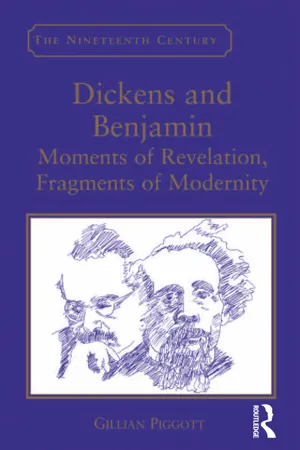
Placing the works of Charles Dickens and Walter Benjamin in conversation with one another, Gillian Piggott argues that the two writers display a shared vision of modernity. Her analysis of their works shows that both writers demonstrate a decreased confidence in the capacity to experience truth or religious meaning in an increasingly materialist world and that both occupy similar positions towards urban modernity and its effect upon experience. Piggott juxtaposes her exploration of Benjamin's ideas on allegory and messianism with an examination of Dickens's The Old Curiosity Shop, arguing that both writers proffer a melancholy vision of a world devoid of space and time for religious experience, a state of affairs they associate with the onset of industrial capitalism. In Benjamin's The Arcades Project and Dickens's Sketches by Boz and Tale of Two Cities, among other works, the authors converge in their hugely influential treatments of the city as a site of perambulation, creativity, memory, and autobiography. At the same time, both authors relate to the vertiginous, mutable, fast-paced nature of city life as involving a concomitant change in the structure of experience, an alteration that can be understood as a reduction in the capacity to experience fully. Piggott's persuasive analyses enable a reading of Dickens as part of a European, particularly a German, tradition of thinkers and writers of industrialization and modernity. For both Dickens and Benjamin, truth appears only in moments of revelation, in fragments of modernity.
Information
Exquisite Agony: Elements of Messianism and the Baroque in Dickens and Benjamin
Part 1 Introduction
In October 1930 in Berlin, Walter Benjamin read Dickens’s 1840–1841 novel The Old Curiosity Shop in German translation.1 He and his colleague Theodor Wiesengrund Adorno were fascinated by the novel, Adorno producing an essay on it in 19312 and Benjamin quoting the essay next to an excerpt from OCS in his magnum opus, The Arcades Project.3 Benjamin would later note that ‘The Curiosity Shop as Interior’ ought to be considered for a motif in the Arcades; and he included as one of his Arcades entries Chesterton’s notion that the novel is the key to the whole of Dickens’s creative output.4
But the point of connection being pursued in Part 1 of this book goes deeper than the intertextuality resulting from Benjamin’s fascination with OCS. What is suggested, through a lengthy analysis, is that Benjamin and Dickens, in OCS, shared a vision of the religious and semantic crisis at the heart of modern life. German Romanticism and the German Baroque are the source of these ideas, and it must be acknowledged at once that Dickens is not usually discussed in relation to these eras. But he may have had a ‘conduit’ to these artistic movements – this can only be a speculative suggestion – through the influence of Thomas Carlyle (1795–1881). German Romanticism and Baroque culture does come together in Carlyle’s thinking.5 Benjamin ‘rediscovered’ his own Jewish religion through the metaphysics of the German Romantics, themselves deeply interested in the Jewish Kabbalah.6 He then developed his theory of allegory in an essay on Baroque drama.7 In a discussion of three essays by Benjamin, this book brings out a vision of a fallen modern world, a world so cruel, unjust and grotesque, there are only tiny sparks of meaning and redemption available in a life. When one considers Nell’s trajectory, this appears to be an outlook that is relevant to a reading of OCS.8
The argument is this: OCS is a powerful delineation of passionate suffering and desolation, both Nell’s and the world’s. The peculiar energy of this mournful depiction of pain and decline is puzzling and has yet to be satisfactorily explored by criticism. Some Dickens criticism tends to steer clear of any metaphysical or religious interpretation of the novelist.9 Malcolm Andrews throws doubt upon approaching the novel from the notion of the pilgrimage, with its religious connotations, since ‘this approach is not sustained at any level comparable to Bunyan’s allegory’.10 The contention here is that a more sensitive reading of the deeply melancholic tone and incredibly mournful Nell passages is available when the novel’s allegorical form is seen as operational throughout; when Dickens’s delineation of the decay of the physical world, of its harshness and cruelty and violence is seen as a religiously inflected, allegorical vision. A philosophical reading, through Benjamin, of Dickens’s allegorical turn of mind may seem counterintuitive, but it is worth bearing with. The melancholy passages of the novel are genuinely moving, and this approach allows an appreciation of them while avoiding, importantly, reading ‘the death of Nell’ as sentimental or vulgar.11 Certain tendencies and elements in the novel – its masochistic hawking upon suffering and death, its lamentation and handwringing phrases and passages, Nell’s peculiar status as both sinful and angelic, the meaning of objects in the novel, the position of comedy and the Lord of Misrule, Quilp – are brought into play in this reading in ways that throw an intriguing light on the work. Critics have given a lot of weight to the question of comedy in OCS, even arguing that the humor: ‘controls the form of the novel and makes effective its pathos’.12 While the comedy does indeed provide, formally, a brilliant contrast with the sadness of Nell’s decline, this reading resists the idea that it is the most important structuring feature. And there is little focus upon comedy and how it works in the novel here.13 This could be seen as the drawback of this reading. However, there are advantages, and rather than schematizing comedy in opposition to the dark side of the novel, as a number of critics do, this Benjaminian reading emphasizes how both lightness and, more forcefully, darkness are two aspects of the declining physical world, a cruel world where Nell will suffer and die, and no amount of vibrant comedy will save her from her fate.
Chapter 1 argues that OCS exhibits distinct notes of messianism within the contours of the text, a central component of a theological worldview Benjamin formulated in the early part of his career. The discussion examines two of Benjamin’s early essays: the 1916 essay, ‘On Language as Such and On the Language of Man’ (Über die Sprache überhaupt und über die Sprache des Menschen), and the ‘Theological-Political Fragment’ (Theologisch-Politisches Fragment), which was probably written in 1920–1921, although Adorno dates this piece later, at 1937.
What will become clear in the précis of these essays is that Benjamin’s concern at this point was to explore what role theological truth, or religious experience, played in everyday experience. How could one live an ethical, meaningful life when the uncertainties thrown up by war and the progress of science appeared to augur the death of God? What was it about modern existence that seemed to allow truth and meaning to fall away? The historical moment of writing was a poignant one – one of the essays was written during the First World War, the second, just afterwards, in 1920–1921. Not only hellish world events but philosophy itself had contributed to what Benjamin viewed as a loss of ‘fullness’ in experience. Kant, for instance (in 1781), had removed the absolute – totality and immediacy – from the realms of the theoretically knowable.14 Benjamin came up with a fairly clear response to the problem: the absolute did indeed play a role within the experience of everyday life. The immanent absolute, reality as theological truth, made its appearance in distorted, partial, veiled forms. The revelation of these ‘redemptive moments’ in experience involve the notion of a dialectical relationship between the historical world and its redemptive ‘other’ – a messianic realm.
There is a revolutionary political dimension to this. ‘The Theological-Political Fragment’ stages Benjamin’s messianism as an understanding of the historical (capitalist) world as a realm in constant dialectical tension with a redeemed or utopian paradise.15 The ‘profane’ historical world is mired in a context of utter devastation and corruption; but it burns with present hope for a different future. According to Talmudic texts, the messiah, the redeemer famed to bring about the end of history, comes only in an era of total corruption and guilt. And the historical world of Benjamin’s apocalyptic vision is the site of such injustice, cruelty and devastation for the oppressed that its destructive end and redemption cannot, one imagines, be far off. Material conditions are so hellish for the poor, the messiah must surely be on his way soon. A positive yearning for the world’s explosive, violent and abrupt cutting off permeates this worldview, then – this is the revolutionary aspect of it. The politics of the real world generates a desire for a better, completely different world, in Benjamin’s ‘Fragment’. Its view of time involves an energetic yearning for an end to suffering at each and every moment; an understanding of the future – as an instant possibility in the present – which culminates not only in a better world but a totally different one.
These areas of complexity will be opened up in an extended discussion of Dickens’s novel. This line of enquiry argues that there are aspects of the fictional world of OCS that bear a resemblance to the messianic vision of the fallen world of modern capitalism articulated by Benjamin. OCS is caught up in the politics of the real world, Nell and grandfather are losers in the economy of profit and exchange. Dickens’s fictional delineation of the nature of money and property avarice (Quilp and grandfather), of tainted relationships (Nell and grandfather, among others) and his focus upon Nell’s suffering and the destitution of other poor people, comes close to Benjamin’s messianic notion of the historical world as a constantly declining, lamentable place. Like Benjamin’s vision of the historical world, Nell’s is cruel, wanton and corrupt. Dickens’s insistence upon this conversely brings its ‘other’ into play – Nell’s world is simultaneously in mourning for redemption and reparation and is in constant tension with it. Through Dickens’s continual use of the imagery of death, there is an omnipresent yearning for the world to be cut off, for it all to end. But it is when Nell’s suffering is at its most grotesque, when she is at her lowest, that Dickens conversely represents how theological truths or ‘redemptive moments’ appear in the otherwise bleak and apparently ‘godless’ urban life. While Nell is essentially dying, Dickens interposes that trajectory with messianic moments; these take the form of revelatory, even paradoxically climactic experiences in Nell’s life.
Echoing Benjamin’s mournful vision, Dickens places the blame for the world’s piteous state squarely at the door of industrialization, capitalism and the struggle for and obsession with money, property and possessions.
Of course, Dickens is influenced by the Christian biblical and emblematic tradition, by Carlyle and Calvinism. Benjamin is rooted in German Romantic/Judaic metaphysics. This will be discussed at the end of Part 1. As unlikely as it seems, there are aspects of the novel that can be productively read in terms of these Benjaminian ideas. It could even be suggested that Dickens’s vision of Nell, her humorous grotesques, the novel’s comic antics and unrelenting sorrow has more of an affinity with the Judaic comprehension of the material/political world as an imperfect reality to be violently overcome, than to, say, Carlyle’s insistence that only the immaterial world has any status as ‘real’.
Chapter 2 turns to the significance of allegorical form in OCS. This argument is conducted in relation to Benjamin’s theory of allegory set forth in his study of seventeenth-century Baroque drama in OGTD. This concern with allegory in the novel, inspired by Adorno’s reading, is not a departure from Chapter 1. As will become clear, Benjamin’s theory of allegory is deeply steeped in his early metaphysics and is a natural continuation of it.16 Allegory is the linguistic device that, rather than instantly naming essences (as symbol does), represents absences. The fall of language and the ‘loss’ of the absolute mean that allegory, for Benjamin, is the linguistic figure par excellence to evince the truth about the fallen nature of the historical world. Resembling the model of the messianic worldview, allegory’s attempt to embody and redeem meaning is a gesture whose fulfillment is ponderously deferred. Dickens shares with the writers of the seventeenth-century Trauerspiel an attachment to allegorical form and to the melancholy religious meanings and resonances that use of this literary figure represents. And, beyond the theory of allegory, like the Baroque Trauerspiele playwrights, Dickens depicts grotesque violence as a natural part of a doomed world, which is replete with villains apparently succeeding in bringing characters to ruin. He mixes a deep melancholic tone with farcical comedy to conjure the image of the chaotic space of the material world, a world where the good will suffer along with the rest.17
Searching out and discussing elements of messianism and the Baroque, then, will form the backbone of Part 1’s investigation into Benjamin’s essays and OCS. So, to begin with Chapter 1: an investigation into the ideas that constitute Benjamin’s early theological period.
1 The only other evidence that Benjamin read Dickens’s fiction is in a letter to Theodor Adorno, written in 1936, in which he claims he read Great Expectations in French: ‘a very substantial book by Dickens, the first thing of his I have seen since The Old Curiosity Shop’. It impressed him with its ‘significant constellations and rather wonderful figures,’ but, like Forster, he disliked its ‘inadequate’ ending (Theodor Adorno and Walter Benjamin, The Complete Correspondence 1928–1940 [Polity Press, 1999], p. 164).
2 Adorno’s ‘Rede über den Raritätenladen von Charles Dickens’ appeared in the liberal newspaper Frankfurter Zeitung. It is in Adorno’s Gesammelte Schriften, ed. Gretel Adorno and Rolf Tiedemann, vol. 11, pp. 515–22. English translation by Michael Hollington, Dickens Quarterly 6.3 (September 1989): pp. 95–101. The translated version will be referred to as ‘Adorno’s essay’.
3 The Arcades Project, H2a,4 and H2a,5, p. 208. [Benjamin divided the Arcades Project into 36 convolutes or files, collecting material under headings with capitalized letters from A – Z; followed by headings with uncapitalized letters from convolute 27 onwards. Further sub-divisions include numbers and uncapitalized letters. The cited references refer t...
Table of contents
- Cover Page
- Title Page
- Copyright Page
- Dedication
- Contents
- List of Figures
- List of Abbreviations
- Foreword
- Acknowledgments
- Introduction
- Part 1 Exquisite Agony: Elements of Messianism and the Baroque in Dickens and Benjamin
- Part 2 Dickens, Benjamin and the City
- Conclusion
- Appendix 1
- Appendix 2
- Bibliography
- Index
Trusted by 375,005 students
Access to over 1.5 million titles for a fair monthly price.
Study more efficiently using our study tools.
Frequently asked questions
Yes, you can cancel anytime from the Subscription tab in your account settings on the Perlego website. Your subscription will stay active until the end of your current billing period. Learn how to cancel your subscription
No, books cannot be downloaded as external files, such as PDFs, for use outside of Perlego. However, you can download books within the Perlego app for offline reading on mobile or tablet. Learn how to download books offline
Perlego offers two plans: Essential and Complete
- Essential is ideal for learners and professionals who enjoy exploring a wide range of subjects. Access the Essential Library with 800,000+ trusted titles and best-sellers across business, personal growth, and the humanities. Includes unlimited reading time and Standard Read Aloud voice.
- Complete: Perfect for advanced learners and researchers needing full, unrestricted access. Unlock 1.5M+ books across hundreds of subjects, including academic and specialized titles. The Complete Plan also includes advanced features like Premium Read Aloud and Research Assistant.
We are an online textbook subscription service, where you can get access to an entire online library for less than the price of a single book per month. With over 1.5 million books across 990+ topics, we’ve got you covered! Learn about our mission
Look out for the read-aloud symbol on your next book to see if you can listen to it. The read-aloud tool reads text aloud for you, highlighting the text as it is being read. You can pause it, speed it up and slow it down. Learn more about Read Aloud
Yes! You can use the Perlego app on both iOS and Android devices to read anytime, anywhere — even offline. Perfect for commutes or when you’re on the go.
Please note we cannot support devices running on iOS 13 and Android 7 or earlier. Learn more about using the app
Please note we cannot support devices running on iOS 13 and Android 7 or earlier. Learn more about using the app
Yes, you can access Dickens and Benjamin by Gillian Piggott in PDF and/or ePUB format, as well as other popular books in Literature & Literary Criticism. We have over 1.5 million books available in our catalogue for you to explore.