Women in many Westernized countries encounter a wider variety of career opportunities than afforded in previous decades, and the percentage of women leaders in nearly every sector is on the rise. Sport coaching, however, remains a domain where gender equity has declined or stalled, despite increasing female sport participation. The percentage of women who coach women are in the minority in most sports, and there is a near absence of women coaching men. This important new book examines why. Drawing on original multi-disciplinary research from across the globe, including first-hand accounts from practicing coaches, the book illuminates and examines the status of women in coaching, explores the complex issues they face in pursuing their careers, and suggests solutions for eliminating the barriers that impede women in coaching.
Developing an innovative model of intersectionality and power constructs through which to guide research, the book covers issues including sexual identity, race, motherhood, cross-gender coaching and media coverage to give voice to women coaches from around the world. As such, Women in Sports Coaching is essential reading for serious students and scholars of sports coaching, sport sociology or anyone with an interest in gender and sport.
Chapter 1 A framework to understand experiences of women coaches around the globe The Ecological-Intersectional Model
DOI: 10.4324/9781315734651-1
Nicole M. LaVoi
Introduction
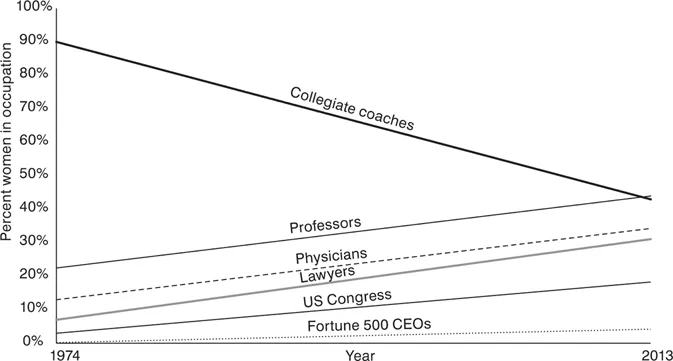
In nearly all professions the percentage of women is on the rise, with the exception of women in sport coaching (see Figure 1.1). In the United States the percentage of women head coaches of women’s collegiate teams has dramatically declined over the last 40+ years to a near all-time low (Acosta & Carpenter, 2014; LaVoi 2013). Researchers have also documented and examined the underrepresentation of women in sport leadership in several countries including Australia (Sibson, 2010), Canada (Shaw & Slack, 2002), Germany (Pfister & Radtke, 2009), the Netherlands (Knoppers & Anthonissen, 2005, 2008), New Zealand (Shaw, 2006a), Norway (Hovden, 2000, 2010) and the United Kingdom (Shaw, 2006b; Shaw & Hoeber, 2003). Data outside these few countries is limited or non-existent. Women coaches around the globe constantly fight to be heard, taken seriously, included, funded and respected (see Chapter 11). Women coaches – no matter where they coach – face a multi-level and complex set of barriers, and depending on their intersectional identities, they may face layered oppression and marginalization. This chapter will lay out a new and expanded ecological model which will provide a guiding framework for the remainder of the chapters, and for future research and dialogue pertaining to women coaches.
Ecological-Intersectional Model of barriers for women coaches
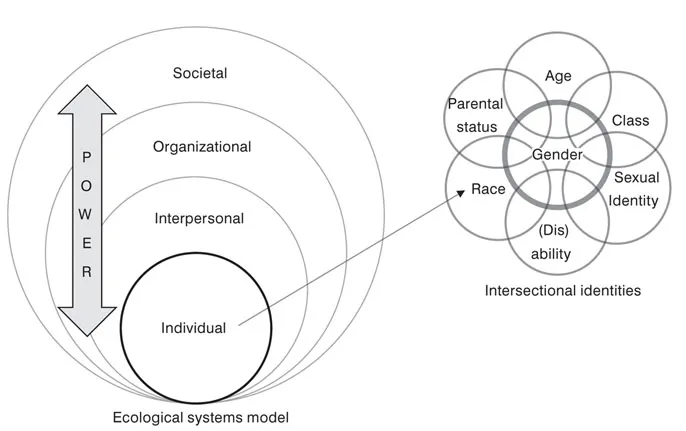
This book is structured by chapter to highlight and delve deeply into the specific layers, aspects and axes of oppression and marginality that intersect with gender, such as race, sexual identity, motherhood, (dis)ability and positional status. However, it should be noted that while the chapter structure may imply or construct that women’s positionalities are compartmentalized and orthogonal, it is impossible to disconnect intersectional identities from each other and from environmental influences. Three guiding theoretical frameworks provide the foundation for the chapters in this book: 1) the Ecological Systems Theory model (Bronfenbrenner, 1977, 1979, 1993), 2) intersectionality, and 3) power depicted by Figure 1.2. The aspects of the Ecological-Intersectional Model, which you will see represented and woven throughout each chapter, will be summarized next. This model can help forward understanding, educate, guide research, stimulate dialogue, and help create change for women coaches around the globe.
Figure1.1 Percent of US women in select occupations from 1974 to 2014
A majority of researchers who study women coaches have employed aspects of, or a complete multi-level framework analysis (Burton, 2014; Dixon & Bruening, 2007; Knoppers, 1992). One particular multi-level model, the Ecological Systems Theory (Bronfenbrenner, 1977, 1979, 1993) is characterized by four social-ecological levels (individual, interpersonal, organizational/structural, and sociocultural) that influence human experience and behavior, and is particularly useful and expounded upon in detail in Chapter 3. An Ecological Systems Model was first applied to women in sport coaching by LaVoi and Dutove (2012) and is similar to the multi-level models which stress the interrelationships between persons and settings, but includes a developmental trajectory approach which adds much needed consideration of life course influences to women in the coaching profession over time. For example, a novice coach with little coaching expertise will not experience, reflect, or respond to colleagues, inequality, marginalization, discrimination, institutional policies, or societal stereotypes in the same way as a 25-year veteran. While Acosta and Carpenter have longitudinally documented the empirical decline of women coaches in US collegiate athletics over time, this data does not capture the dynamic and complex factors that have impacted women in the coaching profession over time. “What it does tell us is that the problem is historical, empirically evident, and continuous” (Stangl, 2013, p. 401).
Recently Leanne Norman (author of Chapter 4) and colleagues conducted the first-ever study that examined barriers and facilitators, women’s career transitions, professional identity, and wellbeing at the various stages of their careers as sport coaches. Norman explained the importance of this ground-breaking research, “Little is known about why career pathways in coaching are gendered, why there appears to be a glass ceiling that prevents progression to the most senior roles, or how women coaches’ occupational experiences affect their health and wellbeing” (Braithwaite, 2015). All of the research to date has documented the experiences of women coaches at one point in time but little attention to the life course and developmental effects of a coaching career exist. The chronic effect (i.e., duration and intensity) of exposure to environmental (e.g., gender bias in the workplace) and relational (e.g., lack of social support) factors over one’s coaching career, and the consequences and impact of that exposure on women coaches is currently unknown. Also unknown is how the timing of major and commonplace life course events such as pregnancy, marriage, divorce, job turnover, elder care, and relocation affect the careers of women coaches – all of which necessitate support and coping skills.
Principles of an ecological systems perspective can be applied to sport contexts. Examples of these principles include the articulation and unfolding of the person-environment dynamics over time, the need for diverse methodology to understand the person/environment relationships so change is possible, and understanding that person-based variables (gender, stage in life course) can shape the nature of human responses and action taken with regard to the organizational or institutional environment (Winkel, Saegert, & Evans, 2009). Nation of origin as an environmental and organizational barrier or support is illuminated in Chapter 11, as the voices of women coaches and leaders in women’s sport around the globe are heard. A gap in the empirical literature exists pertaining to the experiences of women coaches outside of a handful of countries mentioned earlier in this chapter. Barriers faced by women coaches around the globe are certainly similar, but political, economic, social and historical variables of each nation state are likely to be accompanied by unique challenges. An ecological model also provides understanding that people “seek out niches that are accessible and in which they can survive or thrive” (Winkel et al., 2009, p. 322) which may in part illuminate self-selection into and out of the coaching profession. At the heart and center of the ecological model is the complex, dynamic individual-level construct of intersectionality.
Intersectionality
Intersectionality is a term first coined by black feminist and lawyer Kimberlé Crenshaw (1989) and used by Patricia Hill Collins (1990) and others to draw attention to compounded or overlapping forms or systems of oppression, domination, and discrimination experienced by women of color. In Chapter 5, the authors explain the importance of using intersectionality to understand women coaches of color. More broadly and contemporaneously, including within this book, intersectionality forwards understanding that one’s identities (e.g., race, gender, sexuality, age, class, ability, and ethnicity) interact on multiple, interdependent, and often simultaneous levels with racism, sexism, homophobia, and belief-based bigotry, which contributes to “intersecting” forms of systemic injustice, oppression, and social inequality.
Adding intersectionality, visibly and explicitly, at the heart of the ecological model, at the individual level, helps researchers consider the experiences of women coaches along differential identity axes, and how women may experience – in similar and different ways – ageism, misogyny, homophobia, and sexism, among other forms of oppression, over the trajectories of their coaching career and life course. In Chapter 4 the experiences of lesbian coaches is expounded upon, and Chapter 6 details the research on mother-coaches and the impact of motherhood on women coaches. By including intersectionality in the model and throughout this book, the goal is to highlight complexities and not wash out differences and inequalities of race, social class and sexualities that exist within a category like “women” (Messner, 2011). While each chapter in this book is not written exclusively with an intersectionality framework, it is not our intention to privilege some power relationships over others as McDonald and Birrell (1999) caution, but to expand analysis of women coaches and power beyond one particular axis (gender) to the best of our abilities given our current understanding of the literature.
Age is one aspect of intersectionality. You will not find a separate chapter on or read much about age, if any, in this book or elsewhere. No empirical evidence exists into gendered patterns of ageist bias in sport coaching, despite numerous anecdotal examples and assertions of its existence in the popular press. The dominant opinion of women’s sport advocates and Title IX and Title VII lawyers is that an age bias against women coaches exists. Common opinions which need empirical testing include the belief that women over 45, many of whom are successful veterans, are fired or non-renewed by administrators who perceive them to be “out of touch with the athletes,” troublemakers who advocate for equity and resources (i.e., take resources away from men’s teams), voice concerns about Title IX violations, and command higher and equitable salaries to their male peers, and therefore are replaced with younger coaches. It is also believed these veteran women rarely get another coaching job. Conversely, men at the same age are perceived to be competent, assertive, in their coaching prime, re-enter the coaching carousel and obtain another job quickly and seamlessly. Currently LaVoi and Kinnaird (in progress) are examining age and gender trends of coach turnover in NCAA Division-I institutions.
Similar to age, there is very little, if any, empirical knowledge about disabled women coaches. Karen DePauw has written about athletes with disabilities, disability in sport and how disability – like other intersectional categories like race, class and gender – is a socially-constructed category that must be acknowledged, understood and challenged (DePauw, 1997, 1999, 2000). DePauw argues that disability must be examined in context, rather than as a problem of the individual with biological differences. Furthermore, how bodies are understood in sporting contexts (e.g., male v. f...
Table of contents
Cover Page
Half-Title Page
Series Page
Title Page
Copyright Page
Dedication Page
Table Of Contents
List of illustrations
List of contributors
Acknowledgments
Introduction
PART I
1 A framework to understand experiences of women coaches around the globe: the Ecological-Intersectional Model
2 A socio-cultural examination of a lack of women coaches in sport leadership positions
3 An ecological/multisystem approach to understanding and examining women coaches
PART II
4 Lesbian coaches and homophobia
5 Women coaches of color: examining the effects of intersectionality
6 Coaching and motherhood
7 Cross-gender coaching: women coaching men
8 Female athletes’ conceptions of leadership: coaching and gender implications
9 Female assistant coaches: planting seeds and growing roots
PART III
10 Women in sport media: where are the women coaches?
11 Hear their voices: suggestions for developing and supporting women coaches from around the world
12 Women in coaching: theoretical underpinnings among quantitative analyses
13 Women in coaching: theoretical underpinnings among qualitative research
PART IV
14 Concluding thoughts: creating change for women coaches
Index
Trusted by 375,005 students
Access to over 1.5 million titles for a fair monthly price.
Study more efficiently using our study tools.
Frequently asked questions
Yes, you can cancel anytime from the Subscription tab in your account settings on the Perlego website. Your subscription will stay active until the end of your current billing period. Learn how to cancel your subscription
No, books cannot be downloaded as external files, such as PDFs, for use outside of Perlego. However, you can download books within the Perlego app for offline reading on mobile or tablet. Learn how to download books offline
Perlego offers two plans: Essential and Complete
Essential is ideal for learners and professionals who enjoy exploring a wide range of subjects. Access the Essential Library with 800,000+ trusted titles and best-sellers across business, personal growth, and the humanities. Includes unlimited reading time and Standard Read Aloud voice.
Complete: Perfect for advanced learners and researchers needing full, unrestricted access. Unlock 1.5M+ books across hundreds of subjects, including academic and specialized titles. The Complete Plan also includes advanced features like Premium Read Aloud and Research Assistant.
Both plans are available with monthly, semester, or annual billing cycles.
We are an online textbook subscription service, where you can get access to an entire online library for less than the price of a single book per month. With over 1.5 million books across 990+ topics, we’ve got you covered! Learn about our mission
Look out for the read-aloud symbol on your next book to see if you can listen to it. The read-aloud tool reads text aloud for you, highlighting the text as it is being read. You can pause it, speed it up and slow it down. Learn more about Read Aloud
Yes! You can use the Perlego app on both iOS and Android devices to read anytime, anywhere — even offline. Perfect for commutes or when you’re on the go. Please note we cannot support devices running on iOS 13 and Android 7 or earlier. Learn more about using the app
Yes, you can access Women in Sports Coaching by Nicole M. LaVoi in PDF and/or ePUB format, as well as other popular books in Social Sciences & Gender Studies. We have over 1.5 million books available in our catalogue for you to explore.