The economic geography of music is evolving as new digital technologies, organizational forms, market dynamics and consumer behavior continue to restructure the industry. This book is an international collection of case studies examining the spatial dynamics of today's music industry. Drawing on research from a diverse range of cities such as Santiago, Toronto, Paris, New York, Amsterdam, London, and Berlin, this volume helps readers understand how the production and consumption of music is changing at multiple scales – from global firms to local entrepreneurs; and, in multiple settings – from established clusters to burgeoning scenes. The volume is divided into interrelated sections and offers an engaging and immersive look at today's central players, processes, and spaces of music production and consumption. Academic students and researchers across the social sciences, including human geography, sociology, economics, and cultural studies, will find this volume helpful in answering questions about how and where music is financed, produced, marketed, distributed, curated and consumed in the digital age.
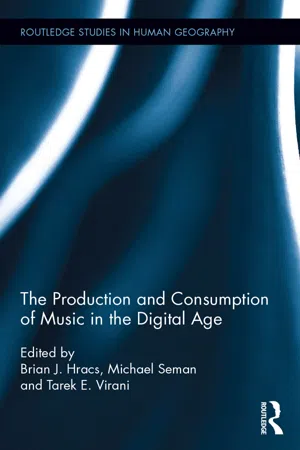
eBook - ePub
The Production and Consumption of Music in the Digital Age
- 278 pages
- English
- ePUB (mobile friendly)
- Available on iOS & Android
eBook - ePub
The Production and Consumption of Music in the Digital Age
About this book
Information
Part I
Introduction
1 Introduction
The Evolving Economic Geography of Music
Although geographers have demonstrated a sustained empirical interest in music-related topics, the economic geography of music continues to evolve as new digital technologies and practices are introduced and adopted (Connell and Gibson 2003; Hracs 2012; Leyshon 2014). Indeed, new technologies, organizational forms, market dynamics, and consumer behavior continue to restructure the industry at multiple scales (from global firms to local entrepreneurs) and in multiple spatial settings (from established clusters and burgeoning scenes to online environments). Record labels and intermediaries are reinventing themselves while independent musicians are negotiating a range of new opportunities and challenges. Against this backdrop, a new interconnected sonic ecosystem of cities, scenes, venues, festivals, record shops, and online communities is emerging.
In the late 1990s and early 2000s the MP3 file format and file sharing networks such as Napster and Kazaa emerged as transformative forces. Together, the digitization and illegal downloading of music catalyzed a “structural shock” within the industry that fundamentally altered its spatial dynamics and business models (Hracs 2012). The change has been so dynamic and widespread that a framework for studying the global music landscape is emerging that views related activities in terms of pre- and post-“MP3 Crisis” (Hracs 2012).
In the contemporary era, change is constant and pervasive and it is difficult to measure or predict the impacts of digital technologies. For example, the rise of streaming services such as Spotify and Apple Music, the refusals of artists like Taylor Swift and Neil Young to allow their music to be streamed, and the near collapse of streaming companies like Jay Z’s Tidal remind us that the effect of digitization on music is not only far from straightforward, but far from over. Given the restless dynamism associated with the contemporary marketplace for music, this volume gathers cutting-edge research that nuances our understanding of the digital revolution and raises new questions for further music-related research in geography.
Together, the scholars in this volume provide an analytical snapshot of how and why several important and interrelated processes in the music industry are evolving. The chapters are diverse in terms of theoretical framework, methods, and empirical focus, but they are unified by a common approach which emphasizes the geographic analysis of music, or “the examination of music and how it interacts with the people, economy, built environment, and technology that comprises a certain space or place” (Paquette 2014). Although nascent within the broader discipline, much like the analysis of food and other cultural phenomena, applying a geographic lens to music can offer considerable “insight into how landscapes develop and how they might continue to do so in the future” (Paquette 2014).
This volume acknowledges and builds upon relatively recent works, including Connell and Gibson’s (2003) Sound Tracks: Popular Music, Identity, and Place, Bennett and Peterson’s (2004) Music Scenes: Local, Translocal, and Virtual, Adam Krims’ (2007) Music and Urban Geography, and Johansson and Bell’s (2009) Sound, Society and the Geography of Popular Music. These books examine the geography of music holistically, but do not focus on the influence of digital technologies. The explicit focus on economic geography in this volume complements Sonic Synergies: Music, Identity, Technology and Community edited by Bloustien et al. (2008), which offers an excellent collection of essays about the influence of digital technologies from the perspectives of anthropology and cultural studies. Ultimately, this volume seeks to continue the lineage of geographers examining music by addressing the topic in terms of economics and digital technology—two aspects of the discipline that are still underutilized to analyze the production, distribution, and consumption of music.
The majority of the contributors to this volume are geographers by training, but the disciplines of urban planning, public policy, business, political science, cultural studies, and sociology are also represented. While many are established scholars who have chronicled developments in the music industry over time, others are emerging scholars with fresh perspectives and cutting-edge insights. It should also be noted that many of the contributors are not only music researchers and consumers but musicians in their own right. Together, the contributors address a range of questions related to music, digital technologies, and economic geography from a wide geographic spectrum that includes cities such as Santiago, Toronto, Paris, New York, Amsterdam, London, and Berlin among others.
This volume is structured to illustrate how digital technologies are altering every facet of the global music landscape. The reader is guided from the production of music, including the recording of songs, to the consumption of music which may occur in the home, at a festival, or online. The chapters are organized in sections to highlight the process from start to finish.
In the first section, “Recording,” Watson (Chapter 2, this volume) and Arditi (Chapter 3, this volume) offer insight into how digital technologies have given musicians the financial and spatial freedom to eschew large studios (often controlled or owned outright by major labels) and record more affordably in their homes or project studios elsewhere, adhering to a time schedule they develop. However, this freedom is a double-edged sword. Digital recording has blurred boundaries forcing everyone from recording engineers to interns looking to break into the music industry to be available 24/7. This availability often results in precarious work practices that exploit studio labor—a practice that ultimately benefits major labels.
In the second section, “Working,” consideration is paid to how the digitally driven double-edged sword of freedom extends to musicians in all facets of their career and has also impacted those working at major labels. Digital technologies are continuing to allow music to be acquired free of charge or at a price point that is disadvantageous to musicians (e.g., through illegal downloading or low-paying streaming platforms). This loss in revenue and the retreat of label support is forcing musicians to exchange a specialized division of labor for a DIY approach. As Hracs notes in Chapter 4, this volume, it is not uncommon for indie musicians in Toronto to take on roles such as manager, promoter, booking agent, and merchandising expert. Yet, digital technologies also afford musicians spatial freedom from the established centers of music production. As a result, Hracs demonstrates that musicians are leaving Toronto’s bohemian downtown core for more affordable and creative spaces in the suburbs. In Chapter 5, of this volume, Speers notes a similar multitasking trend amongst hip-hop artists in London. This trend proves problematic for two reasons. First, the new role of cultural entrepreneur causes some hip-hop artists internal friction as they struggle to balance art and commerce in their careers. Other artists find it difficult to master the digitally-driven skill sets required to be a cultural entrepreneur which results in the marginalization of their art in the commercial marketplace. Haijen (Chapter 6, this volume) focuses on this trend amongst Dutch hip-hop artists noting that although digital technology has lowered the barrier of entry for artists in the scene, increased competition places a heavier importance on artists being more entrepreneurial in nature. She found that having access to social and financial capital, a savvy business strategy, and retaining an authenticity were needed to survive in a crowded marketplace. Juggling these dynamics finds musicians engaging in business pursuits both online and in-person outside of the traditional locations of venues or recording studios while also underscoring the increasing need to network socially and professionally. Frenette (Chapter 7, this volume) examines working conditions at record companies during the digital age and finds that these employees face similar challenges to musicians. For example, as revenues continue to plummet, major label employees must learn how to fill multiple roles in order to remain viable as companies continue to restructure and shed employees in the digital age.
The steps taken to record music and the actions necessary to ensure that one can operate as a musician are often the backstory to what many interpret as the primary role of the musician … performer. Digital technologies have disrupted all facets of the music industry, with live performances being no exception. The core of a live performance is still a performer playing a song for an audience, but the instruments and equipment used in the process of that performance, the promoting of it, methods of selling tickets for it, and how it might be streamed globally or captured for fans to hear later are all areas affected by the digital revolution. Live performance is an important area to consider in the post-MP3 Crisis era, for although consumers may be buying less music, they are still going to see musicians play live.
Virani (Chapter 8, this volume) introduces the section, “Playing” with a case study of a London venue specializing in eclectic music programing that leans towards free improvisation. Virani details how the venue continues to act as a physical hub for the surrounding scene while leveraging digital technologies to archive what are generally one-time only performances. This archiving helps elevate the venue’s brand globally, attracting interest and acts from far beyond its physical location and the scene it anchors. Johansson, Gripshover, and Bell (Chapter 9, this volume) shift the focus from London to Pittsburgh and Nashville where venues, including bars and clubs, have embraced digital technologies like social media to help promote shows and navigate ticket purchases. The authors suggest that the advent of the Internet has been advantageous to all venues, but continuing corporatization of larger venues and changing dynamics in ticketing, marketing, and booking may marginalize some smaller venues if they are not nimble in embracing a rapidly evolving set of digital tools. At the same time as revenues from recordings continue to fall, the popularity and prevalence of festivals has risen dramatically, giving a much-needed economic boost to musicians who tour. However, these festivals are shifting in mode in the digital age. Wynn and Dominguez-Villegas (Chapter 10, this volume) consider the “Newport Effect” and illustrate how a festival appearance, in this case at the storied Newport Folk Festival, ascends from being a live performance opportunity to a tool increasing one’s brand cache on touring circuits. In Chapter 11, this volume, Jansson and Nilsson show how the changing structure of the music industry in the digital age is forcing musicians in Sweden to be more entrepreneurial. This results in festivals becoming interconnected, critical networking spaces for performers to gain more work—on tour and off.
Fans always want a final product that captures the performances of their favorite musicians. The “Distributing” section looks at how digital technologies have altered this step after recording, working, and playing that historically resulted in a physical product one purchased to enjoy at their own discretion. In Chapter 12, this volume, Bürkner notes how many in Berlin’s thriving electronic dance music (EDM) scene take a cue from the previous “Working” and “Playing” sections and see the physical or digital product as a calling card to gain better shows at venues. For example, these scene participants release tracks on their own labels expecting low monetary returns, but increased name recognition for booking live shows. Brandellero and Kloosterman (Chapter 13, this volume) then shift the focus to the internationally recognized world music scene in Paris arguing that, much like music scenes around the globe, sales of physical products continue to decline while live performances have emerged as an important revenue stream. Scene actors respond to the effects of digitization by leveraging it for global promotion and communication concerning recordings and live shows, while also investing in the production of elaborately packaged physical products to differentiate product in the market. In Chapter 14, this volume, Sonnichsen explores another vital site of distribution—vinyl record stores. It is suggested that the success of these stores is partially due to their ability to create hybrid places incorporating both a physical and online presence which mirrors, to a degree, the business acumen of participants in the Parisian world music scene. Looking to the future, Pratt (Chapter 15, this volume) considers the global dynamics of copyright law and argues that the future of global music consumption rests on the interaction between the continuing development of digital technologies and copyright issues, and how that interaction is interpreted in countries with very different laws and moral perspectives regarding the subject.
The final section, “Promoting and Consuming” explores how digital technologies have changed the relationships amongst musicians, intermediaries, fans, and the spatial arenas where interactions take place. In Chapter 16, this volume, Arriagada considers the activities of several bloggers living in Santiago who focus on creating and disseminating content online about their local music scene while also acting as funnels for information concerning music scenes abroad for readers in Santiago. The practice encompasses aesthetic preferences, design, and technical acumen to create a “digital habitus” imbuing the bloggers with competitive cultural capital exceeding that afforded to those who only operate in a journalistic space. Lange (Chapter 17, this volume) then addresses the enduring value of professional tastemakers such as music journalists, suggesting that it is increasingly tenuous as digital technologies have opened the door for passionate amateur scribes like the bloggers in Santiago and elsewhere to gain international followings. In addition, Lange outlines the growing importance of digital music service algorithms which are designed to curate personal playlists based on past selections. Finally, Chapter 18, this volume, examines the viability of digitally-driven crowdsourcing options in the music industry. Leyshon, Thrift, Crewe, French, and Webb detail how crowdsourcing technology has made it easier for bands to connect with fans directly. This connection allows the creation of an album to be an immersive experience wherein fans can track its progress and fund it while it is still in the developmental stages. The authors note that while crowdsourcing is currently met with enthusiasm, it alone is not a significant enough force to reverse the course of the music industry’s overall economic struggles and places an additional burden and risk on artists employing the process.
The chapters contained in this volume are a snapshot of an industry in transition. This volume is meant to inform, engage, and encourage readers to push the discourse presented further through their own research and writing. Digital technologies have disrupted the majority of the music industry and have brought entirely new economic and spatial dimensions to those who create music and those who listen to it. As the industry continues to search for ways to adjust to this disruption and fans encounter and embrace new ways of enjoying music, it is important to continue documenting and analyzing this transition through a geographic lens. After all, there will always be someone ready to sing a song and someone ready to listen—it is our hope that this research will help to facilitate that connection, wherever it may take place.
References
Bennett, Andy, and Richard, A. Peterson. Music Scenes: Local, Translocal, and Virtual. Nashville: Vanderbilt University Press, 2004.
Bloustien, Gerry, Margaret Peters, and Susan Luckman. Sonic Synergies: Music, Identity, Technology and Community. Burlington: Ashgate Press, 2008.
Connell, John, and Chris Gibson. Sound Tracks: Popular Music, Identity, and Place. London: Routledge, 2003.
Hracs, Brian J. “A Creative Industry in Transition: The Rise of Digitally Driven Independent Music Production.” Growth and Change 43, no. 3 (2012): 442–461.Johansson, Ola, and Thomas L. Bell. Sound, Society and the Geography of Popular Music. Burlington: Ashgate Press, 2009.
Krims, Adam. Music and Urban Geography. New York: Routledge, 2007.
Leyshon, Andrew. Reformatted: Code, Networks and the Transformation of the Music Industry. Oxford: Oxford University Press, 2014.
Paquette, Danielle. (2014, September 8). “Meet the Man Who Studies Indie Music Economies.” Accessed September 8, 2014. http://www.washingtonpost.com/news/storyline/wp/2014/09/08/meet-the-man-who-studies-indie-musics-economic-impact-yes-hes-in-a-band-too/
Part II
Recording
2 Laptops, Pro Tools, and File Transfer Protocols
On the Intensification and Extensification of Recording Work in the Digital Age
Cultural and creative workers, it has been argued, symbolize the contemporary transformations of work perhaps more tha...
Table of contents
- Cover Page
- Half-Title Page
- Series Title Page
- Title Page
- Copyright Page
- Table of Contents
- Figure
- Tables
- Acknowledgments
- Part I Introduction
- Part II Recording
- Part III Working
- Part IV Playing
- Part V Distributing
- Part VI Promoting and Consuming
- Contributors
- Index
Trusted by 375,005 students
Access to over 1.5 million titles for a fair monthly price.
Study more efficiently using our study tools.
Frequently asked questions
Yes, you can cancel anytime from the Subscription tab in your account settings on the Perlego website. Your subscription will stay active until the end of your current billing period. Learn how to cancel your subscription
No, books cannot be downloaded as external files, such as PDFs, for use outside of Perlego. However, you can download books within the Perlego app for offline reading on mobile or tablet. Learn how to download books offline
Perlego offers two plans: Essential and Complete
- Essential is ideal for learners and professionals who enjoy exploring a wide range of subjects. Access the Essential Library with 800,000+ trusted titles and best-sellers across business, personal growth, and the humanities. Includes unlimited reading time and Standard Read Aloud voice.
- Complete: Perfect for advanced learners and researchers needing full, unrestricted access. Unlock 1.5M+ books across hundreds of subjects, including academic and specialized titles. The Complete Plan also includes advanced features like Premium Read Aloud and Research Assistant.
We are an online textbook subscription service, where you can get access to an entire online library for less than the price of a single book per month. With over 1.5 million books across 990+ topics, we’ve got you covered! Learn about our mission
Look out for the read-aloud symbol on your next book to see if you can listen to it. The read-aloud tool reads text aloud for you, highlighting the text as it is being read. You can pause it, speed it up and slow it down. Learn more about Read Aloud
Yes! You can use the Perlego app on both iOS and Android devices to read anytime, anywhere — even offline. Perfect for commutes or when you’re on the go.
Please note we cannot support devices running on iOS 13 and Android 7 or earlier. Learn more about using the app
Please note we cannot support devices running on iOS 13 and Android 7 or earlier. Learn more about using the app
Yes, you can access The Production and Consumption of Music in the Digital Age by Brian J. Hracs,Michael Seman,Tarek E. Virani in PDF and/or ePUB format, as well as other popular books in Social Sciences & Music Theory & Appreciation. We have over 1.5 million books available in our catalogue for you to explore.