eBook - ePub
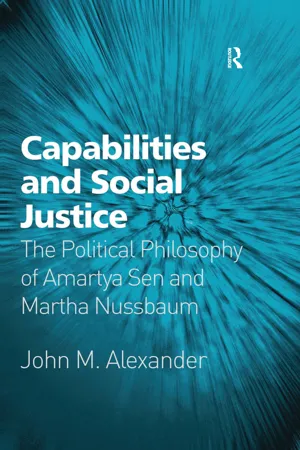
Capabilities and Social Justice
The Political Philosophy of Amartya Sen and Martha Nussbaum
- 200 pages
- English
- ePUB (mobile friendly)
- Available on iOS & Android
eBook - ePub
Capabilities and Social Justice
The Political Philosophy of Amartya Sen and Martha Nussbaum
About this book
The capability approach to social justice construes a person's well-being in terms of the substantive freedoms people value. John Alexander engages with the rapidly growing body of literature on the capability approach in economics, inequality, poverty measurement and development studies. Critically assessing Sen and Nussbaum's work in normative economics, social ethics and political philosophy, Alexander develops a unified vision of the capability approach embodying the ideal of creating the greatest possible condition for the realization of basic capabilities for all. He then assesses this vision as a political theory arguing that capabilities are necessary but not sufficient for overcoming conditions of domination. The book calls for a more intimate relationship between individual liberty and the freedom of the political community as a whole.
Information
PART I
The Capability Approach in Perspective
Chapter 1
Sen's Critique of Utilitarianism
Considerable evidence suggests that if we use an increase in our incomes, as many of us do, simply to buy bigger houses and more expensive cars, then we do not end up any happier than before. But if we use an increase in our incomes to buy more of certain inconspicuous goods – such as freedom from a long commute or a stressful job – then the evidence paints a different picture. The less we spend on conspicuous goods, the better we can afford to alleviate congestion; and the more time we can devote to family and friends, to exercise and sleep, travel and other restorative activities. On the best available evidence, reallocating our time and money in these and other similar ways would result in healthier, longer – and happier – lives.
Robert H. Frank, 'How Not to Buy Happiness'
How can you measure Progress if you don't know what it costs and who has paid for it? How can the 'market' put a price on things – food, clothes, electricity, running water – when it doesn't take into account the real cost of production?
Arundhati Roy, The Algebra of Infinite Justice
From the late eighteenth century, utilitarianism has been a prominent moral theory particularly in the sphere of public philosophy, even though some of its defenders have advocated it as a comprehensive theory suitable both for personal and public morality. The main intention of these theorists was to search for a single criterion or principle based on which individual actions as well as social policies and institutions can be evaluated. There are different varieties of utilitarianism depending on whether one takes utility to be some psychological states of pleasure or happiness, or whether one takes utility to be the satisfaction of 'actual' or 'rational' preferences. Nonetheless the fundamental tenet of utilitarianism is that one should do whatever maximizes total or average utility. Sen has often developed the theoretical foundations of the capability approach in response to the limitations of the various forms of utilitarianism and envisages a capabilities-based understanding of justice as an alternative non-utilitarian approach.
One of Sen's crucial objections to utilitarianism is that it is a subjective approach to well-being which requires us to maximize utility or welfare construed as pleasure, happiness or preference-satisfaction. Sen does not advocate a dictatorial or paternalistic approach by which governments, policymakers and interested third parties would pursue or promote people's well-being against their own will and consent. Yet he thinks that an approach to social justice should search for certain non-subjective criteria as die basis for claims of justice. Sen's critique of utilitarianism, as discussed in what follows, shares a number of common features with those of Rawls, Dworkin, Williams. Elster and Scanlon. However, Sen also takes up issues with different forms of utilitarianism with applying his own unique economic and philosophical insights and viewpoints. While some of them are reminiscent of Aristotle's admonition of hedonism, others try to revive Adam Smith's appreciation for the complexity of moral sentiments and human motivations. Sen's (1980) criticism has generally made use of two lines of approach. The first one, which Sen calls the 'prior-principle critique', consists in appealing to general principles such as freedom, human rights, equity and commitment which at a more fundamental level conflict with the principle of utility. The second one known as the 'case-implication critique' exposes the inconsistencies present in various forms of utilitarianism by constructing examples of special cases that counter-check our moral intuitions. Moreover, Sen finds the consequentialist ethics (§1.2) espoused by utilitarianism and the anthropological vision of homo economicus (§1.3) underlying the standard economic explanation of motivation and rationality to be reductionist.
1.1 Forms of Utilitarianism
a) Hedonism
Jeremy Bentham (1748–1832), generally considered the father of utilitarianism, advocated that 'the greatest happiness of the greatest number' should be the criterion of assessment for social policies and individual actions. By this he meant that the sum total of human happiness should be made as large as possible over the long run. Furthermore, he construed 'happiness' in terms of mental states of pleasure and pain: a life is said to be going well to the extent it contained a balance of pleasurable sensations over painful ones (Bentham 1970). Bentham envisaged utilitarianism to be a 'democratic' theory in the sense that everyone a priori should be treated as equally important: 'everybody is to count for one. and nobody for more than one'. This principle implies that each person's interests and preferences should be given equal consideration and that no one has the right to either change them, or in instances of social choices, assign them more or less weight than those of others. It is important to note that Bentham conceived of the utilitarian criterion of maximizing happiness as a rival to individual rights as the criterion of social justice. According to Bentham, positive rights specified by the existing legislations and institutions might either be a hindrance or helpful to the maximization of utility and hence, the worth of individual rights (including moral and human rights) should be judged according to the standard of utility.
From the standpoint of Sen's capability approach, the Benthamite utilitarianism is a hedonistic view of human well-being. There is indeed something attractive about the idea that individuals should pursue happiness and avoid pain and suffering. Perhaps this is the reason why utilitarianism has for so long remained an appealing theory in public philosophy. But to reduce happiness to psychological states of pleasurable sensations and to advocate pleasure as the sole criterion of well-being is problematic. It is nothing other than inadequate judgement to assess people's quality of life purely on the basis of their feelings of pleasure. Pleasurable sensation cannot be the only good that people seek in life. There are many other things that people find valuable to pursue even when they involve considerable discomfort and pain. Therefore, as an alternative approach it seems more appropriate to evaluate people's lives on the basis of different and heterogeneous 'doings' and 'beings' which Sen technically calls 'functionings' such as nutrition, health, education, social recognition and political participation. These functionings may contribute to different mental states including pleasure and happiness, but nevertheless they are quite distinct from the psychological sensations they induce.
Moreover, when we apply Sen's prior-principle critique, the hedonistic species of utilitarianism turns out to be a false egalitarian doctrine for it assumes that persons are nothing but a sum of their pleasure. As an implication of the utilitarian maxim 'everybody is to count for one. nobody for more than one', it is true that every person is treated as equal or of equal worth irrespective of whether one is a man or woman. Muslim or Christian, black or white. But this is in effect not an equal treatment because the items of worth or elements of value are not persons as such, but rather experiences of pleasure or satisfaction which persons have. Even though from a moral point of view people's interests matter equally, it does not follow that the best way of giving form to that idea is to give the desire of each person the same weight without regard for the 'content' of those desires and the impact they are likely to have on others (Hart 1979: 829–830; Kymlicka 1990: 26). If people get pleasure from inflicting harm on others, should that be counted? As Sen insists, egalitarian judgements should take into account not just utility information concerning people's pleasurable experiences, but whether they conflict with non-utility factors such as people's human rights and commitments. Also, from the case-implication point of view, Sen (1997a: 16–20) finds utilitarianism to be morally counter-intuitive. He considers the example of a handicapped person who needs extra money to be mobile and another person, a pleasure-wizard, who derives a great deal of satisfaction from every dollar that he is able to spend. Equalizing marginal utility between the two requires giving more money to the latter and less to the really needy, the handicapped person.
The philosophical basis for Sen's criticism of hedonism and his proposal to view human well-being in terms of what people are actually able to do and be can be embedded in a long tradition going back to Aristotle, whereby 'pleasure' was to be distinguished from 'happiness'. As sketched out in his Ethics. Book I, for Aristotle happiness (eudaimonia) consists in pursuing worthwhile activities of excellence and character rather than pleasurable amusements. He also argued that these valuable activities are varied and plural: art and science, love and friendship, ethical and political excellence and so on. Aristotle never suggests that pleasure is something bad or something that should be avoided. What he uncompromisingly rejects is the identification of happiness with a life of pleasure. Pleasure, he believed, is something that usually accompanies an unobstructed performance and accomplishment of the activities that constitute happiness. A life of pure pleasure, for Aristotle, is something meant for cattle and not for human beings (Ethics I, 5: 68).1 As Arendt (1958: 175ff.) has illuminatingly demonstrated, not only for Aristotle, but generally in the Greek tradition, it was common to make a distinction between praxis and poiesis, between action and work. For the Greeks, action was superior to just fabrication of things for use and consumption. The former belongs to the sphere of freedom because through action and speech, argument and discussion people can participate in the public realm both as equals to others and at the same time distinguish themselves from others by creativity and excellence. The latter belongs to the sphere of necessity and routine where the producer often has to conform and cater to the tastes of the consumer. In the Greek paradigm then, it is not the one who produces the violin, but the one who plays it who appreciates its real worth. Hedonism is, in a way, incapable of making this distinction because it regards the relation between actions and happiness as cause to effect: actions do not have an intrinsic importance and independent value; they are instrumentally valued in function of experiences they produce.
b) Utilitarian Liberalism
John Stuart Mill (1806–1873) is a more complex philosopher than other utilitarian thinkers. He professes allegiance to utilitarianism as well as to liberal values, both vying with each other for equal consideration. Mill holds an important place in moral philosophy not because he suggested a non-utilitarian approach to public philosophy, in fact he remained a strong advocate of utilitarianism, but because his philosophy genuinely exhibits the tension of having to be a utilitarian and liberal at the same time (Lyons 1977; Annas 1977). Mill refines and broadens the content of utility: 'I regard utility as the ultimate appeal on all ethical questions; but it must be utility in the largest sense, grounded on the permanent interests of man as a progressive being' (Mill 1995: 81). Accordingly, Mill's conception of happiness includes not merely 'quantitative' but also 'qualitative' experiences and associates happiness with 'self-development'. A happy person, according to Mill, is one who refines his tastes, increases his sympathies and pays close attention to his character and standards of excellence. In this sense Mill, in his definition of happiness, is much closer to Aristotle than to his utilitarian guru Bentham.
Furthermore, on the societal level, Mill advances a number of liberal tenets. In On Liberty (1995), he advocates anti-paternalism as a general social policy and argues for the 'liberty principle', namely the only good reason to restrict an adult individual's liberty is to prevent harm to others. In his writings on political economy (Mill 1965), he favours economic competition and free exchange, but he also envisages a role for the state in providing public goods, which otherwise would not be provided by an unregulated capitalist economy. In his political writings (Mill 1974a; 1980), he defends equal rights for women and argues for representative democracy with universal suffrage, although qualified by a sort of plural ballot scheme that gives extra votes to better educated voters. However, Mill (1974b) holds the view that these various liberal claims are consistent with the general aim of utilitarianism in the sense that more utility would be generated and maximum happiness can be achieved by adherence to these liberal principles.
Mill's justification of democratic rights on grounds of utilitarianism has provoked the criticism that individual rights such as citizenship, the right to vote, free speech, and political participation are simple demands of justice which have their own intrinsic importance regardless of whether or not they would favourably contribute to general welfare. A firm commitment to individual rights, as Mill claims, need not always be consistent with the recommendation to undertake actions or policies that would maximize the sum of happiness. In this regard, as some feminist thinkers point out. Mill's support for the liberation of women embodies a confused mixture of a 'reformist approach' founded on utilitarian concerns and a 'radical approach' which upholds women's equality on its own terms (Annas 1977). Entrenched unfairness and inequalities against women cannot be overcome by an approach that takes people's (women's as well as men's) preferences as they are and then suggest changes that would merely produce the maximum satisfaction of desires. On the contrary, we require a non-utilitarian approach that not only takes existing preferences, attitudes and institutions as part of the problem, but also envisages circumstances of equality where women, just like men, would be respected as sources of certain inviolable claims.2
Sen's own views on the intrinsic value of liberal and democratic rights (more fully discussed in Chapter 7) are an important corrective to those of Mill which try to justify such rights on utilitarian grounds of maximizing social utility. Sen advocates the idea that democracy - understood both in a fundamental sense of free and fair elections, a functioning democratic government, vibrant opposition parties, free and critical press, etc and in a broader sense of public reasoning and discussion – positively contributes towards many socially desirable goals such as overcoming famines and achieving equity. But democratic rights do not only have derivative importance in terms of what they contribute to social goals, but rather they have their intrinsic importance. Democratic rights are non-negotiable claims which cannot be subjected to the calculation of utility maximization.
c) Actual and Rational Preferences
Unlike Bentham or Mill, modern utilitarians do not characterize utility as experiences of pleasure or happiness, but as satisfaction of preferences. Preference theories, as distinguished from experiential or desire theories inspired by Bentham or Mill, hold
the view that the quality of a person's life can be assessed to be good or bad to the extent that a person's preferences are satisfied (Scanlon 2000: 113; Parfit 1984: 493). Preferences are said to be 'revealed' either in actions people perform or in the choices they make (Sen 2002a: 121–157). Some of people's preferences might be 'personal' in the sense of what people want pertaining to their own life's goals and ambitions. Others, however, might be ' social' or 'political' in the sense of what people wish with regard to others, their community or environment at large (Dworkin 2000: 11ff.).
Sen's key objection to a preference-satisfaction view is the problem of adaptive preferences. Preferences are often formed by the circumstances in which people grow and are socialized; they are conditioned and shaped by the law and institutions under which people live. Sen directs his attention particularly to people who live in deprived conditions.
The problem is particularly acute in the context of entrenched inequalities and deprivations. A thoroughly deprived person, leading a very reduced life, might not appear to be badly off in terms of the mental metric of desire and its fulfilment, if the hardship is accepted with non-grumbling resignation. In situations of long-standing deprivation, the victims do not go on grieving and lamenting all the time, and very often make great efforts to take pleasure in small mercies and to cut down personal desires to modest – 'realistic' – proportions ... The extent of a person's deprivation, then, may not at all show up in the metric of desire-fulfilment, even though he or she may be quite unable to be adequately nourished, decently clothed, minimally educated and properly sheltered. (Sen 1992: 55)
The types of people that Sen has in mind are battered housewives, bonded labourers, oppressed minorities, exploited immigrants, and so on (Sen 1999a: 62–63). Because these people have to endure situations of severe deprivation, and often do not see an immediate way out of their misery, they tend to adjust their preferences to what is seen as feasible. Elster (1982) has used the metaphor of 'sour grapes' to describe this phenomenon, precisely because people in such conditions spurn what is beyond their reach, similar to the fox which judged the unobtainable grapes to be sour. In severely harsh or coercive situations, people's perceptions and desires about their well-being are just too malleable to be reliable guides in assessing their quality of life. Even though their lives might 'objectively' lack some basic functionings such as adequate nutrition, literacy, good health and f...
Table of contents
- Cover
- Half Title
- Title
- Copyright
- Dedication
- Contents
- Acknowledgements
- Introduction
- Part I The Capability Approach in Perspective
- Part II Capabilities, Morality and Politics
- Bibliography
- Index
Trusted by 375,005 students
Access to over 1.5 million titles for a fair monthly price.
Study more efficiently using our study tools.
Frequently asked questions
Yes, you can cancel anytime from the Subscription tab in your account settings on the Perlego website. Your subscription will stay active until the end of your current billing period. Learn how to cancel your subscription
No, books cannot be downloaded as external files, such as PDFs, for use outside of Perlego. However, you can download books within the Perlego app for offline reading on mobile or tablet. Learn how to download books offline
Perlego offers two plans: Essential and Complete
- Essential is ideal for learners and professionals who enjoy exploring a wide range of subjects. Access the Essential Library with 800,000+ trusted titles and best-sellers across business, personal growth, and the humanities. Includes unlimited reading time and Standard Read Aloud voice.
- Complete: Perfect for advanced learners and researchers needing full, unrestricted access. Unlock 1.5M+ books across hundreds of subjects, including academic and specialized titles. The Complete Plan also includes advanced features like Premium Read Aloud and Research Assistant.
We are an online textbook subscription service, where you can get access to an entire online library for less than the price of a single book per month. With over 1.5 million books across 990+ topics, we’ve got you covered! Learn about our mission
Look out for the read-aloud symbol on your next book to see if you can listen to it. The read-aloud tool reads text aloud for you, highlighting the text as it is being read. You can pause it, speed it up and slow it down. Learn more about Read Aloud
Yes! You can use the Perlego app on both iOS and Android devices to read anytime, anywhere — even offline. Perfect for commutes or when you’re on the go.
Please note we cannot support devices running on iOS 13 and Android 7 or earlier. Learn more about using the app
Please note we cannot support devices running on iOS 13 and Android 7 or earlier. Learn more about using the app
Yes, you can access Capabilities and Social Justice by John M. Alexander in PDF and/or ePUB format, as well as other popular books in Philosophy & Philosophy History & Theory. We have over 1.5 million books available in our catalogue for you to explore.