eBook - ePub
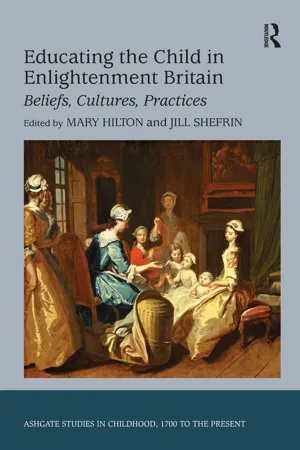
Educating the Child in Enlightenment Britain
Beliefs, Cultures, Practices
- 254 pages
- English
- ePUB (mobile friendly)
- Available on iOS & Android
eBook - ePub
Educating the Child in Enlightenment Britain
Beliefs, Cultures, Practices
About this book
Posing a challenge to more traditional approaches to the history of education, this interdisciplinary collection examines the complex web of beliefs and methods by which culture was transmitted to young people in the long eighteenth century. Expanding the definition of education exposes the shaky ground on which some historical assumptions rest. For example, studying conventional pedagogical texts and practices used for girls' home education alongside evidence gleaned from women's diaries and letters suggests domestic settings were the loci for far more rigorous intellectual training than has previously been acknowledged. Contributors cast a wide net, engaging with debates between private and public education, the educational agenda of Hannah More, women schoolteachers, the role of diplomats in educating boys embarked on the Grand Tour, English Jesuit education, eighteenth-century print culture and education in Ireland, the role of the print trades in the use of teaching aids in early nineteenth-century infant school classrooms, and the rhetoric and reality of children's book use. Taken together, the essays are an inspiring foray into the rich variety of educational activities in Britain, the multitude of cultural and social contexts in which young people were educated, and the extent of the differences between principle and practice throughout the period.
Information
Chapter 1
‘Oh Miserable and Most Ruinous Measure’: The Debate between Private and Public Education in Britain, 1760-1800
Sophia Woodley
Writing to his cousm Lady Hesketh in 1786, the poet William Cowper described the practice of sending boys to school as a 'miserable and most ruinous measure'.1 He went 011 to say that 'parents certainly pursue it only because they want to get rid of their Little ones and know not where else to dispose of them. I am no father, yet does my heart tell me that had I... any children, I had rather see them dead than so manage them.'2 Although Cowper's feelings were unusually vehement, he was far from being an isolated voice. Private education in the late eighteenth century represented a vibrant alternative educational tradition with its own discourse and culture. It remained the default choice for girls up until the end of the century and was a significant and widely accepted option for the education of boys.3
Given new life by the writings of Rousseau – whose Emile raised fundamental issues about the relationship between the child and society, as well as more practical questions of method – educational theory in the late eighteenth century was structured as a battleground between two distinct kinds of education, public and private, which revealed radically different assumptions about human nature and the nature of society. Did schools teach virtue or vice? Did children flourish under authority or liberty? Were children naturally good, or did they need to be taught goodness? In viewing schools as microcosms of society as a whole, both radical and evangelical writers placed their opposition to public education within the context of their criticisms of society as it was currently constituted. Thus, the public/private debate had relevance beyond the narrowly pedagogical; it served as a site where major philosophical and political issues of the day could be contested. Up to the 1780s, this debate primarily concerned the education of boys, as the place of girls was generally agreed to be in the home.4 yet much of its rhetoric was permeated by gendered ideas and arguments.
in modern terms, the debate could be described as concerning the value of home schooling. The term, however, is a recent coinage; even the self-explanatory ‘home education’ was not widely used until the 1820s or 1830s. Instead, the debate was framed in terms of ‘public education’ versus ‘private education’. In the eighteenth century, the great divide was not between state and private schools – there being, of course, no state system – but between a public education (being educated with other children in school) and a private education (being educated at home). The strength of this distinction was such that even today, the great boarding schools such as Eton and Harrow are still described as ‘public schools’ – a fact which demonstrates the enduring power of the debate which so preoccupied eighteenth-century educationalists.
In the eighteenth century, however, this terminology was far from uncontested. In practice, the boundaries between public and private education were notably hazy – very small family-run girls’ schools and small tutorial establishments for boys came close to bridging the gap entirely.5 the term ‘public education’, though most strictly referring to the great public schools, was easily elided with the idea of education in public – that is, school education. Thus, ‘public education’ was used on occasion to refer to girls’ boarding schools,6 as well as to both great public schools and ‘those numerous private schools, which under a smaller scale pursue the same system.’7 it was in the interest of supporters of private education to construct the terminology, and hence the debate, in binary terms. By taking advantage of the lack of a specific term for smaller privately-run schools, they could frame their arguments against public education specifically in terms of the widely-acknowledged flaws of large boarding schools. In this chapter, I will frame the debate in traditional private/public terms, but will take care to clarify the senses in which the authors used them.
the debate concerning the relative value of home and school education has a long pedigree in Britain. A recognizable and coherent philosophical discourse on the subject stretches as far back as the seventeenth century. In particular, the arguments of John locke in Some Thoughts Concerning Education (1693) retained significant influence; due to their continuing relevance, they were discussed and debated actively for the better part of a century.8 Many of Locke’s ideas filtered down to later authors, often unattributed, and became part of a general consensus among supporters of home education.
While Locke stressed the importance of disciplining the wills of young children, he also placed an emphasis on self-directed learning which was unusual for the educational theory of the day.
We naturally, as I have said, even from our Cradles, love Liberty, and have therefore an aversion to many Things, for no other Reason, but because they are injoyn’d us. I have always had a Fancy, that Learning might be made a Play and Recreation to Children; and that they might be brought to desire to be taught, if it were propos’d to them as a thing of honour, credit, delight, and recreation, or as a Reward for doing something else; and if they were never chid or corrected for the neglect of it.9
Like later radical authors, Locke believed that liberty was as essential in the governance of children as in the governance of nations. He counselled that children should be taught when they were most receptive to learning, an approach which required careful attention to an individual child’s ‘Seasons of Aptitude and Inclination.’10
Locke’s support for private education derived fundamentally from his belief that the first priority of education was the teaching of virtue. He felt that knowledge of the classical languages was valued more in public schools than was the moral development of the child.11 ‘y ou have a strange taste for words,’ he commented, ‘when... you think it worthwhile to hazard your son’s Innocence and Vertue, for a little Greek and Latin.’12 for locke education was a multifaceted process, taking place both through a formal curriculum and through the context of a child’s upbringing. Public schools, with their morally corrupting atmosphere and their championing of a classical education which relied heavily on the use of the rod, fell short in terms of both aims and method.
Locke acknowledged that there were advantages for boys in public education. Chief among these was the experience and knowledge of life that schools provided, making boys more confident in society and more ready to take their eventual place in the world. While questioning some of the assumptions behind this widely-held belief, he argued that the advantages of private education outweighed any possible benefit from schooling.
Vertue is harder to be got, than a knowledge of the World; and if lost in a Young Man is seldom recovered. Sheepishness and ignorance of the World, the faults imputed to a private Education, are neither the necessary consequents of being bred at home, nor if they were, are they incurable Evils. Vice is the more stubborn, as well as the more dangerous Evil of the two; and therefore, in the first place, to be fenced against.13
He did not believe that public education represented a necessary part of a young man’s training in masculinity; indeed, he turned to beliefs about female education in order to justify his views on the value of home training for boys. ‘Nor does anyone find, or so much as suspect,’ he noted, ‘that that Retirement and Bashfulness, which their daughters are brought up in, make them less knowing or less able Women.’14
Seventy years after the publication of Some Thoughts Concerning Education, discussion of educational theory was given new life by Jean-Jacques Rousseau’s highly controversial Emile. Published in 1762, it was translated into English in the same year – a sign of the interest it provoked. While Emile ostensibly dealt with educational issues, it was in fact a work of political philosophy, best understood in conjunction with Rousseau’s Social Contract (also published in 1762). In turning his attention to education, rousseau made it into another strand in his criticism of modern society. ‘God makes all things good,’ he commented in the opening to Emile, ‘man meddles with them and they become evil.’15
Rousseau’s ideal education aimed to create a natural child, freed from the corruption and artifice of society and from the ‘crushing force of social conventions’.16 While Rousseau intentionally avoided engaging with current educational debates, he did not need to emphasize the impossibility of a school providing such an education as he envisioned. ‘Good social institutions,’ Rousseau argued, ‘are those best fitted to make a man unnatural, to exchange his independence for dependence, to merge the unit in the group.’17 Thus, his system of education was not institutional; on the contrary, it focused completely upon the individual. Emile, his fictional pupil, was to be separated entirely from society and educated exclusively by a single young tutor, who would commit to staying by Emile’s side for the twenty-five years that it would take him to grow into adulthood.
One of the most distinctive aspects of the system recommended in Emile was its emphasis on negative education. Rousseau’s belief, innovative for ...
Table of contents
- Cover
- Half Title
- Title
- Copyright
- Contents
- Notes on Contributors
- Introduction
- 1 'Oh Miserable and Most Ruinous Measure': The Debate between Private and Public Education in Britain, 1760-1800
- 2 Evangelicalism and Enlightenment: The Educational Agenda of Hannah More
- 3 Marketing Religious Identity: Female Educators, Methodist Culture, and Eighteenth-Century Childhood
- 4 Learning and Virtue: English Grammar and the Eighteenth-Century Girls' School
- 5 'Familiar Conversation': The Role of the 'Familiar Format' in Education in Eighteenth- and Nineteenth-Century England
- 6 Hosting the Grand Tour: Civility, Enlightenment and Culture, c. 1740-1790
- 7 'Superior to the Rudest Shocks of Adversity': English Jesuit Education and Culture in the Long Eighteenth Century, 1688-1832
- 8 Colonizing the Mind: The Use of English Writers in the Education of the Irish Poor, c. 1750-1850
- 9 'Adapted for and Used in Infants' Schools, Nurseries, &c.': Booksellers and the Infant School Market
- 10 Delightful Instruction? Assessing Children's Use of Educational Books in the Long Eighteenth Century
- Bibliography
- Index
Trusted by 375,005 students
Access to over 1.5 million titles for a fair monthly price.
Study more efficiently using our study tools.
Frequently asked questions
Yes, you can cancel anytime from the Subscription tab in your account settings on the Perlego website. Your subscription will stay active until the end of your current billing period. Learn how to cancel your subscription
No, books cannot be downloaded as external files, such as PDFs, for use outside of Perlego. However, you can download books within the Perlego app for offline reading on mobile or tablet. Learn how to download books offline
Perlego offers two plans: Essential and Complete
- Essential is ideal for learners and professionals who enjoy exploring a wide range of subjects. Access the Essential Library with 800,000+ trusted titles and best-sellers across business, personal growth, and the humanities. Includes unlimited reading time and Standard Read Aloud voice.
- Complete: Perfect for advanced learners and researchers needing full, unrestricted access. Unlock 1.5M+ books across hundreds of subjects, including academic and specialized titles. The Complete Plan also includes advanced features like Premium Read Aloud and Research Assistant.
We are an online textbook subscription service, where you can get access to an entire online library for less than the price of a single book per month. With over 1.5 million books across 990+ topics, we’ve got you covered! Learn about our mission
Look out for the read-aloud symbol on your next book to see if you can listen to it. The read-aloud tool reads text aloud for you, highlighting the text as it is being read. You can pause it, speed it up and slow it down. Learn more about Read Aloud
Yes! You can use the Perlego app on both iOS and Android devices to read anytime, anywhere — even offline. Perfect for commutes or when you’re on the go.
Please note we cannot support devices running on iOS 13 and Android 7 or earlier. Learn more about using the app
Please note we cannot support devices running on iOS 13 and Android 7 or earlier. Learn more about using the app
Yes, you can access Educating the Child in Enlightenment Britain by Jill Shefrin, Mary Hilton,Jill Shefrin in PDF and/or ePUB format, as well as other popular books in Literature & Literary Criticism. We have over 1.5 million books available in our catalogue for you to explore.