- 296 pages
- English
- ePUB (mobile friendly)
- Available on iOS & Android
eBook - ePub
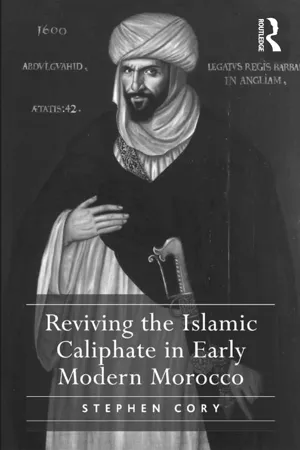
Reviving the Islamic Caliphate in Early Modern Morocco
About this book
Historians have long grappled with the question of how Islamic civilization - so clearly dominant during the medieval period - could fall completely under Western hegemony in the modern age? Many Western writers answer this question by referencing European ingenuity, initiative, and transformative energy in contrast with Islamic parochialism, passivity, and resistance to change. This book challenges such assumptions by studying the career of an aggressive sultan in early-modern Morocco, Mulay Ahmad al-Mansur (r. 1578-1603), who dared to take on the international super-powers of his day and sought to redraw the map of Islamic Africa. Al-Mansur is best known for launching a bold invasion across the Sahara desert to conquer the West African Songhay Empire. Most historians ascribe strictly economic motives for this assault, stating that the sultan wished to capture the prosperous gold trade that had traveled for centuries from West Africa to the Mediterranean. Dr Cory argues instead that Mulay Ahmad was pursuing more expansive goals than simply stuffing his coffers with West African gold, as evidenced by audacious claims made on his behalf in numerous panegyric texts produced by the sultan's court. Through a detailed analysis of official histories, documents and correspondence, writings by European observers, and architectural evidence, he contends that the sultan sought to establish a Western caliphate that would eclipse the Ottoman Empire. Mulay Ahmad advanced this agenda through panegyric literature, elaborate court ceremonies, grand constructions, stunning military conquests, and astute diplomacy with European powers, Ottoman officials, and sub-Saharan rulers. Such assertions of universal caliphal authority had not been seriously promoted in Islam for over three hundred years before al-Mansur's reign. Thus al-Mansur sought to move his country forward into the modern age by returning to an institution that had governed Muslim lands during the fabled golden age of the Abbasid and Andalusian Umayyad caliphates. Through an investigation of the sultan's ambitions and achievements Dr Cory provides new insight into the history of relations between Muslim states and the West.
Chapter 1
The Revival of the Western Caliphate
The Significance of Aḥmad Al-Manṣūr
There is no disputing the importance of the sixteenth century for understanding the foundations of the modern age.1 However, the value of studying Morocco during this era could be questioned. After all, Fernand Braudel’s masterful synthesis of the sixteenth-century Mediterranean world provides hardly a glance at Morocco. Marshall Hodgson’s comprehensive three-volume work on Islamic civilization, The Venture of Islam, devotes barely a paragraph to the sixteenth-century Moroccan Sa`dī state. Although the Ottoman dynasty had ongoing interactions with the Sa`dīs throughout the second half of the sixteenth century, most Ottoman historians, as well as modern historians who write about the Ottoman Empire, scarcely mention Morocco. In the same way, Gülru Necipoğlu, in her thorough study of the Topkapı Palace during the fifteenth and sixteenth centuries, compares the Turkish palace and court ceremonial with those of Europe, Safavid Iran, and Moghul India, but never refers to Aḥmad al-Manṣūr’s Badī` palace in Marrakesh.2 Given this situation, it is fair to question the scholarly impact of a book devoted to considering how a late sixteenth-century Sa`dī monarch legitimized his reign. Morocco’s usefulness as a site for anthropologic studies has been amply demonstrated.3 But Moroccan history? As a European historian once asked me in a job interview, “Has anything been published in English recently on Moroccan history?”4
And yet, our modern Western perspective on Morocco’s significance may not accurately represent the importance that contemporaries placed upon the Sa`dī state. For instance, at the height of Ottoman power, Süleyman the Magnificent considered the Sa`dī sultan Muḥammad al-Shaykh to be such a threat that he ordered operatives to assassinate him. The sixteenth-century Ottoman historian Muṣṭafā al-Janābῑ believed that the Sa`dīs merited a chapter in his most important work, even though the reigning Sa`dī sultan, Aḥmad al-Manṣūr, would later contest the manner in which his dynasty’s history was represented. The gifts that foreign potentates showered upon al-Manṣūr after his victory in the Battle of Wādī al-Makhāzin show that these countries considered Morocco to be an important player in contemporary international politics. In addition, the ongoing diplomatic attention shown to Morocco by Spain, England, France Netherlands, and other European countries makes the same point.
Beyond the opinions of contemporary historians and potentates, Mūlāy Aḥmad al-Manṣūr’s reign presents insights into compelling issues that face the modern Middle East. For instance, the issue of authoritarianism is important in the Middle East, especially given the failure of democracy to prosper in this region. Morocco represents a case of enduring authoritarianism par excellence. The current Moroccan dynasty is the sole Middle Eastern government to survive the colonial period intact, and it traces its form of political legitimacy back to the sixteenth century Sa`dī state. A study of Aḥmad al-Manṣūr’s approach to legitimizing his state is extremely relevant for examining the roots of authoritarianism in the Middle East and North Africa.
In addition, there is the question that Hodgson and others have struggled with: how is it that Islamic civilization, clearly dominant during the medieval period, could fall so completely under the hegemony of the West during the modern age? A number of studies have examined this question in reference to the Ottoman Empire. However, not as much research has been devoted to considering this transition in the Arab world. This is most likely due to the fact that many historians view the Arab states as being subsumed within Ottoman domains from the sixteenth century onwards. And yet, despite the Turkish conquest of Syria, the Ḥijāz, Egypt, and most of North Africa, Morocco did not succumb to Ottoman domination. The history of the Sa`dī dynasty sheds new light upon this question of Europe’s colonial triumph over the Islamic world.
This book presents a study of how an Early Modern sultan deployed important elements of traditional Islamic ideology to enhance his political legitimacy within the context of the emergent modern world. Issues of legitimacy were especially important to centralizing Early Modern regimes, including the Sa`dī dynasty. Aḥmad al-Manṣūr, the greatest of the Sa`dī sultans, ruled Morocco from 986/1578 to 1012/1603. His reign is frequently remembered as a golden age in Moroccan history. Al-Manṣūr is best known for attempting to expand his influence through a bold invasion, across the Sahara desert, of the Muslim West African Songhay Empire. Most scholarly literature ascribes strictly economic motives for this invasion, citing the prosperous gold trade that had traveled for centuries from West Africa to the Mediterranean coast, along various Saharan caravan routes. The authors of these works point out that eyewitnesses believed that the invasion was motivated by greed, and that al-Manṣūr was thought to have obtained so much wealth through this conquest that he became known as “al-Dhahabī” (the Golden One).
However, I maintain that there was more to this invasion than simply al-Manṣūr’s desire to load up his treasury with West African gold. I believe that al-Manṣūr was seeking to establish a Western caliphate to rival the Ottoman Empire, the likes of which had not existed since the storied Umayyad caliphate of Córdoba in the fourth/tenth century or the Almohad caliphate of Marrakesh during the sixth/twelfth century. In fact, claims to universal caliphal authority had not been seriously promoted in Sunni Islam for more than 300 years prior to the rise of the Sa`dī dynasty. To back up such a claim, al-Manṣūr emphasized his status as a sharīf (descendent of the Prophet Muḥammad) and made use of symbolism and messianic religious imagery through the panegyric writings of court poets and historians, elaborate ceremonies, parades and rituals, an efficient and imposing army, and an ambitious building program through which he drew attention to the grandeur of his reign.
Al-Manṣūr’s caliphal aspirations account for many of his actions, including the invasion of West Africa and his attempts to convince ulama in the Arab East (under Turkish political domination at that time) of his superior claims to leadership in the Islamic world. The panegyric literature used as propaganda for this campaign called to mind great Islamic dynasties from the past, and asserted that al-Manṣūr’s reign exceeded them all. By making sharīfian and caliphal claims that challenged Ottoman supremacy, al-Manṣūr expanded upon an approach that had been used by previous Sa`dī sultans.
Religious Imagery and the Sa`dī State
The Sa`dī dynasty first arose in the early sixteenth century, largely in response to Portuguese incursions into Morocco from their fortresses along the Atlantic coast. These strongholds had been established during a period of aggressive Portuguese expansion that began with the conquest of Ceuta in 818/1415. During the century that followed this conquest, the Portuguese were able to create a series of outposts from Aṣīla in the north to Santa Cruz (modern day Agadir) in the south. At the same time, the Moroccan Marīnid dynasty was in its death throes, eventually being co-opted by its allies, the Waṭṭāsid family, who ruled from 823/1420 in the Marīnids’ name.
Despite this transition in power, the Waṭṭāsids proved to be no more successful in combating the Portuguese than the Marīnids had been. Unable to expel the Portuguese militarily, the Waṭṭāsids made deals with the foreign invaders in order to preserve their own authority in the northern part of Morocco.5 By the late ninth/fifteenth century, the southern portion of the country was under the control of various tribal leaders who acknowledged Waṭṭāsid authority in name only, while contending with each other and the Portuguese for regional control. Meanwhile, the European states of Genoa, Venice, Flanders, France, England, and Spain competed with the Portuguese for Moroccan trade, exchanging firearms and other Euro...
Table of contents
- Cover Page
- Title Page
- Copyright Page
- Contents
- List of Maps
- Chronology
- Glossary
- Foreword and Acknowledgments
- 1 The Revival of the Western Caliphate
- 2 Dealing with Dār Al-Ḥarb
- 3 Propaganda Wars: Challenging the Ottoman Empire
- 4 Expanding the Caliphate: Al-Fishtālī and the Triumphant Caliphal Armies
- 5 Symbolic Narrative: The Use of Symbolism and Imagery in the Sultan’s Self-Representation
- 6 The Plan to Reconquer Al-Andalus
- 7 The Legacy of Aḥmad Al-Manṣūr
- Bibliography
- Index
Trusted by 375,005 students
Access to over 1.5 million titles for a fair monthly price.
Study more efficiently using our study tools.
Frequently asked questions
Yes, you can cancel anytime from the Subscription tab in your account settings on the Perlego website. Your subscription will stay active until the end of your current billing period. Learn how to cancel your subscription
No, books cannot be downloaded as external files, such as PDFs, for use outside of Perlego. However, you can download books within the Perlego app for offline reading on mobile or tablet. Learn how to download books offline
We are an online textbook subscription service, where you can get access to an entire online library for less than the price of a single book per month. With over 1.5 million books across 990+ topics, we’ve got you covered! Learn about our mission
Look out for the read-aloud symbol on your next book to see if you can listen to it. The read-aloud tool reads text aloud for you, highlighting the text as it is being read. You can pause it, speed it up and slow it down. Learn more about Read Aloud
Yes! You can use the Perlego app on both iOS and Android devices to read anytime, anywhere — even offline. Perfect for commutes or when you’re on the go.
Please note we cannot support devices running on iOS 13 and Android 7 or earlier. Learn more about using the app
Please note we cannot support devices running on iOS 13 and Android 7 or earlier. Learn more about using the app
Yes, you can access Reviving the Islamic Caliphate in Early Modern Morocco by Stephen Cory in PDF and/or ePUB format, as well as other popular books in History & Early Modern History. We have over 1.5 million books available in our catalogue for you to explore.