- 232 pages
- English
- ePUB (mobile friendly)
- Available on iOS & Android
eBook - ePub
Baptist Women's Writings in Revolutionary Culture, 1640-1680
About this book
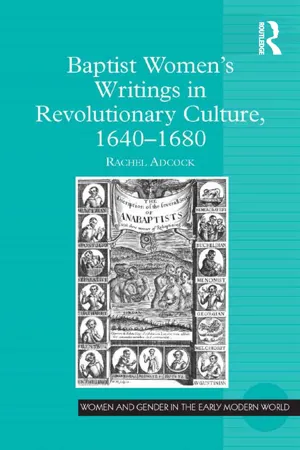
Although literary-historical studies have often focused on the range of dissenting religious groups and writers that flourished during the English Revolution, they have rarely had much to say about seventeenth-century Baptists, or, indeed, Baptist women. Baptist Women's Writings in Revolutionary Culture, 1640-1680 fills that gap, exploring how female Baptists played a crucial role in the group's formation and growth during the 1640s and 50s, by their active participation in religious and political debate, and their desire to evangelise their followers. The study significantly challenges the idea that women, as members of these congregations, were unable to write with any kind of textual authority because they were often prevented from speaking aloud in church meetings. On the contrary, Adcock shows that Baptist women found their way into print to debate points of church organisation and doctrine, to defend themselves and their congregations, to evangelise others by example and by teaching, and to prophesy, and discusses the rhetorical tactics they utilised in order to demonstrate the value of women's contributions. In the course of the study, Adcock considers and analyses the writings of little-studied Baptist women, Deborah Huish, Katherine Sutton, and Jane Turner, as well as separatist writers Sara Jones, Susanna Parr, and Anne Venn. She also makes due connection to the more familiar work of Agnes Beaumont, Anna Trapnel, and Anne Wentworth, enabling a reassessment of the significance of those writings by placing them in this wider context. Writings by these female Baptists attracted serious attention, and, as Adcock discusses, some even found a trans-national audience.
Information
Chapter 1
‘Frantique Handmaids’:
Female Baptists in the Popular Imagination
Joining a society of Baptists was an independent choice made by many women, often, as we have seen, without the permission of their fathers, husbands, or brothers. Sectarian worship, rejecting the rituals and traditions of the established church, was a sign of disagreement and of rebellion because the Anglican Church was controlled by the state. A woman choosing to worship in this way, separating herself from both the state-controlled church and potentially her family, was then doubly rebellious, leading sensational pamphleteers to focus on sectarian women’s exploits as symptomatic of the breakdown of established religion and authority. This was a period of revolution and change in the nature and breadth of ecclesiastical control: the Civil Wars of the 1640s, the move towards Restoration and subsequent persecution of 1658–62, and after Charles II’s second Declaration of Indulgence in 1672. It is no coincidence that at this time, sensational pamphlets focusing on the rebelliousness of the sects proliferated. Such pamphlets played on contemporary anxieties: the villainous ‘Anabaptists’, as they were called, were supposedly behind insurrections and murders, and could use their devilish charm to seduce young women to their cause, baptising them naked in freezing rivers during the night. Women who easily submitted to such seductions were labelled ignorant or ‘silly’, lascivious, and disorderly, and their heretical behaviour was thought to provoke harsh judgement from God who punished them with hardships including death, illness, and madness. Many Baptist women, therefore, experienced the judgement of their friends and neighbours. Tobie Allein recorded in 1657 that he was ‘perplext to hear daily the Scoffs and Taunts wherewith some of our brethren have every where at their doors; and shops, and tables vilified’ his wife Mary, who had become a separatist and then repented, which damaged their cloth business.1 An anonymous female convert of another gathered church also addressed her Anglican relatives from her deathbed, urging them to leave off their ‘wild discourses’, where they called her conversion ‘Phrenzy’ (or mental derangement), her holy conversation ‘Phanat[ic]ism, or (which is worse) Sedition and Rebellion; and the words wherein it is held out, Canting’.2 The texts from which these accusations are taken were intended as vindications from the aspersions of the writers’ geographical and familial communities, and so this chapter will not only explore popular beliefs about the disorderly behaviour of female Baptists, but it will also show how the women themselves responded to these ideas in their writings.
An example of the cultural stereotypes that confronted Baptists, and particularly their female members, can be seen recorded in the narrative composed by twenty-two-year-old Agnes Beaumont of Edworth, Bedfordshire, who was best known for riding to a meeting on the back of John Bunyan’s horse to the horror of her father John who accordingly fell into a passion and ran after her, hoping to pull her off.3 The conflict between Agnes, as a member of John Bunyan’s congregation (made up of both baptised and non-baptised members), and her father, seems not to have been caused not by a difference of religious beliefs, but because of outside pressure from prominent members of John Beaumont’s community. Agnes wrote in her manuscript defending her behaviour, now known as The Narrative of the Persecution of Agnes Beaumont, that her father had previously heard Bunyan ‘preach gods word, & heard him with a broaken heart as he had done several others’, going to ‘meetings for a great while together’.4 However, when Agnes was first ‘awakened’, and began to examine her conscience as to whether she was indeed one of God’s elect, she experienced ‘such distress about my soul’ that caused her father to observe: ‘I thinck my daughter will be distracted, She scarce Eats, drincks, or sleeps’ (p. 209). Such behaviour, as Chapter 3 will go on to show, seems to have been common for women who undertook puritan self-examination before they came to the realisation that were not damned; but to outsiders, and especially to anxious parents, the threat of mental disorder (and even death) was a real concern.5 Agnes observed that following these events an ‘evil minded man in the town would set [her father] against these meetings’ by urging him: ‘Have you lived to these years to be led away with them? These be they that lead silly women Captive into houses, and for pretence make long prayers’ (p. 209). It was these words, as Agnes’s father told her later, that caused him to be ‘censed’, to bar her from his home when she returned from the meeting, leading her to sleep in a barn, and him to threaten to disinherit her: he was persuaded that Bunyan had captivated his daughter (as the false preachers captivating ‘silly women’ recorded in 2 Timothy 3:6) by his engaging speeches, and had encouraged her to disobey her father’s authority. Tellingly, when Agnes tried to gain access to her house again, her father called her ‘hussif’ (p. 204), a name that could mean both ‘housewife’ and ‘whore’: she was to choose whether she would remain a housewife under the domestic control of her father, or reject that control and be a whore.
Beaumont’s narrative depicts the repercussions of this kind of defamation, both for her reputation in her geographical community (and also her church community), and also for her relationship with her father. When she accepted a ride on the back of Bunyan’s horse to the church meeting taking place at Gamlingay on Friday 13 February 1674, she was unprepared for the rumours witnesses would circulate: as she wrote afterwards, ‘My heart was pufft up with pride, [ … ]; and I was pleasd that any body did look after me as I rode A long’ (p. 197). However, one person who witnessed their journey, a clergyman called Mr Lane who was eager to discredit John Bunyan as a dissenting minister, ‘staird his Eyes Out; and afterward did scandalise us after a base manner, and did raise a very wicked report of us, which was altogether false’ (p. 198). He circulated the rumour at Baldock Fair that ‘at the towns End’, the couple were ‘naught together’, accusing them of sexual misconduct (p. 214). Bunyan added several paragraphs to the fifth edition of his own spiritual testimony, Grace Abounding, published in 1680, which appears to be responding to accusations such as these: ‘It began therefore to be rumored up and down among the People that I was a Witch, [ … ]. But that which was reported with the boldest confidence, was, that I had my Misses, my Whores, my Bastards.’6 However, while Bunyan could say that he bound ‘these lies and slanders to me as an ornament’, as it belonged to his ‘Christian Profession to be vilified’ as Christ was, Agnes’s reputation was to prove more difficult to salvage. Four days later, after father and daughter had made peace with one another, John Beaumont died of a heart condition that took him suddenly in the night. When friends and neighbours were alerted to events, a neighbouring lawyer Mr Feery accused Beaumont of poisoning her father with the help of Bunyan, despite the her father’s age: Patricia L. Bell has shown that John Beaumont was likely to have been ‘about seventy years old’ and near his time.7 As Bernard Capp acknowledges, however, ‘if a woman enjoyed a good reputation and the allegations appeared ill-founded or malicious, she might have little to fear’, but Agnes’s reputation was already fragile: she was a member of a Baptist congregation, she had been observed as ‘distracted’, and had also recently argued with her father over her relationship with Bunyan.8 Patricide was a crime against a superior and regarded as petty-treason because it re-enacted the monarch and subject relationship: the penalty was to be burnt at the stake. Fortunately Agnes was not found guilty, despite Mr Feery’s attempts to incriminate her, and she described her trials as ‘afflicting dispensations’, drawing on Psalms 119:71, showing how they made her stronger in her faith and confirmed her election.
Cultural stereotypes of the Baptists appear to have been at the heart of Feery’s accusations. Bell’s research, for instance, shows that Feery’s design was to match his own son, Thomas, to Agnes, encouraging Agnes’s father to leave her more money than her sister in his will so that his son could benefit, and that this was then thwarted when she began to attend Baptist meetings, eventually joining them in fellowship.9 As Agnes wrote, ‘He put my father on to give me more then my sister because of some design that he had then, but afterwards when I came to go to meetings he was turned Against me’ (p. 222): Feery clearly did not relish the thought of a Baptist for a daughter-in-law, and in revenge, after the funeral, appears to have encouraged Agnes’s brother-in-law to sue her for the money her sister had been denied. Agnes paid them £60 as a settlement. Evidently, her acquittal from all charges did not do enough to clear her reputation. Agnes was also plagued by rumours that she heard were circulating at Bigglesworth market, that she had ‘Confest that I had poysoned my father, and that I was quite distracted’ (p. 223), suffering madness as a result of sins. ‘A lost reputation’, Capp writes, ‘brought notoriety across an area that might extend ten miles or more from the point of origin’.10 In response, then, Agnes travelled to Bigglesworth market, equidistant from Edworth, Gamlingay, and Baldock, to show that she was in her right mind, recording that ‘all the Eyes of the market was fixt upon me’ (p. 223). Later, in summer 1675, not content with meddling in Agnes’s finances, Feery also raised another rumour recorded in the later fair manuscript copy of her narrative, that she had set one of the houses in town on fire (p. 224), which indicates that Beaumont continued to face accusations of sedition because of her beliefs, even after a jury cleared her of the original charges. Scholars have suggested that damage to her reputation is why Beaumont did not marry until 1702 when she was fifty years old, and then to a fellow dissenter.11
Agnes Beaumont’s narrative was certainly written as a vindication, defending her reputation and by extension that of her congregation, from the aspersions of her enemies. What the work also shows is that contemporary fears about Baptist behaviour were deeply entrenched and could provoke extreme measures: members of Agnes’s wider community had little difficulty in believing that she was a distracted fanatic, held in the thrall of a lascivious minister, who had done away with her father to prevent him disinheriting her. Her religious beliefs caused her to quarrel with her father, to lose her marriage prospects, and nearly her life. Scholars have often noted that Beaumont’s treatment resulted from disobedience to her father, but what has been left under-discussed is how her work is evidence of popular perceptions of female Baptists, and how a woman could respond to these culturally entrenched ideas. Therefore, before looking more closely at Beaumont’s narrative strategies for dealing with these accusations, as well as those of other Baptist women writers, this chapter will explore representations of female Baptists in sensational literature from this period.
‘Nature Unnatured’: Disorderly Female Anabaptists
The vehemence with which opponents of the Baptists attacked their congregations and their female members is testament to how much their new practices were seen to resemble old European heresies brought forth in a new guise, now appearing in the heart of England. Observers of flourishing Baptist congregations in the early 1640s were mindful of their similarities with the rebellious continental Anabaptists led by Jan Bockelson (John of Leiden) who had attempted to establish a theocracy in Münster in the 1530s, hence why those outside the Baptists constantly referred to them as ‘Anabaptists’ (‘re-baptisers’). This group of male and female millenarians had violently attempted to establish a ‘New Jerusalem’ and advocated adult baptism, abolished private ownership, and practised polygamy: they turned all established traditions upside-down. What seventeenth-century studies of the Anabaptists often failed to explore was that this violent faction was part of a wider group, who were, J. F. McGregor writes, ‘pacifist in principle’ which is why they ‘regarded civil authority, dependent on the power of the sword, as irredeemably corrupt’.12 Instead, sensational histories of the Anabaptists that circulated in the early 1640s tended to concentrate on the events of Münster, devoting much discussion to how the group had gained control of the city and murdered those who refused to be converted, hoping to provoke their readers to see parallels with the upheaval of civil war. A Warning for England [ … ] in the Famous History of the Frantick Anabaptists (1642), for instance, stressed that Anabaptist ministers pretended ‘a wonderfull and more then ordinary zeale, having with great passion preached against the Popish Errors’, and that they claimed to have ‘some divine revelations, that god by dreames & Visions did reveal unto his saints his will’.13 This was certainly intended to associate Anabaptism with the extempore preaching characteristic of sectarian congregations in the 1640s. The collapse of Archbishop Laud’s Court of High Commission in 1641 allowed the proliferation of all kinds of zealous preaching: the pamphlet also tells its readers that the people ‘dayly flocked after [an Anabaptist minister] & admired him as a man divinely ...
Table of contents
- Cover Page
- Title Page
- Copyright Page
- Dedication
- Contents
- List of Figures
- Acknowledgements
- List of Abbreviations
- Note on the Text
- Introduction: ‘Virgins of Sion’: Female Baptists and Revolutionary Culture
- 1 ‘Frantique Handmaids’: Female Baptists in the Popular Imagination
- 2 ‘Valiant Deborahs’: Women’s Voices in Baptist Congregations
- 3 ‘Mothers in Israel’: Women’s Contributions to the Baptist Movement
- 4 The Woman’s Seed: Baptist Women and Fifth Monarchist Prophecy
- Conclusion
- Bibliography
- Index
Trusted by 375,005 students
Access to over 1.5 million titles for a fair monthly price.
Study more efficiently using our study tools.
Frequently asked questions
Yes, you can cancel anytime from the Subscription tab in your account settings on the Perlego website. Your subscription will stay active until the end of your current billing period. Learn how to cancel your subscription
No, books cannot be downloaded as external files, such as PDFs, for use outside of Perlego. However, you can download books within the Perlego app for offline reading on mobile or tablet. Learn how to download books offline
Perlego offers two plans: Essential and Complete
- Essential is ideal for learners and professionals who enjoy exploring a wide range of subjects. Access the Essential Library with 800,000+ trusted titles and best-sellers across business, personal growth, and the humanities. Includes unlimited reading time and Standard Read Aloud voice.
- Complete: Perfect for advanced learners and researchers needing full, unrestricted access. Unlock 1.5M+ books across hundreds of subjects, including academic and specialized titles. The Complete Plan also includes advanced features like Premium Read Aloud and Research Assistant.
We are an online textbook subscription service, where you can get access to an entire online library for less than the price of a single book per month. With over 1.5 million books across 990+ topics, we’ve got you covered! Learn about our mission
Look out for the read-aloud symbol on your next book to see if you can listen to it. The read-aloud tool reads text aloud for you, highlighting the text as it is being read. You can pause it, speed it up and slow it down. Learn more about Read Aloud
Yes! You can use the Perlego app on both iOS and Android devices to read anytime, anywhere — even offline. Perfect for commutes or when you’re on the go.
Please note we cannot support devices running on iOS 13 and Android 7 or earlier. Learn more about using the app
Please note we cannot support devices running on iOS 13 and Android 7 or earlier. Learn more about using the app
Yes, you can access Baptist Women's Writings in Revolutionary Culture, 1640-1680 by Rachel Adcock in PDF and/or ePUB format, as well as other popular books in Literature & Early Modern History. We have over 1.5 million books available in our catalogue for you to explore.