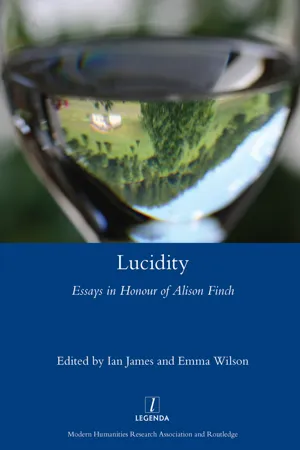
- 196 pages
- English
- ePUB (mobile friendly)
- Available on iOS & Android
eBook - ePub
About this book
This collection of essays addresses the question of lucidity as a thematic in literature and film but also as a quality of both expression and insight in literary criticism and critical thought more generally. The essays offer treatments of lucidity in itself and in relation to its opposites, forms of obscurity and darkness. They offer attention to problems of philosophical thought and reason, to questions of literary and poetic form, and of photographic and filmic contemplation. Ranging from engagements with early modern writing through to more recent material the contributions focus in particular on nineteenth- and twentieth-century French prose and poetry, the field which has been the predominant focus of Alison Finch's critical writing. They are written as tributes to the distinctively lucid insights of her work and to the breadth and clarity of its intellectual engagement.
Information
CHAPTER 1 ❖ Lucidity and Tact
DOI: 10.4324/9781315543192-2
The Petit Robert defines the adjective ‘lucid’ as that which is ‘clair’, ‘lumineux’, ‘conscient’. A lucid person is therefore someone who perceives or understands things with clarity, and a lucid mind or intelligence sees clearly, has a keenness or acuteness of vision. ‘Lucidity’ as a noun is similarly defined in terms of clarity and clairvoyance but also as a capacity of penetration or perspicacity. The lucid person is therefore not just someone who possesses clearness of vision but also someone who is able to penetrate beneath the surface of what is immediately visible and, with a certain discernment of mental perception, bring into the light of day that which was previously hidden or obscure.
Reviewing these familiar definitions of the lucid and of lucidity reminds us of the extent to which our everyday language of perception and cognition, of intelligence and knowing, is shot through with the metaphorical language of light and vision, and therefore also doubled with that of obscurity and blindness. Within the Western philosophical tradition, of course, the intimate connection between truth and light or clarity is as old as the tradition itself, as is the association of ignorance and falsity with darkness or shadow.1 One need only cite Plato’s famous allegory of the cave to pinpoint one of the key inaugural moments of such a connection and association. According to the model of cognition described by Plato’s allegory, ‘the upward journey of the soul in the region of the intelligible’ (Republic, VII. 517) is figured in terms of a passage from imprisonment in the obscure and shadowy ignorance of the sensible world towards the light and sun of the intelligible world, where the ultimate knowledge of the essential Form of Goodness is the guarantee of all intelligence and truth.2 Here the being of truth and the truth of being are inseparable from the language of luminosity and light. Similar decisive moments can easily be discerned within philosophical modernity from the early modern period onwards. Descartes’s assertion in the fifth of his Meditations on First Philosophy that ‘everything which I clearly and distinctly perceive is of necessity true’ continues and renews the association of light, clarity, and vision with certain knowledge of being, as do his references, mostly in the third and sixth Meditations, to the ‘lumen naturale’ of reason.3 Likewise Leibniz’s distinction in the essay ‘Meditations on Knowledge, Truth and Ideas’ between clear or vivid knowledge (cognitio clarus) and dim knowledge (cognitio obscurus) further renews this association and greatly influences later thinkers of the German Enlightenment such as Christian Wolff.4 Later in the modern period the goal of conceptual clarity comes to play a central and ongoing role in the development of analytic philosophy, as is borne out by Wittgenstein’s comment in the Tractatus that: ‘Everything that can be thought at all can be thought clearly. Everything that can be said can be said clearly’ (4.116).5
Yet it is arguably in the modern tradition of phenomenology that the association of light and clarity with truth, knowledge, and Being finds its apotheosis. Yet it also comes, finally, to be eclipsed.6 Phenomenology as the study of that which appears or becomes visible to consciousness is fundamentally oriented towards the visual. This is confirmed in Husserlian philosophy by the central place it gives to the first person point of view in the method of phenomenological description and the notion of ‘phenomenological seeing’. Likewise in Heidegger’s phenomenological ontology notions of ‘lighting’ or ‘clearing’ occupy a central place in his understanding of Dasein and Being. He speaks, for instance, of Dasein’s ‘luminous relation to beings’ as the ‘lucidity through which we constantly see’.7 Yet, decisively, for Heidegger, Being itself is of course never a being or a thing. It is a temporal event of the revealing, unconcealing, or illumination of things which, as an event, is nevertheless withdrawn from their visible presence such that things are never entirely manifest or fully present as such. In Heidegger, the illumination of beings or entities is always doubled with an obscurity, a concealment of that which escapes from visibility, that is to say, the temporal event of Being itself. So light and clarity in this context, rather than being figured as an emanation of the intelligible world of Ideas and Forms (Plato), is a quality of the world of sensible appearance itself, but only to the extent that it is intimately and irreducibly bound up with obscurity. Arguably the Heideggerian account of Being as revealing (illumination) and concealing (obscurity) sets the stage, within the phenomenological tradition and its French legacy, for the eclipse of the figure of light as the dominant metaphor that organizes our understanding of cognition, knowledge, and truth.
What follows will trace a particular trajectory of this eclipse of Western philosophical ‘lumino-centrism’ from Nietzsche, via Blanchot and Merleau-Ponty, through to the present day speculative philosophies ofJean-Luc Nancy and Graham Harman. It will do so in order to highlight specific ways in which touch rather than seeing or vision have taken on a fundamental ontological and epistemological role within two examples of contemporary ‘post-continental’ philosophy.8 This displacement of vision by touch has implications for our understanding of everyday knowing and perceiving. Within the contemporary philosophical contexts of post-deconstructive thought (Nancy) and speculative realism (Harman) it also has implications for our knowledge of the world of objects and things in general.
* * * * *
The world is deep and deeper than the day has ever comprehended. Not everything may be spoken in the presence of day.NIETZSCHE, Thus Spoke Zarathustra9
In L’Entretien infini [The Infinite Conversation] (1969) Maurice Blanchot interrogates the role played by the figure of light in the very foundations of epistemological thought within the European philosophical tradition. He questions Nietzsche’s remark in Also sprach Zarathustra [Thus Spoke Zarathustra] that ‘Not everything may be spoken in the presence of the day’:10
Pourquoi, dit [Nietzsche], ce rapport du jour, de la pensée et du monde? Pourquoi ce que nous disons du jour, le disons-nous avec confiance de la pensée lucide et, ainsi, croyons nous tenir le pouvoir de penser le monde? Pourquoi la lumière et le voir nous fournirait-ils tous les modes d’approche dont nous voudrions que la pensée — pour penser le monde — fût pourvue?11[Why, asks [Nietzsche], this relationship between the day, thought, and the world? Why is what we say of the day also said with confidence of lucid thought in such a way that we believe that we hold the power to think the world? Why should light and seeing offer us all the modes of approach that we would want thought to be provided with in order to think the world?]
Blanchot suggests that the metaphor of light has become primordial in our theories of knowledge and our approaches to the truth or being of the world to the extent that all knowledge has been subordinated to ‘l’exercice d’une première métaphore’ [the exercise of a primary metaphor] resulting in our collective subjection to an ‘impérialisme de la lumière’ [imperialism of light].12 Yet he also goes on to suggest that light is fundamentally duplicitous in its structure. For just as much as it makes things visible, Blanchot argues, light is itself invisible: it conceals itself in the very act of revealing things. Phenomenologically speaking, what we see, whether it be the luminescence or incandescence of light sources or the surfaces of things which reflect light, is varying intensities of brightness within the field of visibility as such. Light itself, however, is the invisible element which illuminates this field of visibility without itself appearing as a thing. This reasoning allows Blanchot to argue as follows:
La lumière efface ses traces; invisible, elle rend visible; elle garantit la connaissance directe et assure la présence pleine, tandis qu’elle se retient elle-même dans l’indirecte et se supprime comme présence. Sa tromperie serait donc de se dérober en une absence rayonnante, infiniment plus obscure qu’aucune obscurité, puisque celle qui lui est propre est l’acte même de clarté, puisque l’őuvre de lumière ne s’accomplit que là où la lumière nous fait oublier que quelque chose comme la lumière est à l’őuvre.13[Light effaces its own trace; itself invisible, it makes visible; it guarantees direct knowledge and gives assurance of full presence, whilst withholding itself in indirectness and suppressing itself as presence. Its deception lies in the way it hides itself in a radiant absence, infinitely more obscure than any obscurity, since the work of light is only accomplished in the moment that light makes us forget that something like light is at work.]
Blanchot’s language slips between a phenomenological understanding of light as the medium in which the world of appearance shows itself to us as presence, and a metaphorical language of light understood as the clarity and distinctness of certain knowledge of the world of appearances. So light, here, illuminates the world of appearances and gives immediate knowledge but does so only insofar as it conceals itself as light. This means that although the world of appearance may present itself as simple presence, directly accessible to knowledge within the light of day and through lucid perception, its truth is never to be located within the immediate visibility of that simple presence. Phenomenologically speaking, appearances are a realm of light, but the truth of their being is irreducibly bound up with a withdrawal from light into a realm of obscurity. Blanchot continues with the metaphor of the day:
Le jour est un faux jour, non pas parce qu’il y aurait un jour plus vrai, mais parce que la vérité du jour, la vérité sur le jour, est dissimulée par le jour; c’est à cette condition seulement que nous voyons clair: à condition de ne pas voir la clarté même.14[The day is a false day not because there would somewhere be a more true day, but because the truth of the day, the truth about the day, is dissimulated within the day; it is only on this condition that we can see clearly: on the condition of not being able to see clarity itself.]
So, for Blanchot, the metaphorical language of light that permeates the philosophical tradition is both imperialistic and duplicitous at the very same time. From Plato onwards, the argument might be phrased, we have relied on the figure of light as the vehicle by which truth, certitude, and knowledge will be achieved. Yet the fact that light effaces or conceals itself in the very act of illuminating a world means that the truth of light is not itself at any point illuminated but remains concealed.
There may be echoes of Heidegger’s account of Being as revealing-concealing here. Yet where, for Heidegger, the event of Being as revealing-...
Table of contents
- Cover Page
- Half Title Page
- Dedication
- Title Page
- Copyright Page
- Table of Contents
- Acknowledgements
- Notes on Contributors
- Introduction
- 1 Lucidity and Tact
- 2 ‘À propos, ou hors de propos, il n’importe’: Relevance Theory and Montaigne
- 3 Lucidity and Misrecognition in Late Corneille
- 4 Flaubert: Lucidity, Mysticism, and the Senses
- 5 Lucidity, Modernity: Mallarmé, Morisot, and Zola
- 6 Easy Reading: Zola’s Kitsch
- 7 The Fog of War: Impressionism and Zola Revisited
- 8 Baudelaire, Bonnefoy, Jeanne Duval: Poetry and Ethical Lucidity
- 9 The Peculiar Lucidities of Verse Form: Translation as an Operation of Consciousness
- 10 Marcel Proust, On and Off
- 11 Seeing Clearly into the Past: Sartre and Beauvoir at War
- 12 Nathalie Sarraute’s Domestic Spaces: Windows, Walls, and Blinding Lucidity
- 13 ‘Et la raison vacilla’: Sociality as Burden in Tahar Djaout and Mohammed Dib
- 14 ‘The open sea but not the wilderness’: Light and Clarity in the Late Work of Colette and Agnes Varda
- 15 Varda’s Hermitage: The Madonna del Parto and La Pointe Courte
- Index
Trusted by 375,005 students
Access to over 1.5 million titles for a fair monthly price.
Study more efficiently using our study tools.
Frequently asked questions
Yes, you can cancel anytime from the Subscription tab in your account settings on the Perlego website. Your subscription will stay active until the end of your current billing period. Learn how to cancel your subscription
No, books cannot be downloaded as external files, such as PDFs, for use outside of Perlego. However, you can download books within the Perlego app for offline reading on mobile or tablet. Learn how to download books offline
Perlego offers two plans: Essential and Complete
- Essential is ideal for learners and professionals who enjoy exploring a wide range of subjects. Access the Essential Library with 800,000+ trusted titles and best-sellers across business, personal growth, and the humanities. Includes unlimited reading time and Standard Read Aloud voice.
- Complete: Perfect for advanced learners and researchers needing full, unrestricted access. Unlock 1.5M+ books across hundreds of subjects, including academic and specialized titles. The Complete Plan also includes advanced features like Premium Read Aloud and Research Assistant.
We are an online textbook subscription service, where you can get access to an entire online library for less than the price of a single book per month. With over 1.5 million books across 990+ topics, we’ve got you covered! Learn about our mission
Look out for the read-aloud symbol on your next book to see if you can listen to it. The read-aloud tool reads text aloud for you, highlighting the text as it is being read. You can pause it, speed it up and slow it down. Learn more about Read Aloud
Yes! You can use the Perlego app on both iOS and Android devices to read anytime, anywhere — even offline. Perfect for commutes or when you’re on the go.
Please note we cannot support devices running on iOS 13 and Android 7 or earlier. Learn more about using the app
Please note we cannot support devices running on iOS 13 and Android 7 or earlier. Learn more about using the app
Yes, you can access Lucidity by Ian James, Emma Wilson, Ian James,Emma Wilson in PDF and/or ePUB format, as well as other popular books in Languages & Linguistics & Languages. We have over 1.5 million books available in our catalogue for you to explore.