- 310 pages
- English
- ePUB (mobile friendly)
- Available on iOS & Android
eBook - ePub
About this book
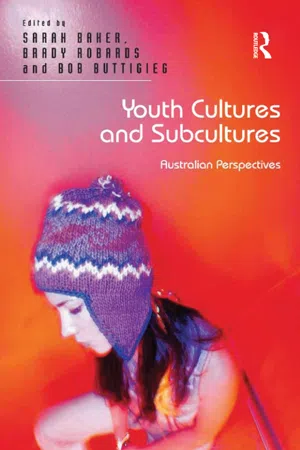
This volume critically examines 'subculture' in a variety of Australian contexts, exploring the ways in which the terrain of youth cultures and subcultures has changed over the past two decades and considering whether 'subculture' still works as a viable conceptual framework for studying youth culture. Richly illustrated with concrete case studies, the book is thematically organised into four sections addressing i) theoretical concerns and global debates over the continued usefulness of subculture as a concept; ii) the important place of 'belonging' in subcultural experience and the ways in which belonging is played out across an array of youth cultures; iii) the gendered experiences of young men and women and their ways of navigating subcultural participation; and iv) the ethical and methodological considerations that arise in relation to researching and teaching youth culture and subculture. Bringing together the latest interdisciplinary research to combine theoretical considerations with recent empirical studies of subcultural experience, Youth Cultures and Subcultures will appeal to scholars and students across the social sciences.
Information
PART I Theoretical Matters
DOI: 10.4324/9781315545998-2
Chapter 1 Australian Subcultures: Reality or Myth?
DOI: 10.4324/9781315545998-3
During the course of the last 20 years, the concept of subculture has been heavily contested on the grounds that the theoretical premises it sets out have little or no bearing on the everyday lived experiences of young people. Through what is now commonly referred to as the post-subcultural turn, researchers argue that contemporary youth culture is characterised by a multiplicity of different lifestyle articulations and orientations (see Bennett, 1999; Muggleton, 2000). In the light of this, it is maintained, the notion of a sub-dominant binary relationship between ‘youth’ subcultures and a hegemonically superior ‘parent’ culture is becoming increasingly obsolete (Chaney, 2004).
Thus far, there has been little discussion of how the post-subcultural turn applies in an Australian context. Indeed, it is interesting to observe how, in a number of notable examples of Australian youth scholarship, the concept of subculture still continues to be presented in a relatively unreconstructed and unproblematic fashion (e.g. see White, 2012). This may well be related to the legacy of the British cultural studies tradition (including its rendering of subcultural theory) in Australia. Yet, given the distinct differences – geographically, economically and demographically – between Australia and the United Kingdom, there may be pertinent reasons for reappraising the value of subculture in a local context. For example, and as will be discussed in more detail later in this chapter, while surfing is often described as a ‘subculture’ in academic studies of surfing practice, there are a number of characteristics associated with surfing that serve to make such a description problematic. Not least of all in this respect is the way that contemporary surfing culture often transcends class, gender and race (Baker, Bennett and Wise, 2012).
Similarly, while a number of allegedly ‘subcultural’ youth practices in Australia are modelled on and take inspiration from the UK experience, the result may be a deeply mythologised and romanticised articulation of a ‘subcultural’ identity. In this sense, what may be the driving factor for the takeup of a ‘subcultural identity’ is the celebration of a perceived identity, grounded in an idealised version of the past. This chapter examines the application of subculture in Australian youth research, and investigates whether it has conceptual validity or has become as redundant in Australia as it has in other developed, Westernised countries. Before turning to this issue, however, it is useful to briefly revisit the development of subcultural theory, its adaptation for the examination of style-based and music-based youth cultural practices and the criticisms that have been directed at this approach.
The Problem of Subculture
The subcultural perspective as applied to style-based and music-based youth culture in Australia and elsewhere is indebted to the work of the Birmingham Centre for Contemporary Cultural Studies (CCCS) (see Hall and Jefferson, 1976), whose adaptation of the Chicago School model of subculture to examine issues of class, style and resistance became highly fashionable from the mid-1970s through to the early 1990s. In their original application of subculture, Chicago School theorists such as Cohen (1955) and Whyte (1955) had used it as a framework for understanding how youth ‘deviance’ was a normal response to issues of social and economic inequality in the inner-city slums of US cities. Taking the essential tenets of the Chicago School thesis, the CCCS applied a cultural Marxist perspective using Gramsci’s (1971) concept of ideological hegemony to position the style-based working-class youth cultures of post-World War II Britain as subjects of resistance in an ongoing class struggle. The problems identified with this model of subcultural theory are by now well documented, and all that is essentially required here is a brief summary of some of the most salient criticisms levelled at the CCCS approach since the 1980s.
McRobbie (1990) suggested that a key problem with subculture was its male-centric characteristic – an issue that, she claimed, extended both to the object of research and those conducting the research. The creation of subculture as a site of male bravado, argued McRobbie, both served to exclude any consideration of female involvement in subcultures and, equally importantly, airbrushed out of existence the ‘other lives’ that male subculturalists lived as sons, siblings and so forth (tensions that are seen to play out stridently in the fictionalised film account of English mod culture, Quadrophenia). 1 Clarke (1990) criticised the metropolitan centredness of subcultural theory, claiming that little sense could be made of youth’s responses to items of fashion, popular music and so on without casting an eye on young people’s use of such cultural objects and texts in the provinces. Waters (1981) extended this criticism, suggesting that such was the Anglo-centric focus of the CCCS subcultural theory that it made little sense of youth culture beyond the United Kingdom, a view echoed by Cagle (1995) some 15 years later in his study of the US glitter rock scene. Finally, Cohen (1987) took issue with the fact that much of the CCCS research was conducted with little or no recourse to young people themselves, an approach exemplified in Hebdige’s (1979) Subculture: The Meaning of Style, which bases its interpretation of punk on a semiotic reading of the UK punk style of the late 1970s.
Despite such criticisms of subcultural theory, the concept of subculture remained a dominant trope in research on youth culture throughout the 1980s and much of the 1990s, being slowly distanced from the original theoretical tenets of the CCCS until it had become, as I note elsewhere, little more than ‘a convenient “catch-all” term used to describe a range of disparate collective practices whose only obvious relation is that they all involve young people’ (Bennett 1999, p. 605). However, in the wake of the ‘cultural turn’ (see Chaney, 1994), a new analytical trope emerged in youth culture research that came to be known as post-subcultural studies, or the post-subcultural turn (Bennett, 2011). A central argument in this new approach was that the proliferation of consumer goods, including a vibrant retro market, combined with the increasing individualisation of society, had given rise to a new generation of stylists who were less invested in the subcultural conventions of old and more inclined to engage in style-mixing, drawing on aspects of subcultural dress from different generations and genres (Muggleton, 2000). Indeed, some post-subcultural theorists questioned whether subcultures had ever actually exited at all, or whether they were merely a figment of the sociologist’s/cultural theorist’s fertile imagination (Bennett, 1999; Redhead, 1990).
The Australian Experience
The legacy of CCCS subcultural theory has been evident in many parts of the English-speaking world – not least in Australia, where the ready acceptance of subculture as a theoretical frame of reference can be seen in the context of the influence of the broader cultural studies field on Australian academics. Indeed, it would not be an exaggeration to suggest that, in the main, cultural studies in Australia has been the standard-bearer of cultural research per se, while Australian sociology has, until quite recently, been more focused on conventional – that is to say, ‘non-cultural’ – sociological subject-matter. Indeed, as the cultural turn gathers more traction in Australia, it is interesting to note how a wave of youth cultural scholarship is beginning to embrace the tenets of post-subcultural theory (e.g. see Cummings, 2008; Robards and Bennett, 2011; Taylor, 2012). This, however, is an emergent rather than established field, and its impact on the Australian youth culture research field is yet to be measured.
In terms of the existing landscape of Australian youth culture research, however, there are clear and very firm links with the theoretical discourses established by the CCCS. For example, in his book The Young Ones: Working Class Culture, Consumption and the Category of Youth, Stratton (1992) – although focusing on locally specific variations of youth in Australia (notably the ‘Bodgies’ and ‘Widgies’ of the 1950s) – adopts a theoretical vocabulary and set of conceptual frameworks that owe much to the class-based analyses of the CCCS, with the implication that the latter have a trans-national reach that is, at many levels, insulated from the influence of local circumstances. Another example of such Australian-based reference to the British subcultural theory paradigm – and one to which we will return later – is Moore’s (1993) The Lads in Action, a study of the local skinhead scene in Perth. From its title – a clear nod to the ‘lads’ in Paul Willis’s (1977) seminal study of the counter-school culture of the British comprehensive education system of the 1970s – to its analytical approach, the book represents a clear attempt to superimpose an analytical model designed to study British working-class youth during the late 1960s and early 1970s onto an Australian youth cultural experience some 20 years later; to analytically ‘wish’ into existence the version of subculture conceptualised by the CCCS as part of the contemporary Australian urban experience.
Challenging the Myth of Australian Subcultures
As illustrated above, the criticisms of subcultural theory are manifold. At this stage, it would be easy to argue that the problems identified with subculture elsewhere in the world also hold true for the Australian context and leave it at that. Assuming such a position, however, neglects a timely opportunity to review the landscape of Australian youth cultural research, and to consider possible local factors that contribute to arguments against subculture as a conceptual framework. Thus the concluding part of this chapter addresses this issue by focusing on specific examples of youth culture research to have emerged from Australian scholarship over the last 20 years.
Surfing
Interestingly, despite its long-standing centrality in Australian youth culture, surfing is only now beginning to achieve critical mass in the academic literature on youth, consumption and leisure. Early surfing scholarship by Australian academics tended to couch surfing in broadly subcultural terms. A pertinent example of this is Stedman’s (1997) feminist critique of conspicuous consumption among male Australian surfers. The application of subculture in Stedman’s work is representative of the way in which the concept’s global mobility has further intensified its position as a term increasingly distanced from its original theoretical context and reapplied in an eclectic and largely uncritical manner. The basis of Stedman’s argument is that the ‘postmodernisation’ of surfing has led to its rearticulation as an activity that cuts across race, class and gender. At the same time, Stedman argues that this postmodernisation process has enabled new discourses of authenticity and belonging that further conspire to exclude women from what has traditionally been a predominantly male sport and leisure activity. While not discounting the propensity of such processes to generate new forms of female exclusion, one is left to ponder the relevance of subculture in the context of Stedman’s argument. Indeed, subculture here seems to be applied in a way that continues to construct surfing as ‘other’, as non-mainstream and as a minority pursuit. In fact, however, the process of commercialisation to which Stedman points has led to surfing becoming an increasingly mainstream pursuit, albeit with scope for different articulations of surf practice, each of which embodies varying notions of authenticity and earnestness. In this sense, one could argue that surfing is not a subcultural but a post-subcultural phenomenon, a practice that is globally endorsed by a range of surfing practitioners who each inscribe surfing with different values and lifestyle aesthetics.
Instructive here is Canniford and Karababa’s (2013) work on the desire among discrete communities within the global surfing scene to rediscover a connection with the ‘primitive’ – a dimension of surfing that they perceive to have been lost, or at least significantly reduced, due to the wholesale commodification of surfing in recent decades. As Canniford observes, surfers desiring a return to the ‘primitive’ consider a key aspect of this to be the surfer’s proximity to the natural world. As ...
Table of contents
- Cover Page
- Half Title Page
- Title Page
- Copyright Page
- Table of Contents
- List of Figures and Tables
- Notes on Contributors
- Acknowledgements
- Introduction: Youth Culture Research in Australia
- Part I Theoretical Matters
- Part II The Place of Belonging
- Part III Gendered Experiences
- Part IV Doing Subcultural Studies
- Index
Trusted by 375,005 students
Access to over 1.5 million titles for a fair monthly price.
Study more efficiently using our study tools.
Frequently asked questions
Yes, you can cancel anytime from the Subscription tab in your account settings on the Perlego website. Your subscription will stay active until the end of your current billing period. Learn how to cancel your subscription
No, books cannot be downloaded as external files, such as PDFs, for use outside of Perlego. However, you can download books within the Perlego app for offline reading on mobile or tablet. Learn how to download books offline
Perlego offers two plans: Essential and Complete
- Essential is ideal for learners and professionals who enjoy exploring a wide range of subjects. Access the Essential Library with 800,000+ trusted titles and best-sellers across business, personal growth, and the humanities. Includes unlimited reading time and Standard Read Aloud voice.
- Complete: Perfect for advanced learners and researchers needing full, unrestricted access. Unlock 1.5M+ books across hundreds of subjects, including academic and specialized titles. The Complete Plan also includes advanced features like Premium Read Aloud and Research Assistant.
We are an online textbook subscription service, where you can get access to an entire online library for less than the price of a single book per month. With over 1.5 million books across 990+ topics, we’ve got you covered! Learn about our mission
Look out for the read-aloud symbol on your next book to see if you can listen to it. The read-aloud tool reads text aloud for you, highlighting the text as it is being read. You can pause it, speed it up and slow it down. Learn more about Read Aloud
Yes! You can use the Perlego app on both iOS and Android devices to read anytime, anywhere — even offline. Perfect for commutes or when you’re on the go.
Please note we cannot support devices running on iOS 13 and Android 7 or earlier. Learn more about using the app
Please note we cannot support devices running on iOS 13 and Android 7 or earlier. Learn more about using the app
Yes, you can access Youth Cultures and Subcultures by Sarah Baker,Brady Robards in PDF and/or ePUB format, as well as other popular books in Social Sciences & Sociology. We have over 1.5 million books available in our catalogue for you to explore.