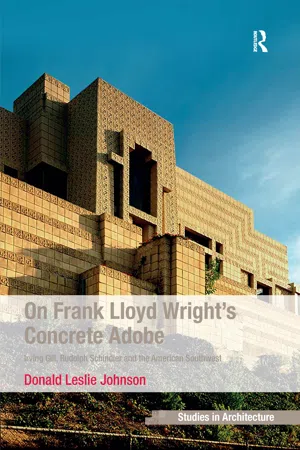
During the years 1919 into 1925 Frank Lloyd Wright worked on four houses and a kindergarten located in metropolitan Los Angeles using concrete blocks as the main building material. The construction system has been described by Wright and others as 'uniquely molded', 'woven like a textile fabric' and perceived as ground breaking, truly modern, unprecedented. Many have attempted to uphold these claims while some thought the house-designs borrowed from old exotic buildings. For the first time this book brings together Wright's declarations, the support of upholders and inferences in order to determine their accuracy and correctness, or the possibility of feigned or fictional stories. It examines technical developments of concrete blocks by Wright and others before his experiences in Los Angeles began in 1919. It also studies the manner of Wright's design process by an examination of relevant pictorial and textual documents. A unique, in-depth and critical analysis of the houses is set within historical, biographical and theoretical contexts. Consequently, the book explains the impact upon Wright of California contemporaries, architects Irving Gill and Rudolph Schindler, and their instrumentally profound role upon the course of modernism 1907-1923. In doing so, it allows a full appreciation of Wright's, Gill's and Schindler's buildings beyond their experiential qualities.
eBook - ePub
On Frank Lloyd Wright's Concrete Adobe
Irving Gill, Rudolph Schindler and the American Southwest
- 258 pages
- English
- ePUB (mobile friendly)
- Available on iOS & Android
eBook - ePub
On Frank Lloyd Wright's Concrete Adobe
Irving Gill, Rudolph Schindler and the American Southwest
About this book
Information
Topic
ArchitectureSubtopic
Architecture General1
Questions, Events … and Precast Concrete
Reason and Will have been exalted by Philosophy and Science. Let us now do homage to Imagination.
— Frank Lloyd Wright, 1927
Before a building appeals to the intellect it will have appealed to the senses.
— John Burchard and Albert Bush-Brown, 1961
In the creative individual’s mind, more often than not there is no precise line between invention and borrowing, between originality and appropriation. The unconscious subliminal aspect of human creativity is not easily measured by either the activator, producer, participant, or observer. During the architectural design process (the most important conceptual activity in imagining a future building), an awareness of appropriation can be blurred by mental fevers in devising, contriving, discovering, even puzzling. They can be subverted by hidden mental dishonesties induced by ignorance, fantasy, unconscious acts, and self-imposition. Receiving and applying inspiration is inherently a personal riddle.
Borrowing can be holus bolus or particular, acknowledged (in music, for example, variations on a theme), or not. But when not explicitly admitted in words, its identification can be problematic, accusation withheld. In Frank Lloyd Wright’s case some recent research has proven valuable in illuminating the extent of the problem through clarification and insight. Perhaps the first and certainly one of most useful was research conducted for an exhibition and documentary film that was published in an extensive, well-illustrated catalogue, all with the general title of Frank Lloyd Wright and Madison: Eight decades of artistic and social interaction. Under the editorship and guidance of architecture historian Paul E. Sprague, the researchers he marshaled relied on primary documentation and interviews, not on hearsay or propaganda from any source, or hagiography, and presented a series of essays about the various architectural commissions. As well, the authors were counseled to avoid “drawing general conclusions about Wright’s methods, attitude or visual strategies”. Sprague described the catalogue as Wright’s “designs and executed buildings in and near Madison, Wisconsin, [and] records the artist’s life and work there from 1879, when his family settled in the Madison area, until his burial in the Lloyd-Jones cemetery near Taliesin in 1959”.
Donald Hoffman’s well documented study of Wright’s Fallingwater house for Edgar Kaufmann—basically a concrete structure—near Mill Run, Pennsylvania was first published in 1978 and then generally ignored for a couple of decades. Finally it was revised and republished in 1993. His book about Hollyhock house and another about the Dana House of 1902-04 were equally dedicated to objectivity.1 More recently is Franklin Toker’s compendious frank, humorous, and useful Fallingwater Rising of 2003.
Anthony Alofsin’s erudite essays about possible European and other precedents for Wright’s architectural and figural ornamentation prior to around 1920 provided ample proof of the multiplicity of probable sources of particular appropriations, subtle or blatant. As well, we hasten to add, Alofsin acknowledged Wright’s own creations. Joseph Siry’s documentation and dense analyses in a book about Unity Temple set aside myth, clarified the client’s program, sorted design evolution, explained relevant concrete construction techniques 1900-1908, and suggested influences and precedents for that extraordinary building. Two of Siry’s latest contributions to architectural history are of reinforced concrete structures for Wright’s Imperial Hotel in Tokyo and for the Pfeiffer Chapel at Florida Southern College.
Also useful to the context of these essays is Kathryn Smith’s history of the Aline Barnsdall commissions given to Wright for buildings in Chicago and Los Angeles during 1915-1931.2 The information Robert Sweeney offered in the compact book Wright in Hollywood about Wright’s concrete block buildings for Barnsdall contained a narrow band of historical detail while interpretations were linear and traditional. Kevin Nute’s informative research into possible Japanese models as sources for Wright’s two and three dimensional designs was less objective or comparative (to Western or Chicago traditions) but otherwise a valuable contribution. Paul Kruty’s study of Midway Gardens presented new information and detail on that highly influential concrete and tile building of 1913-14. And there was my own book, Frank Lloyd Wright versus America: the 1930s published in 1990.
While these illustrated books, and others, for the most part ignore or treat too lightly the subject of Original Action, as do all biographies or quasi-biographies of Wright, they do acknowledge, as had Wright, the guiding inspiration of, for instance, preindustrialized cultures, the nineteenth century French architect and theorist E.-E. Viollet-le-Duc, England’s interrelated Arts and Crafts Movement as it devolved in America, Viennese secession of the 1890s, and traditional Japanese two-dimensional art.3 Yet, Wright and some of his students, followers, observers and assenters (hagiographers in the main) have maintained that he was the author of many inventions. One is the focus of this study.
What concerns us here is not the advancement of claims that Wright went outside his own mind and borrowed things or ideas created elsewhere. All artists reluctantly admit verbally, or by exposition, their eclecticism, if not its degree or the propriety of its elements. Rather, we want to know what prompted those supposed appropriations, their magnitude, their intervention during Wright’s design process, and therefore about the role of invention. Particularly, do Wright’s claims or those of his assenting observers hold firm under scrutiny.
Back in 1831 the prescient author Mary Shelly suggested that to invent was an organic process, intuitive rather than linear or rational. “Invention [she said] consists in the capacity of seizing on the capabilities of a subject; and in the power of moulding and fashioning ideas suggested to it”.4 This was probably close to Wright’s understanding. We shall carry on more practically, keeping in mind the thought of Arthur Conan Doyle: “What one man can invent another can discover”. For our purpose, to invent is to originate as a product of one’s own contrivance something useful that did not exist before. (The words “something useful” also admits a potential legal constraint.) It is uneasily distinguished from acts of emulation, simulation, mimicry, imitation, even parody, but is persuaded by assimilation, absorption, and other acts induced by influence and inspiration, even at the subliminal level.
Our investigation will study five houses in the Los Angeles area designed by Wright and built between 1919 and 1925 under his often indirect supervision or under that of his first-born son or that of his trusted draftsman Rudolph Schindler. Cement stucco applied to fired hollow clay blocks were the major construction materials for the walls of one now called Hollyhock. It was designed and built for the oil heiress, brazen political progressive, arts patron and theater director and producer, Aline Barnsdall, from June 1919 and into 1921. Some people have referred to Barnsdall as the ultimate iconoclast, a “pinko”, communist, anarchist, or the socialist she was. After twenty-four years of trailing Barnsdall the Federal Bureau of Investigation concluded she was a harmless, bohemian-styled lady of wealth.5 Wright found her “neither neo, quasi, nor pseudo,” disarming and disingenuous, and as “domestic as a shooting star”. She was also a confidant of another Wright client in Los Angles, the Freemans and also of the Lovells who were clients of architects Rudolph Schindler and Richard Neutra. The title “Hollyhock,” apparently the lady’s favorite flower, was not Barnsdall’s but given by Wright first as late as 1932 in his autobiography. Until then it was known as her residence or Barnsdall house.6 Her stucco-faced mansion set within sloping bush land, olive trees in broken orchard lines, bound by streets and suburbia, still sits proudly centered on top of a high round hill on the edge of Hollywood in Los Feliz (see Figs 1.1 and 1.2). Back then it had views of surrounding citrus orchards and west to the great ocean. Now it sits in city-owned Barnsdall Art Park next door to an imposing municipal art gallery and within a treed landscape constructed post-1950.
Patterned precast concrete blocks were employed for the walls of the other four more modest houses of 1923 into 1925. Each of the five is heritage listed and known worldwide. That adulation, however, is based on an enjoyment of them as works of design, yes, but also on suspect—often erroneous—information that these essays will endeavor to expose, politely, and correct.

Fig. 1.1 Aline Barnsdall house in the Los Feliz district of Hollywood, California, 1919-1922
The architectonics and appearance of the four houses, Wright often told us, were derived from technological, historical, regional and universal considerations. Surely the client’s needs were also influential. There was a moment when he also said that his concrete block system of construction for the four houses was his invention.7 In other instances people have said he borrowed from—at times implying that he copied—ancient buildings. (Perhaps most famously was historian Vincent Scully’s list of 23“borrowings” based mainly on visual comparison.8) As a corollary, therefore, we need to discover the evidence in support of Wright’s various declarations and, of course, that in support of assertions made by observers, art and architectural historians in the main.
We need to test the veracity of claims, including the possibility that feigned, imagined or made-up stories were presented as firm evidence. Answers, or at least explanations, are found in technical developments of concrete block before Wright’s sad experiences with Los Angelenos began in 1919. They are found in the manner of his design process, and a careful reading of relevant pictorial and textual documents and of extant buildings. Only then can a clarifying interpretation of intent be assembled and placed in historical, biographical and theoretical contexts. Only then can we fully appreciate the buildings beyond their visual qualities. The revelations are—the history is—not as expected.

Fig. 1.2 Barnsdall house in Hollywood, California, 1919-1922
IMPORTANT EVENTS
The sequence of critical events to be studied in the following chapters, are outlined chronologically.9
ca.1903
• U.S. publications about concrete blocks and the machinery to make them begin earnestly, many published in Chicago.
1903-1906
• United States Shoe Machinery Company, Beverly, Massachusetts, “Daylight Factory,” Ernest L. Ransome, engineer, poured concrete post, beam and slab construction.
1905
• FLW and wife Catherine and Mr and Mrs Winslow engaged in a three month tour of Japan.
1907-1911
• In San Diego architect Irving J. Gill created a series of classic modern buildings, some built of concrete, notably houses for Allen (1907), Price (1908-1909), Miltmore (1911), and Barker (1911-12); also a Boys’ Dormitory for the Childrens’ Home Association (1908), Scripps Institution (1908), and Bella Vista Terrace houses (1910).
1908
• The patented Turner flat-slab concrete construction system that employed “mushroom” column capitals.
• New York architect Grosvenor Atterbury perfected a system of precast concrete panels for walls, floors and roof construction and created a residential aesthetic devoid of historical referents, initially housing in Sewarn, New Jersey, to 1910.
1910
• FLW in Europe, arrived September 1909, visited Germany, France and Italy, returned to Chicago early 1911; his work published in Berlin by Wasmuth.
• (Mexican revolution began.)
• Washington, D.C. architect Milton Dana Morrill perfected a system of reusable steel forms for concrete in situ walls and created an aesthetic devoid of historial referents, notably for Cement City suburb in Nanticoke, Pennsylvania, to 1913.
1912
• JLW (Jo...
Table of contents
- Cover Page
- Title Page
- Copyright Page
- Contents
- List of Illustrations
- Acknowledgements
- Preface
- Introduction
- List of Abbreviations
- 1 Questions, Events … and Precast Concrete
- 2 The Buildings
- 3 The Taylors and the Griffins
- 4 Tiles and Blocks
- 5 Wright’s Fiction
- 6 Historians’ Fiction
- 7 Irving Gill, Regionalism and Concrete Adobe
- 8 Closure … Schindler and Resurgence
- Appendix One
- Appendix Two
- References
- About the Author
- Index
Trusted by 375,005 students
Access to over 1.5 million titles for a fair monthly price.
Study more efficiently using our study tools.
Frequently asked questions
Yes, you can cancel anytime from the Subscription tab in your account settings on the Perlego website. Your subscription will stay active until the end of your current billing period. Learn how to cancel your subscription
No, books cannot be downloaded as external files, such as PDFs, for use outside of Perlego. However, you can download books within the Perlego app for offline reading on mobile or tablet. Learn how to download books offline
Perlego offers two plans: Essential and Complete
- Essential is ideal for learners and professionals who enjoy exploring a wide range of subjects. Access the Essential Library with 800,000+ trusted titles and best-sellers across business, personal growth, and the humanities. Includes unlimited reading time and Standard Read Aloud voice.
- Complete: Perfect for advanced learners and researchers needing full, unrestricted access. Unlock 1.5M+ books across hundreds of subjects, including academic and specialized titles. The Complete Plan also includes advanced features like Premium Read Aloud and Research Assistant.
We are an online textbook subscription service, where you can get access to an entire online library for less than the price of a single book per month. With over 1.5 million books across 990+ topics, we’ve got you covered! Learn about our mission
Look out for the read-aloud symbol on your next book to see if you can listen to it. The read-aloud tool reads text aloud for you, highlighting the text as it is being read. You can pause it, speed it up and slow it down. Learn more about Read Aloud
Yes! You can use the Perlego app on both iOS and Android devices to read anytime, anywhere — even offline. Perfect for commutes or when you’re on the go.
Please note we cannot support devices running on iOS 13 and Android 7 or earlier. Learn more about using the app
Please note we cannot support devices running on iOS 13 and Android 7 or earlier. Learn more about using the app
Yes, you can access On Frank Lloyd Wright's Concrete Adobe by Donald Leslie Johnson in PDF and/or ePUB format, as well as other popular books in Architecture & Architecture General. We have over 1.5 million books available in our catalogue for you to explore.