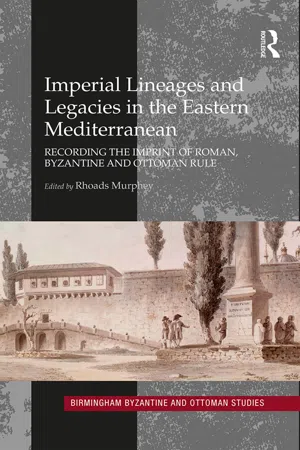
The comparative study of empires has traditionally been addressed in the widest possible global historical perspective with comparison of New World empires such as the Aztecs and Incas side by side with the history of imperial Rome and the empires of China and Russia in the medieval and modern periods. Surprisingly little work has been carried out focusing on the evolution of state control and imperial administration in the same territory; approached in a rigorous and historically grounded fashion over a wide extent of historical time from late antiquity to the twentieth century. The empires of Rome, Byzantium, the Ottomans and the latter-day imperialists in the nineteenth and early twentieth centuries, all inherited or seized and sought to develop overlapping parts of a common territorial base in the Eastern Mediterranean and all struggled to contain, control or otherwise alter the political, cultural and spiritual allegiances of the same indigenous population groups that were brought under their rule and administration.
The task undertaken in Imperial Lineages and Legacies in the Eastern Mediterranean is to investigate the balance between continuity and change adopted at various historical conjunctures when new imperial regimes were established and to expose common features and shared approaches to the challenge of imperial rule that united otherwise divergent societies and imperial administrations. The work incorporates the contributions by twelve scholars, each leading practitioners in their respective fields and each contributing their particular insights on the shared theme of imperial identity and legacy in the Mediterranean World of the pagan, Christian and Muslim eras.
How the corpus of Roman law was transmitted to Byzantium and how it developed there has been the subject of much recent scholarship. What has been subject to far less examination is the question of the transmission of legal practice.1 What was the court structure available to provincial Byzantines, and what happened when they went to court? How far can this experience be traced back to Late Roman tradition? What elements were new? Justice systems and the courts do, indeed, tend towards the traditional. In Great Britain, barristers still wear the black robes instituted in mourning for the death of Charles II in 1685 and wigs which were last in fashion at the end of the eighteenth century; internationally, most judges and advocates still wear old-style robes and headgear.2 Many court procedures have a long tradition behind them, and legal language is often alien to the contemporary vernacular.3 Given this inbuilt traditionalism, if not antiquarianism, looking at courts may provide considerable insight into the more ‘Old Roman’ elements of the legal practices of ‘New Rome’. This discussion will be confined to the tenth and eleventh centuries and, since it will concentrate on archival material, will mainly deal with evidence from the documents of the period preserved in the monasteries on Mount Athos.4 Geographically, it will focus on Macedonia and Thrace, where Athonite houses held most of their property. Since we are somewhat better informed about courts in Constantinople, where aspects of continuity with the Roman past are much easier to discern, it may be useful to concentrate on this provincial evidence.5 It will also deal with civil cases; we know little about the workings of the criminal law in Byzantium during this or any other period.6
We also know little about the physical appearance of Byzantine courts. When they are depicted in contemporary art, the context is always Biblical. The Last Judgement is the most familiar portrayal: one found, for example, in the frescoes of the Church of the Panaghia ton Chalkeon in Thessalonike and in the mosaics of the basilica of Santa Maria Assunta on the island of Torcello in the Venetian lagoon, as well as in other mediums, such as the manuscript illumination of the Last Judgement in BNF Paris. gr. 74, fol. 51v.7 Although these depict Christ sitting in public judgement assisted by the Virgin and the Apostles, like the Roman and Byzantine judge with his assessors, they give little sense of the architectural environment of the court itself. John Chrysostom made an interesting allusion to the courts of his own day, around the year 400, when he described the Last Judgement: ‘For as it is with the judges, when they judge publicly, the attendants drawing back the curtains show them to all; even so then likewise all men shall see Him sitting, and all the human race shall stand by and He will make answers to them by Himself.’ 8
The depictions of the Trial of Christ in the sixth-century Rossano Gospels are, however, of more assistance in imagining what a Late Antique or Byzantine court might have looked like. Indeed, William Loerke long ago suggested that they were a ‘representation of the trial which is both faithful to the Gospel account and to that state of Roman jurisprudence which obtained when the prototype was made’.9 Two judicial scenes are depicted: the first, when Christ is led before Pilate by the Jewish high priests, and the second, where the choice between saving Barabbas or Christ is offered to the Jews. Loerke argued that the details of these scenes – the judge Pilate holding his scroll of office, sitting enthroned behind a covered table supplied with pens and inkwell and flanked by standard-bearers carrying vexilla with imperial insignia – present the setting as an imperial court of last resort, the proper place for a trial for treason.10 Certainly many of the elements found in both Roman and Byzantine courts are there: the insistence on a written judgement (hence the pens and ink), the presence of a shorthand writer compiling a court record in the scene where the choice is made between Christ and Barabbas (fol. 8v), the entering of spoken pleas as the Jews make their case before Pilate. If the prototypes for the Rossano Gospel scenes were indeed, as Loerke has argued, wall-paintings in a praetorium (or domus Pilati) reconstructed in the Church of Haghia Sophia in Jerusalem in which sixth-century pilgrims were read the Gospel accounts of Christ’s trial on Good Friday, then there is even more reason to believe that they convey ‘a sense of authentic legal action’.11 But apart from this one example, although we have some depictions of lawgivers (such as those of Justinian, Leo III and Constantine V in Cod. Marc. Gr. 172, fol. 27v), we have no other visual indications of what Byzantine judges looked like, what they wore in court, or the physical environment in which they sat.12 We are reliant on deductions from the titles of courts: the Judges of the Velon, for example, are generally supposed to have taken their name from the fact that they originally sat behind a curtain (vêlon) in the covered buildings of the Hippodrome in Constantinople; their subordinates were the ‘Judges of the Hippodrome’, again, an indication of the location where they met.13
But to begin at the beginning: what were Byzantine law courts for? As in Roman times, they were an expression of the imperial power, for justice was done in the emperor’s name and by his officials. Unlike the early medieval West, where dispensing justice was often part of the rights of local lordship, the devolution of judicial power from the centre to officials in the provinces remained an imperial prerogative.14 The prooimion (preface) to a late tenth-century imperial edict emphasised the imperial responsibility of dispensing justice by evoking God as a ‘just father’, ‘a scale of justice, a straight line and an accurate measuring rod’. ‘Accordingly’, it continued, ‘it is incumbent on those to whom the rulership has fallen to follow His example all the more… since they have been called by the lawgivers of old legal authorities and a blessing common and equitable.’ 15 As Jill Harries has so succinctly put it in the context of the Late Roman Empire: ‘Law was used as a tool of enforcement, an expression of power or a pawn in the endless games played out between emperor and citizen, centre and periphery.’ 16 This was still very much the case in Byzantium, where the use and acceptance of the imperial courts also implied the recognition of the legitimacy of the power that instituted them.17 But the fact that the courts were continuously used must also indicate their ongoing usefulness; they were a last resort when other means of dispute resolution – private agreement, mediation or arbitration – had failed.18 They served a practical purpose: to put a definitive end (it was hoped) to long-running and complex disputes. And lest it be thought that, given the expense involved, recourse to courts was the sole prerogative of the rich and powerful, the Athonite archives provide examples of groups of townspeople and villagers who also took their grievances to imperial courts in the province and, indeed, as far as Constantinople, much like the Syrian villagers who travelled at least 350 kilometres to Antioch in the third century AD to seek a hearing before the emperor Caracalla.19
Before turning to further discussion of judicial practices, one major problem needs to be acknowledged. This is the ‘black hole’ in the Greek legal evidence which exists between legal records from sixth- and early seventh-century Egypt and the earliest documents from the Athonite archives, which date to the end of the ninth century.20 We have no official documentation in Greek about courts and legal practices for most of the late seventh, eighth and ninth centuries, though tantalising scraps of evidence appear in hagiography regarding saints falling foul of the legal system, particularly during the iconoclast periods.21 Coptic documents certainly provide evidence of continuing Roman judicial structures and of legal formulae in Greek modelled on Latin originals, but the increasing use of Arabic models for legal affairs in Egypt and the widespread disruptions caused by the invasions in the Balkans, Asia Minor and the Eastern provinces during the so-called Byzantine ‘Dark Age’ means there is a dearth of Byzantine administrative evidence for this period as a whole.22 So there is an inbuilt chronological challenge to any attempt at comparison. In addition, of course, one has always to bear in mind that things which may look much the same to us, may not, in fact, have been the same!
We need now to ask what provincial courts existed and where they were, how such courts were constituted, and what evidence of their personnel can be found. Then we must turn to court procedure and how decisions were recorded, before finally investigating what happened after a court hearing was concluded. If that was the end of the matter, how were decisions recorded and preserved? If not, what other courts might be involved in appeals? In every case, a comparative approach will be taken, surveying first the Late Roman evidence and then that of the Middle Byzantine period.
In the Late Roman Empire, cases involving sums of less than 300 solidi were often heard by the town magistrate; the duties of the defensor civitatis were spelled out in Justinian’s Novel XV of 535.23 This individual also registered wills and donations, aided in tax collection and supervised people known for bad behaviour.24 From Justinian’s time onwards, the structure of the iudices pedanei (itinerant justices) was rationalised; Justinian himself acknowledged, however, that there was a shortage of skilled notaries, especially in the countryside. More important cases, those involving sums of at least 500 solidi (later, 750 solidi) and some appeals were heard by the iudex (the provincial governor or his deputy). From the fifth century onwards, petitioners addressed the iudex via a libellus which described the nature of the defendant and the accusation. In the 530s, two higher judges were appointed at Constantinople to hear appeals stemming from such cases. Special judges also existed; the emperor could delegate his authority to a designated individual to act in a particular case. The sixth-century historian Agathias relates a case of an imperial judge sent from Constantinople to Colchis who held court on a raised dais, with all the panoply of officials and shorthand writers, ‘ushers and heralds’, before a crowd of uncomprehending but apparently appreciative locals.25
We can certainly see some parallels in tenth- and eleventh-century Byzantium, with one significant exception. Governors, or rather stratêgoi (the military governors of the new territorial divisions, or themes, which grew up after the seventh century) and their chief legal officials, the kritai (judges) still heard cases, as did subordinates. Judges, as we shall shortly see, remained itinerant, and, on occasion, specially delegated individuals were still sent out from Constantinople.26 The Constantinopolitan judges of the Velon and Hippodrome also continued to serve in the provinces. As Andreas Gkoutzioukostas has shown, many of them can be seen judging cases in Macedonia in the eleventh century, and Eric Limousin has established that over half the judges known in the Peloponnese between the tenth and twelfth centuries were members of these courts.27 But there is no longer any sign of legal officials with permanent imperial appointments operating in urban areas outside Constantinople, though, as we shall see, we do find private legal ‘professionals’, taboullarioi and notarioi.28 John Haldon has suggested that the courts of the defensores civitatis fell into abeyance and were subsumed into those of the bishops during the late sixth and seventh centuries, a theory which is plausible but must remain a conjecture given the lack of evidence.29 What is certain is that by the tenth and eleventh centuries, when evidence for the very existence of bishops’ courts is scanty, senior churchmen often appear as assessors in lay courts. Such courts were chaired by lay officials, but these officials were drawn from the thematic administration or from Constantinople, not specifically from each town. In May 942, for example, when the monks of Athos and their lay neighbours, the inhabitants of the kastron (fortified town) of Hierissos, concluded an agreement concerning the boundary between their respective landholdings, the hearing occurred in Thessalonike before a ‘bench’ which consisted of the stratêgos Katakalon, the kritês Zoetos, the epoptês (financial official) Thomas, and the basilikosprôtospatharios Thomas Tzoulas, as well as Gregory, Archbishop of Thessalonike.30 In November of 996, the prôtospatharios Nicholas, kritês of Strymôn, Thessalonike and Drougoubiteia, heard a case in Kassandreia in the Chalki-dike in the company of the imperial episkeptitês and prôtospatharios Stephen and thirteen other assessors (symponoi). The symponoi, all holders of signifi-cant office or rank, included two bishops: Leo, Bishop of Kassandreia, and Panaretos, Bishop of Kitros.31 The Roman practice of dispatching an imperial official, rather than a professional jurist, to preside over legal proceedings, with a group of local archontes serving as assessors, seems to have endured. In the thoroughly Christianised society of the Byzantine empire, such notables naturally included members of the clergy.
Figure1.1 Map showing geographical distribution of court cases and legal disputes in Macedonia (tenth–eleventh centuries)
This brings us to the question of where Byzantine courts convened. The urban context clearly remained important in this period, as courts often met in large cities like Thessalonike, Philippi and Serres, but also ...
Table of contents
Cover Page
Half Title Page
Title Page
Copyright Page
Table of Contents
List of figures
Notes on contributors
Acknowledgements
Introduction: recording the imprint of Roman, Byzantine and Ottoman rule
Part I Law and empire
Part II Assertion and disputation of imperial identity in art
Part III Individual, group and corporate identity in an imperial context
Part IV Empire and region / region and empire
Index
Trusted by 375,005 students
Access to over 1.5 million titles for a fair monthly price.
Study more efficiently using our study tools.
Frequently asked questions
Yes, you can cancel anytime from the Subscription tab in your account settings on the Perlego website. Your subscription will stay active until the end of your current billing period. Learn how to cancel your subscription
No, books cannot be downloaded as external files, such as PDFs, for use outside of Perlego. However, you can download books within the Perlego app for offline reading on mobile or tablet. Learn how to download books offline
Perlego offers two plans: Essential and Complete
Essential is ideal for learners and professionals who enjoy exploring a wide range of subjects. Access the Essential Library with 800,000+ trusted titles and best-sellers across business, personal growth, and the humanities. Includes unlimited reading time and Standard Read Aloud voice.
Complete: Perfect for advanced learners and researchers needing full, unrestricted access. Unlock 1.5M+ books across hundreds of subjects, including academic and specialized titles. The Complete Plan also includes advanced features like Premium Read Aloud and Research Assistant.
Both plans are available with monthly, semester, or annual billing cycles.
We are an online textbook subscription service, where you can get access to an entire online library for less than the price of a single book per month. With over 1.5 million books across 990+ topics, we’ve got you covered! Learn about our mission
Look out for the read-aloud symbol on your next book to see if you can listen to it. The read-aloud tool reads text aloud for you, highlighting the text as it is being read. You can pause it, speed it up and slow it down. Learn more about Read Aloud
Yes! You can use the Perlego app on both iOS and Android devices to read anytime, anywhere — even offline. Perfect for commutes or when you’re on the go. Please note we cannot support devices running on iOS 13 and Android 7 or earlier. Learn more about using the app
Yes, you can access Imperial Lineages and Legacies in the Eastern Mediterranean by Rhoads Murphey in PDF and/or ePUB format, as well as other popular books in History & European Medieval History. We have over 1.5 million books available in our catalogue for you to explore.