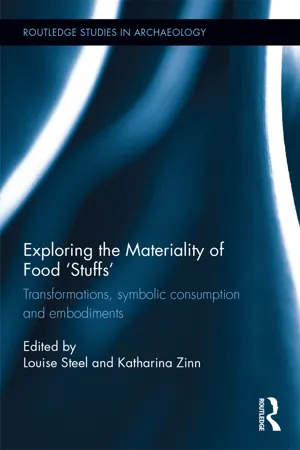
From remote antiquity to contemporary contexts, food and the 'stuff' of food remains central to people's daily experiences as well as their sense and expression of identity. This volume explores the materiality of foodstuffs past and present, examining humanity's intriguingly complex relationships with, and experiences of, food. The book also makes a fresh contribution to our understanding of materiality through a novel focus on material culture, analysing objects used to prepare, wrap, serve and consume food and the tactile experiences involved in its production and consumption. Considering a wide range of cultures, spanning from ancient China to modern-day Kenya, this broad collection of interdisciplinary chapters reveal the multiple interplays between foods, bodies, material worlds, rituals and embodied knowledge that emerge from these encounters and which, in turn, shape the material culture of food. Exploring the Materiality of Food 'Stuffs' makes an important contribution to this burgeoning field and will be of interest to archaeologists and anthropologists working in the key area of food research.
eBook - ePub
Exploring the Materiality of Food 'Stuffs'
Transformations, Symbolic Consumption and Embodiments
- 292 pages
- English
- ePUB (mobile friendly)
- Available on iOS & Android
eBook - ePub
Exploring the Materiality of Food 'Stuffs'
Transformations, Symbolic Consumption and Embodiments
About this book
Information
1 Introduction
Exploring the materiality of food ‘stuffs’: Transformations, embodiment and ritualized consumption
Introduction
Food touches everything. Food is the foundation of every economy. It is a central pawn in political strategies of states and households. Food marks social differences, boundaries, bonds, and contradictions. Eating is an endlessly evolving enactment of gender, family, and community relationships.
(Counihan and van Esterick 1997, 1)
This volume – which has grown out of two workshops1 examining the materiality of foodstuffs past and present – sets out to explore people’s intriguingly complex, shifting relationships with, and experiences of, the materialities of ‘foodstuffs’.
Both in contemporary contexts and in remote antiquity, food – and the ‘stuff’ of food – is central to people’s daily experiences, as it is to social reproduction, and their sense and expression of identity. Myriad aspects of the materiality of food, and how it is socialized, have been extensively researched by both anthropologists and archaeologists. Within anthropology, the emphasis has been on the actual food, in particular highlighting its symbolic meaning (Lupton 1994; Miller 1998; Mintz and du Bois 2002) and its place within the political economy (Mintz 1985; Watson and Caldwell 2004). More recently there has been increasing emphasis placed on the relationship between the human body and edible substances; there is a focus on the physical transformative relationship between people and the food they eat – how the biological act of ingestion makes and transforms a body (cf. Hayes-Conroy and Hayes-Conroy 2008; Lavis 2016; Lupton 1996; Mol 2008). This perspective is increasingly informed by the agency of food, the concept of edible matter as actant (cf. Bennett 2010, 39–51). The visceral sensuality of food, as well as the importance of taste and smell in constructing memory and meaning, comprises another fruitful area of enquiry (Holtzman 2006; Lupton 1994; Sutton 2001; see also Wilk, this volume).
In contrast, the material culture of food (and drink) tends often to be overlooked by anthropologists. The materialities of the ‘stuff’ of food – the objects used to prepare, wrap, serve and consume food and the tactile experiences involved in its production and consumption – have tended to be tangential to anthropological enquiry. The focus has rather been on the substances ingested rather than the embodied actions embedded in the preparation, storage, presentation, consumption and discard of food as well as the objects thereof.
Archaeological studies have engaged more explicitly with the material culture of food and drink, as much as with the substances consumed; the latter are increasingly being woven into narratives of past cultures through the rich data evidenced by palaeobotany (cf. Tzedakis and Martlew 1999), faunal remains (cf. Miracle and Milner 2002) and residue analyses (cf. McGovern 2003; 2009; Tzedakis and Martlew 1999). These scientific analyses are primarily directed towards the identification of ancient diet and the physicality of food (Ryan et al. 2012; Ryan and Spencer 2013). Another productive area of enquiry has focused on storage strategies, especially those embedded in emergent political systems (cf. Christakis 2011; Wesson 1999), but equally those within the household (Christakis 1999; Steel 2016). An additional area which has received considerable attention is the political significance of sharing food; there has been some discussion on ritualized consumption (Blake 2005; Steel 2004) and the dialectics of feasting (Bray 2003; Dietler 1996; Dietler and Hayden 2001; Hayden 1996; Hayden 2014). On the other hand, there has been rather less emphasis on the embodied experience of the consumers, to a certain extent no doubt, reflecting the temporal distance of the researcher from their object(s) of study. The sensuality of consumption, notably the use of food and foodstuffs in the creation and fostering of embodied memory, has received limited attention (Hamilakis 1998; 2008; Hamilakis and Sherratt 2012). Likewise, with rare exceptions such as Stockhammer’s (2012) discussion of culturally situated handling of drinking vessels, the cultural practices and embodied physical acts involved in the consumption and actual experience of foodstuffs remain elusive.
Our book aims to challenge this perceived intellectual dichotomy by bringing together researchers from various fields of food history such as Chinese Studies and Egyptology, as well as archaeology and anthropology. The workshops referred to earlier, involving individuals of differing interests and experience, culminated in a vibrant and refreshing discussion. We trust that the variety and enthusiasm the participants of the workshop(s) brought to that debate is roundly demonstrated through the spirit of this volume as well as within their respective chapters.
The book as a whole sets out to explore people’s embodied engagement with food and the material culture that accompanies the production, consumption and socialization of food both within contemporary cultures and in ancient communities. Rather than simply reiterating the symbolic meaning(s) of food and its role as a social actant, the individual chapters focus on the material characteristics of foodstuffs and their associated objects. The aim is to build upon existing dialogues concerning the materiality of food by interweaving strands which focus equally on the properties and agency of the diverse substances consumed by people, with the materiality of the objects used in the production, distribution and consumption of edible matter.
The golden thread running through this volume is the material culture of food and drink. Objects are central to the production, distribution and consumption of foodstuffs, be they grinding stones, containers (basketry, pottery, cans and Tupperware), cooking equipment and implements, or branded food wrappings, to name just a few examples. These artefacts are entangled within daily experiences of foodways; they mediate – as much as they are mediated by – people’s embodied engagements with the food consumed and the places where these foodstuffs are produced, prepared, exchanged and consumed. In this volume the entanglement of objects, consumables and people is illustrated by a number of case studies, which variously demonstrate how myriad objects are, and have been, used to process, package, store, advertise, serve and consume food, and moreover, how these various activities are central to the creation and reproduction of social worlds.
The materiality of these foodstuffs is explored through the lens of three key interconnected conceptual themes: transformations (Part One), embodied encounters (Part Two) and symbolic consumption (Part Three). These three leitmotifs are not exclusive, but mutually beneficial; most of the presented chapters could also easily have been placed within at least one other category: Attala (Part One) in addition to the transformations made possible by exploring water flows also describes manifold embodied encounters with this substance, while Forde likewise describes the inherent transformative character of the application of permaculture even though her main focus lies with embodied encounters. Equally, depositional contexts as specified by Reinhart (Part Three) not only reflect symbolic consumption of foodstuffs, but also the transformation of the deposit (area) over a certain time. The placement of the particular papers into the three sections therefore reflects both the broadness of the topic as well as the personal choice of the editors.
Our case studies are drawn from a range of geographical and historical contexts, with the expressed intention of fostering debate and ensuring that discussion does not become fixed within esoteric or regionalist debates.
Transformations
In Part One: Transformations we consider various ways in which foodstuffs and their associated material culture might be transformed. Our starting point is the notion of ‘making’ (Ingold 2013) and the actual production of cuisine; the transformation of edible substances from raw, unprocessed ingredients to a meal, something that is socialized and to be consumed. We also explore changing social and material practices surrounding the production and consumption of food and drink and how these have radically altered the landscape of eating and drinking, both in remote antiquity and in the very recent past. Ryan, Verriet and Hayden illustrate how the technologies of food production, preparation and consumption are (and have been) continually changing and being transformed. Shifting patterns in the types of materials and objects used to produce, package and serve food ultimately result in altered embodied knowledges and experiences of that food, a process which shapes choices of what food-stuffs’ people consume, how they utilize these foods and the social environments in which this is done. Particular attention is given to the ways in which new behaviours and ways of doing things become embedded within society. In a number of case studies, therefore, we examine how the development of new technologies, from grinding stones in the Epipaleaolithic to the development of canned and frozen foods in the nineteenth and twentieth century, respectively, inevitably affected people’s relationships with the food they eat and resulted in various new social practices. This sheds light on how transitions, discontinuities and changes in the material culture of food, food environments and cultural knowledges are variously interpreted and experienced.
Ryan explores the transformation of raw plant materials into cuisine. Her focus is the ancient Egyptian diet from the surviving archaeobotanical evidence; charred macros and phytoliths, from Amara West (Nubia), revealing the basic ingredients of the ancient Egyptian diet, rather than the finished foodstuffs consumed within a meal. Amara West also throws light on the transformation of these plant products in the daily production of food at the site, in the form of a rich material culture dataset, comprising grinding stones, cereal grinding emplacements and bread ovens. The materiality of ancient Egyptian food production, such as crop cultivation and the transformation of foodstuffs into the basics of daily foodways, is enhanced by reference to ethnoarchaeological research carried out by Ryan in the Nubian villages on nearby Ernetta Island. Intriguingly, this study has thrown light on another transformation faced by food producers in the region in recent decades, impacting upon food procurement strategies and dietary practices – that of environmental change.
Verriet moves the focus of enquiry from the transformation of edible commodities to the people’s mutable relationship with the material culture of food – wrappings, packaging and the presentation of these in the media. He examines changing food technologies during the twentieth century, namely the ‘domestication’ of canned food, in particular shifting perceptions of the can in the Netherlands during the mid-twentieth century. Verriet provides detailed analysis of how this type of packaging was variously advertised and promoted to consumers, in an attempt to inveigle the product into the household. He describes the social process by which canned foods became an ordinary, accepted part of a household’s foodstuff as ‘domestication’: the integration of new food technology into daily life. His findings provide an insight into ‘domestication strategies’, oft exploited by manufacturers and the role that these play in the creation and/or manipulation of people’s perception of a physical object to illustrate how consumer needs and perceptions of foodstuffs evolve over time, ironically eventually resulting in the pedestrianization of the commodity.
Transformations in the material culture of food, and as a corollary the inevitable impact on the construction of social worlds, are explored within a very different cultural and temporal environment by Hayden et al. Building upon an earlier study of Natufian grinding stones and the development of beer as an intoxicating beverage for feasting within the first sedentary communities of the Levant (Hayden et al. 2012), in this volume Hayden et al. further investigate the development of new grinding equipment for processing grains in the Epipalaeolithic Levant to produce specialist foods (namely beer and bread) for feasting. This chapter thus provides an important insight not simply on the development of new technologies for processing foodstuffs but equally how the creation of a new cuisine helped mould new social practices which transformed human relations (cf. Hayden 2014).
The final chapter in Part One: Transformations looks specifically at the challenge faced by communities in rural Kenya of living in a radically changing environment, one that is characterized by increasing desertification and the ever-present threat of harvest failure. Rather than the more usual range of foodstuffs, Attala focuses her enquiry on water, not only the staple of food production but also essential to sustain the human body and that of the plants and animals consumed by people. At the heart of this chapter is an understanding of the agency of water, explored within the intellectual framework of the New Materialisms (Bennett 2010; Coole and Frost 2010). Attala presents a troubling picture of the global water situation and in the context of her case study how, as a result of climatic change, the lives of the Giriama of Kenya are moulded and transformed through their changing relationships with, and understanding of, water.
Embodied encounters
Through a diverse series of case studies, Part Two: Embodied Encounters moves the discussion along by investigating the material experiences involved in the production and consumption of food and drink. It considers a number of distinct corporeal relationships between the people producing, processing and consuming foodstuffs and the substances which they handle, ingest and consume, an aspect as we have seen, that is often neglected. In addition, it investigates the materials and objects through which these relationships are mediated and the haptic relationship between people and the material culture, the ‘working tools’ they use to process, store and consume foodstuffs. This approach is suitably informed by Bourdieu’s ([1972] 1977) notion of habitus – culturally engrained practices, including body knowledges and the handling of objects that shape people’s daily foodways (see in particular Allison). Embodiment also encompasses the interaction between body, mind and stuffs, specifically how foods shape, mould and form mind and body (see Jansen, this volume). The focus of this section, therefore, is on people’s physical engagement with the ‘things’ of food, an approach that fosters images of the ‘hands on’ part of the interaction; whilst looking at practical methods, this part evokes investigation and the interpretation of these embodied practices within ancient, historical and contemporary contexts.
The physical, emotional and spiritual consequences of eating form the subject of Jansen’s reinterpretation of the Chinese legend of Princess Miaoshan. Through the lens of ritual practice and dietary prohibitions he explores how the biological act of ingestion makes and transforms the body and as a consequence people’s experience of the world around them. Jansen moves the debate beyond the material, bodily experience of food to a consideration of its capacity to alter our mental and spiritual state. He further highlights how food, as something that is experienced very differently (bodily and conceptually) by men and women is intimately intertwined with gender relations.
Forde’s analys...
Table of contents
- Cover
- Title
- Copyright
- Contents
- List of figures
- List of tables
- Acknowledgements
- List of contributors
- 1 Introduction: Exploring the materiality of food ‘stuffs’: Transformations, embodiment and ritualized consumption
- Part one Transformations
- Part two Embodied encounters
- Part three Symbolic consumption
- Index
Trusted by 375,005 students
Access to over 1.5 million titles for a fair monthly price.
Study more efficiently using our study tools.
Frequently asked questions
Yes, you can cancel anytime from the Subscription tab in your account settings on the Perlego website. Your subscription will stay active until the end of your current billing period. Learn how to cancel your subscription
No, books cannot be downloaded as external files, such as PDFs, for use outside of Perlego. However, you can download books within the Perlego app for offline reading on mobile or tablet. Learn how to download books offline
Perlego offers two plans: Essential and Complete
- Essential is ideal for learners and professionals who enjoy exploring a wide range of subjects. Access the Essential Library with 800,000+ trusted titles and best-sellers across business, personal growth, and the humanities. Includes unlimited reading time and Standard Read Aloud voice.
- Complete: Perfect for advanced learners and researchers needing full, unrestricted access. Unlock 1.5M+ books across hundreds of subjects, including academic and specialized titles. The Complete Plan also includes advanced features like Premium Read Aloud and Research Assistant.
We are an online textbook subscription service, where you can get access to an entire online library for less than the price of a single book per month. With over 1.5 million books across 990+ topics, we’ve got you covered! Learn about our mission
Look out for the read-aloud symbol on your next book to see if you can listen to it. The read-aloud tool reads text aloud for you, highlighting the text as it is being read. You can pause it, speed it up and slow it down. Learn more about Read Aloud
Yes! You can use the Perlego app on both iOS and Android devices to read anytime, anywhere — even offline. Perfect for commutes or when you’re on the go.
Please note we cannot support devices running on iOS 13 and Android 7 or earlier. Learn more about using the app
Please note we cannot support devices running on iOS 13 and Android 7 or earlier. Learn more about using the app
Yes, you can access Exploring the Materiality of Food 'Stuffs' by Louise Steel,Katharina Zinn in PDF and/or ePUB format, as well as other popular books in Social Sciences & Archaeology. We have over 1.5 million books available in our catalogue for you to explore.