- 158 pages
- English
- ePUB (mobile friendly)
- Available on iOS & Android
eBook - ePub
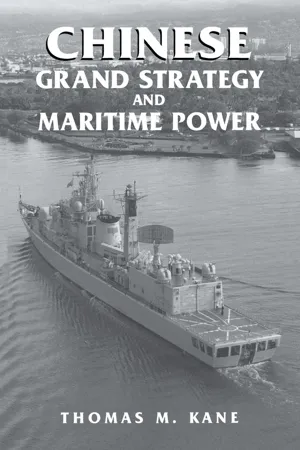
Chinese Grand Strategy and Maritime Power
About this book
This challenging new book argues that the People's Republic of China is pursuing a long-term strategy to extend its national power by sea.
1
China to the Sea
'There lies a sleeping giant', Napoleon Bonaparte said of China, 'Let him sleep, for when he wakes, he will shake the world.1 Over the second half of the twentieth century, China appears to have awakened. Indeed the People's Republic of China (PRC) has called for changes in the international system, which its own leaders describe as nothing less than a 'new order'.2 China's attempts to create such an order must lead to friction, for, in the words of one expert, on no single strategic issue are China and the West on the same side.3
If China wishes to claim a leading role in international politics, it must become a seapower. Maritime strength is a fundamental part of global strategic leverage for any nation, but it is particularly important for the PRC.4 Although China is hardly an island, the regions of greatest importance to its national destiny are most accessible to it by sea. Two of Beijing's strongest potential rivals and wealthiest potential trading partners, Japan and the United States, are separated from China by water. The PRC's disputes in the Taiwan Straits and the South China Sea are entirely maritime.
Although there are overland routes between China and the rest of Eurasia, the Chinese will find it far cheaper to trade with Europe, Southeast Asia and the Middle East by water. China's rivalry with India is partially land-oriented, but also partially naval. For these reasons and others, it is no surprise that China has devoted great resources to improving its navy and commercial fleet, or that Western analysts have paid special attention to this development. Seapower is not the only factor which will determine whether the PRC realizes its potential to become a global power, but it ranks alongside economic development and political stability as one of the most critical. In the past two decades, not surprisingly, the road to promotion in the Chinese armed forces has led through military academies that emphasize the importance of the navy.5
China clearly needs seapower, and influential members of the Beijing establishment recognize that need. These facts raise the questions of whether the PRC is able to build a powerful navy, and how it might go about so doing. Not only are these questions interesting for their inherent drama, but they are critical to any debate over how other countries should respond to Beijing's international debut. History is full of examples of how dangerous it can be to underestimate a rising power, but as the China expert Gerald Segal noted, it may be perilous to overestimate the PRC as well.6 Citizens and policymakers throughout the world must assess the PRC accurately, and must understand as much as possible about both what China is trying to achieve and what this might mean for their own countries.
As one investigates these questions, one sees that advocates of Chinese naval power will have to overcome formidable economic and technical obstacles, and perhaps important political obstacles as well. Nevertheless, such an investigation also indicates that China's naval strategists know what they are doing. Although Beijing's means are limited, it is using them intelligently to work itself into a position from which it will be able to exercise far more influence in the future. In other words, China's leaders appear to be pursuing a consistent and well-founded grand strategy, which has put them on a course toward realizing their most ambitious political goals. Maritime development is one of the most prominent and most challenging goals of the PRC's strategy, and it reveals the techniques Beijing is using in its larger strategic enterprise.
Grand Strategy Defined
What does it mean to follow a 'grand strategy'? Carl von Clausewitz defined strategy as 'the use of engagements for the object of the war', and this author continues in that vein to define grand strategy as the use of political, economic and military actions to achieve the objectives of the regime.7 Success at either kind of strategy depends on one's ability to make effective combinations: to assemble seemingly discrete endeavors such as battles, industrial programs or diplomatic initiatives into an overall pattern of victory. Plato compared the art of statesmanship to the art of weaving separate threads into a whole piece of cloth, and the analogy is apt.8
This definition of grand strategy is open-ended. A state leader may incorporate any imaginable activity into his or her plans, as long as it furthers the aims of the regime. Likewise, grand strategy may unfold over any period of time. One tends to associate the concept with long-term plans. Books on the grand strategy of the Roman Empire, for instance, routinely hypothesize about political gambits which are supposed to have evolved over the course of centuries.9 Nevertheless, state policy can have specific objectives, and there are specific moments in history when states bring their plans to fruition, often through swift action and the decisive use of violence.
Historically, assorted leaders have written detailed political blueprints that lay out their grand strategies in detail. Many have intended for their plans to unfold over many decades. In the seventeenth century, for instance, Cardinal Richelieu wrote a testament to help future generations of French statesmen continue what he had begun.10 Frederick William I of Prussia entrusted his son Frederick with a similar document, and the young man realized his father's goals effectively enough to earn the sobriquet 'the Great'.11
However, there are limits to what even the most far-sighted statesmen can plan in advance. The elder Moltke's maxim, 'no plan of operations can look with certainty beyond the first meeting with the major forces of the enemy', is as valid in grand strategy as it was on the nineteenth-century battlefield.12 In statecraft, the metaphorical 'major forces of the enemy' can appear in many guises and at the most unexpected times. The fact that few governments can sustain a consensus about even their own interests and policies makes it yet more difficult for leaders to map out long-term strategies in detail.
These difficulties need not stop state leaders from practicing grand strategy, any more than the proverbial fog of war stops military commanders from practicing strategy on the battlefield. What Clausewitz said about combat applies to statecraft as well.
Nowhere, in consequence, are differences of opinion so acute ... and fresh opinions never cease to batter at one's convictions. No degree of calm can provide enough protection: new impressions are too powerful, too vivid, and always assault the emotions as well as the intellect.13
Plans fall to pieces in such an environment, but one would be foolish to rely on ad hoc reactions to these innumerable and frequently contradictory 'impressions' as well. Those who merely react are apt to dither aimlessly, hurting their own cause as often as they help it, until finally the tide of events overwhelms them. In an earlier comment, Clausewitz suggested that '[a]ction can never be based on anything firmer than instinct'.14 Instinct alone, however, is clearly not enough - it must be grounded in 'a sensing of the truth'.
How, then, can one sense the truth amidst chaos? Clausewitz suggests a solution: 'Only those general principles and attitudes that result from deep understanding can provide a comprehensive guide to action' (emphasis in original). In a military campaign, principles, attitudes and understanding can belong to an officer who possesses that 'sense of unity' and 'power of judgment' that Clausewitz describes as genius.15 Even dictatorships seldom place their entire foreign policy in the hands of a single leader, but 'principles', 'attitudes', 'understanding' and a 'sense of unity' can provide a comprehensive guide to action for collectives in the same way that they provide such a guide for individuals.
One can best illustrate the way grand strategy takes shape amid the chaos of international affairs by means of an example. Within 20 years of its defeat in the First World War, Germany had put itself back in a position to overrun western Europe. The Germans accomplished this by pursuing active, consistent and mutually supporting programs in all the dimensions of statecraft. Germany's return to power involved interlocking fiscal policies, industrial policies and diplomatic policies, as well as the putatively secret rearmament policy itself.
This book has defined grand strategy as 'the use of political, economic and military actions to achieve the objectives of the regime', and Germany's return to power is a clear example of such a strategy in action. Clearly, the German feat required well-conceived and purposeful action. Nevertheless, not only did the Germans face turmoil and unforeseeable setbacks in the 1920s and 1930s, it seems unlikely that they were following any kind of detailed plan until the process was nearly complete. The first steps in the rearmament program began, not with Hitler, and not even under the Weimar regime, but in 1917, with the First World War nearly a year from its end and the Kaiser still in power.16 It seems highly unlikely that an official state program would have survived these two revolutionary changes in government, but the general predilections that allowed German leaders to carry on a coherent policy did.
Formally and informally, German society had indoctrinated its leaders with what Clausewitz called a 'deep understanding' of their country's political situation, and with the 'principles' and 'attitudes' they needed to achieve national goals. This allowed them to practice a large-scale version of what their field officers might have called Auftragstatik. This is a military doctrine in which higher commanders state their goals in general terms, and allow their subordinates to accomplish them in whatever way the situation requires. In grand strategy, the overall goals often come from geographical understandings, overall political sentiments and a nation's historical aspirations rather than explicit military commands, but the concept remains the same.
On Studying Grand Strategy
For these reasons, it is a mistake to limit one's understanding of grand strategy to formal strategic blueprints. Master plans to take over the world have existed, but they are most common in the realms of thriller movies and conspiracy theory. To understand grand strategy in its more common and possibly more effective form, one must try to think like a grand strategist. Just as state leaders weave their policies one thread at a time, following general principles rather than detailed blueprints, so must analysts study the way the threads cross over each other, following general principles in an attempt to see the pattern as it emerges on the loom. This process involves speculation, but it is one of reasoning rather than guesswork.17
In investigating grand strategy, one must allow for the fact that no one can ever ...
Table of contents
- Cover
- Half Title
- Title
- Copyright
- Dedication
- Contents
- Series Editor's Preface
- Acknowledgements
- List of Abbreviations
- 1 China to the Sea
- 2 The History of Chinese Seapower
- 3 Principles of Chinese Seapower
- 4 Enter the People's Republic of China
- 5 The Twenty-first-Century PLAN
- 6 The Diplomacy of Chinese Seapower
- 7 Conclusion
- Bibliography
- Index
Trusted by 375,005 students
Access to over 1.5 million titles for a fair monthly price.
Study more efficiently using our study tools.
Frequently asked questions
Yes, you can cancel anytime from the Subscription tab in your account settings on the Perlego website. Your subscription will stay active until the end of your current billing period. Learn how to cancel your subscription
No, books cannot be downloaded as external files, such as PDFs, for use outside of Perlego. However, you can download books within the Perlego app for offline reading on mobile or tablet. Learn how to download books offline
Perlego offers two plans: Essential and Complete
- Essential is ideal for learners and professionals who enjoy exploring a wide range of subjects. Access the Essential Library with 800,000+ trusted titles and best-sellers across business, personal growth, and the humanities. Includes unlimited reading time and Standard Read Aloud voice.
- Complete: Perfect for advanced learners and researchers needing full, unrestricted access. Unlock 1.5M+ books across hundreds of subjects, including academic and specialized titles. The Complete Plan also includes advanced features like Premium Read Aloud and Research Assistant.
We are an online textbook subscription service, where you can get access to an entire online library for less than the price of a single book per month. With over 1.5 million books across 990+ topics, we’ve got you covered! Learn about our mission
Look out for the read-aloud symbol on your next book to see if you can listen to it. The read-aloud tool reads text aloud for you, highlighting the text as it is being read. You can pause it, speed it up and slow it down. Learn more about Read Aloud
Yes! You can use the Perlego app on both iOS and Android devices to read anytime, anywhere — even offline. Perfect for commutes or when you’re on the go.
Please note we cannot support devices running on iOS 13 and Android 7 or earlier. Learn more about using the app
Please note we cannot support devices running on iOS 13 and Android 7 or earlier. Learn more about using the app
Yes, you can access Chinese Grand Strategy and Maritime Power by Thomas M. Kane in PDF and/or ePUB format, as well as other popular books in History & Military & Maritime History. We have over 1.5 million books available in our catalogue for you to explore.