- 200 pages
- English
- ePUB (mobile friendly)
- Available on iOS & Android
eBook - ePub
About this book
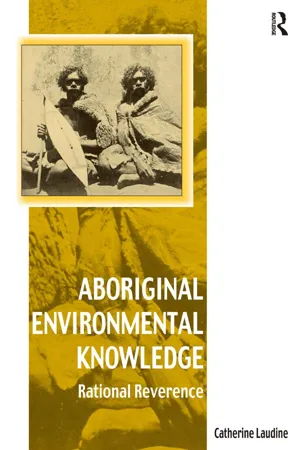
Whilst there are popular ideas about which champion Aboriginal environmental knowledge, many of these are based more on romantic notions than on any detailed understanding of what might be the content of this knowledge. This book is based on a grounded and broad assessment of less well known details of Aboriginal knowledge and provides both a great deal of detail and a new assessment of rituals and practices. Aboriginal environmental knowledge is examined here as an integrated source of both religious and scientific knowledge. An important finding is that Aboriginal environmental knowledge also includes knowledge about education for attitudes considered appropriate for survival. Though evidence for this is readily available in the literature, it has not been part of current depictions of Aboriginal environmental knowledge.
Information
Chapter 1
Aborigines as Experts on the Environment
Of course there never has been just one attitude towards Aborigines on the part of whites. There always has been, and still is, a range of attitudes through communities and across the land. Many are decidedly anti-Aboriginal, many are concerned about their situation and there have always been those who show respect.
But what seems to be reasonably new these days is the feeling that Aborigines have something to offer, not that in any sense they are morally superior and we should learn from them (though there are some that do think this), and not even that they actually are offering something (though some may be), just that they have something we do not have and that it might be an idea to grab it.1
It is true that this attitude is not new, in that this is what happened in the original white takeover of land. Something of value was grabbed. Most people then refused to recognise what was going on, usually by means of denying any Aboriginal relationship with the land. it is an irony that this second takeover is in part based on recognition of this very relationship to land, yet what is happening now is more subtle than the previous process in that what is being seized is not concrete but cultural.2
It is a further irony that Aboriginal recovery has partly led to this phenomenon. the fact that Aborigines have proudly asserted their difference has helped to make some whites appreciate the importance of the ancient Aboriginal heritage and the lack of this connection for whites in this land.
The sorts of things i am talking about here are the grabs being made by the image makers of mainstream Australia, by the film makers, the writers, artists and musicians.
White Australians have long had a feeling that they suffer as cultural orphans, so far removed from their origins that for practical purposes their cultural heritage no longer exists. Australians, or at least the ones who write about such things, the image makers, felt themselves deprived in comparison to their European cousins. they developed a cultural cringe, and acted it out, almost as a celebration of lack of confidence. True, the bush ballads and songs of mateship had their day, but that day is past. they never did catch on internationally as images of Australia. There has been some overseas recognition of entertainers such as, Paul Hogan and Joan Sutherland, and sometimes Australians have made an impression in the world of sport, but what has really caught on are images of Australia as the home of Aboriginality and the desert. In other words, it is not white Australians who have made an impression overseas but the Aboriginal outsiders in their own land.3 Now faced with evidence of their popularity, the white Australian response has been to wish to become part of it.4
We were told for example, by a writer in The Australian Magazine, discussing an exhibition of Aboriginal art in New York, that; ‘It has taken two hundred years for non-Aboriginal Australians to begin to realise that the original art of their ancient continent is also their heritage. Sentimental stories of dreaming of a white Christmas in a European homeland are replaced by pride in stories of this land’s Dreamings’ (December 17, 1988:4).
Whilst asserting a rather dubious overthrow of the Australian white Christmas this passage also asserts non-Aboriginal Australian ownership of Aboriginal art.
Another example also looks at Aboriginal culture in terms of what it can provide for whites. ‘Aboriginal art probably owes its growing popularity to its promise of spiritual authenticity, as the insipid professionalism of much western art leaves us hungry for that kind of experience’ (McDonald 1993:16).
Then we have the assumption of ownership of Aboriginal culture on the part of whites which does not even find it necessary to mention Aboriginal people. ‘When you travel the outback on this famous desert train, The Ghan, you go back in time to the atmosphere of Australia’s legendary Dreamtime’ (Australian Geographic, No 21, p 12).
All this celebration of Aboriginality is only about ‘real’ Aboriginality, not about what the people in fringe camps are doing. The concern is with what the outback black is doing, or occasionally with what some sophisticated inner-city black is doing. The art critics are not celebrating the art of the mission stations or reserves of New South Wales or Victoria. It is ‘authentic’ art they are interested in. None of this is said. It is just implied; and it fits into a long tradition in Australia where the ‘real’ blacks are somehow more acceptable than the ones who are living closer to white ways, who are seen as neither one thing nor the other. The ‘authentic’ Aborigine has the value of a relic, useful to display to visitors. The other unmentionable ones living half in and half out of the white world have no such value at all.
When it comes to matters environmental, something similar is happening and there is potential for further coercive modern myth-making and co-option of Aborigines for the purposes of others. the fact that environmental matters are now so much in vogue makes the conjunction of them and Aboriginality doubly fashionable.
There is however an added dimension to the consideration of attitudes to Aborigines and the environment. this is the question of science. in part, Aborigines are being celebrated as experts on the environment because of a crisis of faith in science. this is particularly felt and articulated by those active in conservation movements and by New Age spiritual seekers.
So there is both a negative and a positive element to the dynamic. there is both a taking on of what is believed to be Aboriginal environmental knowledge as a valued possession and a taking on of it as a weapon in the anti-science arsenal. on the one hand it is being appreciated as a valuable addition to mainstream culture and on the other as a weapon to use against that culture. this contradictory position may be loaded with new pressures for Aborigines to live up to white expectations regarding Aboriginal attitudes to controversial environmental matters. white ideas on Aboriginal environmental knowledge may also be discussed and celebrated without much actual information about just what Aboriginal environmental knowledge actually was, or is.
~~~
These days everyone is talking about ecological systems. if someone wants to save the wetlands environment near to where they live, it is quite likely that they will argue that it is a unique ecological system. it may be that what they are really against is lots of neighbours with canal access to their favourite fishing spot, but their argument will be presented in more global and altruistic terms. Furthermore, they will not necessarily need a rigorous analysis of the system’s components to get some media coverage. A few key words will do. television news does not have time to go into the details of just what might be the wonderful component parts that make up a particular wetlands system, but they are interested in the argument about the development dollar versus the integrity of the environment. this particular debate is well and truly on the agenda.
Despite the fact that this means quite cynical use can be made of it, it is also on the agenda because of genuine concerns felt by many people about pollution and the global warming problems of our planet.
These concerns have their roots in the counter-cultural movements of the sixties when there was questioning throughout the western world of most aspects of industrial life and culture.
One expression of this questioning was the hippie movement whose credo was ‘back to nature’. Many young people left urban centres to try to live a simple life in the countryside. They rejected the direction being taken by their parents’ generation. They rejected the accepted wisdoms of their parents’ world regarding progress and technology and regulated work. They wanted something simpler, something freer, something safer, cleaner, and healthier. They had lost faith in the god of science. They felt too much humanity had been sacrificed to this god. They had doubts about science as the be-all and concerns about it as the end-all.
There was an apocalyptic feeling about the times. Theodore Roszak expressed the urgency of his concerns with an argument being made by many today.
[I]f there is any hope of saving the rights of the person and planet in the years ahead, we—by which I mean, the ordinary, chronically powerless people who live in the belly of the urban-industrial leviathan – we are going to have to find our way back to a […] sense of mutual aid, a […] capacity to live self-reliantly within more local and domestic economies, an appreciation of the wealth that lies in modest means and simplicity of need. We are going to have to rethink some of our most firmly held assumptions about property and privacy, security and success, recognizing that there is simply no liveable future for the competitive, self-regarding, high consumption, middle-class way of life which we have been taught to regard as the culmination of industrial progress.(1978:287)
This movement, common throughout the developed world, had particular consequences in Australia. When people got to the country to try to live out the new ideas, they found themselves not particularly welcomed by the old locals and this was made clear by the harassment many received from police. Suddenly they were receiving the kind of treatment usually reserved for Aborigines and other fringe groups. This placed the new settlers in a position where they were likely to be more sympathetic to the similar problems faced by Aborigines. This feeling of identification was given form by activities at the 1973 Aquarius Festival at Nimbin in northern New South Wales. The festival booklet enthusiastically praised the Aborigines for living for centuries in harmony with the environment. Organisers tried to reach out to local Aboriginal communities by such means as the Birth and Beyond group inviting an Aboriginal woman to talk about Aboriginal birthing practices; but the land rights tent seemed to be permanently empty and the ‘white corroboree’ did not find easy acceptance amongst Aborigines. Many Aborigines who went to the festival refused to pay on the grounds that it was their land anyway (Newton 1988:62–4). The feeling of identification seemed not to be reciprocated. Aboriginal people, understandably and probably quite rightly, were suspicious of the motives of the New Age people.
In part the motives of the new settlers were to do with spirituality. Many of them thought that Aborigines were more in touch with their spirituality than the new settlers were. There was an idea that, being closer to their ancient ancestral roots, they were privy to the sorts of things lost to the mainstream cultural heritage because of civilisation. These sorts of ideas were not new at this time, for example, Andrew Lang, writing in 1898 speculated that ‘very probably there exist human faculties of unknown scope’ and that these ‘conceivably were more powerful and prevalent among our remote ancestors who founded religion’ (1898:66). What was new was that they were being taken up as part of a significant youth protest movement. the hope of rediscovering the individual ability to develop these lost ‘human faculties’ became an important part of the quest. indeed, for most New Age seekers, concern with social issues came second to expansion of their own personal and spiritual potential. As Janice Newton says (1988:64), this helps to explain why the land rights tent was so often empty and the yoga and massage demonstrations were well attended. it also places into perspective the ‘white corroboree’ and the closing of the festival with a big spiral ‘Rainbow Serpent’ dance. the sympathetic identification and celebration quickly merged into appropriation.5
The new life philosophy was originally city-based and middle-class in origin. these young members of a privileged society found themselves in a position where they could not only hear and fear what they took to be warning signs around them but could do something about them. that something tended to have a lot to do with the rejection of the excesses of a culture based on science-spawned supertechnology and a conscious attempt to return to, or create, more simple, cleaner, ‘alternative’ technology.
At the same time people within the discipline of science were coming to conclusions that challenged contemporary scientific paradigms.
Barry Commoner was one of the scientists speaking out with warnings in those days. He urged greater humility in our attitude towards development and awareness of its debilitating effects on the environment. ‘Like sorcerers’ apprentices, we are acting upon dangerously incomplete knowledge. We are, in effect, conducting a huge experiment on ourselves’ (1963:31).
By the mid-seventies many other scientists and philosophers had added their voices to the likes of Barry Commoner’s. The second report of the influential Club of Rome was published, arguing that the problems of pollution were not purely technological but also political, social and even psychological. they argued that the solution required a simultaneous consideration of all aspects of mankind’s evolution from individual values and attitudes to ecological and environmental conditions (Mesarovic & Pestel 1975:136–44). they were saying the same sort of things that the young people were saying. By this stage too, pressure groups like Friends of the Earth (founded 1971) were working to bring pollution problems to the public eye.
The same sorts of ideas, and often the same people, were found in these pressure groups as in the back-to-nature movement, and where Aboriginal ideas seemed to fit with alternative notions then they were taken on as allies in the green struggle.
Michael Krockenberger, for example, Co-ordinator of the Darwin Environment Centre and Australian Conservation Foundation Councillor for the Northern Territory, supported his argument for preventing mining in Kakadu, by expounding the view of the Jawoyn people that the mining being planned for the South Alligator Valley would bring catastrophe. ‘This country is the home of their dreamtime spirit Bula […] the minerals […] are like Bula’s blood. They are part of his life essence. If Bula is disturbed, apocalypse will be unleashed upon the Earth’ (1989:4).
In another case, the Wildlife Preservation Society of Queensland found it convenient to mount an argument for saving Shelburne Bay in Cape York as a land rights case for the Wuthathi people, ‘so that we might all appreciate the landscape through Aboriginal eyes’ (Borschmann 1986:7).
There is an aspect of these celebrations of Aboriginal nature knowledge by conservationists, that places their knowledge above the oppositional knowledge, and so holds Aboriginal knowledge up as more scientific than science. For example, Judith Wright McKinney talks about problems with mining in the Alligator Rivers region and cautions that Aborigines say that there has been much higher rainfall and flooding in the past than we are allowing for in estimates (1985:31).6 A more general example of this type of thinking is provided by Robert Lawlor’s book Voices of the First Day, where he argues that the Aboriginal way of life in no way assaulted the planet and so was far superior to the consequences of science-based knowledge. Despite the fact that he points to similarities between some new science findings and ancient Aboriginal cosmology, he favours the idea that the solution to the world environment crises should come from outside science.
The kind of thinking which makes connections between Aboriginal cosmology and the metaphysical implications of new science can also lead to Aboriginal knowledge being held to be superior to science. Those, like Lawlor, who argue for the importance of these connections, believe that the ancient knowledge is superior because the truths were known by the ancients before they were discovered by science. Such thinking, whereby science is seen to be pointing the way towards metaphysical ‘truths’, which have been part of the teachings of ancient religious systems, has been quite popular. (See, for example, Davies 1983, Prigogine and Stengers 1984, Lawlor 1991, Knudtson and Suzuki 1992.)
Lawlor and others see science as part of the problem. As we have seen, this sort of p...
Table of contents
- Cover
- Half Title
- Title Page
- Copyright Page
- Table of Contents
- Dedication
- Dedication
- Acknowledgements
- List of Figures
- Introduction
- 1 Aborigines as Experts on the Environment
- 2 What the ‘Experts’ Say
- 3 Contemporary Aboriginal Voices
- 4 Traditional Ways: the Evidence of Myths
- 5 Traditional Ways: Daily Practices Regarding Food
- 6 Traditional Ways: Daily Practices Regarding Fire, Shelter and Healing
- 7 Traditional Ways: Beyond the Ego
- 8 Away from a World of Unique Truth (The Question of Comparison with Science)
- 9 Rational Reverence
- Epilogue: The Real Future Eaters
- Appendix Tree Mobs Tjilpi Bob Randall and Catherine Laudine
- Bibliography
- Index
Trusted by 375,005 students
Access to over 1.5 million titles for a fair monthly price.
Study more efficiently using our study tools.
Frequently asked questions
Yes, you can cancel anytime from the Subscription tab in your account settings on the Perlego website. Your subscription will stay active until the end of your current billing period. Learn how to cancel your subscription
No, books cannot be downloaded as external files, such as PDFs, for use outside of Perlego. However, you can download books within the Perlego app for offline reading on mobile or tablet. Learn how to download books offline
Perlego offers two plans: Essential and Complete
- Essential is ideal for learners and professionals who enjoy exploring a wide range of subjects. Access the Essential Library with 800,000+ trusted titles and best-sellers across business, personal growth, and the humanities. Includes unlimited reading time and Standard Read Aloud voice.
- Complete: Perfect for advanced learners and researchers needing full, unrestricted access. Unlock 1.5M+ books across hundreds of subjects, including academic and specialized titles. The Complete Plan also includes advanced features like Premium Read Aloud and Research Assistant.
We are an online textbook subscription service, where you can get access to an entire online library for less than the price of a single book per month. With over 1.5 million books across 990+ topics, we’ve got you covered! Learn about our mission
Look out for the read-aloud symbol on your next book to see if you can listen to it. The read-aloud tool reads text aloud for you, highlighting the text as it is being read. You can pause it, speed it up and slow it down. Learn more about Read Aloud
Yes! You can use the Perlego app on both iOS and Android devices to read anytime, anywhere — even offline. Perfect for commutes or when you’re on the go.
Please note we cannot support devices running on iOS 13 and Android 7 or earlier. Learn more about using the app
Please note we cannot support devices running on iOS 13 and Android 7 or earlier. Learn more about using the app
Yes, you can access Aboriginal Environmental Knowledge by Catherine Laudine in PDF and/or ePUB format, as well as other popular books in Theology & Religion & Religion. We have over 1.5 million books available in our catalogue for you to explore.