The Arab uprisings have put Lebanon under increased strain. While the revolutions in Tunisia and Egypt caused limited reverberations, the war in Syria echoed in the fine-tuned political and confessional balance of Lebanon. Over one million refugees, equal to one-quarter of Lebanon's population, have moved in from Syria. The country's economy and its already weak public infrastructure have been impacted heavily. Hizbullah's engagement in Syria has posed questions about Lebanon's disassociation policy. Terrorist attacks by ISIL and the growing risk of radicalization across the confessional spectrum have left the country at unease. However, Lebanon's political elites have vowed to shield the country from regional turbulences. Lebanon recently saw a series of demonstrations because of the inability of the government to manage the garbage crisis, but it has been far from witnessing a large-scale citizen uprising similar to the 2005 Cedar Revolution or the revolts next door. This book provides a comprehensive overview of the current situation in Lebanon, and a detailed assessment of the difficulties which the country is currently facing.
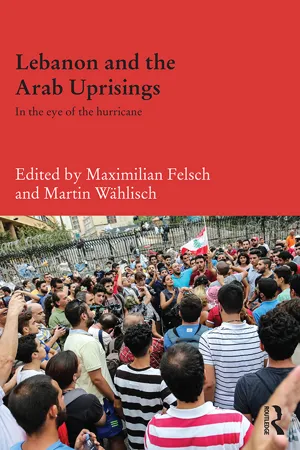
eBook - ePub
Lebanon and the Arab Uprisings
In the Eye of the Hurricane
- 220 pages
- English
- ePUB (mobile friendly)
- Available on iOS & Android
eBook - ePub
Lebanon and the Arab Uprisings
In the Eye of the Hurricane
About this book
Information
Part I Stability, unity and confessional balance
1 Lebanon’s consociational politics in the post-2011 Middle East
The paradox of resilience
DOI: 10.4324/9781315715216-2
Lebanon’s political system is framed as an instance of consociationalism organized by power-sharing arrangements of its larger religious denominations.1 From a theoretical perspective, in such a power-sharing system, leaders are to represent various constituent groups, and forge ties of cohesiveness, contributing to the two-fold outcome of democracy and stability.2 In reality, however, Lebanon’s system has long shied away from this normative model.3 This trend continued with the new challenges that the Arab uprisings have brought about since 2011.
In the pre-war period (1943–1975), manuals portrayed the Lebanese system as a model of democratic pluralism in a region dominated by authoritarian regimes.4 Yet, the system collapsed in 1975, and a fifteen-year-old civil war (1975–1990) shaped by domestic and international factors shattered the myth of Lebanon’s “unity in diversity.” After the war, the small polity recovered, and its power-sharing system was reestablished. The transition in light of the Ta’if Peace Accords has been however characterized with illiberal features.5 For instance, political squabbling has interfered with electoral law reform and the timeline of elections. Lebanon’s sectarian model of politics has moreover reinforced clientelism. The latter constitutes the main circuit through which elites consolidate their power: they bestow services to their followers in return for their loyalty.6
A determining factor that increased the burdens on Lebanon’s system is Syria’s post-2011 armed conflict. Domestic divisions over the Bashar al-Assad regime’s crackdown on its uprising, the Syrian refugee crisis on Lebanese soil, and the deterioration of security in regions bordering Syria have tested the limits of Lebanese consociationalism. For the first time since the end of the Lebanese Civil War, legislative elections have been postponed twice in a row. Furthermore, ever since former president Michel Suleiman’s term ended in May 2014, the parliament has not been able to elect a president. Alawite and Sunni confrontations in the North of Lebanon in addition to the Lebanese army’s clashes with Syria-based jihadists have evoked the specter of the war. Despite the so-called “dissociation” policy that the Lebanese state adopted in 2012 vis-à-vis Syria’s armed conflict, Hizbullah has spearheaded major battles in Syria to support the Assad regime. The party’s military involvement has heightened divisions on Lebanon’s domestic scene. Notwithstanding multiple strains, the polity has so far pulled through challenges, spurring interest in its stability.7
In this chapter, I analyze the main trends underlying Lebanon’s politics after the Arab revolts, and account for some of the reasons for Lebanon’s paradoxical resilience. This paradoxical resilience can be captured through the following equation: power-sharing institutions are dysfunctional, procedural aspects of democracy such as elections have been suspended, and political polarization permeates policy spheres. However, the state apparatus holds together. An inter-elite pact to safeguard Lebanon from breakdown is in place. Furthermore, tensions have so far not threatened national cohesiveness.
Understanding the paradox of resilience in Lebanon requires a closer look at power-sharing dynamics and their interactions with regional instability. Ever since Syria’s unrest has escalated into an armed conflict, Lebanon’s politicians have sought to adapt to regional pressures. This process of adaptation, I argue, lies in privileging security politics and an informal approach to power sharing.8 This informal approach takes form through deal making and downplaying institutions. This approach has given elites more room to negotiate Lebanon’s strategic choices, and manage political polarization. Yet it has brought about paralysis and weakened the democratic components of the system.
The political architecture of Lebanon’s sectarianism
Since Lebanon’s independence in 1943, the small republic has relied on a model of political governance which guarantees dispersal of power among constituent groups. The system depends on an executive coalition in which the president of the Republic is Maronite, the prime minister is Sunni Muslim and the speaker of parliament is Shia Muslim. All recognized communities are granted segmental autonomy insofar as non-elected religious authorities administer the personal status law for their own community members and exercise independent jurisdiction in this field. The political leaders of the three largest groups—Maronite Christians, Sunni Muslims, and Shia Muslim—may claim veto powers to suspend political arrangements they consider to be detrimental to their interests.
The first 1943 republic was characterized by the preponderance of the Maronite Christian president, granting domination of the executive branch of the government. The president could appoint the prime minister and all ministers. In addition, Christians have enjoyed overrepresentation in the legislature prior to the 1975–1990 conflict.
The 1989 Ta’if Accord, credited for ending the civil war and restoring power sharing, introduced some amendments to the consociational arrangement. It reduced the power of the presidency, and ascribed more powers to the Sunni prime minister and the Shia speaker of parliament. It moreover revised the representation of various political and sectarian currents in the cabinet and introduced parity representation between Muslims and Christians in the parliament.
However, in the eyes of many, Ta’if failed to re-accredit consociational politics. On one hand, the accord reinforced perceptions of Christian marginalization. On the other, in their struggle for political dominance, the three executive posts (the president, the speaker of parliament and the prime minister) often bypassed institutions. Most importantly, Ta’if gave a legitimate cover to Syria’s domination over Lebanon’s affairs.9 Syria’s role may have acted as a regulator for elites’ bickering. Yet, it spurred divisions over Lebanon’s political course and its ability to govern its domestic and foreign affairs.
In 2005, disputes over Syria’s role in Lebanon crystallized into a divide between pro-Syrian and anti-Syrian groupings. After the anti-constitutional mandate extension of former president Emile Lahoud, and the assassination of late prime minister Rafic Hariri in February 2005, anti-Syrian protests rocked the country for almost eight weeks. Protests came to an end after the departure of Syrian troops under stark international pressure. Since then, Lebanon has been divided into two coalitions. Led by the Shiite “Party of God” Hizbullah, the pro-Syrian or the March 8 coalition wants to harmonize Lebanon’s path with the Assad regime in Syria. It defends Hizbullah’s military power and its role as resistance to Israel. In addition, it argues that the Special Tribunal for Lebanon (STL), tasked with trying the perpetrators behind Hariri’s assassination is a politicized international instrument. In contrast, the anti-Syrian or the March 14 coalition—led by the Sunni-based Future movement—has sought to distance Lebanese politics from the Assad regime. In 2004/2005, it endorsed the 1559 UN Security Council Resolution, which among other things called for the withdrawal of Syrian forces and the demilitarization of Hizbullah.
Since 2005, political divisions have brought Lebanon’s institutions to a gradual state of paralysis. The painful birth of cabinets and the difficulty to abide by electoral and constitutional deadlines are illustrative examples. With the end of pro-Syrian President Emile Lahoud’s term in 2007, Lebanon plunged into a crisis that ended with the externally brokered 2008 Doha agreement. The agreement enabled the election of President Michel Sleiman as consensus candidate after eight months of presidential vacuum. The Doha Accord furthermore defused tensions that had spiraled into violence. At that time, the Fouad Siniora government, close to the March 14 coalition, ordered closing down Hizbullah’s telecommunication network and dismissing the head of security at the Beirut Airport under the pretext that he was serving Hizbullah’s interests. The Party of God interpreted those decisions as outright defiance. Sunni-Shia fighting broke out. Qatar’s invitation to discuss an end to the dispute between Hizbullah and the government put an end to escalating violence.
In light of the 2008 Doha Accord, Lebanon’s council of ministers introduced a new power-sharing provision called the obstructional third. An interim cabinet, comprised of 16 members from the March 14 Alliance, 11 members from the March 8 Alliance and 3 members close to the president, was established in view of paving the way for the 2009 parliamentary elections. In case any grouping secures an obstructional third, quorum is prevented, blocking the processing of divisive issues.
Dysfunctional consociationalism in the wake of the uprisings
Though the small republic did not witness an uprising in 2011, it has suffered from the shockwaves of surrounding transformations, in particular those stemming from the Syrian conflict. The massive influx of Syrians on Lebanese soil has stressed the deficiencies of Lebanon’s infrastructure, legal system and governmental institutions. Cross-border clashes between the Lebanese army, and fighters from Jubhat al-Nusra and the ISIL have escalated into a national security threat. Adding to this, the neighboring conflict has exacerbated pro-Assad versus anti-Assad divides. These divisions have manifested themselves through polarized discourses and political violence.
On one hand, the March 8 coalition has not expressed sympathy with the 2011 uprising against the Assad regime. Instead, it warned that the uprising threatened to prop up radical actors and endanger minorities. On the other, the March 14 coalition has generally framed the 2011 uprising as a popular attempt to overthrow an authoritarian regime.10
Polarization around the Syrian question has furthermore triggered violence, mostly in areas bordering Syria. A case in a point is the confrontation in Tripoli between the Sunni-based neighborhood of Bab al-Tabbaneh siding with the Syrian rebels and the Alawite-based neighborhood supporting the Assad regime. Adding to this, Hizbullah’s alignment with the Syrian regime constitutes an issue of contention between the March 8 and the March 14 Alliances. The party’s military role in the Syrian conflict has moreover increased tensions between Lebanon’s Sunni and Shia communities.11
It is in the context of such strains that Lebanon’s model of devolving sectarian power has to be analyzed. In the section below, I describe how Lebanon’s consociational politics has undergone a process of democratic erosion and has been gripped by extended periods of paralysis. I look at the main crises that have occurred over the last few years and examine their interrelationships with the Syrian conflict.
“Democratic power sharing” put on hold
As the protests in Tunisia and Egypt were taking place, tensions between the 8 March and the 14 March alliances over the STL tribunal led to the collapse of the Saad Hariri cabinet in January 2011. Drawing on the one-third-plus-one representation powers, Hizbullah ministers withdrew, forcing the government to resign. Following a five-month executive vacuum, moderate political figure Najib Mikati formed a government in which the March 14 Alliance did not participate. The relegation of March 14 into the opposition dealt a blow to the Doha agreement. Back then, the agreement stipulated that the winning parliamentary coalition would be tasked with forming the government. Although the anti-Syrian coalition won Lebanon’s last elections in 2009, the resignation of Hizbullah’s ministers in 2011 led to a protracted deadlock that only the formation of a cabinet, in which the March 14 coalition did not participate, brought to an end.12 This practice not only showed the brittleness of the Doha Agreement but also undermined a key power-sharing device at the heart of Lebanon’s Ta’if Accords: an inclusive coalition cabinet.
In March 2013, the Mikati government, however, had to resign. On one hand, it failed to adopt an electoral law for the upcoming legislative elections. On the other, the March 8-dominated government criticized Mikati’s attempt to extend the term of Ashraf Rifi, the general director of the Internal Security Forces (ISF) who is a Hariri ally. The opposition to extending Rifi’s term was interpreted as a broader struggle between pro-Hariri and pro-Hizbullah forces to control security institutions in the divided polity.13
Tammam Salam was tasked one month later with forming a new cabinet, yet it took the premier ten months to do so. Feuding over ministerial portfolios and their allocation to certain sects not only delayed the process but also hampered the adoption of a new electoral law. In February 2014, the Salam Cabinet saw the ...
Table of contents
- Cover Page
- Halftitle Page
- Series Page
- Title Page
- Copyright Page
- Table Of Contents
- List of illustrations
- List of contributors
- List of abbreviations
- Introduction Lebanon and the Arab uprisings: in the eye of the hurricane
- PART I Stability, unity and confessional balance
- PART II Humanitarian, economic and social challenges
- PART III Foreign policy, regional ties and international relations
- Index
Trusted by 375,005 students
Access to over 1.5 million titles for a fair monthly price.
Study more efficiently using our study tools.
Frequently asked questions
Yes, you can cancel anytime from the Subscription tab in your account settings on the Perlego website. Your subscription will stay active until the end of your current billing period. Learn how to cancel your subscription
No, books cannot be downloaded as external files, such as PDFs, for use outside of Perlego. However, you can download books within the Perlego app for offline reading on mobile or tablet. Learn how to download books offline
Perlego offers two plans: Essential and Complete
- Essential is ideal for learners and professionals who enjoy exploring a wide range of subjects. Access the Essential Library with 800,000+ trusted titles and best-sellers across business, personal growth, and the humanities. Includes unlimited reading time and Standard Read Aloud voice.
- Complete: Perfect for advanced learners and researchers needing full, unrestricted access. Unlock 1.5M+ books across hundreds of subjects, including academic and specialized titles. The Complete Plan also includes advanced features like Premium Read Aloud and Research Assistant.
We are an online textbook subscription service, where you can get access to an entire online library for less than the price of a single book per month. With over 1.5 million books across 990+ topics, we’ve got you covered! Learn about our mission
Look out for the read-aloud symbol on your next book to see if you can listen to it. The read-aloud tool reads text aloud for you, highlighting the text as it is being read. You can pause it, speed it up and slow it down. Learn more about Read Aloud
Yes! You can use the Perlego app on both iOS and Android devices to read anytime, anywhere — even offline. Perfect for commutes or when you’re on the go.
Please note we cannot support devices running on iOS 13 and Android 7 or earlier. Learn more about using the app
Please note we cannot support devices running on iOS 13 and Android 7 or earlier. Learn more about using the app
Yes, you can access Lebanon and the Arab Uprisings by Maximilian Felsch, Martin Wählisch, Maximilian Felsch,Martin Wählisch in PDF and/or ePUB format, as well as other popular books in Politics & International Relations & Terrorism. We have over 1.5 million books available in our catalogue for you to explore.