eBook - ePub
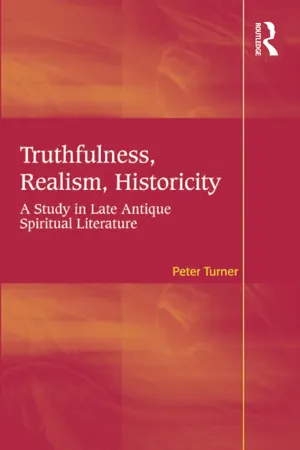
Truthfulness, Realism, Historicity
A Study in Late Antique Spiritual Literature
- 232 pages
- English
- ePUB (mobile friendly)
- Available on iOS & Android
eBook - ePub
About this book
Were holy men historical figures or figments of the theological imagination? Did the biographies devoted to them reflect facts or only the ideological commitments of their authors? For decades, scholars of late antiquity have wrestled with these questions when analysing such issues as the Christianization of Europe, the decline of paganism, and the 'rise of the holy man' and of the hagiographical genre. In this book Peter Turner suggests a new approach to these problems through an examination of a wide range of spiritual narrative texts from the third to the sixth centuries A.D.: pagan philosophical biographies, Greek and Latin Christian saints' lives, and autobiographical works by authors such as Julian and Augustine. Rather than scrutinizing these works for either historical facts or religious and intellectual attitudes, he argues that a deeper historicity can be found only in the interplay between these types of information. On the textual level, this analysis recognises the genuine commitment of spiritual authors to write truthfully and to record realistically a world felt to be replete with spiritual and symbolic meaning. On the historical level, it argues that holy men, expecting the same symbolism within their own lives, adopted lifestyles which ultimately provoked and confirmed this world view. Such praxis is detectable not only in the holy men who inspired biography but also in the period's scattered autobiographical writings. As much a historical as a textual phenomenon, this spiritually-minded scrutiny of the world created interpretations which were always open and contested. Therefore, this book also associates spiritual narrative texts with only one possible voice of religious experience in a constant dialogue between believers, opponents, and the sceptical undecided.
Trusted by 375,005 students
Access to over 1.5 million titles for a fair monthly price.
Study more efficiently using our study tools.
Information
Chapter 1
Hagiography – A Truth-telling Genre?
Defining Truthfulness
In 440 A.D., Theodoret of Cyrus wrote a Religious History dedicated to the most prominent monks that had lived in his homeland of northern Syria over the preceding century.1 Like many late antique authors, he prefaced his work with a substantial prologue which introduced his subject matter, himself as author, his motivation for writing and his literary strategy. The central message of the prologue was that an absolute commitment to truthfulness pervaded the entire work.
This bold assertion contained several subtle strands. At its heart was the extraordinary nature of his inspiration – ‘excellent men, the athletes of virtue’ (ἀρίστων ἀνδρῶν καὶ τῆς ἀρετὴς ἀθλητῶν).2 Such spiritual excellence demanded to be recorded for posterity, even if ‘mere narration’ could only be a substitute for the lives themselves. Theodoret also sought to win the reader’s trust by explaining his meticulous research methods. He had recorded only events to which he was eye-witness, or which he had heard about from trustworthy associates of the monks themselves. He could maintain with confidence, therefore, that the events he recorded demanded belief no less urgently than those of the Bible. For a reader to doubt them would be the equivalent of doubting ‘the truth of what took place through Moses, Joshua, Elijah and Elisha … the working of miracles that took place through the sacred Apostles’.3
As we shall shortly see, such assurances of truthfulness are a common and characteristic feature of late antique hagiography. They have, however, been subjected to little systematic, comparative analysis. It is not hard to see why this should be the case for those historians who approach the texts in the search for hard data. A good example of such an approach is a recently published lecture series by T.D. Barnes. Beginning by contesting very specific claims within hagiographies, for example points of chronology, Barnes moves to a more general statement about the genre by arguing that many texts contain far more fabrication than has often been acknowledged.4 Whilst Barnes does not ignore assurances of truthfulness entirely, he exploits them principally as further evidence of authorial disingenuousness by juxtaposing them with information he holds to be fallacious.5 Seen from this positivistic perspective, hagiographical guarantees of truthfulness can appear incongruous and indeed hollow, or at very least peripheral to the main interest of the text.
Since very few people would claim that all information contained within hagiographies is either entirely true or entirely false, the positivist project of assessing and separating both types of content is legitimate. However, the present chapter neither discredits nor pursues this approach; its aims are simply different. Rather than moving from points of detail to general evaluations of the works as historical documents, it begins with a systematic and comparative analysis of the various guarantees of truthfulness offered by hagiographers. This is partly because the consistency and sophistication of these statements demands our attention; it is also because they are usually the first part of a work encountered by a reader, located as they often are within prologues, and thus the nearest thing they contain to a literary definition. By beginning our examination here, the present study attempts to reflect on the way that truthfulness was professed and presented within the hagiographical genre, on the role of truthfulness in defining these texts as a genre and, subsequently, on the way in which this value was reflected throughout the work. By adopting this approach, the aim, at least initially, is to shift attention away from the relationship between the hagiographer and the information he relates, and onto the complex and mutual set of attitudes that connected him to his audience. As Averil Cameron rightly observes, the question how audiences read hagiographies and what they expected remains an area of great uncertainty.6
Theodoret’s purportedly truth-telling stance was quite typical of late antique Christian hagiography. By definition, hagiographers located their inspiration and justification in the extraordinary nature of their subjects. For the sixth-century Palestinian author Cyril of Scythopolis, for example, to record the lives of local monks could be regarded as an act of faith whose omission would be sinful, though by its very nature, any record was bound to fall short of the truth.7 Such a task demanded scrupulousness: like a bee gathering pollen he had travelled through the desert, interviewing the oldest living monks about the lives of their predecessors. Similar attitudes prevail in hagiography dedicated to more contemporaneous figures. For example, Sulpicius Severus, the first Latin Christian hagiographer, saw in Martin a Gallic hero every bit as significant as his Egyptian counterparts, and promised to record only events to which he had been eyewitness or which had been related to him by the saint himself.8
Comparable guarantees are offered in many hagiographical texts including the History of the Monks of Egypt,9 Palladius’ Lausiac History,10 and Ferrandus’ Life of Fulgentius of Ruspae.11 That the author himself was an eyewitnesses to the events he recorded, or a recipient of information from trustworthy sources, were common claims. There is no simple correlation between the intensity of these claims and either the extent of their miraculous content or the reputation for accuracy they have enjoyed in modern times; indeed, precisely because their details are challenging, miracles are often an occasion to remind readers of the hagiographer’s factual integrity. The first story in Paulinus’ Life of Ambrose, for example, is the mysterious visitation to the saint’s cradle of a swarm of bees symbolic of future literary achievements.12 But this anecdote immediately follows a specific plea by the author ‘to believe that what we say is true. And let no one think that I have put down anything which lacks truth, through the bias of love; since it is indeed better to say nothing at all than to set forth something false’.13 Similarly, although the historicity of Jerome’s Lives has been vigorously contested by modern scholars, not least because of their exaggerated and sometimes fantastical content,14 we must remember that few authors were more vigorous and explicit in defending their own works’ truthfulness.15 That these guarantees were more than introductory conventions is suggested by the fact that a number of authors, such as Cyril of Scythopolis and the author of the Lives of the Jura Fathers, intermittently reminded readers of their commitment to truthfulness during the course of the narrative.16 They might offer general assurances or defences of specific information. In a way which could be said to anticipate the isnad system of early Islamic tradition, Cyril details the chain of informants from whom he has learnt about a particular miracle.17 Such assurances are also offered by authors of miracle collections such as that of Thecla:18 works which detail the lives and achievements of saints after their physical death.
Another extremely common feature of Christian hagiography was the recognition of the limitations of the literary work. This could take several forms. Often it was very personal: many authors professed either their unworthiness to write about such great men or their inability to do so.19 For Theodoret, the sheer quantity of saints made a complete account impossible and necessitated a regional perspective;20 for Constantius, the immeasurable number of Germanus’ spiritual achievements caused a similar problem.21 These limitations too are not just mentioned at the outset, but reiterated later in the narrative.
We should not think of the admission of these limitations as merely accompaniments to the insistence on truthfulness; rather, they are a crucial aspect of it. This is shown by the many authors who in various ways point to language itself as inadequate to the task in hand: far from exaggerating the truth, they simply lack the tools to represent such great truths adequately. Within the limits of the possible, hagiography claimed to be a direct representation of the extraordinary reality of saints’ lives, or at least the external lives they had led on earth. Such a claim had major implications in terms of authorial self-perception. For Theodoret, it meant writing, or at least claiming to write, like the Evangelists whose plain style was no obstacle to recording the historical truth of Christ’s life.22 Conversely, writing in a way suitable to hagiography meant declining to write according to the established rules of poetry, history, tragedy, comedy and panegyric23 – secular genres dedicated to far lesser themes. With more or less justification, hagiographers regularly excused their own styles as rustic, whilst simultaneously portraying this as a legitimate rejection of secular culture.24 Such attitudes had deep roots in the Christian community of a classical world whose education system had for centuries been overwhelmingly literary and rhetorical in emphasis. Against this background, the truthfulness of much of the Bible had sometimes been associated precisely with its lack of literary pretensions. One might almost say that for Theodoret and others, to write about the saints required, in a very real sense, not to follow a literary tradition at all; rather, it involved claiming to commit oneself – however imperfectly – to the truth itself.25
This literary positioning of hagiographers, which might include associating their work with biblical tradition and dissociating ...
Table of contents
- Cover Page
- Dedication
- Title Page
- Copyright Page
- Contents
- Abbreviations
- Acknowledgements
- Introduction: Boethius in Exile
- PART I
- PART II
- Conclusion: Sanctity between Belief and Self-Doubt
- Bibliography
- Index
Frequently asked questions
Yes, you can cancel anytime from the Subscription tab in your account settings on the Perlego website. Your subscription will stay active until the end of your current billing period. Learn how to cancel your subscription
No, books cannot be downloaded as external files, such as PDFs, for use outside of Perlego. However, you can download books within the Perlego app for offline reading on mobile or tablet. Learn how to download books offline
Perlego offers two plans: Essential and Complete
- Essential is ideal for learners and professionals who enjoy exploring a wide range of subjects. Access the Essential Library with 800,000+ trusted titles and best-sellers across business, personal growth, and the humanities. Includes unlimited reading time and Standard Read Aloud voice.
- Complete: Perfect for advanced learners and researchers needing full, unrestricted access. Unlock 1.5M+ books across hundreds of subjects, including academic and specialized titles. The Complete Plan also includes advanced features like Premium Read Aloud and Research Assistant.
We are an online textbook subscription service, where you can get access to an entire online library for less than the price of a single book per month. With over 1.5 million books across 990+ topics, we’ve got you covered! Learn about our mission
Look out for the read-aloud symbol on your next book to see if you can listen to it. The read-aloud tool reads text aloud for you, highlighting the text as it is being read. You can pause it, speed it up and slow it down. Learn more about Read Aloud
Yes! You can use the Perlego app on both iOS and Android devices to read anytime, anywhere — even offline. Perfect for commutes or when you’re on the go.
Please note we cannot support devices running on iOS 13 and Android 7 or earlier. Learn more about using the app
Please note we cannot support devices running on iOS 13 and Android 7 or earlier. Learn more about using the app
Yes, you can access Truthfulness, Realism, Historicity by Peter Turner in PDF and/or ePUB format, as well as other popular books in History & Ancient History. We have over 1.5 million books available in our catalogue for you to explore.