- 208 pages
- English
- ePUB (mobile friendly)
- Available on iOS & Android
eBook - ePub
About this book
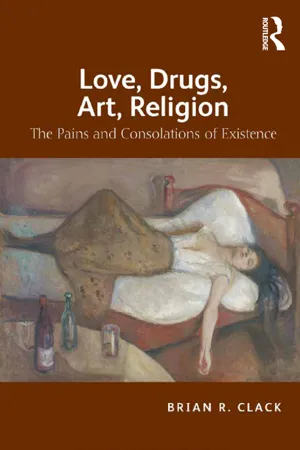
In this original and far-reaching contribution to the philosophy of religion, Brian R. Clack examines the manner in which religious belief emerges from the turbulence and anxiety of human existence. Taking his cue from Freud's suggestion that human life is so hard to bear that it requires nothing short of cultural and psychological palliative care, Clack explores each of the 'palliative measures' Freud catalogues - intoxicants, religion, art and love - and evaluates their role in the mitigation of suffering and the provision of the assistance required for an endurable life. This examination provides the context for an investigation into the meaning and function of religious belief when considered as a palliative. Clack initially subjects religion to ferocious critique, defending the psychoanalytic judgment that religious beliefs operate as wish-fulfilling illusions, but then elaborates a revised understanding of religion, one in which comforting illusions are banished and in which religious belief faces up to reality and reconciles us both to the pains and disappointments of existence and to our nullity and inevitable annihilation. in this genuinely interdisciplinary work, Clack breaks new ground by using detailed explorations of the phenomena of drug-use, romantic love and the enjoyment of art in order to throw light on the meaning and nature of religion. This book will be vital reading for anyone concerned with the fundamental questions of religious belief, the psychoanalytic approach to culture, or simply the unavoidable existential problems lying at the very heart of human life.
Information
Chapter 1
‘Life, as we find it, is too hard for us …’
Man that is born of a woman hath but a short time to live, and is full of misery.
The Book of Common Prayer
William Paley’s Natural Theology, first published in 1802, is remembered principally for an analogy drawn by the author between the world and a watch, an analogy intended to demonstrate the existence of God. The marks of contrivance so apparent in the structure of a watch (its complexity and intricacy, the interconnectedness of its parts) will lead any investigator – even one heretofore incognizant of watches and clocks – to conclude that it was put together for some purpose, put together by some intelligent designer. Since the world exhibits those self-same features demanding explanation in terms of a designer (complexity, intricacy, purposive interconnectedness), with the only difference being that of magnitude, the contrivances of nature far surpassing the contrivances of human creativity, one must concede the existence of a Creator of the world. Thus runs the familiar argument from design. There is no shortage of defenders of this kind of argument, but an intense assault upon its foundations (aimed variously by David Hume, Immanuel Kant and the Darwinian tradition) has probably undermined its effectiveness. But my intention in raising the case of Paley here has not to do with that issue. Rather, I wish to bring to prominence an aspect of Paley’s thought bearing on the vital matter of what attitude a person should take towards this world.
A standard criticism of the design argument concerns the restrictions on any conclusion that may be drawn from an observation of complexity and order in nature. Hume pointedly advanced such a criticism thus: ‘If the cause be known only by the effect, we never ought to ascribe to it any qualities, beyond what are precisely requisite to produce the effect.’1 For instance, if only one side of a set of scales is visible and it can be seen that an object weighing ten ounces is outweighed by something on the other (hidden) side, the only conclusion legitimately to be drawn concerning the hidden object is that it is heavier than ten ounces. Anything more would be mere speculation. The application of this insight to the question of design is straightforward. One might, perhaps, be justified in inferring that some designer is responsible for the order detected in nature, but nothing more substantial can be said of that being than that it is a designer. From this data alone, it cannot be said that the designer possesses omnipotence, omniscience or any of the long etcetera of attributes traditionally ascribed to the deity. To flesh out the bare idea of a designer with such a set of attributes would go well beyond the evidence at hand, and can merely be an exercise in ‘exaggeration and flattery’.2
This is not a conclusion Paley is willing to embrace, for certain features of the world warrant conclusions about the nature of the deity and the attributes properly and not arbitrarily predicated of him. One such attribute is goodness. Of course, those sympathetic to Hume will hold that the character of the world – even if this character supported the idea of design – can not support or ground any doctrine regarding divine benevolence, since the prevalence of pain and suffering must put a halt to any speculation that the creator of the universe is loving and cares about the well-being of the world’s inhabitants. The evidence would better warrant a conclusion that the designer is malevolent or (at best) indifferent to suffering. Paley does not share such qualms. An objective evaluation, stripped of affected melancholy, should reveal the truly felicitous character of nature. In giving Paley’s view of this matter I am now no longer concerned with this as data marshalled in support of the doctrine of divine benevolence. It is the view of life contained in his words that will itself be our focus of attention.
It is a happy world after all. The air, the earth, the water, teem with delighted existence. In a spring noon, or a summer evening, on whichever side I turn my eyes, myriads of happy beings crowd upon my view. ‘The insect youth are on the wing.’ Swarms of new-born flies are trying their pinions in the air. Their sportive motions, their wanton mazes, their gratuitous activity, their continual change of place without use or purpose, testify their joy, and exultation they feel in their lately discovered faculties. A bee amongst the flowers in spring, is one of cheerfullest objects that can be looked upon. Its life appears to be all enjoyment: so busy, and so pleased … If we look to what the waters produce, shoals of the fry of fish frequent the margins of rivers, of lakes, and of the sea itself. These are so happy, that they know not what to do with themselves. Their attitudes, their vivacity; their leaps out of the water, their frolics in it, (which I have noticed a thousand times with equal attention and amusement,) all conduce to show their excess of spirits, and are simply the effects of that excess.3
Paley continues in this vein for a good number of pages, detailing a picture of the blissful harmony of existence. This picture encompasses the entirety of being, applying to both human and nonhuman, young and old: ‘Happiness is found with the purring cat, no less than with the playful kitten; in the arm-chair of dozing age, as well as in either the sprightliness of the dance, or the animation of the chase.’4 Though inflated and evidently whimsical, Paley’s depiction nonetheless occupies a place in a widely accepted view of life, which shall here be called existential felicity. Such a view of things has historically found expression in manifold ways, from the judgement of the Creator on his work (‘God saw that it was good’) to the United States Declaration of Independence, in which ‘pursuit of happiness’ is regarded as an unalienable right. So here we encounter a perspective on things enshrined alike in theological doctrines, political documents, and the outlook of countless individuals: the world is good, life is a blessing, and the conditions for happiness are built into the very fabric of existence.
But what if that view is wrong? What if it is not merely an exaggeration but an error to declare the world a place conducive to happiness? What kind of lives could human beings then be expected to lead? What strategies need be employed simply to cope?
A great many writers have drawn attention to the deficiencies of a view of existence such as that expounded by Paley, highlighting instead how physical and mental suffering undermines and outbalances the fleeting pleasures offered by life. Such attacks on existential felicity have been most strongly (though by no means exclusively) advanced by that tradition of thought known as pessimism, a tradition counting among its principal figures such writers as Jean-Jacques Rousseau, Giacomo Leopardi, Arthur Schopenhauer, Thomas Hardy and Sigmund Freud.5 Indeed, Freud’s widely-read book Civilization and Its Discontents occupies a central place in the canon of pessimistic literature, and within its pages we find a most explicit negation of existential felicity: ‘One feels inclined to say that the intention that man should be “happy” is not included in the plan of “Creation”.’6 Our attention must thus turn to the range of features that might plausibly be held to work against the very possibility of human happiness. We will start with an element of our condition that even the most optimistic of individuals will need to acknowledge: suffering.
A Blighted Star, Not Sound
Early on in Hardy’s novel Tess of the d’Urbervilles, the young Tess Durbeyfield converses with her brother Abraham about the starry skies above them. Abraham persistently requests answers from his older sister about these twinklers, how far away they are, and whether God lives on the other side of them.
‘Did you say the stars were worlds, Tess?’
‘Yes.’
‘All like ours?’
‘I don’t know; but I think so. They sometimes seem to be like the apples on our stubbard-tree. Most of them splendid and sound – a few blighted.’
‘Which do we live on – a splendid one or a blighted one?’
‘A blighted one.’
‘Tis very unlucky that we didn’t pitch on a sound one, when there were so many more of ’em!’
‘Yes.’7
At the root of Tess’s judgement that our world is ‘a blighted star, and not a sound one’8 is a recognition, from her own experience, of the troubles afflicting human beings. She refers to her father’s drunkenness and her mother’s seemingly endless domestic toil, though in the context of the novel as a whole, this blighted state of things can be seen to refer to something more terrible: the extraordinary sufferings she is fated to endure.
It would seem therefore to be the phenomena of suffering and pain which principally mark our world out as being of the blighted variety, and this is a view forcefully expressed also by Hume. In the Dialogues Concerning Natural Religion, ‘the whole earth’ is depicted as ‘cursed and polluted’:
A perpetual war is kindled amongst all living creatures. Necessity, hunger, want stimulate the strong and courageous; fear, anxiety, terror agitate the weak and infirm. The first entrance into life gives anguish to the new-born infant and to its wretched parent; weakness, impotence, distress attend each stage of that life, and it is, at last, finished in agony and horror.9
Here Hume recounts how suffering permeates the entire span of an individual’s life, every moment from birth to death being accompanied by pains of distinctive kinds. Each pain a person experiences can be seen to stem from one of a number of sources, and these sources are classified by Freud in a clear threefold schema. Let us then return to Civilization and Its Discontents, the book in which this schema is advanced.
Freud’s isolation of the three directions whence suffering may arise is framed by a contrast he draws between the exacting conditions required for the sensation of happiness and the ease, on the other hand, with which unhappiness is experienced. Our individual lives, after their own fashion, constitute evidence to support this judgement. Happy experiences – a dinner party, a vacation, a wedding – require much planning (and money), whereas it takes no such exertion to experience the misery of a disease or an illness, and death may be brought about by something as small as ‘a hair, a fly, an insect’.10 Freud, however, alerts our attention to something else. Intense enjoyment, he says, can be derived only from a contrast, and not from a steady state of things, for happiness comes from the ‘satisfaction of needs which have been dammed up to a high degree, and it is from its nature only possible as an episodic phenomenon’.11 One may here think of the enjoyment of eating after a day without food, or the intensity of an orgasm following a period of sexual abstinence and frustration. Any prolonged experience, contrariwise, can only bring mild contentment, irritation even, and he reminds us of Goethe’s remark that ‘nothing is harder to bear than a succession of fair days’.12 The contrast of happy experiences with painful ones is therefore acute. While our possibilities of happiness are restricted by our very constitution (since tho...
Table of contents
- Cover Page
- Title Page
- Copyright
- Contents
- List of Figures
- Preface
- 1 ‘Life, as we find it, is too hard for us …’
- 2 The First Palliative: Intoxicants
- 3 The Second Palliative: Religion
- 4 The Third Palliative: Art
- 5 The Fourth Palliative: Love
- 6 Religion beyond Illusion
- Bibliography
- Index
Trusted by 375,005 students
Access to over 1.5 million titles for a fair monthly price.
Study more efficiently using our study tools.
Frequently asked questions
Yes, you can cancel anytime from the Subscription tab in your account settings on the Perlego website. Your subscription will stay active until the end of your current billing period. Learn how to cancel your subscription
No, books cannot be downloaded as external files, such as PDFs, for use outside of Perlego. However, you can download books within the Perlego app for offline reading on mobile or tablet. Learn how to download books offline
We are an online textbook subscription service, where you can get access to an entire online library for less than the price of a single book per month. With over 1.5 million books across 990+ topics, we’ve got you covered! Learn about our mission
Look out for the read-aloud symbol on your next book to see if you can listen to it. The read-aloud tool reads text aloud for you, highlighting the text as it is being read. You can pause it, speed it up and slow it down. Learn more about Read Aloud
Yes! You can use the Perlego app on both iOS and Android devices to read anytime, anywhere — even offline. Perfect for commutes or when you’re on the go.
Please note we cannot support devices running on iOS 13 and Android 7 or earlier. Learn more about using the app
Please note we cannot support devices running on iOS 13 and Android 7 or earlier. Learn more about using the app
Yes, you can access Love, Drugs, Art, Religion by Brian R. Clack in PDF and/or ePUB format, as well as other popular books in Philosophy & Religion. We have over 1.5 million books available in our catalogue for you to explore.