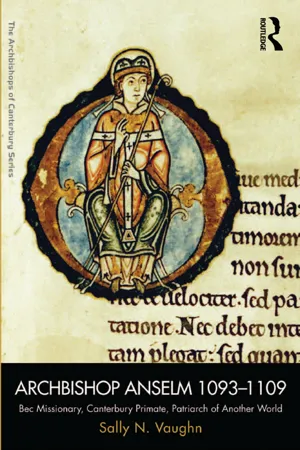
eBook - ePub
Archbishop Anselm 1093–1109
Bec Missionary, Canterbury Primate, Patriarch of Another World
- 312 pages
- English
- ePUB (mobile friendly)
- Available on iOS & Android
eBook - ePub
Archbishop Anselm 1093–1109
Bec Missionary, Canterbury Primate, Patriarch of Another World
About this book
St Anselm's archiepiscopal career, 1093-1109, spanned the reigns of two kings: William Rufus and the early years of Henry I. As the second archbishop of Canterbury after the Norman Conquest, Anselm strove to extend the reforms of his teacher and mentor at Bec, and his predecessor at Canterbury, Archbishop Lanfranc. Exploring Anselm's thirty years as Prior and Abbot of the large, rich, Norman monastery of Bec, and teacher in its school, this book notes the wealth of experiences which prepared Anselm for his archiepiscopal career--in particular Bec's missionary attitude toward England. Sally Vaughn examines Anselm's intellectual strengths as a teacher, philosopher and theologian: exploring his highly regarded theological texts, including his popular Prayers and Meditations, and how his statesmanship was influenced as he dealt with conflict with the antagonistic King William Rufus. Vaughn argues that Rufus's death influenced Anselm's rivalry with King Henry I and fostered a more subdued and civil conflict between Anselm and Henry which ended with cooperation between king and archbishop at the end of Anselm's life. King and archbishop became'yoked together as two oxen pulling the plow of the church through the land of England'. Anselm's final years at the pinnacle of power reveal a superb administrator over Canterbury and Primate over the churches of all Britain, in which position his followers described him as 'Pope of another world'. The final section includes a selection of original source material including archiepiscopal letters drawn primarily from Lambeth Palace Library.
Information
The Narrative, Anselm’s Archiepiscopate
Chapter 1
Introduction: Anselm’s Story through his Letters in Lambeth 59
Shortly after his 1079 election as abbot of Bec in Normandy, probably in 1080, Anselm visited England, where, as a good abbot, he needed to look after Bec’s many lands “for the common good of the brethren” of Bec. But he also wished to go to England for another reason, no less strong: his desire to see his Bec teacher and dear friend Archbishop Lanfranc of Canterbury. The monks of Canterbury welcomed him joyfully and showed him great honor, whereupon he preached a sermon to them on the greater good of loving another, as they had shown their love for him, than of receiving such a gift of love. Then the Canterbury monks received him into their community, where he lived among them as one of them, talking to them daily in the chapter house and cloister. Moreover, he began preaching to England’s people throughout the land on the virtues of living a good life.1 Thus Abbot Anselm of Bec in Normandy became a monk of Canterbury long before he became England’s archbishop, and immediately assumed duties appropriate to his future archiepiscopal functions.
Anselm’s visit to England in 1080 clearly foreshadows his election as archbishop of Canterbury thirteen years later, in 1093, and suggests that Lanfranc—and the monks of Canterbury—may well have intended for Anselm to succeed him as England’s metropolitan and primate, preparing the way by inducting him as a Canterbury monk and sending him forth to perform archiepiscopal duties. Thus the story of Anselm’s archiepiscopate must begin well before his election and consecration, and include his Bec years in which he maintained close ties with Lanfranc in England. This book will chronicle Anselm’s archiepiscopal career as the second Norman primate of England, as archbishop of Canterbury. First, this introduction will enumerate the relevant sources available for a study of Anselm’s archiepiscopate, including primarily his letters, some of which we have selected carefully to illustrate his career and placed in Part II of this book, in the original Latin and in English translation. Other sources, especially the two biographies written by Anselm’s student and secretary Eadmer, require analysis as to their usefulness. I will also suggest in this chapter the hitherto unsuspected importance of William of Malmesbury’s two histories to Anselm’s archiepiscopal story. Of the hundreds of books and articles written about Anselm, we will select those most relevant to his archiepiscopate for discussion. Other sources pertaining more directly to each chapter will be discussed in those relevant chapters.
In the second chapter, we will look at the foreshadowing of Anselm’s career in the Bec sources, where there seems to have been a sense of missionary endeavor toward Normandy itself, as well as, later, toward England. The founders and rulers of Bec, as their Bec biographers assert, intended to reform Normandy almost from Bec’s foundation. Later, they would think of England as a barbarous land also needing reform, as we will see from the first selection in Part II, an excerpt from The Life of Herluin by Bec monk and abbot of Westminster Gilbert Crispin. In Chapter 3, we will see that Anselm’s election as archbishop and primate prompted him to think deeply about this role, especially after the crisis and turmoil surrounding his election. He stated the outlines of his theoretical vision of his primacy, which can be augmented through his charters, letters, and Canterbury chronicles. Chapter 4 will examine the first phase of Anselm’s tenure, as archbishop under King William Rufus, in which he described himself as an old sheep yoked to a wild bull—indeed an apt description of his relationship to that king. At this point in the narrative, we will insert Chapter 5 as an Interlude: a reflection upon the death of William Rufus and its enormous impact on the reign of his brother and successor King Henry I.
In the second phase of Anselm’s archiepiscopal rule, examined in Chapter 6, we will see that after a period of some debate, Anselm did succeed in establishing with King Henry I a more ideal relationship, which he had earlier envisioned as king and archbishop as being like two oxen pulling the plow of the church through the land of England. The reigns of these two kings involved a papal challenge to their royal powers over the churches and churchmen in their realm, commonly known as the English Investiture Controversy. I have argued elsewhere that this controversy was in fact a three-way struggle between king, pope, and primate over the rights and powers of each against the claims of the other two participants.2 Thus Anselm had a view of himself as possessing certain primatial powers, independent of the papacy, that constituted him as Patriarch of Another World. Chapter 7 will try to reconstruct this vision, largely through his successes in bringing it about, as he brought his own primacy to its height—a level of achievement above that of his predecessor Lanfranc, and never again reached by his successors. In the midst of these efforts, he faced the defiant resistance of several archbishops of York, which is often seen as the main focus of his primacy; but I will argue that it was rather a side issue within a larger theoretical construct of Anselm’s vision of his primatial rule over “another world.”
In the midst of these lofty visions of theories and rights of the rulers of church and state, and missions of high diplomacy, Anselm must deal with the necessities of daily life both for the monks committed to his care and for the churches committed to his care, which will be the focus of Chapter 7. Anselm was a superb administrator at Canterbury on this level of detail, conscientiously winning, maintaining, or retrieving specific rights of his churches on the local level of rights to manors, taxes, mills, trade, and other sources of income for Canterbury, including the building and rebuilding of many churches—not least Canterbury Cathedral. In these struggles of daily life, he could call on a host of Bec monks now installed as abbots of most of England’s monasteries.
Anselm himself is still a figure of much renown, not only as archbishop of Canterbury, but also, and perhaps primarily, as a profound theologian. But Anselm resembles a renaissance man, with many and varied accomplishments in many different fields, famed widely in his own lifetime for his profound theological treatises, his beautiful and inspiring prayers and meditations, his teaching in the school of Bec, his discourse on friendship and contributions to the consciousness of the individual, and finally his administration of the metropolitan see of Canterbury. Anselm’s most well-known modern biographer is Sir Richard Southern, whose 481-page comprehensive study of Anselm’s life, Saint Anselm: A Portrait in a Landscape,3 is the starting point for any student of Anselm. This fine analysis deals with Anselm holistically, weaving together Anselm’s Bec years as a teacher and theologian with his more publicly involved Canterbury years as the primatial director of the Church of England, in which Southern seeks to balance the various sides of Anselm—theologian, teacher, friend, monk, correspondent, and finally archbishop and primate—to reveal all the various sides of Anselm’s personality and career. Brian Patrick McGuire wrote extensively on Anselm’s cultivation of friendship,4 and Colin Morris saw Anselm as instrumental in the development of the medieval idea of the individual.5
Southern’s earlier work, Saint Anselm and his Biographer,6 was Southern’s first version of Anselm’s story, which he expanded and amended in this second work. The earlier work, however, still remains very valuable, especially in its study of Anselm’s earliest biographer, his secretary Eadmer, and Southern’s assessment of Anselm’s students. Southern discussed Anselm’s archiepiscopal career in some detail, in both of these major works. His interpretation followed closely the testimony of Eadmer, especially in St. Anselm and his Biographer, seeing Anselm as mainly a teacher and theologian who hated the secular world, and especially involvement in its politics. In politics, Southern saw Anselm as rather helpless and at the mercy of forces he could not control, uninvolved and, pawnlike, manipulated by strong and ruthless political players. But in the end, Anselm came out victorious over such forces. Southern’s interpretation served as a counterpoint to a slightly earlier book by Norman Cantor, Church, Kingship and Lay Investiture in England, 1089–11357 (which Southern did not mention), in which Cantor saw Anselm quite differently, as an effective politician and a political player in bringing the Investiture Controversy to a successful conclusion for the papacy.
Southern’s view prevailed for some thirty years, until I partially revived Cantor’s political view of Anselm, but saw him rather as a player in a three-way struggle between king, pope, and primate, having his own agenda against both king and pope, and, as an intelligent and shrewd politician, outwitting both to bring about a conclusion to his liking.8 This book also portrayed Eadmer’s accounts as more complicated and artful than the eyewitness observations of a simple monk that Southern portrayed, and revived and intensified the debate over Anselm’s nature and character in his role as archbishop, with many vocal adherents on both sides of the issue. This present book will attempt to clarify and expand the argument for Anselm’s conscious political and administrative effectiveness, after many additional years of study and contemplation. But one must always keep in mind that Anselm was a man of many varied interests and achievements, with so many different sides to his life-long career and interests and activities that, as Southern argued, to focus ...
Table of contents
- Cover Page
- Half Title Page
- The Archbishops of Canterbury Series
- Title Page
- Copyright Page
- Contents
- List of Illustrations
- Source Abbreviations
- Prologue and Acknowledgments
- Part I The Narrative, Anselm's Archiepiscopate
- Part II Illustrative Sources, Anselm's Letters from Lambeth 59
- Select Bibliography
- Index
Trusted by 375,005 students
Access to over 1.5 million titles for a fair monthly price.
Study more efficiently using our study tools.
Frequently asked questions
Yes, you can cancel anytime from the Subscription tab in your account settings on the Perlego website. Your subscription will stay active until the end of your current billing period. Learn how to cancel your subscription
No, books cannot be downloaded as external files, such as PDFs, for use outside of Perlego. However, you can download books within the Perlego app for offline reading on mobile or tablet. Learn how to download books offline
Perlego offers two plans: Essential and Complete
- Essential is ideal for learners and professionals who enjoy exploring a wide range of subjects. Access the Essential Library with 800,000+ trusted titles and best-sellers across business, personal growth, and the humanities. Includes unlimited reading time and Standard Read Aloud voice.
- Complete: Perfect for advanced learners and researchers needing full, unrestricted access. Unlock 1.5M+ books across hundreds of subjects, including academic and specialized titles. The Complete Plan also includes advanced features like Premium Read Aloud and Research Assistant.
We are an online textbook subscription service, where you can get access to an entire online library for less than the price of a single book per month. With over 1.5 million books across 990+ topics, we’ve got you covered! Learn about our mission
Look out for the read-aloud symbol on your next book to see if you can listen to it. The read-aloud tool reads text aloud for you, highlighting the text as it is being read. You can pause it, speed it up and slow it down. Learn more about Read Aloud
Yes! You can use the Perlego app on both iOS and Android devices to read anytime, anywhere — even offline. Perfect for commutes or when you’re on the go.
Please note we cannot support devices running on iOS 13 and Android 7 or earlier. Learn more about using the app
Please note we cannot support devices running on iOS 13 and Android 7 or earlier. Learn more about using the app
Yes, you can access Archbishop Anselm 1093–1109 by Sally N. Vaughn in PDF and/or ePUB format, as well as other popular books in Theology & Religion & Christian Denominations. We have over 1.5 million books available in our catalogue for you to explore.