- 198 pages
- English
- ePUB (mobile friendly)
- Available on iOS & Android
eBook - ePub
About this book
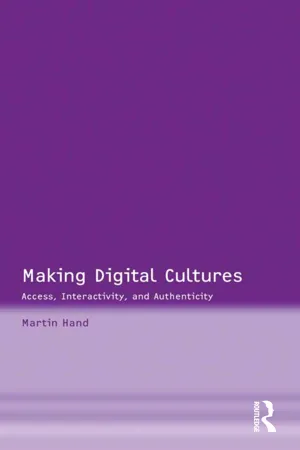
Many people in the West or global North now live in a culture of 24/7 instant messaging, iPods and MP3s, streamed content, blogs, ubiquitous digital images and Facebook. But they are also surrounded by even more paper, books, telephone calls and material objects of one kind or another. The juxtaposition and proliferation of older and newer technologies is striking. Making Digital Cultures brings together recent theorizing of the 'digital age' with empirical studies of how institutions embrace these technologies in relation to older established technological objects, processes and practices. It asks how relations between 'analogue' and 'digital' are conceptualized and configured both in theory and inside the public library, the business organization and the archive. With its direct engagement with new media theory, science and technology studies, and cultural sociology, this volume will be of interest to scholars and students in the areas of media and communication and science and technology studies.
Information
Chapter 1
Making Digital Cultures: An Introduction
Introduction
This book examines how digital technologies and techniques are being enfolded into the fabric of specific institutional and broader cultural environments. It is about the cultural significance of shifts from analogue to digital but it is not about the triumph of digitization in any homogenous sense. It is often about the rather uneasy alliances between analogue and digital objects, practices and processes, and how we might understand this from both the lofty heights of theory and the grounded practices of those directly engaged with taking the digital turn. There is no definitive model of ‘digital culture’ and as such the book tries to explore and illuminate emerging tendencies at different moments and in different places, and from different theoretical angles. Instead of ‘reading backwards’ and finding the ends of such efforts, it looks at the digital turn inside three sites – the public library, the business organization, and the national archive – asking what is being made, how this is or is not achieved, and who or what we might consider to be the architects. For some of the advocates and detractors involved, shifting toward digital culture is primarily about the provision of ‘access’; in other environments it involves engagements with novel business practices in relation to that ‘interactive’ digital culture ‘out there’; for others it is wrapped in unresolved issues of memory making, authenticity and the possibility of managing histories. In examining the often diverse range of efforts to bring digital cultures into being, to reorganize existing institutional and other environments around sets of digital ideals, this book presents a different take on some of the dynamics of the seemingly inevitable ‘convergence culture’ in the twenty first century (Jenkins 2006).
To question ubiquity and inevitability might appear a strange way of proceeding in that anecdotally at least those in the west or global north appear to be fully immersed in all things digital. Many people now live in a culture of 24/7 instant messaging, iPods and mp3’s, streamed content, blogs, ubiquitous digital images, and Facebook. It is noticeable that many more environments involve digital media of some sort, from the routine gathering of data, the ubiquity of software, to the presence of wireless technologies. It is also the case that increasingly, cultural, social, economic and political issues and concerns involve digital media, where digital media is both the channel and forms the central topic of discussion. This is most acute when an ‘event’ in news journalism becomes both dispersed through digital media (blogs, cameraphone images, web based commentary) and in turn invites reflection upon those media and their role in shaping the event, its reception and its ongoing reinterpretation. In other words, the popular notion that digitization is having a major impact in almost all areas of everyday life is writ large and needs taking seriously. But we are also surrounded by even more paper, books, telephone calls, and material objects of one kind or another.1 The juxtaposition of older and newer technological objects and practices is striking and it is this that provides the backdrop to this book. In the book, I bring together recent theorizing of the novelty of the ‘digital age’ with empirical studies of how different institutions are adopting these technologies in relation to older established technological processes and practices.
There is a plurality of possible understandings of ‘digital culture’. But despite such a conventional observation, debates about digital culture do tend to have cohered rather firmly around three central and interrelated issues which form the narrative structure of the book: access, interactivity, and authenticity. I will simply introduce these key ‘motifs’ here.
Firstly, it has become clear that there are hugely significant social, political and economic resources in digital form but they are differentially located, managed and accessed. Within public policy and among those concerned with developing inclusive social policy it is thought that as many people as possible need access to these benefits in order to fully participate in digital culture. Such benefits might be educational and other governmental services, commodities, knowledge resources, popular culture, and so on. Obviously, as I will discuss, there are serious debates about quite what the benefits of digital information are, and how access might be organized, and so on. But there are few in social theory or in public policy who do not advocate universal public access to digital culture. Alongside the simple provision of information there are implications for what kinds of skills and competence are required, on the part of institutions and citizens, and what implications that has for modes of organization and identity.
Secondly, it is commonly argued that what is being accessed and how it is being accessed is qualitatively different from pre-digital resources and media in that it involves a high degree of interactivity. Such digitally enabled interactivity is thought to produce different relations between state and citizen, producer and consumer, culture and technology. It arguably transforms the roles of institutions, and is enabling a very different kind of culture to emerge, for good or ill. While there are many models or diagrams of interactivity, as we shall see, its pervasiveness as an idea is remarkable. The relationship between rhetorics, techniques and practices of interactivity are complicated and highly contested.
Thirdly, there seems to be a large question mark over the authenticity of digital culture in comparison to pre-digital or non-digital culture. There are complex questions about recognition, originality, truth, history, and knowledge, in relation to the character of digital information culture, when positioned against a model of non-digital culture. This is partly a cyclical argument about ‘dumbing down’, of ‘banalization’ and so on, but there is more to it than that. While the general metaphor of ‘information overload’ is less common today, the idea that the increasing quantity of information in whatever form has a detrimental effect on the quality of cultural content is a continual theme whether in entertainment, education, politics or contemporary art. Moreover, the idea of originality is thought anachronistic in an age of ubiquitous manipulation.
Of course, while these motifs have a contemporary resonance they also have longer histories partly related to disciplinary orientations and agendas in the social sciences and humanities. The theme of access is firmly tied to ongoing debates about the relationships between technology and democracy, both in the realm of political empowerment and cultural production. The notion of interactivity – especially between human and machine – can be located within computer and information science but also has a longer history within museology and literary criticism. Authenticity, and the more general concern about the fate of meaning under technology, has been an ongoing preoccupation, particularly within critical theories of modernity, technology and culture. So, there’s nothing new about these concerns when considered in a rather general sense, but they do take new forms, in relation to novel and not so novel circumstances. It is the specific ways in which these are assembled, disassembled, and re-assembled – ‘reshuffled’ to borrow from Latour (2005) – that is of interest here. In other words, how digital cultures are being ‘made’ in this sense is the primary occupation.
What Does Digital Mean?
Digital information exists as binary digits of information, either 0s or 1s, sequences of which are usually called binary code or bytes. Digitization, then, refers to the process of converting different forms of information – and this might include sounds, images, texts, and so on – into this code. This information can then be stored, delivered, and received in digital form. Staying with this ‘technical’ definition there are some immediate implications. One is that the information has, apparently, no particular relationship to the system within which it is stored or through which it moves. The same sound recording can be stored via compact disc or mp3 file, played through streaming media player, iPod, and so on. A second implication is that in theory all information becomes ‘the same’ and can be produced and distributed on a scale and with a rapidity that is unprecedented. A third implication is the high level of rewriting or manipulation that can occur when there is an underlying code. The concepts of ‘encoding’ and ‘decoding’ in cultural studies take on a radically different hue in this regard. But even these claims to technical novelty are hotly disputed from the outset in media theory. Where some argue that the discrete nature of digital media is novel, others suggest that this is no different from cinema. Some claim the convergence of multiple media to be novel; others cite the medieval manuscript as not so far removed. What is also immediately apparent is how such claims are wrapped in broader cultural promises and threats which relate to the histories of computing and media and to the imaginary futures of digital culture promoted by various actors. In this sense, I take digital culture to be far more than the switch from analogue formats to digital ones. Digitization is a cultural problematic in the broadest sense: it concerns the technicality of contemporary politics, society and culture. There is scarcely an aspect of contemporary culture that has not been discussed in terms of digitization.
Stating that there is no definitive model of digital culture but that we need to nonetheless explore it requires further explanation. We can begin with the general idea that ‘culture’ in a number of senses is increasingly digitally mediated, and that many digital technologies are increasingly ‘cultural’ in their form and effects – processes so central to much institutional discourse and practice that the moniker ‘digital cultures’ is thought to be justified as a description. Indeed, some have argued that new digital media have, in part, redefined what culture is:
Digitality can be thought of as a marker of culture because it encompasses both the artefacts and the systems of signification and communication that most clearly demarcate our contemporary way of life from others (Gere 2002: 12).
In a more sociological vein, there has been an explosion of interest in the ‘digital age’, ‘information age’, ‘technoculture’, and so on in recent years. Information and communication technologies, the internet in particular, are commonly associated with a variety of dramatic social and cultural changes. This is often most acute in discussions about the impact of digital technologies upon traditional institutional identities and practices, and the consequences for citizenship and selfhood more generally. We hear of the irrevocable disembedding and deterritorialization of existing social relations within the generalized ‘flows’ of global information culture (Castells 1996; Lash 2002; Poster 2006).
One of the key problematics of emerging digital cultures is that they are mostly concerned with establishing the relations between analogue and digital materials, ideals and practices. The precise ways in which these relations are being organized and managed forms the core of this book. This is at odds with both ‘revolutionary’ accounts of celebration or lament, and the ‘continuity’ accounts of conservation or degradation. So, why call them ‘digital cultures’? Well, the emphasis is upon ‘making digital cultures’, and in a way this is what is being attempted, experiments in becoming more digital less analogue. It is argued that sets of ideals that have become attached to digital technology are informing institutional change. But, it does not suggest that this is being achieved in any simple manner or at all necessarily, and certainly not that there is any clear consensus as to what is being achieved and what the effects might be. This leads to the question of what ‘culture’ is taken to be in this book.
What is Culture?
Most academic texts about ‘culture’ begin with the observation that it is an especially difficult concept to define, going on to cite Williams (1983: 87) famous observation in Keywords that ‘culture’ is thought to be ‘one of the two or three most complicated words in the English language’. Without simply repeating etymological senses or well-worn debates here it is necessary to offer an initial clarification of the senses in which the term is to be used in this book, although these will be fully articulated in Chapters 2 and 3. I use the term in its more anthropological sense of ‘forms of life’, encompassing all aspects of our lived experience whether they be deemed ‘ordinary’ or ‘sublime’. This is in contrast to definitions that refer to ‘the arts’ or to the aesthetic components of symbolic exchange and would encompass all institutional and ordinary conduct, structures and modes of organization. In particular, I see ordinary and often invisible conventions and routines as equally constitutive and meaningful as the more conspicuous aspects of cultural display, identity, and so on. I want to stress and elaborate two further orientations here. First, such forms of life are more or less ‘produced’ and ‘organized’ in a Foucauldian sense; our lived experiences are technically shaped and ordered through historically specific machineries. Second, such forms of production and ordering are uneven and have a specificity that needs to be empirically grounded, where as Latour has argued ‘Culture does not act surreptitiously behind the actor’s back. The most sublime production is manufactured at specific places and institutions’ (2005: 175). I will elaborate briefly on these issues here, and how they relate to questions of digitization.
Culture is Technology Made Durable
Throughout the book I draw upon literature that theorizes culture as always a question of technology. Culture is a contingent arrangement of artefacts, knowledge, discourses, and practices within a given site. Sandywell (1996) emphasizes the point here in historical terms:
In short, knowledge systems and technologies must be approached as reflexive media of human evolution…At all costs we must avoid technologism or the romanticism which rejects artefacts and instruments as alienating the human spirit. In historical fact we both act and think only by means of implicit or explicit technical logics – understanding that the vast sphere indexed by the Greek word ‘techne’ represents a complex history of reflexive self-definition (Sandywell 1996: 33).
In Sandywell’s account, then, culture is the available descriptive repertoires and everyday competencies of actors made possible, in part, through existing technical arrangements (institutional and organizational forms of life). That is, we should think of social and cultural life as the available apparatuses of definition, exploration and experience as ‘every aspect of human reality…are historical events mediated by cultural systems embodied in the stock of available technologies and corresponding interpretation systems (Sandywell 1996: 33). Or as Don Idhe states ‘the technological form of life is part and parcel of culture, just as culture in the human sense inevitably implies technologies’ (1990: 20). In its post-Foucauldian variant, there are only ‘cultural technologies’ which are governmental in that they actively shape or guide the possibilities of everyday conduct. Nikolas Rose (1995: 300) has argued convincingly that the history of who we think we are is not so much a matter of ideas but of technologies. By this he means technologies as ‘instruments’, which may be intellectual discourses as much as practical devices which shape the ways in which we can be human. When we isolate an aspect of technology, such as digital code for example, we ignore the other elements which constitute it; the ways of doing things that are coupled with it, the roles humans are expected to play in relation to it, the practices of the self which orientate around it, and so on. For Rose (1999) and others such as Dean (1999) and Barry (2001) technologies conceived in this way are inextricably cultural and governmental. They do nothing less than enable ‘things to be thought’ and skills to be learned. As Foucault observed, a range of technologies work together in producing culture as increasingly governmentalized forms of life (Foucault 1988: 18). This emphasis on the technicality of culture has also found its home within Cultural Studies. I draw upon this conception of culture in terms of the detailed routines and operating practices of cultural institutions as used by Bennett (1998):
…since cultural resources are always caught up in, and function as parts of, cultural technologies which, through the ordering and shaping of human relations they effect, play an important role in organizing different fields of human conduct (82).
I will argue that many institutions are currently preoccupied with the promises and threats of digitization. If, as suggested above, technologies are inseparable from institutional and organizational cultures then we would expect digitization to bring alternative cultural conventions and practices into being. This is be explored though two related dimensions in Chapters 2 and 3. The first is the narrative positioning of digitization within intellectual discourse. This has a number of significant elements to it. One is theoretical, concerned with how digital culture has been positioned in contrast to analogue culture, in terms of the dominant metaphors and tropes used to signify such differences. Another is historical; to do with how academic thinking about digital culture has itself shifted in relation to the pace and proliferation of digital machines. Indeed, for some, Foucauldian analyses of this kind are outmoded as more cultural objects and practices become informationalized (see Lash 2002).
The issue of narrative is significant throughout as I go on to argue that dominant tropes do not simply live in the academy: they ‘script’ digitization in particular ways, and operate as rhetorical vehicles for institutional actors seeking to embrace and implement digitization for locally specific ends. In that sense, these ‘narratives of promise and threat’ tells us something about digital culture at a general level and are also performative in the sense of providing some of the conceptual resources through which people make sense of what is going on ‘out there’. As has been recently argued by Gere:
But technology is only one of a number of sources that have contributed to the development of our current digital culture. Others include techno-scientific discourses about information and systems, avant-garde art practice, counter-cultural utopianism, critical theory and philosophy (Gere 2002: 14).
The second dimension is the character of digital experimentation and invention occurring within relatively bounded institutional cultures. In post-Foucauldian analyses there is a contingency but often a stasis and solidity implied in both the arrangements which constitute cultural technologies but also in the forms of engagement that might take place. We rarely learn, for example, about the ways in which practitioners of various kinds go about assembling and maintaining such arrangements or how subject positions may or may not be taken up. I will argue that digital cultures have to be ‘made’, and this involves ongoing efforts to force together disparate elements into a coherent scheme within a given set of historically constituted boundaries. In the cases highlighted here, institutional cultures are being reorganized around contested notions of the digital. These are moments where some of the elements making up these sites are temporarily ‘reshuffled’ (Latour 2005), where specific innovations make visible the often...
Table of contents
- Cover Page
- Title Page
- Copyright Page
- Contents
- List of Figures
- List of Tables
- Acknowledgments
- 1 Making Digital Cultures: An Introduction
- 2 Hardware to Everyware: Narratives of Promise and Threat
- 3 On the Materials of Digital Culture
- 4 A People’s Network: Access and the Indefiniteness of Learning
- 5 Becoming Direct: Interactivity and the Digital Product
- 6 Lost in Translation: Authenticity and the Ontology of the Archive
- 7 Conclusion: Loss and Recovery in the Digital Era
- Bibliography
- Index
Trusted by 375,005 students
Access to over 1.5 million titles for a fair monthly price.
Study more efficiently using our study tools.
Frequently asked questions
Yes, you can cancel anytime from the Subscription tab in your account settings on the Perlego website. Your subscription will stay active until the end of your current billing period. Learn how to cancel your subscription
No, books cannot be downloaded as external files, such as PDFs, for use outside of Perlego. However, you can download books within the Perlego app for offline reading on mobile or tablet. Learn how to download books offline
Perlego offers two plans: Essential and Complete
- Essential is ideal for learners and professionals who enjoy exploring a wide range of subjects. Access the Essential Library with 800,000+ trusted titles and best-sellers across business, personal growth, and the humanities. Includes unlimited reading time and Standard Read Aloud voice.
- Complete: Perfect for advanced learners and researchers needing full, unrestricted access. Unlock 1.5M+ books across hundreds of subjects, including academic and specialized titles. The Complete Plan also includes advanced features like Premium Read Aloud and Research Assistant.
We are an online textbook subscription service, where you can get access to an entire online library for less than the price of a single book per month. With over 1.5 million books across 990+ topics, we’ve got you covered! Learn about our mission
Look out for the read-aloud symbol on your next book to see if you can listen to it. The read-aloud tool reads text aloud for you, highlighting the text as it is being read. You can pause it, speed it up and slow it down. Learn more about Read Aloud
Yes! You can use the Perlego app on both iOS and Android devices to read anytime, anywhere — even offline. Perfect for commutes or when you’re on the go.
Please note we cannot support devices running on iOS 13 and Android 7 or earlier. Learn more about using the app
Please note we cannot support devices running on iOS 13 and Android 7 or earlier. Learn more about using the app
Yes, you can access Making Digital Cultures by Martin Hand in PDF and/or ePUB format, as well as other popular books in Social Sciences & Media Studies. We have over 1.5 million books available in our catalogue for you to explore.