eBook - ePub
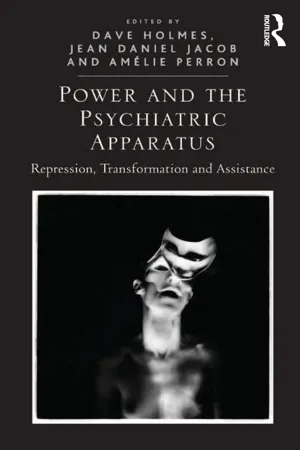
Power and the Psychiatric Apparatus
Repression, Transformation and Assistance
- 352 pages
- English
- ePUB (mobile friendly)
- Available on iOS & Android
eBook - ePub
Power and the Psychiatric Apparatus
Repression, Transformation and Assistance
About this book
Drawing on a broad range of approaches in the fields of sociology, anthropology, political science, history, philosophy, medicine and nursing, Power and the Psychiatric Apparatus exposes psychiatric practices that are mobilized along the continuum of repression, transformation and assistance. It critically examines taken for granted psychiatric practices both past and current, shedding light on the often political nature of psychiatry and reconceptualizing its central and sensitive issues through the radical theory of figures such as Foucault, Deleuze and Guattari, Goffman, and Szasz. As such, this ground-breaking collection embraces a broad understanding of psychiatric practices and engages the reader in a critical understanding of their effects, challenging the discipline's altruistic rhetoric of therapy and problematizing the ways in which this is operationalized in practice. A comprehensive exploration of contested psychiatric practices in healthcare settings, this interdisciplinary volume brings together recent scholarship from the US, Canada, the UK, Europe and Australia, to provide a rich array of theoretical tools with which to engage with questions related to psychiatric power, discipline and control, while theorizing their workings in creative and imaginative ways.
Information
Repression
Chapter 1
Varieties of Psychiatric Criticism1
The American people have always been anxious to know what they shall do with us. … I have had but one answer from the beginning. Do nothing with us! Your doing with us has already played the mischief with us. … All I ask is, give him a chance to stand on his own legs! Let him alone! … What I ask for the Negro is not benevolence, not pity, not sympathy, but simply justice. (Frederick Douglass 1865)2
Introduction
In the eighteenth century, Americans considered the right to liberty – called “unalienable” in the Declaration of Independence – one of their most important moral values and legal protections from despotism. Today, they consider the psychiatrist’s right to protect them from being dangerous to themselves (or others) – called civil commitment – one their most important medical values and legal protections from their hard-earned liberties. Incarceration of law-abiding individuals in an insane asylum – ostensibly a form of preventive and therapeutic medical practice – constitutes the backbone of psychiatry.3 Abolishing psychiatric coercion and the threat of such coercion would spell the end of psychiatry as we have known it in the past and know it today.
Carl Wernicke (1848–1905) – a founder of modern neuropsychiatry – correctly noted that “the medical treatment of [mental] patients begins with the infringement of their personal freedom. … By virtue of his carceral authority, the psychiatrist had become the true guarantor of individual rights and the rule of law” (Engstrom 2003: 251, citing Wernicke 1889). The first task of the psychiatric critic worth his salt is to repudiate this psychiatrized politics: he must oppose the use of psychiatric force and fraud, reject the idea of mental illness, eschew psychiatric language and condemn its journalistic and professional use. Most psychiatric critics, past and present, fail miserably to pass this elementary test. Or, more precisely, they regard the principle as benevolent and support the therapeutic state.
By the eighteenth century, the western Zeitgeist had fully embraced the view that madness is a malady properly treated by the incarceration of the mad person in a mad-house managed by a mad- doctor. The belief that the individual identified as “mentally ill and dangerous to himself or others” is justly deprived of liberty is now accepted as not merely lawful but scientific, and dissent is dismissed as “unscientific” and “irrational”. Mental health codes form an integral part of the legal systems of all modern nations and of the United Nations. These social developments have had far-reaching consequences, among them the popular and political acceptance of a medicalized- psychiatrized vocabulary.
Because the management of persons identified as “mental patients” is synonymous with their legal control by psychiatrists, objections against the practice arose even before psychiatry was so called. Ironically, the history of psychiatry is thus synonymous not only with the medical justification of psychiatric coercion but also with the criticism of such coercion.
In 1818, in his trend-setting Lehrbuch der Störungen des Seelenlebens … (Textbook of Disturbances of Mental Life, or Disturbances of the Soul and their Treatment), the German physician, Johann Christian Heinroth (1773–1843), explained:
The complete concept of mental disturbances includes permanent loss of freedom or loss of reason … which manifests itself as a diseased condition, and which comprises the domains of temperament, diseases of the spirit, and will. … All these diseases, however much as their external manifestations may differ, have this one feature in common, namely, that not only is there no freedom but not even the capacity to regain freedom … Thus, individuals in this condition exist no longer in the human domain, which is the domain of freedom, but follow the coercion of internal and external natural necessity. Rather than resembling animals, which are led by a wholesome instinct, they resemble machines. (Heinroth 1818/1975: 21–25)
This idea is as popular today as it was 200 years ago. Michael S. Moore, Professor of Law and Philosophy at the University of San Diego, asserts: “[Mental patients] resemble infants, wild beasts, plants, and stones – none of which are responsible because of the absence of any assumption of rationality”. (Moore 1975: 1495).
Eventually, people began to recognize that the mad-doctor’s power to deprive innocent persons of liberty poses a threat to everyone’s freedom. In late nineteenth-century Germany, the fear of so-called “false commitment” – sane persons being “incorrectly” diagnosed and detained as insane – generated a growing revolt against the practice of involuntary mental hospitalization. The psychiatric profession quickly nipped this opposition in the bud, dismissing it as “Antipsychiatrie” (“antipsychiatry”) in 1908. A half-century later, a small group of British would-be psychiatric reformers adopted this term as the linguistic emblem of their pseudo-liberatory movement (Szasz 2009).
Viewing the person controlled by his passions rather than his reason as unfree is a classic Graeco-Roman idea. Heinroth used this attribution to define madness: “The man who is fettered by passions deceives himself about external objects and about himself. This illusion, and the con- sequent error, is called madness. … In madness the spirit is fettered and man, just as in passion (both being indissolubly linked), is unfree and unhappy”. (Heinroth 1818/1975: 16, emphasis added). The early alienists thus conflated psychiatrically imputed loss of internal liberty with legally imposed deprivation of political liberty. Yielding to sexual, pharmacological or monetary temptation is radically different from being deprived of liberty by the action of a human agent, such as a judge, jailer or psychiatrist. A stroke deprives the subject of freedom. But such a person is not, properly speaking, “deprived of political liberty”. Nor is he incarcerated by a physician. As mental illness is a metaphorical illness, so the unfreedom attributed to the mental patient is a metaphorical loss of freedom. It becomes a literal loss of freedom only as a result of the actions of psychiatrists (and judges and their deputies).
Heinroth’s assertion that the insane lack freedom – “individuals in this condition exist no longer in the human domain, which is the domain of freedom” – is a strategic claim, not a description or an observation. Because the patient is unfree, the psychiatrist is justified in coercing him: medical control is treatment, psychiatric oppression is liberation. For patients for whom there is hope for recovery, Heinroth (1818/1975, Vol. 1: 25) recommended:
What is needed in such cases is constraint, which is in no way cruelty or inhumanity, but necessary for the reeducation of such patients to the norm of reason. … For as long as such and similar patients have their will, nothing can be done with them. … They [mental disturbances] all have a common starting point, a main principle to which they are subordinated: selfishness.
In contrast, “The doctor of the soul (or psyche) … has overcome selfish interests and treats for purely humanitarian reasons. He influences the patient by virtue of his, one may be permitted to say, holy presence, by the sheer strength of his being, his glance, and his will”. (1818/1975: 332). The secret of curing mental illness lies in dominating the patient: “First, be master of the situation; second, be master of the patient. … Unless this superiority is established, all treatment will be in vain” (1818/1975: 332).
Having justified torture as treatment, Heinroth proclaimed the medical profession’s monopolistic control over the study and treatment of mental illness: “Since we are speaking of medical art and science, we should think that nobody but a doctor should have a right to make mental disturbance the object of his studies and treatment … It is the duty of the state to care for mentally disturbed persons whenever they are a burden to the community or present a public danger” (1818/1975, Vol. 1: 332). In France similar ideas were advanced by the Jacobins. Pinel’s magnum opus, Traité médico-philosophique sur l’aliénation mentale ou la manie, was published in 1801 and quickly became enormously influential in both Europe and the USA. In the 1806 English translation, A Treatise on Insanity, in which are Contained the Principles of a New and More Practical Nosology of Maniacal Disorders than has yet been Offered to the Public, etc., we read:
If [the madman is] met, however, by a force evidently and convincingly superior, he submits without opposition or violence. … In the preceding cases of insanity, we trace the happy effects of intimidation, without severity; of oppression, without violence. … For this purpose the strait-waistcoat will generally be found amply sufficient. … To effect and expedite a permanent cure, unlimited power in the choice and adoption of curative measures were given to his medical attendant. (Pinel 1806/1962: 27–60–69; emphasis added)
Ostensibly, the Jacobins revolted against Louis XVI’s unlimited political power. In fact, they transferred their trust from royalty blessed by God to medicine blessed by science. Pinel and the Jacobins advocated that society entrust mad-doctors and their attendants with unlimited power, succeeding in the process in transforming psychiatric totalitarianism into curative treatment animated by “living beneficence”. Nothing illustrates the central role of coercion in the practice of psychiatry more dramatically than the historical sanctification of Pinel as the “liberator” of the madman.
In the USA, the “credit” for creating the state mental hospital system belongs to Dorothea Lynde Dix (1802–1887). A poor woman trained as a school-teacher, she became a zealous social reformer whose passions meshed with the temper of her times. Growing in numbers and becoming more urbanized, American families and communities wanted to get their troublesome members out of sight and out of mind. Dix offered to satisfy their need: she soothed them with the fiction that her proposed psychiatric plantations would make the slaves healthy and happy (Szasz 1961, 1970, 2009). Ever since, the more self-righteously psychiatric reformers liberated the mental patients, the more firmly enslaved they became. Replacing chains with total institutions was merely a first step in a seemingly endless process of enslavements, culminating in the self-enslavement of today’s so-called “service users”, “voice hearers” and miscellaneous mental patients on the dole demanding free “professional services” from the very professionals they identify as their victimizers.
From 1945 to the Present
I will skip over the long list of psychiatric liberator-oppressors to consider briefly the post-World War II scene. In the late 1960s, a group of psychiatrists in Britain, led by Ronald D. Laing (1927–1989), began to oppose traditional mental hospital practices and sought to replace them with their own version of asylum care, epitomized by Kingsley Hall. In his autobiography, Wisdom, Madness and Folly, Laing defended psychiatric slavery as the natural order of modern society:
Mental hospitals and psychiatric units admit, routinely, every day of the week, people who are sent “in” for non-criminal conduct, but for conduct which their nearest and dearest relatives, friends, colleagues and neighbours find insufferable. … it is our only way to keep people out of the company that can’t stand them. … To say that a locked ward functions as a prison for non-criminal transgressors is not to say it should not be so. Our society may continue to “need” some such prisons for unacceptable persons. As our society functions at present such places are indispensable. This is not the fault of psychiatrists, not necessarily the fault of anyone. (Laing 1985: 5–6)
In 1999 a collection of British psychiatrists organized a group they called the Critical Psychiatry Network (CPN), dedicated to challenging “the stranglehold of a biomedical approach within the psychiatric profession” (Double n.d.). I thought I had done that challenging, and more, a long time ago (Szasz 1961). Not according to Duncan Double, an NHS consultant psychiatrist and one of the leaders of the Network: “Szasz goes too far, to my mind, in arguing that society can manage without any mental health law”. (Double n.d.). For thousands of years societies had managed without such laws.
Double (2002) seeks to liberate psychiatry from its anatomical-medical bonds and make it a more explicitly political form of social control:
Critical psychiatry sees itself as an advance over anti-psychiatry in the sense that it accepts the social role of psychiatric practice. … For example, the Critical Psychiatry Network’s concern about the government’s proposals for reform of the Mental Health Act are based on ethical reasons and linked to its critique of the explanatory model of mental illness, not a rejection of the need for the Mental Health Act itself. In essence, critical psychiatry argues that psychiatric practice does not have to justify itself by postulating brain pathology as the basis for mental illness.
Pat Bracken, an NHS consultant psychiatrist-CPN leader, and Philip Thomas, a psychiatrist- philosopher, state:
We are particularly concerned with the implications of critical psychiatry for us as medical practitioners. … [W]e question whether such binary thinking [as Szasz’s] is adequate to the lived reality of struggling and suffering human beings. … It is possible to imagine forms of political organization that are not state bureaucracies … such a development would require a move to “postpsychiatry”. … This would be to move in the opposite direction to Szasz. (Bracken and Thomas 2010)
Members of the CPN, like their American counterparts, criticize the proliferation of psychiatric diagnoses and “excessive” use of psychotropic drugs, but embrace psychiatric coercions. To be sure, opposing the use of psychiatric force – even to the minimal extent of insisting on a clear economic-legal-political separation between private-voluntary and public-involuntary psychiatric interventions – would have incalculable consequences on the lives of mental health professionals as well as on everyone else’s. Instead, so-called critics support established psychiatric authority and single out one or another aspect of mental health practice for “reform”.
The CPN’s position is not psychiatric criticism, it is a plea for prettifying the psychiatric plantations. Psychiatrists either have the right to forcibly molest persons they call “patients” by calling it “medical treatment” or do not have such a right. As long as the psychiatrist is legally empowered to place his own personal interests and professional opinions ahead of those of the coerced citizen, regardless of “safeguards” the “patient” remains powerless vis-à-vis political-psychiatric despotism. In 2007 the UK Government established:
a shadowy new national anti-terrorist unit to protect VIPs, with the power to detain suspects indefinitely using mental health laws. … The team’s psychiatrists and psychologists then have the power to order treatment – including forcibly detaining suspects in secure psychiatric units. Using these powers, the unit can legally detain people for an indefinite period without trial, criminal charges or even evidence of a crime being committed … NHS documents obtained by The Mail on Sunday reveal the unit’s role “concerns the identification and diversion into psychiatric care of mentally ill people fixated on the prominent”. … The centre, which is based at a secret Central London location, has a staff of four police officers, two civilian researchers, a forensic psychiatrist, a forensic psychologist and a forensic community mental health nurse. … Research led to FTAC [the Fixated Threat Assessment Centre] being set up with a £500,000-a-year budget from the Home Office and Department of Health. NHS documents say: “It is a prototype for future joint services”. (Anonymous 2007)
At the same time, unlike establishment psychiatrists in the USA, Susan Welsh and Martin P. Deahl, both respected psychiatrists in the UK, emphasize in the pages of The Lancet that, “Such power over individuals and its consequent restriction of freedom (“one person cannot coerce another unless he has power over him” [citing Szasz 1987]) will always distinguish psychiatry from other medical specialties”. (Welsh and Deahl 2002).
The livelihood of critical psychiatrists and psychologists in Britain depends on the financial support of the National Health Service. Who pays whom for what?
The Contemporary Scene in the USA
What about contemporary American “critical psychiatry”? American objections to mad-doctoring range widely, from old-fashioned protests against false commitment, especially in cases of insanity acquittees, to new-fashioned propaganda for unorthodox chemical-medical treatments, ranging from the practices of so-called orthomolecular psychiatrists to the practices of antipsychiatrists, and a plethora of other so-called “ethical”, “empathic”, “existential”, “cognitive” and other “psychotherapies” (Szasz 2007).
All these quacks claim to treat mental diseases whose existence they acknowledge or deny as suits their economic interests. Some assert that the patients are not ill, just different. Others reject the role of psychiatric critic, call themselves “reformers” and testify under oath in both civil and criminal prosecutio...
Table of contents
- Cover Page
- Half-Title Page
- Title Page
- Copyright Page
- Table of Contents
- List of Tables
- Notes on Contributors
- Foreword
- Acknowledgements
- Introduction: Unmasking the Psychiatric Apparatus
- Part I Repression
- Part II Transformation
- Part III Assistance
- Index
Trusted by 375,005 students
Access to over 1.5 million titles for a fair monthly price.
Study more efficiently using our study tools.
Frequently asked questions
Yes, you can cancel anytime from the Subscription tab in your account settings on the Perlego website. Your subscription will stay active until the end of your current billing period. Learn how to cancel your subscription
No, books cannot be downloaded as external files, such as PDFs, for use outside of Perlego. However, you can download books within the Perlego app for offline reading on mobile or tablet. Learn how to download books offline
Perlego offers two plans: Essential and Complete
- Essential is ideal for learners and professionals who enjoy exploring a wide range of subjects. Access the Essential Library with 800,000+ trusted titles and best-sellers across business, personal growth, and the humanities. Includes unlimited reading time and Standard Read Aloud voice.
- Complete: Perfect for advanced learners and researchers needing full, unrestricted access. Unlock 1.5M+ books across hundreds of subjects, including academic and specialized titles. The Complete Plan also includes advanced features like Premium Read Aloud and Research Assistant.
We are an online textbook subscription service, where you can get access to an entire online library for less than the price of a single book per month. With over 1.5 million books across 990+ topics, we’ve got you covered! Learn about our mission
Look out for the read-aloud symbol on your next book to see if you can listen to it. The read-aloud tool reads text aloud for you, highlighting the text as it is being read. You can pause it, speed it up and slow it down. Learn more about Read Aloud
Yes! You can use the Perlego app on both iOS and Android devices to read anytime, anywhere — even offline. Perfect for commutes or when you’re on the go.
Please note we cannot support devices running on iOS 13 and Android 7 or earlier. Learn more about using the app
Please note we cannot support devices running on iOS 13 and Android 7 or earlier. Learn more about using the app
Yes, you can access Power and the Psychiatric Apparatus by Dave Holmes,Jean Daniel Jacob in PDF and/or ePUB format, as well as other popular books in Medicina & Psichiatria e salute mentale. We have over 1.5 million books available in our catalogue for you to explore.