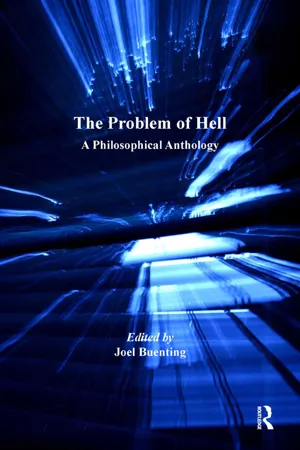
- 246 pages
- English
- ePUB (mobile friendly)
- Available on iOS & Android
eBook - ePub
About this book
How can a perfectly good God justifiably damn anyone to hell? This is one version of the problem of hell. The problem of hell has become one of the most widely discussed topics in contemporary philosophy of religion. This anthology brings together contributions by contemporary philosophers whose work shapes the current debate.
Information
Chapter 1
Grace, Character Formation, and Predestination unto Glory
Christians have traditionally held that, because they are saved by grace, they can take no credit for their own salvation, or even for a virtuous character (where such exists). All credit of this kind goes to God. As St. Paul himself put it in his letter to the Ephesians: “For by grace you have been saved through faith, and this [the faith] is not your own doing; it is the gift of God—not the result of works, so that no one may boast.”1 Indeed, as I interpret him, Paul taught that God’s grace is utterly irresistible in this sense: However free its recipients might be to resist it in certain contexts, or even to resist it for a substantial period of time, they are not free to resist it forever. For the end, at least, is foreordained. In Paul’s own words, “For those God foreknew [that is, loved from the beginning] he also predestined to be conformed to the likeness of his Son.”2 But if some end, such as a person’s eventually being conformed to the likeness of God’s Son, is predestined or foreordained, then that end cannot be avoided forever; and even if one should insist, as some have, that such a predestined end rests upon God’s foreknowledge of certain human choices (something that, so far as I can tell, Paul himself never claimed3), this would be of no help to the large number of Christians who believe, as I do not, that divine foreknowledge is itself incompatible with human freedom. In Paul’s scheme of things, moreover, acquiring a good moral character just is conforming to the likeness of God’s Son. So it looks as if a good moral character is, according to Paul, wholly a work of God within and not something for which the morally virtuous are entitled to credit themselves. And perhaps that is why Paul consistently praised God, not the individuals themselves, for the faithfulness of his Christian co-workers.
Now the first thing to observe about this Pauline doctrine of grace is how well it accords with the actual attitudes of the morally virtuous themselves. Are not the most virtuous among us typically the last to credit themselves for their own moral virtues? A loving mother, for example, will not credit herself for the love that controls her, however thankful she may be for the opportunity to care for (or even to sacrifice on behalf of) her children; and a faithful husband, who would never dream of a sexual indiscretion, will not credit himself merely because he wants to maintain, without jeopardizing it, his valued relationship with his wife. Such faithfulness, he may feel, is a product of clear vision, not profound moral effort. And if pressed to explain how they came to be the kind of people they are, those who consistently display the highest moral virtues may point to their own parents who brought them up in a certain way, or to plain good fortune, or (if they are religious) to the grace of God. Even where an intense moral struggle leads to a more virtuous character in the end, as it sometimes does, the strengthened character may not seem to be a product of one’s own moral effort to overcome temptation. To the contrary, it may seem more like the product of a wholly new perspective, such as we sometimes acquire only after experiencing first hand the disastrous consequences of succumbing to temptation in the first place.
It is hardly false modesty, then, but instead clear moral vision that prevents the truly virtuous from crediting themselves—that is, from crediting their own free choices and moral efforts—for their own good character. For although the religious expression “There but for the grace of God go I” seems to me quite problematic if taken to imply that some other person is not an object of God’s grace, it nonetheless remains a nice way of affirming that one’s own free choices do not suffice to make one any better, or any more worthy of God’s grace, than anyone else. It is even a way, perhaps, of saying something like the following: “Had I been in Hitler’s shoes, facing his demons, my free choices may not have been any better than his were; and had Hitler benefited from the advantages that I have enjoyed, his free choices may not have been any worse than mine have been.” I do not claim that I (or anyone else) could give a clear and coherent sense to such a remark. But the point, once again, is merely to acknowledge that a good moral character is something for which one should be thankful, not something for which one should try to take credit. For a good character, like salvation itself, ultimately “depends,” according to Paul, “not on human will or exertion, but on God who shows mercy”4 and on the clear moral vision he will eventually impart to all.
Accordingly, in this chapter I shall challenge the idea, so widely accepted among libertarians, that free agents “make themselves into the kinds of persons they are”5 and that they are, for this very reason, morally responsible for their own character. Then, after examining (and criticizing) the idea of a “self-forming action,” as Robert Kane calls it, I shall argue that St. Paul’s pre-philosophical understanding of God’s all-pervasive grace in fact makes far better sense of the role that our free choices, the bad ones no less than the good ones, play in the formation of a good character. It also helps to clarify how libertarian freedom, indeterminism, and even sheer chance, if you will, could fit into a predestinarian scheme in which a glorious end is ultimately inescapable.
Free Choice and Character Formation
Many libertarians now concede to the compatibilists, as I believe they should, that an action can be free even when determined by an appropriately formed character, and their intuition seems to be that an agent’s character is appropriately formed only when the agent is at least partly responsible for it. James F. Sennett thus writes as if we sometimes choose our own character: “A character that is libertarian freely chosen is the only kind of character that can determine compatibilist free choices.”6 Laura Ekstrom likewise suggests that our judgment that an action is praiseworthy “may presuppose the idea that the agent’s good character is ultimately of his own making.”7 And Robert Kane explores the idea of a “self-forming action” in great detail and with considerable insight.8
But just what might it mean, in the first place, to say that someone has made, or formed, or produced his or her own character? Robert Kane speaks of certain “voluntary ‘self-creating’ or ‘self-forming’ actions (including refrainings) in the life histories of agents for which the agents are personally responsible.”9 These self-forming actions (or SFAs), says Kane, are “both undetermined … and such that the agents willingly performed them and ‘could have voluntarily (or willingly) done otherwise’.”10 Although undetermined—and, as some might say, self-generated or self-originated—they are also self-forming in the sense that they help to determine or shape the agent’s present motives, purposes, and character traits: “Agents with free will … must be such that they could have done otherwise on some occasions of their life histories with respect to some character- or motive-forming acts by which they make themselves into the kinds of persons they are.”11
Now given my own libertarian proclivities, I have no objection to the idea that a good character is appropriately formed only when an agent’s life history includes some undetermined choices that could have gone the other way. But as soon as we try to puzzle out the precise relationship between these undetermined choices in an agent’s life history and the agent’s present moral character, a host of difficulties begin to emerge. The root idea to which Ekstrom and Kane both appeal is that of a partial causal explanation, or a contributing cause—as when, for example, Ekstrom suggests that, if a person S performs a determined action A at a time t, then S is morally responsible for doing A at t only if S’s present character and resulting inability to act otherwise “is causally explicable at least in part [my emphasis] by S’s own act(s) at some time(s) other than t, such that S could have done otherwise at that (those) other time(s).”12 Or, as Kane puts it in one place, a self-forming action must actually make “a difference in what you are (or in the character and motives you now have).”13
So now we must ask: Just what might count as a relevant difference in the present context? Where “UA” is shorthand for “an undetermined action such that the agent who performed it categorically could have done otherwise,” suppose that a woman has only one UA in her life history, namely her decision as a youngster to spend her allowance on swimming lessons rather than on violin lessons. If that single UA partly explains why she later became an expert swimmer, indeed an Olympic champion rather than a concert violinist, and if her swimming expertise partly explains why she found it unthinkable and therefore psychologically impossible to stand by as a child was drowning—why she leapt into a dangerous river in an effort to save the child—then she evidently meets the Ekstrom necessary condition of being morally responsible for a determined action. As we have just described the case, moreover, this single UA buried in the woman’s past made a huge difference to the kind of person she now is, that is, to her present character and to the motives she now has. I doubt, however, that many libertarians would see this difference, however significant it may be in the woman’s life history, as a morally relevant difference. The decision to take swimming lessons presumably had no great moral significance at the time it was made, and, beyond that, it was not the woman’s intention as a young girl to make herself into a crack swimmer or to prepare herself for saving the child later in life; she just enjoyed swimming as a recreation. She nonetheless illustrates how easily one can meet the Ekstrom necessary condition of moral responsibility and how little clarity it provides in the present context.
Of course, Ekstrom never intended for anyone to treat her necessary condition as if it were a sufficient condition. But even if we restrict our attention to UAs that express morally significant choices, a serious problem remains. For if we should examine carefully the life history of some virtuous person S, we would likely find, I suspect, that S’s immoral choices had an even greater causal impact upon the development of S’s virtuous character than S’s virtuous choices did. Suppose, by way of illustration, that a young and somewhat irresponsible married man should succumb to temptation and should fall into a rather frivolous affair; suppose also that his wife should subsequently find out about the affair and should seriously consider divorcing him on account of this and other irresponsible actions on his part; and suppose, finally, that the young man should then come to appreciate what he is about to lose and, terrified by the prospect of losing the wife he genuinely loves, should feel utterly compelled to re-establish a relationship of trust. So once his wife finds out about the affair, it is fully determined, let us suppose, that he will change his wayward ways; never again does he even consider an affair, lest it undermine the very relationship that he now values so highly. If the man’s decision to have an affair qualifies as a UA, then this UA may not only have made a difference, but also a morally significant difference, to the kind of person he eventually becomes. It also seems to qualify as a contributing cause. For had he not made his foolish choice at this precise time and in circumstances where he would eventually be caught, perhaps he would have gone through his entire adult life sneaking around and taking his wife for granted.
So do we have here a case where the free decision to act in an unfaithful way and to have an affair helped to shape a more trustworthy and faithful character? And do we also have a case where a man acquires his clear vision and therefore his faithfulness in an appropriate way? I think we do. We are not here talking about a man being “zapped,” to borrow an expression from Michael Murray, and simply being reconstituted with a more virtuous character; we are instead talking about a man experiencing the consequences of his own free decision to act unfaithfully and about how he learns an important lesson in the process. The man also acted freely, or at least so I would argue. For not even a libertarian would deny that a determined action can sometimes be voluntary; and if an action is both voluntary and determined by one’s own fully rational judgment concerning the best thing to do, then it remains a paradigm, so I have argued elsewhere,14 of free action. Its being voluntary rules out what Kane calls “constraining control,” such as being held at gunpoint, and its being determined by one’s own fully rational judgment concerning the best thing to do rules out what Kane calls “nonconstraining control,” such as might be “exemplified by … cases of behavioral conditioning and behind the scenes manipulation.”15
Now some will no doubt find counter-intuitive the idea that our immoral choices are sometimes more helpful than our morally proper choices are in producing a virtuous character. For libertarians almost always seem to adopt, as a kind of unexamined metaphysical assumption, a picture similar to what Kane sketches in the following passage:
The probabilities for strong—or weak—willed behavior are often the results of agents’ own past choices and actions, as Aristotle and other thinkers have insisted. Agents can be responsible for building their moral characters over time by their (moral or prudential) choices or actions, and the character building will be reflected by changes in the probab...
Table of contents
- Cover Page
- Dedication
- Title Page
- Copyright Page
- Contents
- List of Contributors
- Introduction
- 1 Grace, Character Formation, and Predestination unto Glory
- 2 Is it Possible to Freely Reject God Forever?
- 3 Annihilationism: A Philosophical Dead End?
- 4 Compatibilism, “Wantons,” and the Natural Consequence Model of Hell
- 5 Value, Finality, and Frustration: Problems for Escapism?
- 6 Hell, Wrath, and the Grace of God
- 7 Molinism and Hell
- 8 Hell and Punishment
- 9 Why I Am Unconvinced by Arguments against the Existence of Hell
- 10 Hell and Natural Atheology
- 11 Infernal Voluntarism and “The Courtesy of Deep Heaven”
- 12 Birth as a Grave Misfortune: The Traditional Doctrine of Hell and Christian Salvific Exclusivism
- 13 Species of Hell
- Index
Trusted by 375,005 students
Access to over 1.5 million titles for a fair monthly price.
Study more efficiently using our study tools.
Frequently asked questions
Yes, you can cancel anytime from the Subscription tab in your account settings on the Perlego website. Your subscription will stay active until the end of your current billing period. Learn how to cancel your subscription
No, books cannot be downloaded as external files, such as PDFs, for use outside of Perlego. However, you can download books within the Perlego app for offline reading on mobile or tablet. Learn how to download books offline
Perlego offers two plans: Essential and Complete
- Essential is ideal for learners and professionals who enjoy exploring a wide range of subjects. Access the Essential Library with 800,000+ trusted titles and best-sellers across business, personal growth, and the humanities. Includes unlimited reading time and Standard Read Aloud voice.
- Complete: Perfect for advanced learners and researchers needing full, unrestricted access. Unlock 1.5M+ books across hundreds of subjects, including academic and specialized titles. The Complete Plan also includes advanced features like Premium Read Aloud and Research Assistant.
We are an online textbook subscription service, where you can get access to an entire online library for less than the price of a single book per month. With over 1.5 million books across 990+ topics, we’ve got you covered! Learn about our mission
Look out for the read-aloud symbol on your next book to see if you can listen to it. The read-aloud tool reads text aloud for you, highlighting the text as it is being read. You can pause it, speed it up and slow it down. Learn more about Read Aloud
Yes! You can use the Perlego app on both iOS and Android devices to read anytime, anywhere — even offline. Perfect for commutes or when you’re on the go.
Please note we cannot support devices running on iOS 13 and Android 7 or earlier. Learn more about using the app
Please note we cannot support devices running on iOS 13 and Android 7 or earlier. Learn more about using the app
Yes, you can access The Problem of Hell by Joel Buenting in PDF and/or ePUB format, as well as other popular books in Theology & Religion & Religion. We have over 1.5 million books available in our catalogue for you to explore.