eBook - ePub
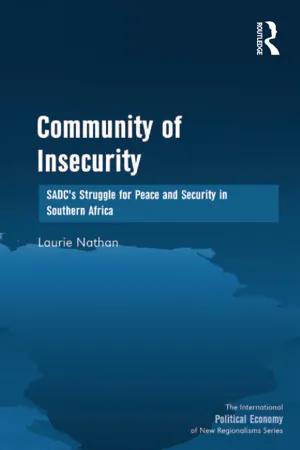
Community of Insecurity
SADC's Struggle for Peace and Security in Southern Africa
- 200 pages
- English
- ePUB (mobile friendly)
- Available on iOS & Android
eBook - ePub
About this book
Exploring the formation, evolution and effectiveness of the regional security arrangements of the Southern African Development Community (SADC), Nathan examines a number of vital and troubling questions: * why has SADC struggled to establish a viable security regime? * why has it been unable to engage in successful peacemaking?, and * why has it defied the optimistic prognosis in the early 1990s that it would build a security community in Southern Africa? He argues that the answers to these questions lie in the absence of common values among member states, the weakness of these states and their unwillingness to surrender sovereignty to the regional organization. Paradoxically, the challenge of building a co-operative security regime lies more at the national level than at the regional level. The author's perspective is based on a unique mix of insider access, analytical rigour and accessible theory.
Information
Chapter 1
Introduction
Community of Insecurity explores the establishment, evolution and effectiveness of the regional security arrangements of the Southern African Development Community (SADC).1 It is a gripping story, filled with the drama of war, intrigue and mistrust among neighbouring states. The dramatic tension is heightened by the international expectation that regional organizations will play a vital role in preventing and resolving violent conflict and by the prognosis in the early 1990s that post-apartheid Southern Africa would shed the destructive conflict of the past and embark on a journey of peace, stability, development and regional integration. These hopes have not been met. Since SADC’s formation in 1992 major conflicts have continued to plague the region and many thousands of its inhabitants have experienced chronic insecurity. Paradoxically, SADC’s collective security mechanism, known as the Organ on Politics, Defence and Security Co-operation,2 has not only been largely ineffectual but has also been a source of bitter acrimony among member states.
In this introductory chapter I begin by outlining the expectation of the United Nations (UN) that regional organizations will contribute to maintaining peace and security within their geographical territories. I then juxtapose this expectation against the mixed record of regional bodies in various parts of the world and summarize the dismal peacemaking history of SADC. The chapter proceeds to present the key concepts that are used in the book, the main findings, the research method and the difficulty of determining the peacemaking effectiveness of a regional organization. I describe my personal involvement in the formulation of SADC’s policies on regional security, which allows for insights based on participation in closed-door meetings and access to documents that are not in the public domain.
Regional Organizations as Conflict Resolution Forums
From the outset the UN has envisaged the engagement of regional bodies in conflict prevention and resolution. Article 52 of the UN Charter promotes regional arrangements and agencies for dealing with matters relating to the maintenance of international peace and security as are appropriate for regional action and in a manner consistent with the purposes and principles of the UN. It adds that the Security Council will encourage pacific settlement of local disputes through such arrangements and agencies. Underlying these provisions of the Charter is the assumption that states have a strong interest in containing and ending conflict in their neighbourhood and that collective forums afford them an efficacious and legitimate means of doing this.
Since the end of the Cold War, regional organizations have grown in number, prominence and assertiveness and the UN, whose peacekeeping and peacemaking capacity has been overstretched, has strongly supported this trend (Boutros-Ghali 1992, Barnett 1995, Pugh and Sidhu 2003). In 1992 UN Secretary-General Boutros Boutros-Gali issued a seminal report, An Agenda for Peace, which expounded a bold and far-reaching perspective on preventive diplomacy, peacemaking, peacekeeping and peacebuilding in the post-Cold War era. The report endorsed the role of regional organizations in all these spheres of activity in order to lighten the burden of the UN Security Council and enable a ‘deeper sense of participation, consensus and democratization in international affairs’ (Boutros-Ghali 1992: para 64). The UN contends that regional organizations have a number of distinctive features that make them well-equipped to perform a peacemaking function: they have a good understanding of the historical background of local conflicts; they are familiar with the actors and issues involved in these conflicts; they can build trust through the frequency of interaction among their member states; and they can develop and uphold appropriate norms on conflict prevention and governance.
Given this compelling logic, An Agenda for Peace called for closer co-operation and co-ordination between the UN and regional organizations in preserving international peace and security. It is an indication of the seriousness with which this issue is taken that it has since been addressed in a declaration of the UN General Assembly (1994) and a resolution of the UN Security Council (2005). It has also been covered in several reports of the Secretary-General and at regular high-level meetings between the Secretary-General and the heads of regional organizations (e.g. United Nations 2001a, 2006a, 2008).
The African Union (AU), established in 2002 as the successor to the Organisation of African Unity (OAU), regards SADC and the other ‘regional mechanisms for conflict prevention, management and resolution’ on the continent as an integral part of its security architecture (African Union 2002: art 16). The mechanisms in question include SADC, the Economic Community of West African States (ECOWAS), the East African Community and the Inter-Governmental Authority on Development (IGAD) in the Horn of Africa. The AU’s Peace and Security Council and the Chairperson of the AU Commission are enjoined to work closely with these regional bodies and ensure that there are strong partnerships between them and the Council in promoting and maintaining peace, security and stability (African Union 2002: art 16).3
Against this background and in light of the success of European institutions – chiefly the European Union (EU), the Conference on Security and Co-operation in Europe (CSCE) and the CSCE’s successor, the Organisation for Security and Cooperation in Europe (OSCE) – donor governments have assiduously promoted the replication of European models of integration and security in the South (Mayall 1995). They have invested heavily in the AU and the regional organizations (e.g. Klingebiel et al 2008). The British government advances the following motivation for constructing regional security arrangements on the continent:
There is need for simple but reliable structures for security co-operation that can stabilise relations, prevent spill over of conflicts, secure emerging common values and, perhaps, lay the foundation for new security regimes. In the absence of effective crisis response structures, regional peacekeeping initiatives will continue to be ad hoc, poorly implemented and driven by the interests of the strongest in the region. (Department for International Development et al 2001: 18)
In contrast to the optimistic perspective of the UN and donor governments, the picture that emerges from case studies of regional organizations is decidedly mixed (Fawcett and Hurrell 1995, Crocker, Hampson and Aall 2001, Pugh and Sidhu 2003, Acharya and Johnston 2007). Indeed, one of the most striking aspects of this picture is the considerable variation in the effectiveness of these organizations as institutions for conflict prevention and resolution (Nathan 2010a). At one end of the spectrum there is the extremely successful EU and its predecessors, which have provided the institutional framework for the attainment of prosperity, stability and security in a region wracked by war for centuries (Møller 2008a). At the other end of the spectrum, there is the utterly ineffectual South Asian Association for Regional Cooperation (SAARC), which has been unable to deal with the deadly conflict between India and Pakistan and the many other violent conflicts between and within member states (Dash 2001, Sridharan 2008).
A number of regional entities fall somewhere between these poles, successful at certain times or in certain respects but not others. For example, the Association of South East Asian Nations (ASEAN) is credited with the major achievement of preventing a war between member states but it has not played a useful role in relation to intra-state crises (Acharya 1998, Sridharan 2008). IGAD has generally failed to address, let alone resolve, violent conflict between and within member states but between 2002 and 2005 it facilitated negotiations between the Sudanese government and the Sudan People’s Liberation Movement, culminating in a peace agreement that ended Africa’s longest running civil war (Healy 2009). ECOWAS, by contrast, has been consistently active in regional peacemaking. In the 1990s it deployed troops in peace enforcement operations in Liberia, Sierra Leone and Guinea Bissau, drawing mixed reviews (Sesay 1995, Adebajo 2002).
Where does SADC fit into this picture? The organization was founded in 1992 with a mandate to promote economic integration, poverty alleviation, peace, security and the evolution of common political values and institutions. It was a time of great hope and promise in Southern Africa. In the late 1980s the Cold War had drawn to a close, easing regional tension as the intrusion of Superpower rivalry dissipated, and at the start of the new decade the global wave of democracy swept through the region with multi-party elections being held in several countries for the first time. Most importantly, the system of apartheid and minority rule in South Africa was about to be replaced by a democratic dispensation. This would not only bring an end to Pretoria’s destabilization of its neighbours but would also bring the most powerful country in Southern Africa into the regional community. The historical patterns of enmity and war would give way to amity and co-operation. With the positive involvement of South Africa, whose economy was treble the size of those of the other SADC states combined (SADCC 1992: 9-11), it would be possible to tackle the region’s socio-economic problems in a co-ordinated and synergistic fashion. Southern Africa was awash with optimism, anticipating an era of peace, stability and economic growth.
Notwithstanding the spirit of optimism, the founders of SADC had no illusions that the region would be free of conflict. They agreed that it was necessary to create a framework and mechanisms for ensuring peace and security (SADC 1992a: 9-10). The SADC Treaty of 1992 thus provides that the organization’s principles include peaceful settlement of disputes, its objectives include the advancement and defence of peace and security and its member states must conclude a protocol on co-operation and integration in the area of ‘politics, diplomacy, international relations, peace and security’ (SADC 1992b: arts 4, 5, 21). In 1996 SADC set up the Organ on Politics, Defence and Security Co-operation, a common security regime charged with promoting peace and security through political, military and security co-operation and the peaceful settlement of inter- and intra-state conflict. In 2001 the SADC heads of state and government approved the Protocol on Politics, Defence and Security Co-operation, which covers the objectives, structures and strategies of the Organ. Two years later the heads of state and government signed the SADC Mutual Defence Pact, which deals with collective action in response to an armed attack against a signatory party.
Following SADC’s inauguration the region remained wracked by a high level of violent conflict. The most prominent conflicts were the long-running civil war in Angola that ended in 2002; election disputes, a mutiny and an external military intervention in Lesotho in 1998; a rebellion and full-blown war with state belligerents in the Democratic Republic of Congo (DRC), which began in 1998 and has continued to flare up periodically, leading to massive displacements of people; state repression, violence and undemocratic elections in Zimbabwe since 2000; and violent protests and an unconstitutional change of government in Madagascar in 2009.
Despite the existence of the Organ, SADC has a woeful record of peacemaking. In many of the major conflicts that beset the region it refrained from diplomatic engagement and critical comment. It played no meaningful role in relation to the Angolan civil war and was sorely divided over the DRC rebellion. Angola, Namibia and Zimbabwe responded to the rebellion by deploying troops in support of the Congolese President, Laurent Kabila, while South Africa, backed by Botswana, Mozambique and Tanzania, pursued a diplomatic solution and championed a ceasefire. The divergent strategies generated acute animosity within SADC and crippled the Organ. South Africa and Zambia facilitated the ending of the Congolese war but SADC has devoted little attention to the subsequent bouts of fighting in the DRC.
The organization has fared very poorly in relation to the Zimbabwe crisis. In the face of fierce state repression and one defective election after another, the SADC heads of state repeatedly expressed solidarity with Harare and dismissed criticism of its gross human rights abuses. In 2007 they appointed President Thabo Mbeki of South Africa to mediate a resolution of the crisis. The next year the President of Zimbabwe, Robert Mugabe, won an electoral victory that was indisputably flawed but the SADC Summit subverted the democratic process and conferred on him the legitimacy he had failed to achieve at the polls. Mbeki thereafter brokered negotiations between the ruling party and the opposition, leading to the installation of a coalition government that remains disunited and fragile at the time of writing (May 2011). The Summit has also tolerated the Zimbabwe government’s outrageous defiance of the SADC Tribunal’s rulings against it (Chapter 5).
In short, the promise of peace and security in Southern Africa has not been realized and SADC has been distinguished less by its peacemaking endeavours than by its fractious quarrels. Of great significance and irony is the fact that many of the major disputes among member states have been around the orientation and strategies of peacemaking and regional security. The formation of the Organ was bedevilled by rancorous disagreements over a ten-year period. Perversely, a vehicle intended to ease tension and enhance unity and confidence had exactly the opposite effect. The process of drafting SADC’s Mutual Defence Pact was similarly protracted and tortuous. The troubled exertions to fashion regional security arrangements and resolve conflicts are the primary subject of this book.
Main Concepts and Findings
Key Questions and Terms
Community of Insecurity revolves around two questions: what are the reasons for SADC’s failure to establish a viable security regime and engage in effective peacemaking? And has SADC attained, or is it likely in the foreseeable future to attain, the status of a security community? Before summarizing the main findings in relation to these questions, it would be helpful to clarify some of the conceptual terms used in the book.
In the discourse of SADC the concept of ‘security’ has different meanings depending on the context. It refers variously to stability within and between states, to the security of states and people and to the military and non-military dimensions of security. The term is generally used in a broad, holistic sense. When applied to cabinet ministers or the security services, ‘public security’ refers to policing and ‘state security’ refers to the intelligence sector.
A ‘security regime’ can be defined as a set of principles, rules, norms and decision-making procedures that constitute institutionalized co-operation and permit states to exercise restraint in the belief that others will reciprocate (Jervis 1983, Krasner 1983). A security regime can take a number of forms, including a common security regime and a mutual defence treaty. States can belong simultaneously to a range of security regimes that have different members, goals and territorial boundaries. In the international relations literature the terms ‘regime’ and ‘institution’ are used interchangeably. SADC, however, employs the term ‘institution’ to mean a formal structure of the organization. The SADC Treaty describes these institutions as being the Summit of Heads of State or Government; the Organ on Politics, Defence and Security Co-operation; the Council of Ministers; the Integrated Committee of Ministers; the Standing Committee of Officials; the Secretariat; the Tribunal; and the SADC National Committees (SADC 2001a: art 9). In the course of this book I sometimes use the term ‘regime’ as a synonym for the government of a SADC country.
‘Common security’ is the conceptual foundation and organizing principle of the Organ. It emerges from the thesis of the Palme Commission (1984), advocated in the midst of the Cold War, that states are interdependent and more likely to obtain security through political co-operation than through military competition.4 In the Southern African context, the concept of a ‘common security regime’ reflects SADC’s view that member states are interdependent, regional security is consequently a collective enterprise and ‘institutional arrangements [are] required to ensure political stability and mutual security as critical components of regional co-operation and integration’ (SADC 1992a: 9-10). From this perspective, ‘common security’ can be considered synonymous with ‘co-operative security’.
A ‘mutual defence treaty’ typically entails a commitment by the signatories to a high level of military co-operation and to support each other, if necessary through the collective use of force, in the event that one of them is subject to an armed attack. This arrangement is also referred to as ‘collective defence’, the best known example being the 1949 Treaty of the North Atlantic Treaty Organisation (NATO).
According to Karl Deutsch and his colleagues, a ‘security community’ exists where a group of people has attained a level of integration and a sense of community and common identity strong enough for them to enjoy dependable expectations of peaceful change, which is to say that they have a real assurance that their disputes will be settled by means other than fighting (Deutsch et al 1957). States that comprise a security community regard the threat and use of force against each other as unthinkable and eschew preparations for fighting one another. A security community can encompass one or more security regimes but this is not one of its defining features. A progression from a conflict formation through a security regime to a security community would reflect movement from international relations of enmity to those of amity (Buzan and Waever 2003: 53-54).
In the course of this book I argue that the debates on SADC’s security arrangements were polarized between militarist and pacific camps. By ‘militaris...
Table of contents
- Cover Page
- Title Page
- Copyright Page
- Dedication
- Contents
- List of Abbreviations
- 1 Introduction
- 2 The Formation of SADC and the Era of Hope
- 3 The Struggle to Establish SADC’s Security Architecture
- 4 Failed Peacemaking in Southern Africa
- 5 Explaining the Failure of the Organ
- 6 The Fiction of Southern Africa as an Emerging Security Community
- 7 Conclusion
- References
- Index
Trusted by 375,005 students
Access to over 1.5 million titles for a fair monthly price.
Study more efficiently using our study tools.
Frequently asked questions
Yes, you can cancel anytime from the Subscription tab in your account settings on the Perlego website. Your subscription will stay active until the end of your current billing period. Learn how to cancel your subscription
No, books cannot be downloaded as external files, such as PDFs, for use outside of Perlego. However, you can download books within the Perlego app for offline reading on mobile or tablet. Learn how to download books offline
Perlego offers two plans: Essential and Complete
- Essential is ideal for learners and professionals who enjoy exploring a wide range of subjects. Access the Essential Library with 800,000+ trusted titles and best-sellers across business, personal growth, and the humanities. Includes unlimited reading time and Standard Read Aloud voice.
- Complete: Perfect for advanced learners and researchers needing full, unrestricted access. Unlock 1.5M+ books across hundreds of subjects, including academic and specialized titles. The Complete Plan also includes advanced features like Premium Read Aloud and Research Assistant.
We are an online textbook subscription service, where you can get access to an entire online library for less than the price of a single book per month. With over 1.5 million books across 990+ topics, we’ve got you covered! Learn about our mission
Look out for the read-aloud symbol on your next book to see if you can listen to it. The read-aloud tool reads text aloud for you, highlighting the text as it is being read. You can pause it, speed it up and slow it down. Learn more about Read Aloud
Yes! You can use the Perlego app on both iOS and Android devices to read anytime, anywhere — even offline. Perfect for commutes or when you’re on the go.
Please note we cannot support devices running on iOS 13 and Android 7 or earlier. Learn more about using the app
Please note we cannot support devices running on iOS 13 and Android 7 or earlier. Learn more about using the app
Yes, you can access Community of Insecurity by Laurie Nathan in PDF and/or ePUB format, as well as other popular books in Politics & International Relations & Politics. We have over 1.5 million books available in our catalogue for you to explore.