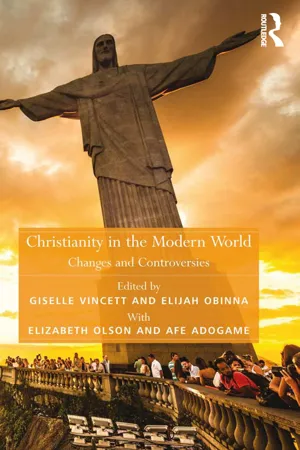
eBook - ePub
Christianity in the Modern World
Changes and Controversies
- 208 pages
- English
- ePUB (mobile friendly)
- Available on iOS & Android
eBook - ePub
Christianity in the Modern World
Changes and Controversies
About this book
What is the state of Christianity today, and what might it look like in the future? In the West, the story for a long time has revolved around decline and the loss of monopoly status, but how are these shifts changing the practice of Christianity or individual belief? Similarly, the rapid growth of Christianities in the Global South has been well reported, but the continuing complex intersections of mission Christianity with indigenous religions are less well known. Large-scale flows of people across increasingly fluid borders mean that not only does immigration sometimes significantly boost Christian numbers in a given country, but that different forms of Christianity shift traditional religious landscapes. How will emerging trends such as 'reverse mission' from the Global South affect Christianities in areas more used to sending rather than receiving missions? As the majority of believers shifts from the West to the Global South, how will issues such as homosexuality be played out theologically, politically and individually? Will new virtual churches manage to create viable long-term communities? How does new festival Christianity function in the religious life of an individual? The divergent and oftentimes contradictory state of Christianity in the modern world fuels questions about its place and future in the world: in politics, education and healthcare. This book brings together cutting edge research on the most recent changes and trends in Christianity worldwide. Contributors drawn from the USA, UK and Europe, Africa and East Asia offer an invaluable breadth of coverage, expertise and disciplinary perspective at the intersections between sociology of religion, theology, politics, education and human geography.
Information
Chapter 1
Young People and Golden Rule Catholicism in the Philippines: The Case of Religiously Involved Filipino Students
Jayeel Serrano Cornelio
The condition of Catholicism in the Philippines presents nuances that can potentially enrich the understanding of Christianity in the world today. On one hand, the Philippines demonstrates the continuing vibrancy of Catholicism outside the supposedly secularized world of the West. Around 80% of the Philippine population is Catholic (National Statistics Office 2008), with 72.4% of Filipinos attending religious services at least two to three times a month, a participation rate which is vastly different even compared to Catholic countries in Europe, such as Italy (41.1%), Spain (27.5%) or Portugal (30.1%). (ISSP 2008) At the everyday level, fervent Catholic Charismatic movements such as El Shaddai (Kessler and Rüland 2008; Wiegele 2005) are quite common, as is pious devotion to the various iconographies of the Black Nazarene, the infant Jesus, Our Lady and the saints. (Cannell 1999; Bautista 2010) Re-enacted crucifixions are typical in the country and graphically portrayed in the media. (The Telegraph 2011) At the level of the religious institution, the perennial intervention of the Catholic Church in public issues such as divorce and artificial family planning is unmistakable. (Gloria 2008; Raffin and Cornelio 2009; Bautista 2010) Today, the continuing involvement of conservative Catholicism in state affairs is a political saga to behold. On the other hand, the Philippines presents itself as an interesting empirical site for the discovery of novel, even revolutionary, nuances within the Catholic Church. Historically, for example, religious texts were strategically used by peasants to articulate discontent and rebellion against the Spanish regime, which ruled and evangelized the country from the sixteenth to the nineteenth centuries. (Ileto 1979) In less than one hundred years since its liberation from Spain, the Philippines saw yet again the pivotal role of the Church for political reform, this time the removal of a dictator in 1986. (Moreno 2006) And recently, the thought of liberation theology has become important in the furtherance of participatory development among grassroots communities in the country. (Nadeau 2004)
One aspect of the vibrancy of Catholicism in the Philippines that remains important, but continues to be neglected by observers, is the participation of its youth. This is in spite of, for example, the biggest papal crowd gathered during the World Youth Day celebrations in Manila in 1995. (Zimmerman 2008) Most of the time, as suggested above, the focus of observers has been on the visible expressions of religiosity and the Church’s institutional activities. Discussions concerning youth religiosity have been scanty and in fact dominated by impressionistic accounts (see, for example, the accounts in Leung 2009). This problem, of course, is not isolated to local sociology of religion. It is only recently that interest in religion and youth has started to gain ground even in Western academia. (Collins-Mayo and Dandelion 2010) In a way, this chapter is also a contribution to that emerging body of literature.
To approach this interest in youth and see how the face of Catholicism in the Philippines might be changing, this chapter will look at how religiously involved Filipino students live their Catholic religion. Lived religion, as a concept, gives emphasis to the practise of the faith and not simply in the profession of a particular religious affiliation or belief. (McGuire 2008)
The religiously involved Filipino young people referred to in this chapter are undergraduate student members of Catholic organizations based in various universities in Metro Manila. In the Philippines, 21.62% of college-age Filipinos (approximately 16–21 years old) are enrolled in a tertiary institution. (Commission on Higher Education 2005) According to the Episcopal Commission on Youth, 40% of Catholic youth are members of religious organizations, a big proportion of which (72.9%) are parish-based, while 15% are campus-based. (Episcopal Commission on Youth 2003)
Religiously involved students are an important sector to study because of their educational attainment and religious socialization. These considerations suggest that this particular group of young people are not only highly educated, they also undergo more organized religious socialization, which should make their nuances about their religion particularly informed and interesting. Furthermore, their interest and participation in Catholic organizations may suggest their future leadership in public and religious opinion. (Wuthnow 1999) It is in this sense that this research aligns with Louden and Francis’s, which looks at the religious views of Catholic priests in England and Wales. (Louden and Francis 2003)
The data presented below are drawn from interviews with sixty-two students involved in various Catholic organizations based in twelve universities in Metro Manila, the capital region of the Philippines. The selection process has been largely purposive in view of differences in gender, academic discipline and nature of religious organization (liturgical, catechetical, outreach-orientated, charismatic and campus ministry-based). My informants come from various types of universities (state, private Catholic and private non-sectarian), a methodological decision that has allowed me to factor in class differences as lower-income students, for example, are more likely to be in state-funded institutions.1 Based upon these data, it is clear that in the midst of a highly pious and conservative Catholic Church, a strand of Golden Rule Catholicism or practical religiosity is discernible. Its dimensions include ‘being there’ for other people and tolerance for other religions, both underpinned by what can be considered a relational form of religious authenticity. Towards the end of this chapter, I articulate such Golden Rule Catholicism as expressive communalism which should inform understanding of youth religiosity in the Philippines and possibly elsewhere today.
Filipino Catholic Youth Today
For many young Filipino Catholics, the beginning of 1995 could not have been more auspicious, promising and religious. With over four million Filipinos and delegates from more than thirty countries, the World Youth Day in Manila gathered what is touted to be the biggest papal crowd ever assembled. (Zimmerman 2008) Christmas holidays at school were extended into January to allow students to witness the occasion. I was in primary six and I vividly remember recording many of these developments in my journal.
Popularly presented with a theme song, ‘Tell the World of His Love’, and a logo depicting a traditional fishing boat sailed by young people, World Youth Day brought together young people and made it clear that they were expected to be ‘a new kind’ of youth. Pope John Paul II exclaimed that
the modern world needs … men and women who are capable of self-discipline, capable of committing themselves to the highest ideals, ready to change radically the false values which have enslaved so many young people and adults. All this is possible with trust in the Lord, and with the help of good teachers, in the University and in your parishes and groups. (1995)
The general atmosphere of the event was celebratory and emotional. The week was packed with worship, liturgy, cultural presentations, break-out sessions and messages from the Pope himself. Many were in tears at the close of ceremonies as the Pope bade farewell to Manila.
By all accounts, the event showcased the religious passion of many Filipino Catholics and reignited it even in those who may have lost it. From a national survey of youth (ages 15–30) conducted a year later, 87% described themselves as religious and 69% claimed to attend religious services at least once a week. (Sandoval et al. 1998) At that time, 84% of Filipino youth professed to be Catholic. Indeed, time and again, many accounts about the Philippines begin with a quick note that it is the only Christian nation in Asia. The statement is almost to say that to be Filipino is to be Catholic, a conception deeply ingrained in the Catechism for Filipino Catholics. (Catholic Bishops Conference of the Philippines 2008)
It is not surprising then that religion occupies a prominent position in the values of many young Filipinos, a point to which researchers working on other aspects of Philippine society perennially refer. One survey found that of 13–24-year-old Filipinos, three quarters had not had sex. Their stated reasons were arguably religious. For instance, ‘very few agreed that it is all right to have sex “for fun”, and around three-quarters believed that “love forever” requires sacrifice’. (Moynihan 2007) Looking at Filipinos 15–24 years old, the 2002 Young Adult Fertility Survey notes, however, that the 23.4% of young people who have engaged in premarital sex is in fact a leap from 17.8% in 1994. (Herrera 2006) Nevertheless, the moral choices of young Filipinos appear to remain deeply influenced by Catholic values and teachings.
More than a decade after World Youth Day in Manila, the indicators of religiosity need to be interpreted with caution by observers. In a fairly recent study, among young people aged 7–21, the proportion of those who professed to be Catholic was down to 76%. (NFO Trends 2001) Another survey on Catholic youth (this time between the ages of 13–39), reported that Mass participation at least once a week is down to 63%. (Episcopal Commission on Youth 2003) However, NFO Trends estimates it to be even lower at 56%. (2001) Moreover, the Episcopal Commission on Youth says that a broad base of Filipino Catholic youth is now nominally affiliated, ‘as evidenced by 44.9% of them who seldom practice their faith, and 3.8% who never did’. (2003: 75) In fact, a closer look reveals that certain types of religious participation seem to have become unpopular. For example, ‘receiving the sacraments’ and ‘participating in Church activities’ garner the lowest ratings. In contrast, most of the young people surveyed are ‘praying’, ‘doing good deeds to others’ and ‘reflecting on the Word of God’. (2003)
If the current Pope were to visit the Philippines today, what kind of young people would he meet? The data suggest a weakening participation in many Church-connected activities in favour of less institutionalized religious activities. The Episcopal Commission on Youth claims that young people in the Philippines ‘may be Christianized in concept or knowledge, but with application, through the practices offered by the institutional Church, they tend toward those which are personalist rather than those with an ecclesial or community dimension’. (2003: 75)
More revealing, perhaps, are the findings of the NFO Youth Study 2001, which shows that whilst 88% of young Filipinos believe in God or a Supreme Being, only 42% acknowledge heaven, 21% hell and 21% life after death. The report, in fact, goes so far as to say that ‘contrary to popular belief, we are no longer a nation of believers we are reputed to be’ and they speculate that ‘Catholic Church membership may decrease in the next generation’. (2001: 25) Indeed, parochial participation among these youth is also low at 18%, the vast majority of whom are serving as choir members. (2001)
Prudence, of course, is called for in comparing these different surveys mainly because the age brackets covered differ from each other and the questions vary. (Voas and Bruce 2004) Nevertheless, each of them offers rare depictions of the state of the faith of young Filipinos.
Given these prominent works, there seems some justification to believe that, consistent with trends amongst Catholic youth around the world, young Filipinos in general are moving in the direction of an individual-expressive religious identity. (Hammond 1998; Hornsby-Smith 2004) What this means is that primary affiliation with institutional church and adherence to its beliefs and practises are declining. Young Filipinos feel free to pick their beliefs and practises. Lamenting this trend, Macasaet, a Salesian rector of a technical college, opines that ‘the true essence of religion seems to have been lost in a subjective, touchy-feely criterion of self-satisfaction’. (Macasaet 2009) The fact, however, that the Jesuit psychologist Bulatao observed a similar trend among his own flock in the mid-twentieth century (calling it ‘split-level Christianity’), suggests that perhaps the changes in the religiosity of the youth are not new and unique to them, but are symptomatic of larger societal trends. (Bulatao 1966)
Lived Religion and Golden Rule Catholicism
If the majority of young Filipinos are moving towards a less institutionalized expressive religious identity, what about religiously involved young people? Do they evidence a similar type of religiosity, albeit one that is institutionally affiliated? Macaset’s interpretation of his students’ religiosity as ‘subjective’, and ‘touchy-feely’ is a common attitude amongst observers of religious change and young people. (Smith and Denton 2005) More than simply being a generalizing statement, which can reinforce negative stereotypes about young people (Miles 2000), it also takes for granted the potentially rich nuances of the individual-expressive religious turn.
Such a tendency is revealed when observers’ expectations concerning a particular set of religious traditions and beliefs are not met by informants and are simply dismissed as ‘fuzzy’ (see, for example, Smith and Denton 2005). The idea of ‘fuzziness’ is criticized by Vincett and colleagues because it is taken to mean that young people are unable to ‘create new forms of Christianity with new markers of fluency and authenticity’. (Vincett et al. 2012) Also, the tendency to dismiss individual religious nuances, of course, is a main limitation of observations based on quantitative research. (Day 2011) Hence, when I embarked on my research, I considered it highly possible that my informants would reveal more personal (or de-institutionalized) religious views and practises even if they may be involved in Catholic organizations. If so, the point was to understand their frame of thought.
Such a point is precisely what Ammerman asserts in observing contemporary religion. (2007) To Ammerman, researchers, while seeing that religious institutions espouse and sanction a set of beliefs and practises, must not expect the same degree of coherence and subscription among religious actors. At the level of everyday or lay religion, attention must be given to how religion is present – imagined, believed, enacted, narrated and rehearsed – in the daily lives of individuals. (Orsi 1997) It is through this lens that such seemingly incoherent self-affirmed terminologies as ‘Reiki Islam’ and ‘gardening as a spiritual discipline’ become deeply reflective. (Jeldtoft 2010)
Such academic interest in studying lived religion has been spurred by at least three conditions. For one, observers have been increasingly intrigued by the emergence of alternative and deliberative voices within institutional religion in spite of their marginalization. Dillon, for example, has investigated pro-change groups involving gay Catholics and those calling for women’s ordination. (1999) Second, religion, as McGuire has cogently argued from a historical and anthropological perspective, is naturally hybridized. (2010) What is deemed ‘traditional’ religion today is, as McGuire argues, in reality a result of a long history of assimilating various cultural influences into a coherent whole. Hence, observers today do not have to be confounded by seemingly contradictory religious practises carried out by an individual. Finally, the condition of contemporary religious identity has shifted from what Hunt considers ‘localism’ to ‘voluntarism’. (2005: 66) In this shift, as a result of differentiation in modernity, choice over personal religious matters supersedes a religious identity traditionally inherited from one’s local community and family. It is for this reason that methodological attention is now given to personal religion, or what Luckmann treats as ‘invisible religion’. (1967)
It is the third condition that matters to my research. As will be shown shortly, my informants embrace a lived Catholicism that emphasizes interpersonal and social responsibility. So although Catholicism is the dominant religion in the Philippines in which piety and sacramental participation are expected, my informants demonstrate a voluntary or personal attitude towards being Catholic which necessitates investigation. Otherwise, they may too easily be dismissed as ‘split-level’ Christians or even ‘cafeteria Catholics’. (Baggett 2009)
Taken as a whole, the views of the young Filipino Catholics whom I interviewed reflect what can be termed ‘Golden Rule Catholicism’. (Ammerman 1997) Ammerman’s research methodology is to examine how an individual defines the Christian life, rather than in terms of their convictions relative to traditional beliefs concerning the Scripture, salvation and other doctrines. In her work, lay Christians claim that it is doing good and having a positive impact in the world that marks their Christianity more than anything else. Relative to evangelical Christians, Ammerman therefore calls these individuals Golden Rule Christians for foregrounding a practical moral philosophy concerning doing good to others. To call them lay liberals misleadingly connotes that they are mainly characterized by a relaxed stance towards Scriptural inerrancy, salvation and other evangelical beliefs.
Among my young informants, a similar Golden Rule ethos is clearly visible which downplays the impo...
Table of contents
- Cover Page
- Title Page
- Copyright Page
- Contents
- List of Tables
- Notes on Contributors
- Introduction
- 1 Young People and Golden Rule Catholicism in the Philippines: The Case of Religiously Involved Filipino Students
- 2 The Dis/Embodied Church: Worship, New Media and the Body
- 3 Refugees’ Encounters with Christianity in Everyday Life
- 4 African Christians in Scotland: Contesting the Rhetoric of Reverse Mission
- 5 Sexuality and Christianity: Understanding the Attitudes and Negotiations of Young Adults in the UK
- 6 Contemporary Evolution of Monasticism in Italy
- 7 Catholicism in Transition: The ‘Religious Beat’ Movement in Hungary
- 8 When Religions of Difference Grow Softer
- 9 Contesting Meaning and Gender: The Role of Christianity in an African Indigenous Religious Festival
- Index
Trusted by 375,005 students
Access to over 1.5 million titles for a fair monthly price.
Study more efficiently using our study tools.
Frequently asked questions
Yes, you can cancel anytime from the Subscription tab in your account settings on the Perlego website. Your subscription will stay active until the end of your current billing period. Learn how to cancel your subscription
No, books cannot be downloaded as external files, such as PDFs, for use outside of Perlego. However, you can download books within the Perlego app for offline reading on mobile or tablet. Learn how to download books offline
Perlego offers two plans: Essential and Complete
- Essential is ideal for learners and professionals who enjoy exploring a wide range of subjects. Access the Essential Library with 800,000+ trusted titles and best-sellers across business, personal growth, and the humanities. Includes unlimited reading time and Standard Read Aloud voice.
- Complete: Perfect for advanced learners and researchers needing full, unrestricted access. Unlock 1.5M+ books across hundreds of subjects, including academic and specialized titles. The Complete Plan also includes advanced features like Premium Read Aloud and Research Assistant.
We are an online textbook subscription service, where you can get access to an entire online library for less than the price of a single book per month. With over 1.5 million books across 990+ topics, we’ve got you covered! Learn about our mission
Look out for the read-aloud symbol on your next book to see if you can listen to it. The read-aloud tool reads text aloud for you, highlighting the text as it is being read. You can pause it, speed it up and slow it down. Learn more about Read Aloud
Yes! You can use the Perlego app on both iOS and Android devices to read anytime, anywhere — even offline. Perfect for commutes or when you’re on the go.
Please note we cannot support devices running on iOS 13 and Android 7 or earlier. Learn more about using the app
Please note we cannot support devices running on iOS 13 and Android 7 or earlier. Learn more about using the app
Yes, you can access Christianity in the Modern World by Afe Adogame,Elizabeth Olson, Elijah Obinna,Giselle Vincett in PDF and/or ePUB format, as well as other popular books in Theology & Religion & Christian Church. We have over 1.5 million books available in our catalogue for you to explore.