- 378 pages
- English
- ePUB (mobile friendly)
- Available on iOS & Android
eBook - ePub
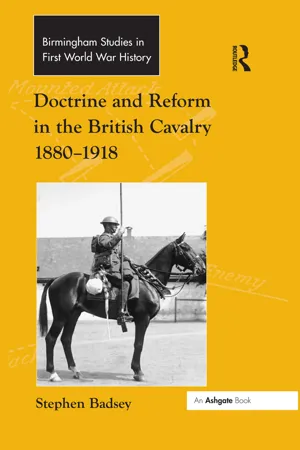
Doctrine and Reform in the British Cavalry 1880–1918
About this book
A prevalent view among historians is that both horsed cavalry and the cavalry charge became obviously obsolete in the second half of the nineteenth century in the face of increased infantry and artillery firepower, and that officers of the cavalry clung to both for reasons of prestige and stupidity. It is this view, commonly held but rarely supported by sustained research, that this book challenges. It shows that the achievements of British and Empire cavalry in the First World War, although controversial, are sufficient to contradict the argument that belief in the cavalry was evidence of military incompetence. It offers a case study of how in reality a practical military doctrine for the cavalry was developed and modified over several decades, influenced by wider defence plans and spending, by the experience of combat, by Army politics, and by the rivalries of senior officers. Debate as to how the cavalry was to adjust its tactics in the face of increased infantry and artillery firepower began in the mid nineteenth century, when the increasing size of armies meant a greater need for mobile troops. The cavalry problem was how to deal with a gap in the evolution of warfare between the mass armies of the later nineteenth century and the motorised firepower of the mid twentieth century, an issue that is closely connected with the origins of the deadlock on the Western Front. Tracing this debate, this book shows how, despite serious attempts to 'learn from history', both European-style wars and colonial wars produced ambiguous or disputed evidence as to the future of cavalry, and doctrine was largely a matter of what appeared practical at the time.
Chapter 1
Doctrine and the Cavalry 1880–1918
‘In what manner the cavalry of the twentieth century will differ from the hussars and cuirassiers of the nineteenth century is undoubtedly, from a military point of view, one of the most interesting and momentous questions of the day’, so wrote Lieutenant Colonel G.F.R. Henderson in 1902, in one of his last published pieces before his premature death in the following March.1 As Professor of Military History at the Army Staff College Camberley 1891–1899, and head of the Intelligence branch of the staff under Field Marshal Lord Roberts VC during the Boer War of 1899–1902, Henderson was widely regarded as the British Army’s principal military theorist of his time, and his concerns over the future of cavalry reflected a profound debate within the Army that was to continue up to the First World War and beyond.2
The origins of this debate may be traced back to before the middle of the nineteenth century, driven by the impact of the industrial revolution on land warfare, including increases in the effectiveness of firearms and artillery, and in Europe and North America at least by the potential for considerable increases in the size of armies provided by the rapid growth of urban populations.3 The extent to which European land warfare was transformed between the early nineteenth century and early twentieth century almost cannot be overstated. The Battle of Waterloo in 1815 was fought in a single day, with fewer than 200,000 soldiers actively engaged, using linear tactics on a battlefield of a few square miles, mostly obscured in clouds of smoke produced by smoothbore muskets with effective ranges of barely 100 yards and smoothbore cannon with ranges of 1,000 yards, both with rates of fire rarely greater than two or three rounds a minute. There could hardly be a more complete contrast between this and the Battle of the Somme in 1916, fought over five months on a frontage of more than twenty miles by several hundred thousand soldiers in rotation, armed with magazine rifles and machine-guns whose maximum ranges and rates of fire exceeded practical ammunition resupply capabilities; protected by barbed wire, earth and concrete; and supported both by artillery using indirect fire at ranges of several miles and by primitive aircraft and tanks.4 As early as the 1850s, it seemed scarcely credible that a target as large and vulnerable as a horseman could survive on a battlefield when faced by the new firepower, and well before the century’s end it was a commonplace assumption that any cavalry charge was doomed. In George Bernard Shaw’s play Arms and the Man of 1894 (set during a war in Bulgaria in 1885), the leading character proclaimed, ‘Well come! Is it professional to throw a regiment of cavalry on a battery of machine guns, with the dead certainty that if the guns go off not a man or horse will get to within fifty yards of the fire?’5
One option open to cavalry in the face of increased firepower was to find some way of improving the effectiveness of their mounted charge. A suggestion examined in the 1860s and 1870s was to maintain a flat-out gallop for a mile or more to reduce the time spent under fire; but although adopted in German cavalry regulations in 1875, this was largely rejected by the British as impractical.6 Another option was to remain mounted, but to fire back in some way (known as ‘saddle fire’) either as part of a charge or some other mounted manoeuvre such as a retreat. Another option was for the cavalry to dismount with a firearm and turn themselves temporarily into infantry. It seemed likely, and turned out to be the case, that any practical solution would require some or all these options in combination. Accompanying this was the issue of whether a single type of cavalry could be trained both to charge and to fight dismounted, or whether two different types of horse soldier were possible or necessary. If there was to be only one type of cavalry, then they would need to be good enough to charge successfully against enemy firepower, and yet also good enough shoot down an enemy mounted charge, and to know which, or which combination, of these options to chose in any given tactical situation.
The British cavalry’s doctrinal response to these issues was one of qualified success, as the cavalry adjusted its composition, its weapons and its tactics to provide a viable and sometimes valuable role in warfare up to the end of the First World War, including the use of mounted charges.7 While there was much continuity in the composition of British cavalry regiments and the military functions that they performed, both the cavalry trooper and the cavalry regiment of 1918 looked very different from their predecessors of 1880, as well as being markedly superior in weaponry, tactics and fighting abilities.8 But the story of the debate over British cavalry doctrine is also linked with the much wider story of the reform and restructuring of the British Army, and the way that it fought the First World War, over which the cavalry debate exercised a significant and not always benign influence.
Not all those who believed that cavalry had a future were cavalrymen: Colonel F.N. Maude, who played an important role in encouraging cavalry reform, was an engineer and Henderson an infantryman.9 Nor was the debate restricted to soldiers: from time to time it involved some of the most senior figures in the British government, and provoked interest and sometimes major rows in public and in the press. The debate also considerably affected the careers of several British officers who held high rank in the First World War, colouring their attitudes to each other and to the way that they thought about their profession. As might be expected, these included officers who began their military service in cavalry regiments and are often regarded as ‘cavalry generals’, such as Sir John French and Sir Douglas Haig, both of whom either witnessed or participated in successful cavalry charges early in their careers. But the debate also affected other officers whose careers are not normally associated with the cavalry, including Sir Horace Smith-Dorrien, Sir Henry Wilson, Sir Henry Rawlinson, and Sir Ian Hamilton. This was a doctrinal issue on which every senior British Army officer of 1914 had, and was expected to have, an opinion.
The idea of what is meant by a military doctrine was well understood in the British Army of the period, although the term ‘doctrine’ was itself only rarely used. Deriving appropriately from the language of religious belief, military doctrine means the prescriptive setting out of the courses of action that armed forces should follow, and in its widest sense it is an all-embracing concept, covering all aspects of their existence and function. One recent definition by the British Army is that ‘Military doctrine is a formal expression of military knowledge and thought, that the Army accepts as being relevant at a given time, which covers the nature of current and future conflicts, the preparation of the Army for such conflicts and the methods of engaging in them to achieve success.’10 Some definitions of military doctrine stress its formal and written nature, and it has been argued that since the Army of 1880–1918 had no central written text it did not have ‘doctrine’ as such but only ‘ethos’.11 But while the Army rejected some forms of written doctrine as over-prescriptive, this is not a distinction that it would have understood or accepted. Written doctrine, in the form of drill books, training manuals, and books set for officers to study, certainly increased both in number and in importance for the British Army before the First World War. But mostly these doctrinal writings followed the terminology established early in the nineteenth century by the Swiss-French theorist Henri Jomini, by avoiding the term ‘doctrine’ and elaborating instead on ‘principles’ or ‘fundamentals’ of war in discursive paragraphs. It was only during and after the First World War that a new fashion emerged, established chiefly by Lieutenant Colonel J.F.C. Fuller, for reducing principles of war to checklists of single words and doctrinal statements to short sentences; and it was not until the end of the twentieth century that the belief that doctrine should be largely centralised and written down came to dominate British military thinking.12
Rather than being expressed in any formal manner, much military doctrine throughout the centuries has fallen within the wider concept of military ethos or culture, and has been inherent in the conscious and unconscious behaviour of armed forces as institutions. The control and definition of doctrine has also been a fundamental part of institutional military power, so that while there were many theories in this era on what the future of cavalry should be, the doctrines actually adopted by the British Army were determined chiefly by where power and authority within the Army lay at the time. Any lack of a centralised and authoritative written British military doctrine before the First World War was the product of the social and organisational structure of the Army and of its officer corps, including the formal and informal power of the regiments, and of prominent generals.
Part of the military thought of the age was that a study of military history was believed to yield ‘lessons’ directly relevant to serving officers. Major General Michael W. Smith (late of the 3rd Dragoon Guards), saw nothing odd in opening his book on ‘modern tactics’ for the cavalry, published in 1869, with a discourse on Xenophon and Alexander the Great, and he was far from being an isolated case.13 Henderson, writing at the end of the nineteenth century, summarised the value of this use of military history for doctrinal purposes:
Theory is of two kinds. First there is speculative theory, which in default of great campaigns fought with modern materiel endeavours, from a study of ballistics, of new inventions, of results on the ranges, of the incidents of manoeuvres and field days, to forecast the fighting of the future. Second, there is theory based on the actual experiences of war; theory which does not neglect to consider the modifications which new arms and appliances may produce, but puts in the fore-ground the conditions which ruled the last great battles between civilised armies… If we would learn what men can do, and what they cannot do, under the stress of fire, then we must turn to history.14
Part of the reasoning behind this belief was that the horse, sword and lance had not changed in any fundamental way for millennia, and neither had many of the basic duties of cavalry. Historically, the role of light cavalry was to carry out scouting duties away from the battlefield, to bring back information on the enemy’s location and movements, and to deny the enemy the same information; although by the nineteenth century this role had been divided by military terminology into a number of largely self-explanatory functions, such as patrol work, outpost work, protection, and pursuit. These were themselves dangerous and demanding roles for mounted troops. Lord Roberts, writing in 1910 of his own experiences in India and Afghanistan many years earlier, claimed that ‘I have taken part in Cavalry combats, and have frequently had occasion to scout and reconnoitre with two, three or perhaps half a dozen Cavalry soldiers, at a time when capture by the enemy meant certain death. And I have no hesitation in saying that scouting and reconnoitring try the nerves far more seriously than charging the enemy.’15 A further widely-discussed form of independent cavalry action was the ‘cavalry raid’, with antecedents stretching back at least to the mediaeval chevauchée, in which a large body of mounted troops rode through enemy territory aiming to inflict economic and structural damage, while avoiding major battles.16 In these cases, cavalry were expected to fight without the support of infantry and artillery (although they might be accompanied by their own ‘horse artillery’), usually skirmishing against the enemy’s cavalry in an effort to obtain superiority and to reach important objectives. Light cavalry’s main strength was in their speed of movement over long distances, requiring smaller men and horses that were lightly equipped, although they might still be expected to charge when needed. On the battlefield, the charge required a different kind of heavy cavalry, bigger men (perhaps wearing partial armour) on bigger horses, used in co-ordination with infantry and artillery to break through enemy cavalry and infantry formations. Cavalry charges against ar...
Table of contents
- Cover
- Dedication
- Title
- Copyright
- Contents
- Series Editor’s Introduction
- List of Illustrations
- Preface
- 1 Doctrine and the Cavalry 1880–1918
- 2 The Wolseley Era 1880–1899
- 3 The Boer War 1899–1902
- 4 The Roberts Era 1902–1905
- 5 The Haldane Era 1905–1914
- 6 The First World War 1914–1918
- Conclusion
- Appendix British and Imperial Cavalry Regiments 1914–1918
- Bibliography
- Index
Trusted by 375,005 students
Access to over 1.5 million titles for a fair monthly price.
Study more efficiently using our study tools.
Frequently asked questions
Yes, you can cancel anytime from the Subscription tab in your account settings on the Perlego website. Your subscription will stay active until the end of your current billing period. Learn how to cancel your subscription
No, books cannot be downloaded as external files, such as PDFs, for use outside of Perlego. However, you can download books within the Perlego app for offline reading on mobile or tablet. Learn how to download books offline
Perlego offers two plans: Essential and Complete
- Essential is ideal for learners and professionals who enjoy exploring a wide range of subjects. Access the Essential Library with 800,000+ trusted titles and best-sellers across business, personal growth, and the humanities. Includes unlimited reading time and Standard Read Aloud voice.
- Complete: Perfect for advanced learners and researchers needing full, unrestricted access. Unlock 1.5M+ books across hundreds of subjects, including academic and specialized titles. The Complete Plan also includes advanced features like Premium Read Aloud and Research Assistant.
We are an online textbook subscription service, where you can get access to an entire online library for less than the price of a single book per month. With over 1.5 million books across 990+ topics, we’ve got you covered! Learn about our mission
Look out for the read-aloud symbol on your next book to see if you can listen to it. The read-aloud tool reads text aloud for you, highlighting the text as it is being read. You can pause it, speed it up and slow it down. Learn more about Read Aloud
Yes! You can use the Perlego app on both iOS and Android devices to read anytime, anywhere — even offline. Perfect for commutes or when you’re on the go.
Please note we cannot support devices running on iOS 13 and Android 7 or earlier. Learn more about using the app
Please note we cannot support devices running on iOS 13 and Android 7 or earlier. Learn more about using the app
Yes, you can access Doctrine and Reform in the British Cavalry 1880–1918 by Stephen Badsey in PDF and/or ePUB format, as well as other popular books in History & World History. We have over 1.5 million books available in our catalogue for you to explore.