eBook - ePub
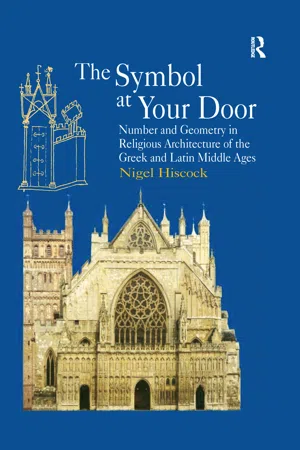
The Symbol at Your Door
Number and Geometry in Religious Architecture of the Greek and Latin Middle Ages
- 441 pages
- English
- ePUB (mobile friendly)
- Available on iOS & Android
eBook - ePub
The Symbol at Your Door
Number and Geometry in Religious Architecture of the Greek and Latin Middle Ages
About this book
Is the display of number and geometry in medieval religious architecture evidence of intended symbolism? This book offers a new perspective in the retrieval of meaning from architecture in the Greek East and the Latin West, and challenges the view that geometry was merely an outcome of practical procedures by masons. Instead, it attributes intellectual meaning to it as understood by Christian Platonist thought and provides compelling evidence that the symbolism was often intended. In so doing, the book serves as a companion volume to The Wise Master Builder by the same author, which found the same system implicit in plans of cathedrals and abbeys. The present book explains how the architectural symbolism proposed could have been understood at the time, as supported by medieval texts and its context, since it is context that can confer specific meaning. The introduction locates the study in its critical context and summarizes Christian Platonism as it determined the meaning of number and geometry. The investigation opens with the recurrent symbolism of the dome and the cube as heaven and earth in the Byzantine world and moves to the duality of the temple and the body in the East and West as reflections of Plato's universal macrocosm and human microcosm. The study then examines each of the figures of Platonic geometry in the architecture of the West against the background of their mathematics and metaphysics, before proceeding to their synthesis with the circle, as seen in circular and polygonal structures, the divisions of circles in Christian art, and their display in window tracery, culminating in the rose window. In view of the multivalency of the symbolism, the investigation establishes systematic occurrences of it, which strongly suggest patterns of thought underlying systems of design. The book concludes with a series of test cases, which show the after-life of the same symbolism as it overlapped with the Renaissance.
Chapter 1
The Sphere and the Cube
Part One: Heaven on Earth
Hagia Sophia, Constantinople, and the symbolism of domed churches
Plato’s description of the universe, with the earth as the ‘fixed sphere’ at its centre, encircled by each of the planets, had its counterpart in his abstract model of it. In this, the universe was a sphere composed of the 4 elements. To each of these was assigned one of the regular polyhedra, which were conceptualized as being inscribed geometrically in the sphere.1 The atmospheric elements of fire, air, and water are unstable, and are composed of equilateral triangles. Earth, the only stable element, is represented by the cube and all are contained by the sphere of the universe.2 This, it would appear, was the model that John of Damascus, the monk and theologian, had in mind when he wrote in the eighth century,
… we say that in the creation of the universe we consider as heavens that which the pagan philosophers … call a starless sphere. … [Some] say that [its substance] is made from the four elements. Still others say that it is a fifth body and distinct from the four elements. … They say that the heavens have seven spheres. … For they have said that there are seven planets … They also say that the heavens surround the earth like a sphere.
De fide II. 6.3
For the architectural expression of the sphere and the cube, and their signification in Christian terms as not only heaven and earth, but heaven on earth, it is necessary to turn to the domed churches of the Byzantine world. At first sight, the manifestation of this symbolism seems simple, even simplistic, with the upper and lower zones of churches being equated with heaven and earth respectively, their domes identified with the dome of heaven atop the cube of earth. Nothing expresses the solid geometry of this symbolism more uncompromisingly than the post-medieval churches of Hagios Nicholas and the Panagia on the sea-lashed rock of Monemvasia (Fig. 13).4 For churches to be conceived as symbolizing the universe, however, the creation of the universe would have to have been similarly perceived and described. In the fifth century, the Syriac writer Narsai (d. c. 503) did so in these verses:
He created two dwellings and constructed two worlds.
He rendered the lower one suitable for mortals;
He gathered it up and filled it with the fruits appropriate to corporeal beings,
He made the upper one a beautiful building full of delights,
So that the spiritual beings might enjoy it spiritually.
Homilies on the Creation I. 92–6.5
In the seventh century, Maximus the Confessor described the reciprocal symbolism of the Holy Church and the sensible world:
God’s holy Church in itself is a symbol of the sensible world as such, since it possesses the divine sanctuary as heaven and the beauty of the nave as earth. Likewise the world is a church since it possesses heaven corresponding to a sanctuary, and for a nave it has the adornment of the earth.
Mystagogia III.6
Here he associates heaven and earth, not vertically with the upper and lower parts of the church, but horizontally with its sanctuary beyond the nave, a distinction that was fitting for a basilica more than a centralized domed church. Other writers consistently visualize a church’s vertical compartmentation. The hymn in praise of the cathedral of Hagia Sophia at Edessa, rebuilt around 525, is explicit:
… it is an admirable thing that in its smallness it should resemble the great world,
Not in size, but in type: waters surround it [situated between two lakes], as the sea [surrounds the earth];
Its ceiling is stretched like the heavens – without columns, vaulted and closed –
And furthermore, it is adorned with golden mosaic as the firmament is with shining stars.
Its high dome is comparable to the heaven of heavens …
Its great, splendid arches represent the four sides of the world …
Edessa Hymn 4–7.7
In the eighth century, it is thought to have been Patriarch Germanus I of Constantinople who wrote:
The church is heaven on earth, where the God of heaven dwells and moves.
Historia Mystagogica I.8
A tenth-century description of a church near Constantinople recorded that,
[The Emperor Justinian] erected from the foundations this great church in the name of Our Lady, which he cleverly compacted by means of only four arches and wrought it in a circle so that it seemed to hang in the air – a smaller dome on earth similar to the greater one of heaven.
De sacris aedibus Deiparae ad Fontem, ASS Nov. III. 879.9
Five hundred years later, the model continued to be proselytized by Symeon, the archbishop of Thessalonica (d. 1429):
… the temple … [expresses] this visible world; and the higher parts of the temple [express] the visible sky, the lower parts however [express] the things which are above earth and [even] paradise itself …
De sacro templo ejus consecratione CXXXI.10
Given the quantity and availability of evidence from contemporary sources, it is difficult to understand how it might be thought that the symbolism in Early Byzantine architecture was less important to people than its geometry or the liturgy performed in it.11 Besides being unsupported by the evidence, such a suggestion appears to be postulating another false dichotomy. Equally, there appears to be greater subtlety in the ekphrasis of the dome of heaven and the realm of earth than justifies characterizing the symbolism as banal.12 Without doubt, the clearest evidence for the association of the sphere and the cube with heaven and earth is provided by descriptions of the principal church of the Byzantine world and palace church of the Emperor, the Cathedral of Hagia Sophia in Constantinople, built by the Emperor Justinian (c. 482–565).
Following the destruction of its predecessor in civil riots, Justinian commissioned the design of the new building, appointing Anthemius (c. 474–c. 534) and Isidorus (fl. sixth century) from the Ionian cities of Tralles and Miletus. Their profession, according to the practice of the time, was that of mechanikos, which was regarded as superior to architecton, but without translating exactly as engineer. Rather it corresponds more with the role of modern architect, with architecton implying master-builder. Their qualifications, however, would be unrecognizable to a modern architect, for Anthemius wrote a treatise on mechanical devices, one on conic sections and had a commentary on conics dedicated to him by someone who may have been a pupil of Isidorus. Isidorus was a professor of geometry or possibly mechanics, revising an edition of Archimedes, commenting on a treatise by Heron on vaulting, while his school translated into medieval Greek works by Apollonius, Archimedes, Heron, and Pappus. One of his pupils wrote a supplement to Euclid’s Elementa, which demonstrates the inscription of regular solids within others and cites Isidorus for the method of drawing the inclination between faces of geometric solids.13 Available to them, among other works, were Heron’s two-volume Geometricorum et Stereometricorum reliquiae, which includes methods of calculating various complex elements of building construction, such as the measurement of curved surfaces and vaults, the volumes of wall sections, columns, arches and beams, and much else. Of particular relevance to the design they were to produce for Justinian, as will be seen shortly, were the determination of spheres in cubes, which enabled a dome to be fitted to a square base, of triangles to spherical surfaces, which facilitated the construction of pendentives, whilst Isidorus’s edition of Archimedes involved the calculation of various properties of the circle and the sphere.14
Started in 532 and consecrated in 537, Hagia Sophia suffered structural collapses in 558, 986, and 1346. In its reconstructed state, which is essentially that of 558–562, its architectural form can be defined as a dome, placed upon a larger dome which has been reduced by having its top sliced off to form a seating for...
Table of contents
- Cover Page
- Title Page
- Copyright Page
- Contents
- Acknowledgements
- List of Figures
- Prologue
- 1 The Sphere and the Cube
- 2 Temple and Body
- 3 Ad Triangulum
- 4 Ad Quadratum
- 5 The Architectural Geometry of the Pentagon
- 6 ‘The Whole Frame of the Universe’
- Epilogue
- Bibliography
- Index
Trusted by 375,005 students
Access to over 1.5 million titles for a fair monthly price.
Study more efficiently using our study tools.
Frequently asked questions
Yes, you can cancel anytime from the Subscription tab in your account settings on the Perlego website. Your subscription will stay active until the end of your current billing period. Learn how to cancel your subscription
No, books cannot be downloaded as external files, such as PDFs, for use outside of Perlego. However, you can download books within the Perlego app for offline reading on mobile or tablet. Learn how to download books offline
Perlego offers two plans: Essential and Complete
- Essential is ideal for learners and professionals who enjoy exploring a wide range of subjects. Access the Essential Library with 800,000+ trusted titles and best-sellers across business, personal growth, and the humanities. Includes unlimited reading time and Standard Read Aloud voice.
- Complete: Perfect for advanced learners and researchers needing full, unrestricted access. Unlock 1.5M+ books across hundreds of subjects, including academic and specialized titles. The Complete Plan also includes advanced features like Premium Read Aloud and Research Assistant.
We are an online textbook subscription service, where you can get access to an entire online library for less than the price of a single book per month. With over 1.5 million books across 990+ topics, we’ve got you covered! Learn about our mission
Look out for the read-aloud symbol on your next book to see if you can listen to it. The read-aloud tool reads text aloud for you, highlighting the text as it is being read. You can pause it, speed it up and slow it down. Learn more about Read Aloud
Yes! You can use the Perlego app on both iOS and Android devices to read anytime, anywhere — even offline. Perfect for commutes or when you’re on the go.
Please note we cannot support devices running on iOS 13 and Android 7 or earlier. Learn more about using the app
Please note we cannot support devices running on iOS 13 and Android 7 or earlier. Learn more about using the app
Yes, you can access The Symbol at Your Door by Nigel Hiscock in PDF and/or ePUB format, as well as other popular books in History & World History. We have over 1.5 million books available in our catalogue for you to explore.