- 208 pages
- English
- ePUB (mobile friendly)
- Available on iOS & Android
eBook - ePub
About this book
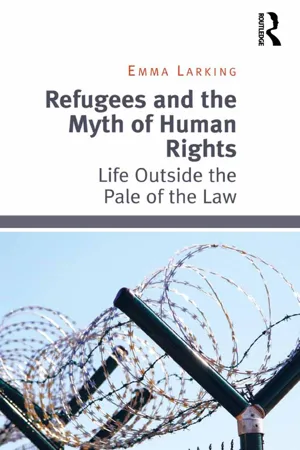
Most Western liberal democracies are parties to the United Nations Refugees Convention and all are committed to the recognition of basic human rights, but they also spend billions fortifying their borders, detaining unauthorised immigrants, and policing migration. Meanwhile, public debate over the West's obligations to unauthorised immigrants is passionate, vitriolic, and divisive. Refugees and the Myth of Human Rights combines philosophical, historical, and legal analysis to clarify the key concepts at stake in the debate, and to demonstrate the threat posed by contemporary border regimes to rights protection and the rule of law within liberal democracies. Using the political philosophy of John Locke and Immanuel Kant the book highlights the tension in liberalism between partiality towards one's compatriots and the universalism of human rights and brings this tension to life through an examination of Hannah Arendt's account of the rise and decline of the modern nation-state. It provides a novel reading of Arendt's critique of human rights and her concept of the right to have rights. The book argues that the right to have rights must be secured globally in limited form, but that recognition of its significance should spur expansive changes to border policy within and between liberal states.
Information
Chapter 1
Scum of the Earth I
Introduction
In 1951, in the preface to The Origins of Totalitarianism (Origins), Hannah Arendt (1968, ix) called for ‘a new guarantee’ for human dignity, suggesting that such a guarantee could only be supplied by ‘a new law on earth’. Arendt, who was herself a refugee of Nazi Germany, argued totalitarianism might well survive the defeat of totalitarian regimes ‘in the form of strong temptations which will come up whenever it seems impossible to alleviate political, social or economic misery in a manner worthy of man’ (1968, 459). This possibility alone should spur the search for a new guarantee for human dignity. If we also accept Arendt’s claim that the events of World War Two mean that the ‘rights of man’ have ‘lost all validity’ (1968, 447), it appears we have no choice but to seek some ‘new law on earth’. There are those who would that argue totalitarianism and its attendant temptations have been comprehensively defeated, and that the great post-World War Two rights revolution – inaugurated by the establishment of the United Nations and proudly proclaimed in the Universal Declaration of Human Rights – has vindicated the rights of man. The plight of contemporary refugees, however, suggests otherwise. I consider their position in Part III of this book. In the first Part, my focus is on Europe’s inter-war refugees, and the contradiction between the modern nation-state’s revolutionary commitment to equality and how it treated the refugees.
In Origins, Arendt argues that the constitutional democracies of Western Europe were implicated in the nihilistic logic of the Nazi ‘corpse factories and holes of oblivion’ (1968, 459) because they responded to the continent’s displaced peoples and refugees from fascism by treating these people as legal anomalies who had no rights. In doing so, she suggests they revealed their disdain for the principle of equality before the law and demonstrated that the rights of man had in fact only ever been conceived of as the rights of citizens. In this chapter I draw on a range of historical and contemporary sources to supplement Arendt’s description of the situation of the refugees. Like Arendt, I focus on the fact that even countries constitutionally committed to rights recognition treated the refugees with impunity. I support Arendt’s argument that the failure to accord rights to refugees had a corrosive impact within these countries, undercutting institutional rights protections and respect for the rule of law. I consider in some detail the legal position of the refugees and highlight the importance of national status for the attribution of legal personality in international law. Arendt’s claim that the refugees were consigned to live outside the protective pale of the law (1968, 277 and see 283, 286, 294) is now well known, and is often taken at face value to imply that the refugees were simply ignored by the law and treated as unworthy of consideration under it.1 In fact the refugees were the objects of a complex international legal regime, and also of punitive laws within particular states.2 Nevertheless, I conclude that Arendt is correct to characterise them as ‘outlaws’ – they were a ‘surplus population’ whose members had no juridical personality and whose ‘greatest danger’ consisted in ‘the abstract nakedness of being nothing but human’ (1968, 300). In the final part of the chapter I discuss the distinction that Arendt draws between the specific rights that, although not ‘innate’ or ‘inalienable’, may be accorded to individuals within a legal framework based on the protection of rights, and the ‘right to have rights’, which in my account is a right to political membership and a legal personality. The importance of this legally constituted persona will be something I elaborate upon in subsequent chapters, and I will return to discuss the ‘right to have rights’ in greater depth in my concluding chapter.
The Inter-war Refugees
Millions of people were displaced by World War One and by the redrawing of borders, civil unrest, and revolutions that followed it.3 Most of the refugees were for all practical purposes stateless. As Arendt (1968, 281 fn. 28) claims, it was largely immaterial whether they were de jure stateless, as a result of a formal denaturalisation process undertaken by their country of origin, or de facto stateless, because they no longer enjoyed the protection of their home country – in practise the refugees’ predicament was identical (see also Holborn 1938, 680; UN 1949, 6; Weis 1979, 44). Furthermore, the majority were in this position not because of their ‘political or religious convictions’ (Arendt 1968, 294) or anything they had done in their country of origin, but simply because of their membership of some deprived, marginalised or stigmatised minority (Koestler 1991, 93; Arendt 1968, 294). It is these people, including after 1935 ‘so-called “economic migrants”’ (Arendt 1968, 286), who provide Arendt’s paradigm case study – individuals persecuted not because of their commitments or activism, but simply because of who they were (1968, 294–5). Designated by their persecutors as ‘the scum of the earth’, they would be recognised and treated as such wherever they went (Arendt 1968, 269, 287).4
As economic conditions worsened throughout the 1930s, hostility towards refugees in the countries of Western Europe increased, and xenophobia and anti-Semitism were rife (Koestler 1991, 46; Skran 1995, 27; Zucotti 1993, 24–7). Western Europe’s constitutional democracies constructed barriers to refugee entry, denied permission to reside or remain, and expelled refugees (Holborn 1938, 698; Jennings 1939, 105, 108; Marrus 1982, 84; Skran 1995, 123, 130–31, 133). The refugees were excluded from ordinary engagement in society with what Marrus (1982, 84) describes as a ‘punctilious, almost Kafkaesque formality’. The minority of refugees who had passports, and thus evidence of their identity and former national status, might have them confiscated at any moment for the smallest infraction – such as being unable to provide the police with evidence of a fixed address (Skran 1995, 133; Marrus 1982, 84; Zucotti 1993, 26). Valid passports and travel or residency visas were necessary not only in order to establish one’s identity and travel legally across the borders of countries, but also ‘for normal existence within countries’ (Holborn 1938, 683). Without a passport, one could not stay in a hotel or enter a hospital (Marrus 1982, 84). One could not work legally, qualify for social or welfare benefits, or even apply for a visa or temporary residence permit (Holborn 1938, 683; UN 1949, 8–9). In fact, one could not ‘marry, be born, or die without creating legal problems, to which there [was] no solution’ (Skran 1995, 103 and see UN 1949, 17–18). Without work or other rights, the refugees were constantly forced into law-breaking acts (Arendt 1968, 286; Marrus 1982, 84). Many obtained false identity documents or crossed secretly into states where the prospects for survival appeared more promising (Holborn 1938, 689; UN 1949, 14). The refugees thus adopted ‘that very posture of illicit activity and secretive behaviour which was so much a part of anti-foreign and anti-Semitic propaganda’ (Marrus 1982, 84 and see UN 1949, 24).
The practice of imprisoning refugees in specially established internment camps became increasingly common in the lead up to World War Two (Arendt 1968, 288; Holborn 1938, 689 and 693; Skran 1995, 216–18; Wilsher 2012, 108; Zucotti 1993, 26). Refugees without valid visas lived under the constant threat of imprisonment. Expelled from one country, they were liable to imprisonment either for failing to comply with the expulsion order or for illegally entering another country. There was no avenue of legal recourse against imprisonment in these circumstances. The refugees were caught in ‘a conflict between two sovereign wills, the one expelling them, the other forbidding their entry. There was no place left to go, and in many cases vagrancy or suicide were the only alternatives of the refugee’ (Holborn 1938, 689). France alone spent 3 million francs a year imprisoning undocumented or ‘undesirable’ aliens (Holborn 1938, 689 fn. 41). Thus, as Arendt (1968, 288) points out, ‘even though there were considerable differences in the treatment of their inmates’, ‘concentration camps were … provided for the same groups in all countries … if the Nazis put a person in a concentration camp and if he made a successful escape, say, to Holland, the Dutch would put him in an internment camp’.
The Refugees’ Legal Status
In Arendt’s account (1968, 277, 286), the intolerable position in which the inter-war refugees found themselves was a function of the fact that they were forced to live – or to die – ‘outside the pale of the law’. In 1949, the United Nations’ Ad Hoc Committee on Refugees and Stateless Persons (‘UN Committee on Refugees’, 6–8) used similar language to describe the stateless. A person who is stateless – whether de jure or de facto – is, it said, ‘an anomaly’, ‘having no definite legal status’ and ‘obliged to live outside the law’. Initially, political asylum offered the only possible escape from this impasse, and although Arendt (1968, 280 and see 284–5) is disparaging of states’ failure to accord asylum to refugees en masse, it was used on a significant scale to grant sanctuary or even permanent protection to particular individuals (Holborn 1938, 681). Those most likely to be awarded asylum were not, however, Arendt’s paradigm refugees – persecuted simply on the basis of their class or race or minority status, but predominantly members of Europe’s progressive elites who were outcasts because of their anti-fascist political convictions. Furthermore, the principle of asylum did not provide even these refugees with an enforceable claim to protection, and many were simply absorbed into the faceless ranks of Europe’s shifting population of ‘indésirables’ (Arendt 1968, 259). In his account of his 1939–1940 detention in a French internment camp for political suspects, the Hungarian Jewish journalist Arthur Koestler (1991, 71) notes that those who had once been considered ‘the martyrs of Fascist barbarism’, had – like their fellow displaced peoples – very quickly ‘become the scum of the earth’: ‘having been labelled “refugees” and beaten out of three or four countries, [we] went about as if carrying an invisible leper’s bell’.
The fact that all the refugees had lost the protection of their national governments in the context of an international system within which the primary actors are states rather than individuals was very significant. The system takes for granted that ‘[t]he normal individual is a national of some state enjoying the protection of the government of that state’ (Jennings 1939, 99). Nationality is the mechanism through which individuals’ legal identity, and therefore their rights, are recognised and protected outside their home state (see Weis 1979, 162). People without national status are deprived of legal standing not only in their home state but also of protection and standing in other states and in the international sphere. A person’s ‘nationality’ in this sense refers to a ‘politico-legal’ concept of international law, denoting membership of a sovereign nation-state (Weis 1979, 3).5 In the international sphere, to be a national of a state means to be a member of an entity that has its own standing and personality; that is a subject of international law (Weis 1979, 13). Individuals are ‘connected with international law’ through their state membership (Weis 1979, 13) and historically they were objects rather than subjects of international law (McCorquodale 2006, 307–8; Weis 1979, 32).
In the domestic sphere, bonds of nationality are ‘the juridical and political link’ (‘Messih v. Minister of the Interior’, in Weis 1979, 31) uniting individuals with their state and constituting each individual’s legal personality, as well as the legal community of the state itself (Brownlie 2003, 497). Through the exercise of ‘national’ or ‘personal’ jurisdiction, states establish the particular attributes of a person’s legal personality, imposing ‘legal characterisations upon persons’ (Lowe 2006, 340) under marriage laws, for example, or laws relating to the age of majority. Nationality establishes a reciprocal relationship between the individual and the state; it is often described as a tie or a contract under which protection is owed by a state to its subjects and allegiance owed by the subjects to their state (Weis 1979, 29–32). Nationality provides the basis upon which individuals appear before and are recognised within domestic law; it is the foundation on which they assert their rights against the state (see Weis 1979, 29–30). The content of these rights, as well as the duties associated with nationality, are determined by the state’s own laws.
All individuals are ‘aliens’ in respect of states of which they are not, within the terms of the state’s own legislation, nationals (Tiburcio 2001, 1). But in addition to states’ national or personal jurisdiction, states exercise territorial jurisdiction. According to the doctrine of the sovereign equality of states, each state has legal competence in respect of its territory and the population in that territory and within its territorial jurisdiction is entitled to develop policy free from external interference.6 An alien on the territory of another state is subject to the territorial jurisdiction of that state and thus bound by its laws. Aliens may also receive legal recognition and be attributed certain rights under the laws of their host state (Brownlie 2003, 500; Lowe 2006, 342) but this is within the state’s sovereign discretion. Historically, the host state’s responsibility in international law to the alien and the alien’s rights in respect of the state were founded solely on inter-state duties, with aliens traveling and living abroad under the protection of their national state. The national state provided, as it still does, all those services, including the provision of identity documents, necessary to allow its nationals ‘to carry out the normal formalities of civilian life’ while living in another country (UN 1949, 24). Meanwhile, the legal standing and identity of individuals in their national state was recognised within another state’s borders in accordance with principles of inter-state reciprocity, usually enshrined in a treaty between the particular states (Brownlie 2003, 498; Holborn 1938, 690 fn. 45; Tiburcio 2001, 12; UN 1949, 11–12).
As the UN Committee on Refugees (1949, 23) points out:
Every state protects its nationals. Its protective influence extends beyond its frontiers. The mere fact that a person possesses a nationality, i.e. that he is linked to a state by a bond of allegiance, brings him within the orbit of the law, and determines his legal status; in short it secures for him a standing which the stateless person, not being a member of any national community, does not enjoy.
The right to exercise diplomatic protection in accordance with the law of state responsibility for injuries to aliens provides that a wrong under international law inflicted by the organs of one state upon a national of another is an injury against the latter state that it is entitled to prosecute.7 The Permanent Court of Justice (in Steiner and Alston 2000, 82) made it clear in 1924 that the law is concerned with states’ rather than individuals’ rights: ‘[b]y taking up the case of one of its subjects and by resorting to diplomatic action or international judicial proceedings on his behalf, the state is in reality asserting its own rights – its rights to ensure, in the person of its subjects, respect for the rules of international law’. Without the protection of their home state, and unable to establish a claim to political membership or legal standing in any other state, the inter-war stateless could be treated with impunity. Regardless of how they were treated, they had no recourse to legal remedies (UN 1949, 44).
Europe in the inter-war years was thus confronted with the problem of hundreds of thousands of refugees living in a legal vacuum. The international response to this crisis was piecemeal. The League of Nations was initially spurred into action in 1921 by calls for a collaborative response from those states most immediately affected by the refugee influx (Holborn 1938, 682), combined with the advocacy of international relief organisations on behalf of those Russian refugees rendered stateless after the 1917 Revolution (Skran 1995, 85). The League Council established a High Commissioner for Russian Refugees and in 1922 the Nansen passport system – named after Fridtjof Nansen, the first High Commissioner for Refugees – was devised specifically for the Russian refugees (UN 1949, 59–60). Over the years the system was gradually extended to include a range of other refugee groups, including Armenian refugees (Holborn 1938, 684 fn. 15), ‘Assyrians and other Christian minorities from the former Ottoman Empire’ (Skran 1995, 113; Holborn 1938, 686), refugees from the Saar region (Jennings 1939, 100 fn. 4), and Czechoslovakian refugees from the Sudentenland (UN 1949, 27). At the outset, it created a special internationally valid certificate of identity for Russian refugees to substitute for a national passport (Holborn 1938, 684). Insofar as the certificate attested to a person’s identity and the fact that he or she was formerly a Russian national, it facilitated travel across international borders and provided what Skran (1995, 104–5) describes as ‘a modicum of legal status’.
But Nansen certificates were vastly inferior substitutes for national passports and the national status of which valid passports are evidence. While the 1922 Arrangement that established the system recommended states parties grant transit visas upon request to certificate holders, this was dependent on the refugees already having a visa in respect of the country to which they wished to travel. The Arrangement provided no guarantee in respect of the grant of such visas. Furthermore, it specified that ‘the grant of the certificate does not in any way imply the right of the refugee to return to the state in which he obtained it’. This provision dramatically reduced the likelihood of refugees being granted entry visas to other countries. Speaking about arrangements to improve the status of stateless people after World War Two, the UN Committee on Refugees (1949, 43) noted that a ‘right to return’ clause ‘alone makes it possible to obtain an entry visa for other countries’.
In 1933, the Convention Relating to the International Status of Refugees codified the Nansen certificate Arrangements, making them legally binding for signatory states (UN 1949, 71). Parties to the Convention undertook to issue Nansen certificates, ‘valid for not less than one year’ to t...
Table of contents
- Cover Page
- Half Title page
- Dedication
- Title Page
- Copyright Page
- Contents
- Acknowledgements
- Refugees and the Myth of Human Rights: Life Outside the Pale of the Law
- Part I
- Part II
- Part III
- Bibliography
- Index
Trusted by 375,005 students
Access to over 1.5 million titles for a fair monthly price.
Study more efficiently using our study tools.
Frequently asked questions
Yes, you can cancel anytime from the Subscription tab in your account settings on the Perlego website. Your subscription will stay active until the end of your current billing period. Learn how to cancel your subscription
No, books cannot be downloaded as external files, such as PDFs, for use outside of Perlego. However, you can download books within the Perlego app for offline reading on mobile or tablet. Learn how to download books offline
Perlego offers two plans: Essential and Complete
- Essential is ideal for learners and professionals who enjoy exploring a wide range of subjects. Access the Essential Library with 800,000+ trusted titles and best-sellers across business, personal growth, and the humanities. Includes unlimited reading time and Standard Read Aloud voice.
- Complete: Perfect for advanced learners and researchers needing full, unrestricted access. Unlock 1.5M+ books across hundreds of subjects, including academic and specialized titles. The Complete Plan also includes advanced features like Premium Read Aloud and Research Assistant.
We are an online textbook subscription service, where you can get access to an entire online library for less than the price of a single book per month. With over 1.5 million books across 990+ topics, we’ve got you covered! Learn about our mission
Look out for the read-aloud symbol on your next book to see if you can listen to it. The read-aloud tool reads text aloud for you, highlighting the text as it is being read. You can pause it, speed it up and slow it down. Learn more about Read Aloud
Yes! You can use the Perlego app on both iOS and Android devices to read anytime, anywhere — even offline. Perfect for commutes or when you’re on the go.
Please note we cannot support devices running on iOS 13 and Android 7 or earlier. Learn more about using the app
Please note we cannot support devices running on iOS 13 and Android 7 or earlier. Learn more about using the app
Yes, you can access Refugees and the Myth of Human Rights by Emma Larking in PDF and/or ePUB format, as well as other popular books in Politics & International Relations & Essays in Politics & International Relations. We have over 1.5 million books available in our catalogue for you to explore.