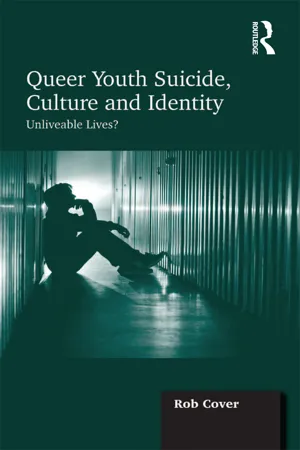
- 184 pages
- English
- ePUB (mobile friendly)
- Available on iOS & Android
eBook - ePub
About this book
Despite increasing tolerance, legal protections against homophobia, and anti-discrimination policies throughout much of the western world, suicide attempts by queer youth remain relatively high. For over twenty years, research into queer youth suicide has debated reasons and risks, although it has also often reiterated assumptions about sexual identity and youth vulnerability. Understanding the cultural context in which suicide becomes a necessary escape from living an unliveable life is the key to queer youth suicide prevention. This book uses cultural theory to outline some of the ways in which queer youth suicide is perceived in popular culture, media and research. It highlights how the ways in which we think about queer youth suicide have changed over time and some of the benefits and limitations of current thinking on the topic. Focusing on identity, Queer Youth Suicide, Culture and Identity also investigates why queer young men continue to attempt suicide. Drawing on approaches from queer theory, cultural studies and sociology, it explores how sexual identity formation, sexual shame and discrepancies in community belonging and exclusions are implicated in the reasons why some queer youth are resilient while others are vulnerable and at risk of suicide. As such, it will appeal to scholars of sociology, media studies, queer theory and social theory with interests in youth, gender and sexuality, and suicidology.
Information
Chapter 1
Queer Suicide Representations in Popular Media
Popular entertainment media, which includes plays, film and television, has long associated suicidality with gay men and lesbians and with sexual non-normativity. Texts such as Tennessee Williams’ Cat on a Hot Tin Roof or the 1970 film The Boys in the Band among the more well-known accounts, although the idea that non-heterosexual persons are prone to suicide has also been depicted in countless fleeting references and characters (Remafedi 1994: 7-14). As Larry Gross (1991: 28) points out, of thirty-two films with major homosexual characters released between 1961 and 1976, thirteen feature gay suicide. Queer youth suicide is made knowable in a range of media depictions from supporting characters in television series and fleeting references to unseen characters in films and self-help talkback shows interviewing the mothers or siblings of vulnerable queer youth. Social and cultural knowledge of the connection between queer youth and suicidality is as much forged in popular culture as in news and policy documents, texts on mental health, psychology, sociology, self-help manuals and in queer community political rhetoric.
The persistence of the link between non-heterosexuality and suicide is, on the one hand, remarkably useful in drawing attention to an issue that in other contexts and situations is often forgotten (Howes 1993: 800). At the same time, however, disseminating the relationship between non-heterosexuality and suicide in popular culture has its risks, given the capacity of entertainment media to reinforce stereotypes of queer persons (Cover 2004). What makes even a brief, throwaway reference to queer suicide in popular non-fictional media significant is that it reiterates and puts into further circulation the notion that suicide is not only what gay men and lesbians have done but what they will do. This serves to strengthen the existing discourse that links non-heterosexuality with suicide as a logical outcome for the more vulnerable and at-risk younger queer persons.
‘Suicidal queer youth’ is not, of course, the dominant image of non-heterosexual youth in entertainment media today. The mid-1990s saw a renaissance in lesbian/gay film and television representation, with a significant change in the frequency and tone of non-heterosexuality on-screen: these include mass-circulation films such as The Opposite of Sex (1998), But I’m a Cheerleader (1999), and television series such as Queer as Folk (USA and UK) and Buffy the Vampire Slayer (USA). Even more recently, depictions of even younger lesbian and gay youth have been more frequent in television, with series such as Glee (2009-), Gossip Girl (2007-), the re-booted 90210 (2008-) and Skins (2007-) depicting mostly male same-sex attracted younger persons as major characters with significant storylines. Contrasting with earlier films such as This Special Friendship (Les Amities Particulieres, 1964) and Another Country (1984) which portray non-heteronormative sexualities and behaviours explicitly in connection with suicide, recent films and television series do not represent minority sexualities as suicidal and they do not present risk behaviour or self- harm as the narrative ‘stumbling blocks’ which young lesbians and gay men must overcome in order to become fully-coherent sexual selves. However, they do frequently represent non-heterosexual characters as vulnerable (Padva 2004), which does not entirely overturn the stereotypical relationship between queerness and suicidality. At the same time, it is important not to presume that just because new entertainment productions do not explicitly make a sexuality-suicide link that the trope is eradicated from popular culture altogether. Stereotypes of homosexual suicidality remain in circulation in repeated television series and older films broadcast on cable networks, overshadowing the often more positive and visible portrayals of queer persons in film and television (Davis, Saltzburg and Locke 2009: 1030). Earlier films and series remain in circulation – no matter how dated some of their concepts might be – through television repeats and video-cassette and DVD availability (Mulvey 2006: 21), and these serve to re-circulate and reinforce stereotypes of sexual minority suicidality. Period pieces such as Tom Ford’s A Single Man (2009), based on Christopher Isherwood’s novel and set in the early 1960s likewise represents suicide as a ‘thinkable’ outcome for a gay man suffering loss and depression, despite the efforts to locate the story in the context of its time.
This chapter examines some of the broad trends in the representation of queer suicidality in popular film and television media with a view to presenting a typology for comprehending the knowledge framework that associates non-heterosexual behaviours, erotics and identities with suicide. Important here is the need to theorise some of the ways in which these changing frameworks contribute to the popular cultural knowledge that sexual minorities are inherently connected with concepts of suicide, are at risk of suicide ideation and suicide attempts, and/or that suicide is the likely outcome for at least some sexual minority youth. This is significant for the formation of a culture in which queer youth suicide emerges and continues: in contemporary western culture, it is primarily through various media forms, technologies, spaces and geographies that discourses on sexuality and sexual identities are communicated, disseminated, and given varied weightings of value. Indeed, adolescents in the later twentieth century and early twenty-first century encounter discourses of sexuality – and make sense of sexual identity – not through the institutions of family, church or education, but predominantly through film, television and magazines (Ashcraft 2003, Greenburg, Brown and Buerkel-Rothfuss 1993). Four different ways of representing queer suicide are identifiable in films and television series that address or mention queer youth and adult suicide: (1) stereotypes of shame and melancholia in the representation of the queer male as ‘fated’ towards a suicidal outcome; (2) queer youth and the various relationships between mental illness and suicide; (3) isolation and rejection from social participation and belonging as a causal factor for queer youth suicide; and (4) stigma, homophobia and the ‘cry for help’ suicide model. Naturally, an exhaustive survey of every reference to queer suicidality in film and television is neither feasible nor useful; rather, by undertaking textual analyses of a number of representative films and television series it is possible to tease out some of the ways in which the social perceptions of both queer youth and queer youth suicidality are formed in popular culture.
Popular Culture and the Constitution of Queer Youth Suicide
Much literature on sexuality-related youth suicide has referred to a debilitating lack of media representation of lesbian/gay personages (Gibson 1989: 133, Morrison and L’Hereux 2001: 44-45, Dorais 2004: 68), although this view has increasingly become outdated since the mid-1990s (Becker 2006). While it is true that popular media culture in general maintains heteronormativity by mirroring social expectations that everyone is heterosexual unless indicated otherwise, there has been a vast increase in the number of representations and voices on, about and by lesbians and gay men including those depicted in dozens of films and television series centring on queer lives. Likewise, the incidental or sideline lesbian/gay characters that have become fixtures in much television drama today are also among the significant voices and often are seen as sympathetic or positive depictions of non-heterosexuality; these range from Willow, Tara and Kennedy in Buffy the Vampire Slayer and David Fisher in Six Feet Under to Mitch in Skins and Kurt in Glee.
Within the study of popular culture, mass media forms such as television are understood to homogenise a community by posing as an extension of a perceived common self, such as heterosexuality, and by confronting audiences with images of what they are not expected to be, such as non-heterosexuals (Day 1990: 8-9). Stories of heterosexual romance and homosexual otherness are part of the sexual narratives that make up our contemporary culture, and what different sexual personages do are depicted in these narratives. As Kenneth Plummer has pointed out, the modern western world has become cluttered with sexual stories:
We have moved from the limited, oral and face to face tales told throughout much of history in epic poems, songs and narratives; through the development of a public print inscribing sexual stories in limited text, first for the few and then for the ‘masses’; and on to a contemporary late modern world where it seems that ‘sexual stories’ know no boundaries (Plummer 1995: 4).
These popular cultural stories tell us, then, not only about common, recognisable and expected sexual lives, but also the sexual lives of the less-common, the less well-reflected, the less-recognisable to broader audiences. It certainly remains true that images of sexual minorities sell media texts (Case 1995: 41), and this includes the depiction of the suicidal gay man or teenager in the past as much as today it is in the depiction of the gay man as connoisseur of fashion, culinary taste and decorative style as represented in, say, Queer Eye for the Straight Guy (2003–2007). Although such representations often commodify queer identity as that which can be produced through conspicuous consumption, it does not make them any less real or informative for different audiences: policymakers, researchers, community activists and queer youth themselves.
In that sense, representations of queer suicidality matter. In some important work on the uses by adolescents of popular media, Catherine Ashcraft points out that popular culture is ‘an increasingly important site of struggle where adolescents’ sexual identities are produced and where dominant discourses of sexuality are reinscribed and/or transformed – often in ways that are more meaningful to or effective with youth’ (Ashcraft 2003: 38). If we are to be concerned with the ways in which suicide might be understood by the more-vulnerable as an ‘expected behaviour’ or logical solution to a seemingly unliveable life, then the role of entertainment media in providing that expectation must not be underestimated, for it is here that expectation is accessed and encountered first and most-readily by younger persons today, whether that be in the re-distribution of older texts or in the intertextual knowledges of a suicide-homosexuality link disseminated in more recent ones. Jane Pirkis and Warwick Blood (2001) have noted that media portrayal of suicide does not have a clear, linear causal relationship with actual suicide attempts or completions. That is, there is no evidence that in consuming such texts an audience member will be driven to attempt suicide. However, what these depictions do is contribute to and reinforce the broad, existing cultural knowledge that associates non-normative sexuality with self-harm and suicide. This is not to suggest that queer youth suicide should not be depicted on-screen, rather it is to say that understanding how popular media has modelled sexuality-related suicide in different ways at various times is important in understanding the cultural framework that makes sexuality-related youth suicide possible and thinkable.
Sexuality, Shame, Stigma and Fate
It was once a common narrative function of texts involving lesbian and gay characters to invoke suicide in some way in order to provide non-heterosexuality with a ‘melancholic quality’. This is typically related to older film and literary stereotypes of the male homosexual as the ‘sad young man’ (Dyer 1993: 22, 42, 73–92). The melancholic representation of homosexual males in film reached its peak in the mid-1970s, best represented by films such as Zee and Co. and Boys in the Band, both of which combined the presentation of sexual non-normativity, camp theatrics and melancholic dispositions as storytelling devices. The swing between camp enthusiasm and melancholic sadness or depression for the gay man or lesbian’s solitary, sidelined existence represents what Dyer suggests are familiar narrative functions that repeat and reinforce existing stereotypes: a woman’s gay male best friend or the threatening, psychopathic and self-destructive lesbian bent on destroying another woman’s marriage, neither of which leads to happiness but to increased melancholia and self-destruction (Dyer 1993: 22). Such depictions resulted partly from the traditions of the Motion Picture Association of America Production Code which, between the 1930s and 1968, insisted that no sympathy for the violation of human, natural and divine laws should be presented. The homosexual was to have been depicted only as a sad or pathetic creature; unhappy and suicidal (Russo 1981: 121–122). The fact that the code was overturned and abandoned by the 1970s did not, of course, prevent the repetition of this trope in film and television of the following decades. Another Country, for example, reinforces melancholia through a historical portrayal of British boarding-school life, in which a boy caught in a same-sex erotic act with another boy hangs himself. Young gay men are likely to be lonely and stigmatised; the lesbian monster must be destroyed. In this category of popular media representation, non-heterosexual identity or behaviour is represented as always fated towards a suicidal outcome: a fate against which one can struggle, but a fate of which one is always vulnerable.
To be fated to take one’s own life has its non-queer precursors, of course. For Emile Durkheim, fatalistic suicides appear predominantly in what he sees as ‘primitive’ societies, and they fall into three categories: the suicides of men on the threshold of old age or illness, those of women on their husbands’ death, and those of servants or followers on the death of their chiefs. Such persons kill themselves not because it is an assumed right of agency over their own lives, but because it is their responsibility to do so (Durkheim 1952: 219) – a subject has lost the authority to be an ongoing, liveable life. While Durkheim does not extend his analysis into the field of identity and identity-related behaviours or expectations, there is a clear pattern of subjectification that can be drawn out from his delineation of fatalistic suicide. The sick elderly, the widowed wife, and the bereaved follower are not only dishonoured or punished for the failure to kill themselves under culturally-sanctioned customs, but are expected to do so because that is the linear, performative pattern dictated by the label or category of identity.
In a similar way, the representation of queer persons for whom suicide is an expected outcome operates within a framework of the non-normative person’s life as an unliveable life, compelled to suicide because the person is not productive (or, indeed, reproductive). The responsibility to suicide is not explicit as in the cultural traditions alluded to by Durkheim (1952: 227), but the narrative functions that produce the melancholic, sad queer person in such representations present an implicit statement that suicide is the expected outcome of such a life. The concept of fatalistic suicide thus draws a link between the notion of a specific identity or category of subject and the expectations that such identities in specific, perhaps extreme, circumstances perform suicide. In contemporary western culture in which sexual preferences and behaviours constitute discrete identities (hetero or homo), subjectivity is upheld by a range of performances that are coherent and intelligible to that identity (Butler 1990). Suicide and suicidality in this respect are among a range of performances that are coherent, intelligible and recognisable for the non-heterosexual subject. In this particular understanding of suicidality, one is fated towards suicidality as a direct result of one’s sexual non-normativity: one must die not only from it but for it.
The portrayal of queer personages as fated towards suicide communicates and recirculates a set of stereotypes. Stereotypes are a node of communication which present ‘recognisable’ information about an identity category – albeit reductive, simplistic and usually not representative of genuine diversity and the broad complexity of subjectivity. As a form of language or a ‘byte’ of information, stereotypes associate a set of behaviours, attitudes or dispositions with an identity category, and this is typically the case for minorities and non-heterosexual persons (Cover 2004). Stereotypes find their persistence over time not in the extent to which a culture might dispute them, but in the ease by which they are circulated and repeated, thereby reinforced even when disavowed (Rosello 1998). Thus in films such as, for example, Consenting Adult (1985) where only the passing mention of a gay male suicide is made by Martin Sheen’s character, or in the TV Movie An Early Frost (1985) where the (unsuccessful) attempt at suicide is made by a closeted gay character recently diagnosed HIV-positive, or Wonder Boys (2000) in which young queer student James (Tobey Maguire) demonstrates a fascination with celebrity suicides, the stereotype that queer persons are fated towards suicidality is reinforced through popular cultural repetition to become a coherent and recognised ‘social fact’.
The classic film The Boys in the Band, based on Mart Crowley’s play and directed by William Friedkin, is a good case in point as to how homosexuality has been depicted as fated towards suicide. Although the characters are on the outer edge of being classified queer youth – noting the relative absence until the early 2000s of younger non-heterosexuals on screen – the film is significant in that it infuses a narrative about gay men with a sense of suicide as a likely outcome for them all. Set at a party of a number of youngish gay men in their late twenties and early thirties, the dialogue among the characters swings between camp frivolity and angry melancholia, with frequent references to suicide. As the men become intoxicated and bitchy, Michael (Kenneth Nelson) taunts his friend Harold (Leonard Frey) over his suicidality:
And the pills: Harold has been gathering and storing and saving up barbiturates for the past year like a squirrel. Hundreds of nembutals, hundreds of seconals, all in preparation for – and anticipation for – the long winter of his death. Well, I’ll tell you something Hally, when the time comes you won’t have the guts. It’s not always like it happens in plays. Not all faggots bump themselves off at the end of the story.
Significantly, Michael’s speech draws attention to the stereotype of queer suicidality and to Harold’s location within the fatalism that is communicated by it. Disavowing the truth or fate of the stereotype, he effectively continues its circulation in popular culture. He does, however, confirm by the end of the film the truth that not all gay men kill themselves, reacting in horror to its symbolism when offered a valium to calm him down. What is made explicit is the notion that the theatrics of manipulation, exuberance and consumption are tools of public self-identification which attempt to obscure the melancholia of homosexual selfhood but effectively reveal it; hiding one’s melancholic ‘nature’ is depicted here always to fail.
While a melancholic and suicidal disposition forms part of the recognisable stereotype circulated by this film, on closer examination we can see that it is actually produced in the text as a fated or cultural expectation resulting from inherent and indelible shame. This is not shame over being homosexual but, rather, unavoidable shame over the failure to be heterosexual. Shame, of course, figures within Durkheim’s categorisations of suicide as an ‘obligatory altruistic suicide’ (Durkheim 1952: 221); the suicide that results from the loss of honour, although this is rather different from the form of shame and self-deprecation that has marked sexual non-normativity throughout much of the Nineteenth and Twentieth Centuries. Queer theorist Michael Warner refers to the ways in which shame figures in the articulation, determination and discourses of sex and sexuality. For Warner, gay culture is ‘marked by a primal encounter with shame’, both embraced in the cultural production of identities within lesbian/gay communities and latched onto by moralists pointing to shame in gay life ‘as though it were proof of something pathological in gay people’ (Warner 1999: 8). Shame operates here, then, not as affect or emotion but as a manifestation of the permanency of stigma, marking the homosexual as fata...
Table of contents
- Cover Page
- Title Page
- Copyright Page
- Contents
- Acknowledgements
- Preface
- Introduction: Queer Youth Suicide, Vulnerability and Unliveable Lives
- 1 Queer Suicide Representations in Popular Media
- 2 Histories and Genealogies of Suicide Research and Sexuality
- 3 It Gets Better? Online Representations of Hope, Vulnerability and Resilience
- 4 Reconstitutions: Identity, Subjectivity and the Dominant Discourses of Sexuality
- 5 Tensions: Suicide, Sexual Identity and Shame
- 6 Community: Homonormativity, Exclusion and Relative Misery
- Conclusion: Towards Liveable Lives
- Bibliography
- Filmography
- Index
Trusted by 375,005 students
Access to over 1.5 million titles for a fair monthly price.
Study more efficiently using our study tools.
Frequently asked questions
Yes, you can cancel anytime from the Subscription tab in your account settings on the Perlego website. Your subscription will stay active until the end of your current billing period. Learn how to cancel your subscription
No, books cannot be downloaded as external files, such as PDFs, for use outside of Perlego. However, you can download books within the Perlego app for offline reading on mobile or tablet. Learn how to download books offline
Perlego offers two plans: Essential and Complete
- Essential is ideal for learners and professionals who enjoy exploring a wide range of subjects. Access the Essential Library with 800,000+ trusted titles and best-sellers across business, personal growth, and the humanities. Includes unlimited reading time and Standard Read Aloud voice.
- Complete: Perfect for advanced learners and researchers needing full, unrestricted access. Unlock 1.5M+ books across hundreds of subjects, including academic and specialized titles. The Complete Plan also includes advanced features like Premium Read Aloud and Research Assistant.
We are an online textbook subscription service, where you can get access to an entire online library for less than the price of a single book per month. With over 1.5 million books across 990+ topics, we’ve got you covered! Learn about our mission
Look out for the read-aloud symbol on your next book to see if you can listen to it. The read-aloud tool reads text aloud for you, highlighting the text as it is being read. You can pause it, speed it up and slow it down. Learn more about Read Aloud
Yes! You can use the Perlego app on both iOS and Android devices to read anytime, anywhere — even offline. Perfect for commutes or when you’re on the go.
Please note we cannot support devices running on iOS 13 and Android 7 or earlier. Learn more about using the app
Please note we cannot support devices running on iOS 13 and Android 7 or earlier. Learn more about using the app
Yes, you can access Queer Youth Suicide, Culture and Identity by Rob Cover in PDF and/or ePUB format, as well as other popular books in Social Sciences & Gender Studies. We have over 1.5 million books available in our catalogue for you to explore.