eBook - ePub
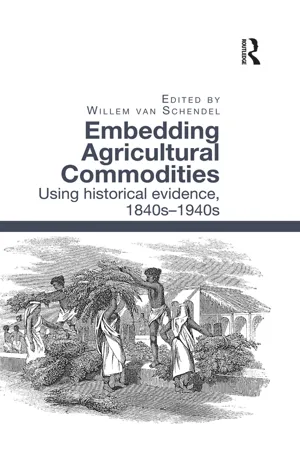
Embedding Agricultural Commodities
Using historical evidence, 1840s–1940s
- 194 pages
- English
- ePUB (mobile friendly)
- Available on iOS & Android
eBook - ePub
About this book
Over the past 500 years westerners have turned into avid consumers of colonial products and various production systems in the Americas, Africa and Asia have adapted to serve the new markets that opened up in the wake of the "European encounter". The effects of these transformations for the long-term development of these societies are fiercely contested. How can we use historical source material to pinpoint this social change? This volume presents six different examples from countries in which commodities were embedded in existing production systems - tobacco, coffee, sugar and indigo in Indonesia, India and Cuba - to shed light on this key process in human history. To demonstrate the effectiveness of using different types of source material, each contributor presents a micro-study based on a different type of historical source: a diary, a petition, a "mail report", a review, a scientific study and a survey. As a result, the volume offers insights into how historians use their source material to construct narratives about the past and offers introductions to trajectories of agricultural commodity production, as well as much new information about the social struggles surrounding them.
1
Embedding agricultural commodities
An introduction
How can we use historical source material to pinpoint social change?Embedding Agricultural Commodities shows six different ways, based on different types of historical source. Each chapter is concerned with the same process: the embedding of commodities in existing agrarian systems. Embedding is the term we use for the process of forging an agricultural commodity chain: introducing a new cash crop and making sure it endures.
Approaching this process from six different vantage points, we demonstrate how important it is to pay close attention to the sources of knowledge on which we base our analyses of social change. They shape our understandings of the past but what do they tell us, and what not? The more we understand how they came about – who wrote them, for whom they were intended, and how they impacted on subsequent social change – the more we are able to assess their usefulness and their limitations.
This volume presents an introduction to the use of sources and it does so by looking at a key process in human history: the way we seek to manipulate the world around us to our own advantage. The focus of this book is on how different historical sources help us understand the insertion of new agricultural commodities into pre-existing social and economic arrangements. To this end, we consider different locations and periods. Our case studies deal with Indonesia, India, Bangladesh and Cuba and they run from the mid-nineteenth to the mid-twentieth century. The main commodities that we look at are tobacco, coffee, sugar and indigo. The book concludes with a chapter that considers these four commodities together to explore the global dimensions of embedding and to argue for the agricultural roots of globalization.
The sources
We have selected six types of historical source on the embedding of commodities. We explore the usefulness of a diary, a petition, a ‘mail report’, a book review, a scientific study and a survey. Each chapter features one of these sources and, as we shall see, each source has its own strengths and limitations. Historians would label these documents ‘primary sources’ because they were created by participants in (or observers of) the historical events that they describe.1 They are also similar in that they are texts – rather than images, material objects, or other relics of the past.2
But they differ from each other in many other ways. First, they began life in diverse places: three of them were crafted in various locations in British India, and one each in Cuba, the Netherlands East Indies and the Netherlands. Second, they were written in the languages of three different colonial regimes – English, Spanish and Dutch – over the course of a century of rapid change, from the 1840s to the 1940s.3 Third, half of them remained unpublished (and can now be found in archives in India, the Netherlands and Britain), two were published in limited editions by government presses (a few copies are now in specialized libraries) and one was published as an article in a Dutch literary journal. Only this last one can currently be found online in full-text version. Finally, these sources vary in size from a couple of pages (the petition) to a five-volume manuscript running into hundreds of pages (the diary).
Variation is even more striking if we consider the authors and their intentions. The creators of four of the texts were Europeans writing in colonial settings, one was in post-independence Cuba, and one in the Netherlands. Three texts had a single author, one was co-authored by a married couple, and the other two were a group effort. All authors except one were male.
The position of the authors with regard to agricultural commodity production differed for each source. At the time of writing they were, respectively, the manager of an indigo factory in rural eastern India (the diary), 21 coffee-planters in South India (the petition), a bureaucrat (the mail report), an essayist (the review), two botanists (the scientific report) and an agronomist (the survey).
Who were they writing for and with what intentions? The audiences they targeted ranged from a single private individual (the diary writer’s father) to the general educated public. Three texts were meant for the eyes of government officials only, and one sought to reach fellow researchers. It is hard to reconstruct exactly which combination of factors motivated the authors but their main concerns were clear enough. The diary was written as an act of self-expression and to sustain personal communication with a faraway relative. The main purpose of the petition and the book review was political lobbying – an attempt to change government policy. The mail report was a cog in the bureaucratic machine, intended to facilitate administrative processes. The scientific report and the survey were all about knowledge production and economic development.
These six sources provide contrasting entry points into the realities of how new commodities get – and stay – embedded in agrarian societies. They give an indication of the types of information that different remnants of the past can provide. But how do researchers use such disparate information to create a convincing narrative? This is what we turn to next.
The historian’s craft in action: how do researchers interact with their sources?
The contributors to this volume have been working in the same field for several years and they have met as participants in a comparative research programme, workshops and conferences.4 Their individual projects have resulted in scholarly monographs and articles. One of the issues that kept coming up in discussions among them was the extent to which diverse sources of information constrain comparisons between cases. Another issue was how each researcher used and interpreted the historical sources at his or her disposal. Obviously, they all based their insights on many sources but the idea of this joint volume is to highlight just one. Each chapter concentrates on a single revealing source to explore its peculiarities and to demonstrate how the researcher used it in constructing a historical narrative, thereby shaping memory.5 The chapters demonstrate the historian’s craft in action. They are not proffered as models to be emulated, but rather as an introduction to the quandaries and possibilities of the everyday work of historians.
In the following chapters, the contributors explain why they consider their selected sources to be especially significant and relevant. They explore the uses and limitations of each source: the perspective it offers, its biases and its silences. They also share parts of the source with us, both to give us a sense of the ‘raw data’ and to help us assess the veracity of their interpretations.
Interpretation of historical sources can take different forms, depending on what the researcher wants to accomplish. The shared interest of the contributors to this volume is to explore what the embedding of new agricultural commodities meant, how it was done and how successful it was. The selected texts act as empirical building blocks in the construction of narratives about this process in concrete cases. The case studies themselves are intended as building blocks for the construction of comparative understandings of how commodity production begins and continues.
The dynamics of embedding
The concept of ‘embeddedness’ first emerged as a significant scholarly concept when Karl Polanyi published his The Great Transformation in 1944.6 In this book, Polanyi analysed economic activities as being ‘socially embedded.’ Since then, the term has been used in many different ways.7 Of special interest to this volume is how the concept has been used in the study of commodities. In 1985, economic sociologist Mark Granovetter published an article in which he argued that standard economic accounts are ‘under-socialized’: they do not take sufficient note of the socio-structural contexts that shape economic behaviour.8 This idea – that ‘economic activity is embedded in social relationships, not the other way round’9 – has had a considerable impact on researchers in the field of commodity chains. These researchers focus on the meso-level and assume that economic activity is embedded either in network structures or in social, economic or political institutions.10 But they ‘typically do not analyse the long-term or underlying causes of the networks themselves’.11
This is precisely what we aim to do in this book. First, we look at longer-term processes of embedding during the nineteenth and twentieth centuries. Second, unlike much commodity chain research, which puts emphasis on the behaviour of firms, we concentrate on how economic activity was embedded in agrarian networks and arrangements. And third, we treat embedding as a continuous process rather than as a single action; embeddedness is not a state but a balancing act.
In the following chapters, we explore several dimensions of the concept. All chapters deal with embedding in the sense of introducing a new commercial crop into a pre-existing agrarian order and the ensuing struggles between those who benefit from it and those who wish to dislodge, or disembed it. As all of our examples are from what is now the Global South – the ex-colonized world – the peculiarities of colonial rule play an important role. Chapters 2 and 3, especially, investigate how the exploitative relationship between Europeans and local populations was predicated upon entrenching the colonial administration in pre-colonial, patrimonial structures. We also examine moral issues beyond the mere profitability of colonial commodity production, notably discourses about property rights, labour relations, social justice, human mobility, coercion and environmental impact (for example, Chapters 2, 3 and 5).
In several chapters, embedding takes on additional meanings. For example, it is also employed to examine the application of technical knowledge (notably Chapters 6 and 7), the competition between different forms of embedding (for example, smallholder versus plantation production, as in Chapters 4 and 5), and the embedding of production-enhancing commodities such as fertilizers, pesticides and improved varieties (Chapters 6 and 7). Embedding was also predicated upon ecological conditions and the biological requirements of individual crops, which put restrictions on their cultivation (Chapter 2). The interplay of various factors became apparent only by trial and error; the essentially experimental dimension of embedding is especially evident in Chapters 6 and 7. Finally, the embedding of new cash crops implied – or at least raised fears of – disembedding other crops, notably food crops and agricultural commodities produced for local markets rather than for Northern ones. The new cash crops also endangered trade in agricultural commodities within the Global South. Much of the resistance against new agricultural commodities stemmed from this perceived threat to local subsistence and South–South trade. This dimension – disembedding resulting from embedding – is examined primarily in Chapters 2, 3 and 7.
Giving a face to the agents of embedding
Each of the six chapters following this introduction uses a particular historical source as its starting point to explore the emergence of a new commodity production system. Rather than presenting this process as the outcome of faceless economic forces and high-level abstractions (world market, state, empire), each chapter calls attention to the agents of embedding. Who were the driving forces behind this process and how did they achieve their goals? The answers show a remarkably varied picture. When we look at the everyday experience of the agents of embedding, it is important to keep in mind that successful embedding was far from assured: the history of agricultural commodity production is strewn with examples of failure.12 Even in the best of circumstances inserting a new crop required careful social engineering. In none of our case studies did the process go smoothly; it always entailed a tussle between opposing social forces and its long-term outcome was determined by the relative power that the agents of embedding could exert over their opponents.
It is no surprise that each of the selected historical sources bears witness to this power struggle. The contributions to this book show that processes of embedding are complex and nuanced. Many players are involved in the initial phase, the...
Table of contents
- Cover
- Title
- Copyright
- Contents
- List of figures
- List of tables
- Notes on contributors
- 1 Embedding agricultural commodities: an introduction
- 2 Staying embedded: the rocky existence of an indigo maker in Bengal
- 3 Multatuli, the liberal colonialists and their attacks on the patrimonial embedding of commodity production in Java
- 4 Smallholdings versus European plantations: the beginnings of coffee in nineteenth-century Mysore (India)
- 5 ‘Keeping land and labour under control?’: reporting on tobacco-shed burnings in Besoeki (Java)
- 6 Embedding cigarette tobacco in colonial Bihar (India): a multi-dimensional task
- 7 Cuba, sugarcane and the reluctant embedding of scientific method: Agete’s La Caña de Azúcar en Cuba
- 8 Globalization’s agricultural roots: some final considerations
- Index
Trusted by 375,005 students
Access to over 1.5 million titles for a fair monthly price.
Study more efficiently using our study tools.
Frequently asked questions
Yes, you can cancel anytime from the Subscription tab in your account settings on the Perlego website. Your subscription will stay active until the end of your current billing period. Learn how to cancel your subscription
No, books cannot be downloaded as external files, such as PDFs, for use outside of Perlego. However, you can download books within the Perlego app for offline reading on mobile or tablet. Learn how to download books offline
Perlego offers two plans: Essential and Complete
- Essential is ideal for learners and professionals who enjoy exploring a wide range of subjects. Access the Essential Library with 800,000+ trusted titles and best-sellers across business, personal growth, and the humanities. Includes unlimited reading time and Standard Read Aloud voice.
- Complete: Perfect for advanced learners and researchers needing full, unrestricted access. Unlock 1.5M+ books across hundreds of subjects, including academic and specialized titles. The Complete Plan also includes advanced features like Premium Read Aloud and Research Assistant.
We are an online textbook subscription service, where you can get access to an entire online library for less than the price of a single book per month. With over 1.5 million books across 990+ topics, we’ve got you covered! Learn about our mission
Look out for the read-aloud symbol on your next book to see if you can listen to it. The read-aloud tool reads text aloud for you, highlighting the text as it is being read. You can pause it, speed it up and slow it down. Learn more about Read Aloud
Yes! You can use the Perlego app on both iOS and Android devices to read anytime, anywhere — even offline. Perfect for commutes or when you’re on the go.
Please note we cannot support devices running on iOS 13 and Android 7 or earlier. Learn more about using the app
Please note we cannot support devices running on iOS 13 and Android 7 or earlier. Learn more about using the app
Yes, you can access Embedding Agricultural Commodities by Willem van Schendel in PDF and/or ePUB format, as well as other popular books in History & World History. We have over 1.5 million books available in our catalogue for you to explore.