- 174 pages
- English
- ePUB (mobile friendly)
- Available on iOS & Android
eBook - ePub
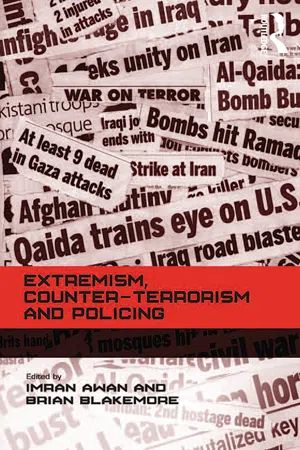
Extremism, Counter-terrorism and Policing
About this book
Extremism, Counter-terrorism and Policing brings together a diverse range of multidisciplinary studies to explore the extent of extremism and how communities are policed. Through analysing the historical development, the present situation, and future trends in the forms and ability to police violent extremism and terrorism, this text provides a detailed contribution towards both academic and policy debate surrounding extremism, its causes, and treatments. With chapters written by experts in their fields, this book provides the reader with detailed definitions of extremism; the psychology of extremists and the causes of radicalisation; policing extremism within a counter-terrorism context; community policing approaches to combating extremism; the legal frameworks and legislation regarding extremism and its limitations in an international setting; and public perceptions and understanding of extremism. It is crucial for policing professionals, policy-makers and academics to have a detailed understanding of government policy and the methods towards tackling extremism from a policing and community level. Extremism, Counter-terrorism and Policing gives a policing rationale alongside specific community approaches towards tackling extremist threats and provides key details for policy readers as well as academics.
Information
Chapter 1
Extremism, Radicalisation and Terrorism
Introduction
There is no single pathway towards extremism, violence and acts of terrorism instead there are a range of factors that lead to such incidents. Extremism has become a nebulous term with many different interpretations and definitions of what the term constitutes (Eatwell and Goodwin 2010). In the UK tackling this threat from extremism has led to a wave of counter-terrorism policies and anti-terrorism legislation. Indeed, the term has also resulted in a polarised debate about what the term ‘extremism’ means amongst academics, policy makers and politicians. For example, Hussain in his book entitled ‘the Islamist’ argues that extremism as a ‘preamble to terrorism’ (2007: 278). However, critics argue that the term extremism is far too broad and being converged with problematic associations with words linked to violent acts, such as ‘violent extremism’; ‘fundamentalism’; ‘radicalisation’; ‘jihad’; ‘Islamism’ and ‘terrorism’ (Davies 2008). Moreover, Eatwell (2006) argues that the term ‘cumulative extremism’ should be adopted as a means to define extremist threats to UK national security.
The British Government has defined extremism as a ‘vocal or active opposition to fundamental British values, including democracy, the rule of law, individual liberty and mutual respect and tolerance of different faiths and beliefs. We also include in our definition of extremism calls for the death of members of our armed forces, whether in this country or overseas’ (HM Government 2011: 107).
The problem with such definitions is that they will shift over time and similarly the term extremism will also evolve and change. Indeed, Hillyard (1993) argued that Irish communities in the 1960s were being labelled as extremists and had therefore become a ‘suspect’ community following the conflict in Northern Ireland. Similarly, Pantazis and Pemberton (2009) have also argued that the post-9/11 political discourse on extremism and the ‘war on terror’ rhetoric has led to British Muslims becoming the ‘new suspect’ community. The author agrees with the label that Muslim communities have become the ‘new suspect’ community and argues that the current Prevent Strategy (2011) reinforces this perception (Awan 2012). Furthermore, the above definitions can be considered as value-laden and subjective and as a result can be problematic when it comes to trying to understand the behaviour and patterns of individuals, groups, and movements described as extremists (Sunstein 2009; Hopkins and Kahani-Hopkins 2009). In 2006 this unprecedented threat from extremism was described by British Prime Minister Tony Blair at the time as:
the poisonous propaganda of those people that warps and perverts the minds of younger people. it’s a very long and deep struggle, but we have to stand up and be counted for what we believe in and take the fight to these people who want to entice young people into something wicked and violent but utterly futile. (The Guardian 2006)
Whilst media coverage and debate about extremism has focused on negative stereotypes and associations with people regarded as terrorists, critics argue that many individuals once regarded as extremists are now considered high profile political activists and reformers (Davies 2008). Furthermore, the word extremism in particular has, in the past, been used to describe people such as Mahatma Ghandi, Nelson Mandela, Malcolm X and Dr Martin Luther King, Jr who are now accepted as being pioneers for change and individuals who have made an important contribution towards social activism and social community cohesion. As Hopkins and Kahani-Hopkins (2009: 101) state:
Dr King sought to re-define the meaning of extremism and moderation so as to re-shape the terms of reference with which his activism was to be judged. Specifically, his contrast between these forms of extremism (love and hate) left no place for moderation or passivity: all right-thinking people must identify with the project of mass activism.
Thus, this pervading debate as to who is and who is not an extremist is rooted in the political versus legal interpretation of extremism and terrorism. The analogy that ‘one man’s terrorist is another man’s freedom fighter’ is ample example of the problems when it comes to defining extremism and indeed terrorism. . Despite the conceptual challenges involved in attempting to define the word extremism there is little doubt that some people labelled as extremists have had the capacity to inflict harm and damage upon society in the pursuit of their ideological causes. Thus, the problem for international governments is the need to balance civil liberties whilst also preserving security (Bleich 2010). Grayling (2009) for example argues that the major problem for democracies across the world is the terrorist threat and also how values and liberalisation are protected within communities.
As noted above the label extremism, for some groups and individuals, can become a symbolic feature of the organisation, giving it credence and an opportunity to gather support and voice supporters’ opposition or concerns (Chakraborti and Garland 2009). Presently, the UK Government identifies the most serious threat emanating from international terrorism as Al-Qaeda led terrorism, followed by the domestic threat from terrorist groups in Northern Ireland and the threat from far right extremist groups or lone individuals (HM Government 2011).
However, the British Government does recognise that similar extremist ideologies are also considered a threat to UK national security from the violent gang culture depicted in the London riots in the summer of 2011, animal rights extremism, anti-abortionists and anti-capitalist extremism. As discussed above there is no single pathway towards extremism; instead there are a wide range of reasons why someone would hold such views depending on their beliefs, vision, motivations, aims and values. These factors are based on a number of socioeconomic, socio-demographic and cultural factors which are linked to issues of identity and self-critique (Davies 2008). Although there are many different forms of extremism this chapter will be focusing upon animal rights extremism, the threat from far right extremism and Islamist extremism.
Defining Extremism?
The UK counter-terrorism strategy CONTEST has four key themes in tackling the threat from terrorism. They are to ‘Protect’; ‘Pursue’; ‘Prepare’ and ‘Prevent’ a terrorist attack. The PREVENT strand of the strategy changes the original phrase of ‘violent extremism’ to just ‘extremism’. According to the Crown Prosecution Service in Britain extremism could include ‘glorifying, provocation or the promotion of criminal or terrorist inspired activity’ (cited online CPS website 2010). Indeed, the problem with the interpretation of extremism is that the phrase can often be merged with other themes of violent acts. For example, Choudhury (2007) argues that extremism and radicalisation often merge into one uniform principle. He states that; ‘Radicalisation requires the communication of extremist ideas’ (Choudhury 2007: 22).
However, as noted above, extremism is a vague concept and one that has, by implication, the potential to marginalise and stigmatise a specific community (such as the Muslim community when discussing Islamist extremism) (Spalek 2011). The PREVENT Strategy 2011 does not help shed light on the debate on the meaning of extremism but instead provides further problematic issues of interpretation and analysis. The Citizenship Survey, run by Ipsos MORI on behalf of the Communities Analysis and Migration Division within the Department for Communities and Local Government, found that most people involved in the survey had rejected all forms of violent extremism (Ipsos MORI 2011).
In defining extremism the PREVENT Strategy 2011 has to focus on challenging and understanding what makes someone follow an ‘extremist’ or a ‘radical’ way of life and begin a process of engagement with support for those who the government deem at risk of becoming extremists or terrorists. Moreover, there is a need for a wider discourse to further understand not just what the term extremism means but also the increasingly important role technology and the internet is playing, as extremist groups begin to use it as a means to recruit, indoctrinate and radicalise ‘vulnerable’ individuals (these issues will be discussed in more detail in Chapter 5). As noted above extremism as a term is so wide that it could cover far right extremism, Islamist extremism and animal rights extremism.
Different Forms of Extremism
Animal Rights Extremism
Counter-terrorism policies in Britain have not made any significant distinctions between different types of acts of terrorism or indeed extremism and as such extremism could be applied to animal rights groups who have used tactics of fear and violence to promote an ideological cause. Moreover, the UK Government has stated that ‘Animal rights extremists engaged in these activities should not, therefore, be surprised to find themselves treated as terrorists’ (Home Office 2004:10). Hadley (2009: 363) in his article ‘Animal Rights Extremism and the Terrorism Question’ raises serious questions and issues regarding whether acts of violence from animal rights protestors should be equated with acts of terrorism or extremism. He stated that: ‘Perhaps animal rights extremists do not warrant the pejorative label “terrorists” but instead deserve to be known as freedom fighters consistently applying philosophically respectable views.’
Social movements and groups within animal rights organisations such as the Animal Liberation Front argue that their core purpose and moral rationale is to cause disruption of research involving animal testing. However, the problem with such groups and movements is the strong links that can be made with forms of extremism and therefore the goals they aim to achieve can often be undermined by the manner in which they protest thereby taking away the credence of these movements. Hadley (2009: 364) states that: ‘A strong association of animal rights with terrorism in the public consciousness could undermine the credibility of the animal rights movement and set the cause of animal protection back decades.’
As noted above, animal rights protest groups have been criticised for the nature of the acts of violence used in their demonstrations. These problems can be manifested in the arguments made by such groups about the merits, morality and ethics of scientific research whereby violence is justified as its use may not be legal but is deemed to be proportionate and fair. Another major issue when labelling particular groups with the words extremism or terrorism is the lack of a universal definition of such terms.
The modern definition of terrorism, for example, has been controversial – the United Nations has not yet accepted a definition of terrorism. Furthermore, not having a universal definition of the word extremism has also led to the media and politicians often portraying terrorists as either dangerous ‘Islamists’ or ‘Jihadists’ which evokes images of ‘Muslim terrorists’ and ‘Muslim fundamentalists’ dressed in long robes, wearing the ‘topi’ (hat) and with beards. However, without a universal definition of the words extremism and terrorism it is a dangerous step to begin to label persons and groups based on their faith/religion and indeed this may lead to further resentment and anger amongst minority groups.
The UK definition of terrorism can be found under section 1 of the Terrorism Act 2000 as the use of threat of action where:
• the action falls within subsection 2
• the use or threat is designed to influence the Government or to intimidate the public or a section of the public the use or threat is made for the purpose of advancing a political, religious or ideological cause
• Action falls within this subsection if it
• Involves serious violence against a person
• Involves serious damage to property
• Endangers a person’s life other than that of the person committing the action
• Is designed seriously to interfere with or seriously to disrupt an electronic system.
The debate surrounding the word terrorism has been problematic since its inception. For example, in a House of Lords debate surrounding the terminology there was a lack of clarity when it came to defining the word terrorism:
I can only agree with what was said by both the noble Lord, Lord Goodhart, and the noble Lord, Lord Cope; namely, that there are great difficulties in finding a satisfactory definition. Indeed, I was unable to do so and I suspect that none of us will succeed. As I say, we must do our best but I hope we will not spend too much time on the definition. (Report by Lord Carlile 2006: 4)
Hadley (2009: 367) states that:
It is not an exaggeration to say that there are as many definitions of terrorism in the literature as there are terrorist attacks in the real world. All of the leading definitions of terrorism, moreover, it is widely acknowledged, have their strengths and weaknesses and are more or less vulnerable to objection by counter-example. This has prompted some recent commentators to eschew attempting to define terrorism; instead they try to show what is distinctive or characteristic about it. (Schmid)
The Threat from Far Right Extremism
As noted earlier, PREVENT 2011 aims to promote integration, cohesion and community safety but as critics argue, failed to tackle the wider issue of far right extremism and instead paved the way for anti-Islamist groups such as the English Defence League (EDL). The UK Government identifies international terrorism, and in particular Al-Qaeda led extremism, as a major threat to UK national security (HM Government 2011). However, the policy has little depth and substance in relation to the threat from far right extremist ideologies and although far right extremist groups have different aims and goals as compared to terrorist groups such as Al-Qaeda critics argue that they also pose a unique threat to international democracy. For example, groups such as extreme anti-capitalists, anti-abortionists and anti-Semites do not necessarily have the same motives as terrorist groups but could also be a threat (Hadley 2009).
Therefore, PREVENT 2011 has the potential to marginalise a single community, and thereby exacerbate the EDL rhetoric that Islamism is on the rise in Britain and should be combated (Chakraborti and Garland 2009). The case of Anders Breivik highlights how far right extremists can have the same impact as Islamist terrorist groups (Blake and Morris 2011). Breivik, who described himself as a Christian fundamentalist, claimed to have had links with the EDL, following his attacks that killed 77 people.
Although in his interview with Norwegian police he openly expressed his deep anti-Islamist views as a main cause for his actions in actual fact his attacks were not directed at the Muslim community but rather at government policy in relation to the migration of Muslim communities in Europe. However, his ideology seems to display a wider systemic problem with far right extremism and the rise of this phenomenon across Europe. According to a DEMOS report (2011) entitled ‘The rise of populism in Europe can be traced through online behaviour’ they found that far right extremist groups in Europe were on the rise. The study, which used Facebook group pages and had over 10,000 respondents from 11 countries, found that many participants across Europe held both hard line nationalist and antiimmigration opinions (Bartlett et al. 2011).
Far right extremist groups have been able to gain momentum and support relatively quickly and without too much notice following the mainstream views from politicians, the media and law enforcement agencies which have been focussed on Islamist groups as the major threat to national security (Bartlett et al. 2011). For example, far right groups such as the Progress party in Norway, the Party for Freedom in Holland led by the Dutch far right politician Gee...
Table of contents
- Cover Page
- Dedication
- Title Page
- Copyright Page
- Contents
- List of Figures and Tables
- List of Contributors
- Introduction
- 1 Extremism, Radicalisation and Terrorism
- 2 Policing Extremism within a Counter-Terrorism Context
- 3 Combating Extremism through Community Policing
- 4 Psychology of Extremism
- 5 International Strategies for Preventing Extremism and Terrorism
- 6 Extremist Groups and Organisations
- 7 An Identity Crisis: Creating Extreme Identities in an Era of Counter-Terrorism
- 8 Countering Global Extremism
- 9 Trends and the Postmodernist Extremist
- 10 Extremism, Counter-Terrorism and Policing
- Index
Trusted by 375,005 students
Access to over 1.5 million titles for a fair monthly price.
Study more efficiently using our study tools.
Frequently asked questions
Yes, you can cancel anytime from the Subscription tab in your account settings on the Perlego website. Your subscription will stay active until the end of your current billing period. Learn how to cancel your subscription
No, books cannot be downloaded as external files, such as PDFs, for use outside of Perlego. However, you can download books within the Perlego app for offline reading on mobile or tablet. Learn how to download books offline
Perlego offers two plans: Essential and Complete
- Essential is ideal for learners and professionals who enjoy exploring a wide range of subjects. Access the Essential Library with 800,000+ trusted titles and best-sellers across business, personal growth, and the humanities. Includes unlimited reading time and Standard Read Aloud voice.
- Complete: Perfect for advanced learners and researchers needing full, unrestricted access. Unlock 1.5M+ books across hundreds of subjects, including academic and specialized titles. The Complete Plan also includes advanced features like Premium Read Aloud and Research Assistant.
We are an online textbook subscription service, where you can get access to an entire online library for less than the price of a single book per month. With over 1.5 million books across 990+ topics, we’ve got you covered! Learn about our mission
Look out for the read-aloud symbol on your next book to see if you can listen to it. The read-aloud tool reads text aloud for you, highlighting the text as it is being read. You can pause it, speed it up and slow it down. Learn more about Read Aloud
Yes! You can use the Perlego app on both iOS and Android devices to read anytime, anywhere — even offline. Perfect for commutes or when you’re on the go.
Please note we cannot support devices running on iOS 13 and Android 7 or earlier. Learn more about using the app
Please note we cannot support devices running on iOS 13 and Android 7 or earlier. Learn more about using the app
Yes, you can access Extremism, Counter-terrorism and Policing by Brian Blakemore, Imran Awan in PDF and/or ePUB format, as well as other popular books in Social Sciences & Sociology. We have over 1.5 million books available in our catalogue for you to explore.