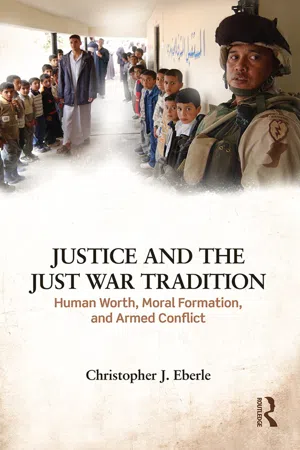
Justice and the Just War Tradition articulates a distinctive understanding of the reasons that can justify war, of the reasons that cannot justify war, and of the role that those reasons should play in the motivational and attitudinal lives of the citizens, soldiers, and statesmen who participate in war. Eberle does so by relying on a robust conception of human worth, rights, and justice. He locates this theoretical account squarely in the Just War Tradition. But his account is not merely theoretical: Justice and the Just War Tradition has a variety of practical aims, one of the most important of which is to serve as an aid to moral formation. The hope is that citizens, soldiers, and statesmen whose emotions and aspirations have been shaped by the Just War Tradition will be able to negotiate violent communal conflict in ways that respect the demands of justice. So Justice and the Just War Tradition articulates a theoretically satisfying and practically engaging account of the reasons that count in favor of war. Moreover, Eberle develops that account by engaging contemporary theorists, both philosophical and theological, by according due deference to venerable contributors to the Just War Tradition, and by integrating insights from military memoire, the history of war, and the author's experience of teaching ethics at the United States Naval Academy.
eBook - ePub
Justice and the Just War Tradition
Human Worth, Moral Formation, and Armed Conflict
- 240 pages
- English
- ePUB (mobile friendly)
- Available on iOS & Android
eBook - ePub
Justice and the Just War Tradition
Human Worth, Moral Formation, and Armed Conflict
About this book
Information
1 An Autobiographical Introduction
DOI: 10.4324/9781315647234-1
1.0 Introduction
I take the Just War Tradition (JWT) to provide the best available framework for reflecting on the morality of war. Decidedly imperfect, disturbingly malleable, bedeviled by serious problems … but the best available nonetheless. So, when I reflect on the morality of war, I do so from the perspective provided by the JWT. Of course, even to the casual observer it should be clear that ‘the’ Just War Tradition is an extremely broad appellation that covers a wide diversity of normative conceptions articulated in distinctive fashion by an even wider diversity of lawyers, philosophers, theologians, and military professionals. It is equally clear that the members of that diverse group have formulated their favored understanding of the JWT in order to achieve very different goals: to assess the moral standing of particular conflicts, to articulate a theoretical account of the true principles of the morality of war, to provide moral guidance to statesmen or soldiers, to explain how the pious can participate in violent conflict, to defend the JWT against its academic critics, and so on. I hope that this book contributes to that cacophonous, conflictual, yet also enlightening—and perhaps occasionally elevating—conversation.
My intention is to articulate an understanding of the JWT that achieves two central aims. The first is to provide a conceptual and propositional resource that citizens, soldiers, and statesmen can employ as an aid to moral formation. The second is to provide an understanding of the morality of war that is open to religious contributions both to the justification and limitation of military violence. These dual aims shape my articulation of the JWT in a number of respects—some important and ramifying, others utterly trivial. In this introductory chapter, I will explain how my pursuit of these goals shapes both my understanding and my presentation of the JWT.
1.1 The Justificatory Core of the JWT
Let me note from the outset that I intend to articulate an understanding of only certain constituents of the JWT, viz., the main elements of the JWT’s justificatory core. Very roughly put, the JWT’s justificatory core is its conception of the justificatory and motivational role of the reasons that bear on the justice of war. According to the JWT as I understand it, for any just war, that war must enjoy the support of sufficient reasons; only certain kinds of reason can provide the required support; many kinds of reasons cannot provide the required support; and the reasons that do provide the required support must play some appropriate role in the lives of those caught up in that war. The JWT’s justificatory core specifies what those reasons are and which role they must play in the lives of citizens, soldiers, and statesmen, among others.
I understand the JWT’s justificatory core to include the following five claims. First, each and every human being has great and equal worth, no matter her race, religion, communal membership, or moral virtue. Second, given that each human community is constituted by members, each of whom enjoys great and equal worth, organized violence between any and all human communities is presumptively wrong. Third, the presumptive wrongness of war can be ‘overridden,’ or ‘defeated,’ but only if one community has a ‘just cause’ to wage war against another, where only a certain delimited set of reasons can provide a just cause for war. Fourth, the reasons by virtue of which a given community has a just cause for war must play some appropriate motivational or intentional role in the lives of the members of that community. (For example, soldiers ought not be motivated to fight by reasons that fail to respect the worth of their enemies, and statesmen ought to be motivated to wage war by the reasons that provide a just cause.) Fifth, a community that possesses, and whose members are appropriately motivated by, a just cause for war has only a prima facie permission (or obligation) to wage war and that prima facie permission is overridden when the evils caused by war are excessive in relation to the goods achieved by means of war. (This is a very rough version of the JWT’s so-called ad bellum proportionality requirement.) This quintet of claims—basic human worth, presumption against war, just cause, right intention, proportionality—constitutes the JWT’s justificatory core.
Note two brief points about my rather narrow focus. First, I do not see how to formulate an account of the JWT’s justificatory core in a way that avoids reasonable disagreement. I see no way to formulate the JWT’s justificatory elements in a manner that fully satisfies the reasonable objections articulated by those who advocate alternative conceptions of the JWT, much less those who repudiate the JWT altogether. This is in significant part a consequence of the fact that I see no way to formulate the JWT’s core elements without relying on extremely contentious normative judgments—unavoidable judgments for any advocate of the JWT, but judgments that are difficult to formulate precisely, harder to defend, and impossible to demonstrate. At every turn, with respect to each and every constituent of the JWT’s justificatory core, we cannot but help ourselves to claims that are disputed by credible, epistemically competent, and morally serious peers. Of course, the JWT includes many platitudes: that some wars occur, that some of those wars are unjust, that a war is made unjust by virtue of some reason(s) or other, that some reasons are utterly unable to even help make war just, and so on. With respect to such platitudinous abstractions, we can expect to reach considerable agreement among our epistemic and moral peers. But once we begin to fill in the details—as we must if our theorizing is to have something more than glancing contact with lived reality—then we will be mired in a cognitive fog that dooms to disappointment any aspiration to precise formulation, crisp argument, or demonstrative success. So, even if we begin our reflections by affirming generic platitudes about the morality of war, we cannot but end our reflections mired in disagreement. Reasonable disagreement about the JWT goes ‘all the way down’ and ‘to the outermost edge.’ 1
Second, I am well aware that my focus on the JWT’s justificatory core leaves out a great deal. I have little or nothing to say about the JWT’s main in bello requirements—necessity, discrimination, in bello proportionality. I have nothing to say about justice ‘after’ war. I don’t even discuss each of the JWT’s familiar ad bellum constituents—namely, legitimate authority, last resort, or reasonable prospect of success. This rather narrow focus naturally raises questions. Why not articulate an account of each of the JWT’s constituent requirements, whether in bello or ad bellum, justificatory or otherwise?
Let me be clear from the outset that I do not focus on the JWT’s justificatory core because it enjoys some privileged normative status. ‘Core’ is not an evaluative term. For example, as I understand it, the legitimate authority requirement is not a constituent of the JWT’s justificatory core. Nevertheless, it could be the case that satisfaction of the legitimate authority requirement is more important—on a number of distinct renderings of ‘importance’—than the ad bellum proportionality requirement. Some very prominent advocates of the JWT will insist that this is the case. 2 Fair enough. Nothing in my account of the JWT’s justificatory core is inconsistent, or even slightly in tension, with this claim.
Note as well that there is no incoherence in articulating an account of the JWT’s justificatory core absent any accompanying account of what makes for legitimate authority, justice after war, or discrimination in war. Consider in this regard the most conspicuous absence in my account—my silence about what makes for legitimate authority. As I see it, the legitimate authority requirement is a constraint on who has the obligation and right to decide for a community whether to wage war: only those who inhabit a social role to which is attached the obligation to further the common good of a given community have the right to decide for that community whether or not it will employ its jointly organized military resources. Absent that obligation-grounded right, no one has a right to decide for a given community that it will go to war, and absent the exercise of any such right, no war can be just. Now whatever one thinks of this (abbreviated) conception of the legitimate authority requirement, it seems clearly distinct from a conception of the reasons that can play a role in justifying war. The former specifies who has the obligation and right to decide that a given community will go to war, whereas the latter specifies the kinds of reason on which those who have that obligation and right must rely when they decide to go to war. Legitimate authority is one thing, the reasons that must guide the actions of legitimate authority are another, and it seems clear that we can articulate an account of the latter that is distinct from our understanding of the former. 3
Of course, even if it is the case that we can articulate the JWT’s core justificatory requirements independently of its conception of legitimate authority, it hardly follows that we have good reason to do so. So why not just provide an exhaustive treatment of the JWT? Well, those who offer an interpretation of the JWT, as I intend to do, invariably do so with certain goals, aims, or purposes in mind. Theorists who articulate a conception of the JWT in order to achieve very different ends may reasonably offer very different conceptions of the JWT and they may do so in accord with varying standards of exactitude. 4 As I see it, the two aims I identified at the outset provide excellent reason to focus on the JWT’s justificatory constituents. In order to see why, it will be helpful to explain them with a bit more specificity than I have. I will do so somewhat indirectly. As is often the case, the aims we pursue in our scholarly endeavors are shaped by the particularities of our biography and social location. That is certainly true in my case. So it will be helpful, I think, to specify the two main aims that I intend my articulation of the JWT to serve by providing a bit of biographical narrative. Hopefully, in this case, personal disclosure will facilitate mutual understanding.
1.2 Moral Formation
I began working at the US Naval Academy in the summer of 2001. The Naval Academy is a kind of national seminary—one that prepares not priests or pastors, but military officers. At the core of its mission—explicitly adopted and, I believe, sincerely pursued—is an aspiration to moral formation. That is, the Naval Academy aspires to shape the minds, hearts, and bodies of midshipmen so that they are fit to fulfill the demanding responsibilities attached to the social role of officer in the US military. My part in achieving that formative aim is to serve as an ethics instructor to midshipmen. That is, I help to deliver “Moral Reasoning for Naval Leaders,” a course of moral instruction that Congress requires the Naval Academy to offer to midshipmen—young men and women, the vast majority of whom have no prior military experience, most of whom will eventually serve as officers in either the US Navy or Marine Corps. Each iteration of that course is delivered by a team of instructors composed of one civilian academic and several military officers. Each team abides by a rough and ready division of labor. Basically, the civilian is responsible for the theoretical content of the course: every Monday for fifteen weeks each civilian lectures to about sixty midshipmen on some canonical philosophical or theological text. After each lecture, small groups of midshipmen meet with experienced officers to reflect on how the theoretical material addressed earlier in the week bears on some particularized scenario—typically drawn from newspaper accounts of actual events or the personal experience of previous military instructors. Reflection on such scenarios under the mentorship of experienced officers introduces midshipmen to the complexities, pressures, and enticements often faced by military professionals ‘in the fleet.’ In short, “Moral Reasoning for Naval Leaders” attempts to meld moral theorizing and practical wisdom by means of close pedagogical cooperation between philosophers and officers.
Participation in that course provides midshipmen with an extended opportunity to reflect on the moral duties of military officers, the temptations to which inhabitants of that social role are characteristically beset, and the virtues that they need to develop if they are to resist those temptations. So, one of the main aims of “Moral Reasoning for Naval Leaders” is to urge midshipmen to reflect on the military importance of moral formation—on the fact that they cannot fulfill their moral, legal, and professional obligations unless they discipline their attitudes, emotions, and aspirations in appropriate ways. Although hardly an unbiased party, I rega...
Table of contents
- Cover
- Epigraph
- Half Title Page
- Title Page
- Copyright Page
- Contents
- Epigraph
- Acknowledgements
- 1 An Autobiographical Introduction
- 2 Tribalism and War
- 3 Basic Human Worth
- 4 The Presumption against War
- 5 Just Cause for War
- 6 Right Intention and Emotion
- 7 Must We Sorrow Over a Just War?
- 8 Rights, Goods, and Proportionality
- 9 An Ambiguous Conclusion
- Works Cited
- Index
Trusted by 375,005 students
Access to over 1.5 million titles for a fair monthly price.
Study more efficiently using our study tools.
Frequently asked questions
Yes, you can cancel anytime from the Subscription tab in your account settings on the Perlego website. Your subscription will stay active until the end of your current billing period. Learn how to cancel your subscription
No, books cannot be downloaded as external files, such as PDFs, for use outside of Perlego. However, you can download books within the Perlego app for offline reading on mobile or tablet. Learn how to download books offline
Perlego offers two plans: Essential and Complete
- Essential is ideal for learners and professionals who enjoy exploring a wide range of subjects. Access the Essential Library with 800,000+ trusted titles and best-sellers across business, personal growth, and the humanities. Includes unlimited reading time and Standard Read Aloud voice.
- Complete: Perfect for advanced learners and researchers needing full, unrestricted access. Unlock 1.5M+ books across hundreds of subjects, including academic and specialized titles. The Complete Plan also includes advanced features like Premium Read Aloud and Research Assistant.
We are an online textbook subscription service, where you can get access to an entire online library for less than the price of a single book per month. With over 1.5 million books across 990+ topics, we’ve got you covered! Learn about our mission
Look out for the read-aloud symbol on your next book to see if you can listen to it. The read-aloud tool reads text aloud for you, highlighting the text as it is being read. You can pause it, speed it up and slow it down. Learn more about Read Aloud
Yes! You can use the Perlego app on both iOS and Android devices to read anytime, anywhere — even offline. Perfect for commutes or when you’re on the go.
Please note we cannot support devices running on iOS 13 and Android 7 or earlier. Learn more about using the app
Please note we cannot support devices running on iOS 13 and Android 7 or earlier. Learn more about using the app
Yes, you can access Justice and the Just War Tradition by Christopher J. Eberle in PDF and/or ePUB format, as well as other popular books in Philosophy & Philosophy History & Theory. We have over 1.5 million books available in our catalogue for you to explore.