- 208 pages
- English
- ePUB (mobile friendly)
- Available on iOS & Android
eBook - ePub
About this book
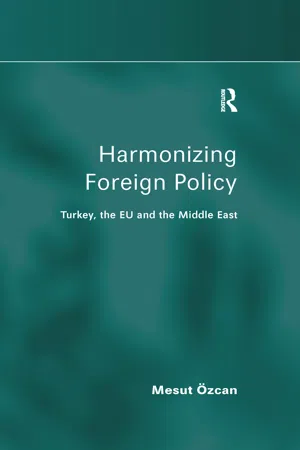
The change in Turkish foreign policy towards the Middle East in the post-Cold War era is a highly debated issue, with most experts believing that Europeanization has become the driving force behind this change. This book takes the cases of Iraq and the Palestinian-Israeli conflict as two important illustrations. Both cases present dynamic issues of conflict in the region and are high on Turkey's agenda in terms of its policies towards the region. Focusing on issues related to EU integration, the study examines the formation of a common foreign policy in general and a common policy towards the Middle East in particular. It also investigates decision making in Turkish foreign policy and foreign policy towards the Middle East before and after EU candidature. As such it provides valuable insights into how parties interact with each other and the way in which foreign policies can be harmonized.
Information
Chapter 1
Theories of Integration
The Need to Theorize
This section analyzes European integration and its effects on the foreign policies of the member countries and the latest enlargement of the European Union in respect to theories of integration. The European integration process has attracted a great deal of attention in the field of international relations. Various theories and conceptual approaches have been applied to the European integration process and to the politics of the European Union. By theorizing, the conditions and structure of the European Union are studied systematically and some predictions about the Union or the constituent parts are made. Chryssochoou argues that the efforts of theorizing about the structure and dynamics, forms and functions of European integration have created a situation in which little remains to be said.1 According to the same author, this should not lead to theoretical inaction; rather it should result in seeking for the refinement of the old attempts to explain the current and future conditions.
The new theorizing efforts on the European Union are very much dependent on the classical theories of integration. In describing the position of the European integration theories within the social sciences, Puchala argues that integration theory will amount to a rather long but not very prominent footnote in the intellectual history of twentieth century social science.2
Manners and Whitman summarize the attempts of theorizing about the EU by different theoretical tools as follows:
International relations theory is thought of as the domain for thinking about the EU primarily as a form of co-operation among sovereign states where intergovernmental relations remain the most important arena for understanding both the EU and its place in global politics. Comparative politics theory is thought of as the domain for thinking about the EU primarily as a form of political system in which member states participate and where theories of comparative politics have become most important way of understanding both the EU and its place in the global politics. Integration theory was the domain for thinking about the EU as lying somewhere between these two domains of international relations and comparative politics where the process of deepening integration (becoming more like a form of state) and widening integration (to include more members) need to be thought about in dynamic terms.3
The existence of different theories about the Union is related very much to the problems with the definition of the nature of the European Union. The EU is neither an international institution nor an ordinary state in conventional terms. In general terms, theories of European integration investigate the changing relationship between the Union’s multiple arenas of governance. The nature of sovereignty within the European Union is one of the most contested areas of discussion in the integration theory debate.
These discussions about the nature of sovereignty within the Union also are related very much to the perception of the nature of the Union and the theory applied to explain it. The discussions on the nature of the EU and the sovereignty in it have been criticized by some scholars by narrowly focusing on the formal structures. It is argued that much of the theorizing efforts on European integration have been trapped in the supranational-intergovernmental dichotomy and this has resulted in an “unhelpful focus on the formal characteristics of the actors at the expense of the processes which characterize their interactions.”4 Much of the contemporary theories of integration try to avoid this dilemma and focus on other aspects of the integration.
The continuously changing nature of the EU also makes theorizing difficult and incomplete. The EU is not a full fledged state and may not become one in the future. But it already possesses some state-like characteristics in the conventional sense, such as a common currency, an independent central bank, a single market and an evolving common foreign and security policy. The EU has been conceived by some scholars “as a political system with a network rather than hierarchy of decision making, an expanding membership and agenda, and degrees of boundedness rather than clear cut boundaries.”5 Instead of deciding whether the EU is supranational or international governance, the same authors propose the term “hybrid polity” to define it.6 Defining the Union as a federal state, confederation of states, a quasi-state, a political community, a partial polity or a partly formed political system is seen as a remedy to finding the most suitable word for the EU. In order to overcome this problem of definition, labelling the European Union as a sui generis political phenomenon and offering new conceptual paradigms or ad hoc theoretical interpretations is one of the methods employed often. However, this way of scholarly work is criticized by some authors as carrying the risk of complying with undisciplined and often ill-founded formulations.7 Such a definition may result in perpetuation of the in-between position of the EU in international politics. There is no conceptual consensus among scholars about the ontological conundrum of the EU. The reason for this failure derives from the existence of different polity ideas, different visions of regional political order and contending orientations for the European polity about the conceptualization of the European political entity.8 In order to make theorizing about the EU easy, it is argued that instead of focusing on the peculiarities of the Union, it might be more profitable to examine those aspects of the EU that are familiar to the existing forms of polity and models of government.9
The most common theories applied to the European integration are neo-functionalism and intergovernmentalism. In addition to these, federalism and new theoretical approaches, like multi-level governance and constructivism also are used in the analysis of European integration. The use and explanation capacity of several theories are related directly to the course of European integration and discussions in the field of international relations theory. Different phases in the history of the Union and subsequent theoretical discussions devoted to explain this situation lead to the assumption that the distinct nature of the European Union resembles an asymmetrical and analytically incongruent synthesis of academic disciplines.10 This ambiguous nature of the EU has provoked various theoretical approaches to analyze several aspects of the European integration process.
In the early years of European integration, neo-functionalist theory was the first to be studied by students of the European Union.11 From the mid-1960s to the present day, however, intergovernmentalism has been situated at the heart of European integration theory. With the transformation of the European Community into the European Union, there has been a return to neo-functionalism and also to the study of other theoretical approaches, especially reflectivist and structuralist, in explaining the integration process.
Federalism
The terms federalism and federation and federalism as a theory of government have often been used in describing the European Union. Although different definitions of federalism exist to explain different federal structures in the world, it generally refers to the co-existence of distinct but constitutive units. In a federation sovereignty is divided and shared between a central (federal) government and the constituent (member states) governments and federations are more representative in comparison to the unitary states. The term “federal Europe” broadly refers to the constantly changing EU, but which has its core of basic principles. The practical definition of federal Europe is given as the combination of centralist and decentralist imperatives that facilitate common solutions to the common problems of the member states and their citizens.12 Other simple axioms used to define federal Europe are “unity in diversity” and “self rule plus shared rule.”
Jean Monnet, one of the founders of the EU, is also considered one of the main advocates of the federalist approach for European integration. He wanted to remove the causes of war from the European scene and to persuade Europeans to channel their conflicts into a form of cooperation that would enable them to achieve their goals by seeking out their common interest. The shocks of nationalism and the terrible effects of the interwar period played an important role in this understanding. Federalism was seen as a remedy for illnesses of the continent. He underlined the interaction between politics and economics as the driving force behind integration. It is argued that Monnet’s approach to the building of a federal Europe meant gradually internalizing what were previously the externalities of the state.13 In this way, the consolidation of the all of the power at the hands of the nation states might be prevented.
Concepts like participation, democracy and liberty also provided an important stimulus effect to federalist theorizing. Federalists argued that the inability of states to provide new means of popular participation and the unprecedented legitimacy crisis had shaken the foundation of their structures and people should look above the nation-states to resolve the acute legitimacy problems.14 Federalists stressed the representative character of the central institutions in order to convince the European peoples to the merits of federalism as a means of safeguarding their cultural and political traditions.15
The essence of Monnet’s method for European integration was piecemeal, cumulative integration whereby “political” Europe would be the culminating point of a gradual process and at the end there would be a qualitative change in the constitutional and political relations between states and peoples.16 He believed that this change would occur when it came to seem natural in the eyes of Europeans. Monnet ignored the realities of organized political power and the fact that the building of a political Europe based on economic performance criteria did not necessarily follow.
The role of the political leadership in furthering the integration has been decisive in the history of the EU. Federalism has been portrayed by its proponents as the only alternative to eliminate the possibility of great wars on the continent of Europe. However, the difficulty lays in convincing the people that they, rather than their governments, must create a political federation.17 The federalists have been criticized with the argument that they are consciously undermining the necessary gradual nature of integration in order to achieve a rigid constitutional setting.18 The current state of the EU shows that federalism’s ultimate goal is not the primary goal for many Europeans and those national governments and their elites are not persuaded by the arguments of federalism.
From a federalist perspective, there should be a balance between the centre and the constituent units. However, the EU still remains at the mercy of intergovernmental bargaining and the current institutional structure within the EU represents an imbalance in favour of the national governments.19 The EU remains confederal and intergovernmental than federal and the failure of the constitutional treaty process constitutes a setback for a move towards a more federal Europe.
Neo-functionalism
Neo-functionalism was the first attempt at theorizing a new form of regional integration. The well known theorist of neo-functionalist integration, Ernst Haas, defined integration as a process “whereby political actors in several, distinct national settings are persuaded to shift their loyalties, expectations and political activities to a new centre, whose institutions process...
Table of contents
- Cover Page
- Title Page
- Copyright Page
- Contents
- Preface
- Acknowledgements
- List of Abbreviations
- Introduction
- 1 Theories of Integration
- 2 Europeanization of the Foreign Policy
- 3 European Integration and the CFSP
- 4 The Middle East Policy of the European Union
- 5 The Making of Turkish Foreign Policy
- 6 Turkish Foreign Policy towards the Middle East until the end of the Cold War
- 7 Turkish Foreign Policy towards the Middle East since the Cold War Era
- 8 The Europeanization of Turkish Foreign Policy
- Conclusion
- Bibliography
- Index
Trusted by 375,005 students
Access to over 1.5 million titles for a fair monthly price.
Study more efficiently using our study tools.
Frequently asked questions
Yes, you can cancel anytime from the Subscription tab in your account settings on the Perlego website. Your subscription will stay active until the end of your current billing period. Learn how to cancel your subscription
No, books cannot be downloaded as external files, such as PDFs, for use outside of Perlego. However, you can download books within the Perlego app for offline reading on mobile or tablet. Learn how to download books offline
Perlego offers two plans: Essential and Complete
- Essential is ideal for learners and professionals who enjoy exploring a wide range of subjects. Access the Essential Library with 800,000+ trusted titles and best-sellers across business, personal growth, and the humanities. Includes unlimited reading time and Standard Read Aloud voice.
- Complete: Perfect for advanced learners and researchers needing full, unrestricted access. Unlock 1.5M+ books across hundreds of subjects, including academic and specialized titles. The Complete Plan also includes advanced features like Premium Read Aloud and Research Assistant.
We are an online textbook subscription service, where you can get access to an entire online library for less than the price of a single book per month. With over 1.5 million books across 990+ topics, we’ve got you covered! Learn about our mission
Look out for the read-aloud symbol on your next book to see if you can listen to it. The read-aloud tool reads text aloud for you, highlighting the text as it is being read. You can pause it, speed it up and slow it down. Learn more about Read Aloud
Yes! You can use the Perlego app on both iOS and Android devices to read anytime, anywhere — even offline. Perfect for commutes or when you’re on the go.
Please note we cannot support devices running on iOS 13 and Android 7 or earlier. Learn more about using the app
Please note we cannot support devices running on iOS 13 and Android 7 or earlier. Learn more about using the app
Yes, you can access Harmonizing Foreign Policy by Mesut Özcan in PDF and/or ePUB format, as well as other popular books in Politics & International Relations & Politics. We have over 1.5 million books available in our catalogue for you to explore.