- 248 pages
- English
- ePUB (mobile friendly)
- Available on iOS & Android
eBook - ePub
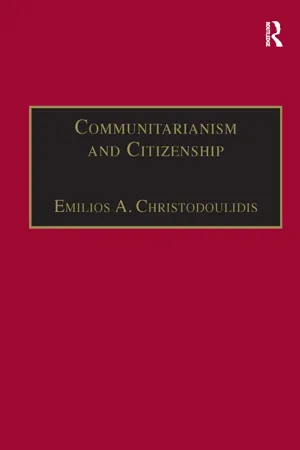
Communitarianism and Citizenship
About this book
This book is volume three in the series and is the edited proceedings of the 1997 ALSP conference. The conference covered issues relating to Communitarianism and citizenship from socio-legal, philosophical and political perspectives. The papers are a collection drawn from international authors covering a wide variety of subjects such as tolerance, social citizenship and social rights in a global context.
Information
PART I
THE AUSTIN LECTURE
1 The Communitarian Persuasion
The New Communitarians
Since the early 1980s, sparked in part by the publication of Alasdair Maclntyre’s After Virtue (1985) and Michael Sandel’s critique of Rawls, in Liberalism and the Limits of Justice (1988), the so-called communitarian vs liberal debate has been a staple of political and social philosophy. I suppose this confrontation is partly driven by the dynamics of pedagogy and by the seductive appeal of polemical confrontations. Nevertheless, something important is going on. At stake is the creation of a public philosophy that can meet the demands of our time. We may hope it will be enriched by dialogue and chastened by self-criticism.
In the United States, the contemporary communitarian movement has had another and more compelling source. In addition to intellectual critique and self-scrutiny, communitarianism has been a response to practical issues in American society, especially a resurgence of unbridled capitalism, erosion of confidence in the welfare state, problems of family, education, drug addiction, crime, and citizenship. The intellectual and practical or policy strands are interwoven when we condemn an exaggerated concern for individual rights and a weakening concern for the common good.
The quest for a communitarian morality, to remedy the perceived defects of modernity, has been a perennial theme of post-Enlightenment thought. The reaction has taken conservative, radical, and liberal forms. In this century, for Americans, a prominent example is the social philosophy of John Dewey. Dewey was a great spokesman for what I call communitarian liberalism. He combined a spirit of liberation and of social reconstruction with a strong commitment to responsible participation in effective communities. On the other hand, more radical doctrines, especially communism and fascism, have given community a very bad name. As we try to think afresh – as we receive and revise communitarian ideas – we can never let ourselves forget these dreadful ways of justifying evil in the name of the good.
This spectre can be faced, and faced down, if we look for moral guidance to the whole experience of community. If we do so we can deal with the dangers and deficits of community, as well as the benefits and ideals. We should take account of egoism as well as altruism; and we should recognize that some forms of altruism, or of solidarity, limit the reach of community and tarnish its ideals.
Seen in its best light, the communitarian persuasion is an affirmation of basic morality. It is a way of upholding the ideal of fellowship, that is, of mutual concern and respect. More specifically, a communitarian morality looks to the enhancement of personal and social responsibility; exhibits a preference for cooperation and reconciliation in all spheres of life, including economic life; affirms the interdependence of belonging and freedom; and values the particularity and diversity of human existence. These principles presume that selfhood can be enlarged as a result of social experience; and they presume that selfhood is sustained by rootedness. The tension between this enlargement and this rootedness is the most striking feature of communitarian thought. It is a tension that brings both promise and peril.
I called the lecture on which this chapter is based ‘the communitarian persuasion’ as a way of stressing that this public philosophy is profoundly opposed to ideological thinking. Ideological thinking is at odds with the textured, nuanced, problem-solving experience of community. To be sure every doctrine abridges reality; every idea simplifies and selects. But ideological thinking abuses the privilege in that it fails to accommodate competing values and necessary trade-offs. It lacks a principle of self-correction.
The Encounter with Liberalism
The communitarian critique of liberalism has centred on the claim that liberal premises are overly individualistic and ahistorical, insufficiently sensitive to the social sources of selfhood and obligation; too much concerned with rights, too little concerned with duty, virtue, and responsibility; too ready to accept a thin or anaemic conception of the common good. The operative words – the words that really distinguish communitarians and liberals – are ‘overly’, insufficiently’, ‘too much’, ‘too little’, ‘too ready’. Indeed the main target of communitarian criticism is intellectual and practical excess. In contemporary liberalism, popular as well as theoretical, there is too much reliance on the power of abstractions; too much hope that some single principle will be an unerring guide to social policy; and too little appreciation for implicit limits, blurred boundaries, competing values, and unintended effects. These criticisms are communitarian in that they point to the social frameworks within which all ideals find their limits as well as their opportunities.
Consider the ideal of autonomy, or personal and political liberty. Contemporary communitarians do not reject autonomy. They certainly do not ‘loathe’ it, as one writer has recently suggested. Rather, they seek to revive commitment to ordered liberty, a notion that calls for specifying contexts, purposes, and competing values. Contextual thinking resists absolutism. It calls for discriminating and situational judgment about kinds of liberty and the limits to liberty.
Put another way, we seek a more empirical and more nuanced conception of autonomy. Genuine autonomy presumes a stabilizing centre in human life. It cannot be equated with doing as you please, driven by impulse, unconstrained by plan, purpose, or commitment. Genuinely autonomous persons have the psychic competence to make commitments, exercise self-discipline, resist distractions, and criticize their own preferences.
This conception is wholly congenial to what we may call a culture of liberty, that is, a broad appreciation for the many ways autonomy contributes to personal and social well-being. In almost every sphere of life we gain from the cultivation of personal autonomy, properly understood. A culture of liberty provides effective opportunity for growth, expression, and the pursuit of individual life-plans; for free inquiry and unburdened communication; for the chance to grow up in settings that encourage criticism and reflection.
A similar analysis must inform other criticisms of liberalism. Communitarians are not opposed to rights. No society can function without them; and claims of right have often been effective engines of moral and institutional improvement. What we resist is an excess of rights-centredness marked by the detachment of rights from responsibilities and contexts. In a rights-centred era, the idea that rights should be exercised or claimed responsibly tends to disappear. In the process rights become abstract, unsituated, absolute. We lose sight of the distinction between invoking rights out of a sense of duty, or to vindicate important interests, and in doing so for more narrow gains and gratifications. After all, rights are not duties; we may or may not invoke the rights we have, or think we have.
Rights-centredness may lead to exaggerated claims, as in the UN Declaration of Human Rights or the American controversy over abortion. The latter has counterposed an abstract ‘right to choose’ and an abstract ‘right to life’. But the most egregious and least defensible example of rights-centredness is the claim to absolute rights of property, a claim that has reasserted itself in recent years. All forms of property are conflated, and conceptions of stewardship are radically attenuated. People who own shares in corporations – shares blessed with limited liability – have the decisive say in what should happen to the company, with all its stakeholders, when a merger is contemplated. On this view, property rights trump all other interests. This is offensive to a communitarian concern for the interests of the community, institution, or enterprise.
A preoccupation with rights is often justified, especially when we articulate ‘basic’ rights or rights that deserve constitutional protection. I believe the United States was well served by the early agitation for a Bill of Rights, embodied in the first 10 amendments to the federal constitution. In due course additional rights of personhood and citizenship were identified and affirmed. All, however, have been subject to interpretation. All have been marred, in one way or another, by the temptation to indulge in rhetorical overreaching.
The communitarian critics need not claim, and should not claim, that liberal doctrine is necessarily ‘atomistic’ or that it denies the social formation of selves. The concept of a social self is wholly compatible with the liberal stress on individuality and independence, that is, with the idea that people construct their own identities, choose their own associates, negotiate their own obligations. Socially formed people do make choices, including self-defining choices. Socialization produces individuality as well as conformity. The question is what kind of self we should favour, and what kind of community we should seek? What does it mean to have a moral self and a moral community?
It may be useful analytically to distinguish socially encumbered or implicated selves from those who choose their own identities and obligations. Freedom of choice is celebrated in liberal thought, as are obligations derived from consent. Contract is the preferred principle of social organization. But moral experience, encompasses constraint as well as choice. Although many obligations are indeed self-chosen, others are thrust upon us. Even if an obligation has its origin in consent, as in marriage and parenting, the element of consent becomes less salient as we encounter new and unforeseen demands. Moreover from the standpoint of morality we may be more free to fashion some of our identities than to decide for ourselves what obligations we owe to particular relatives, friends, colleagues, or institutions. On major issues of identity and obligation, moral judgment must look beyond criteria of freedom and consent. The limits of liberalism, as of so many ideologies, arise from sins of one-sidedness and overreaching, not from egregious or elementary errors, such as a failure to recognize the social formation of selves.
The Texture of Community
Let us now turn to the idea of community, which many people find troublesome and even irritating. That this should be so is not surprising. Community is one of those seminal ideas whose meaning is frustratingly elusive, often contested, routinely vulgarized. These are afflictions of ideas like democracy, morality, freedom, culture, religion, autonomy, and rationality. Each has been the subject of endless discussion; each remains opaque and ambiguous.
I have taken the view that, in dealing with these foundational ideas, we should shift debate from definition to theory. A definition should be logically weak and inclusive, a starting-point for the development of appropriate theories. Although threshold criteria must be met, the definition should allow for variations in kind and degree. We should not pack into a definition attributes that should be determined by empirical and theoretical inquiry. We should not try to solve serious intellectual and policy problems by definitional fiat.
A theory of community should rest upon a broad range of experience; it should identify recurrent elements of community, including characteristic sources of strength and weakness, stability and change. The natural history of community – the sociology of community – cannot be reduced to a single strand. Communities are marked by historicity and identity, that is, by shared experience and a sense of shared fate; but they are also rooted in the experience of mutuality. Mutuality creates the moral infrastructure of cooperation. It arises from all the ways people are knit together by interdependence, reciprocity, and self-interest. Mutuality invokes the special moralities of negotiation, contract, and association, notably trust, good faith, and the legitimacy of expectations. Thus mutuality finds moral imperatives in diversity as well as identity; in self-regard as well as altruism; in rivalry and competition as well as cooperation.
Any community draws much of its substance from this experience of interdependence and reciprocity. These very practical conditions account for the voluntary and rational components of community. If people do not need each other, if little or nothing is to be gained from cooperation, community is not likely to emerge or endure. To be sure the bonds of community are to a large extent emotional and non-rational. Yet rationality is by no means excluded. Participation in normal communities is hardly irrational or self-destructive. Rather, we expect communities to be settings within which people can rationally pursue their diverse interests and plan their largely independent lives. The demands of community are not counterposed to rational judgment and personal autonomy. On the contrary, a radical abridgment of these values can destroy community; and it is loss of community that so often leads to distracted and disorganized behaviour.
As we explore these and related themes, we see that community is a variable feature of social life. That is why the definition of community should allow for variability. A group is a community to the extent that it encompasses a broad range of activities and interests, and to the extent that participation implicates whole persons rather than segmental or specialized interests and activities. This meets two threshold criteria: community as a comprehensive framework within which ordinary life goes forward; and community as an arena within which people relate to one another as persons and not only as associates in a special-purpose enterprise.
Given these threshold criteria, we can then ask ‘To what extent do we find a shared history, a sense of common identity, bonds of interdependence and reciprocity, and effective participation in the group’s culture and social organization?’ If we take this variability seriously we answer many of the questions raised about the name and nature of community.
It follows from what I have said that community is about structure and process as well as belief, about ways of relating as well as feelings. To understand community we must look to that structure and to the special work it does. Community has texture, and different kinds of community have different textures. With this approach we can readily distinguish communities from disciplined special-purpose organizations. We know, however, that such organizations often generate, and even require, the benefits and constraints of community. That is why I have explored the distinction between management and governance, and have stressed the significance of governance, as well as management, for effective organization.
The Federal Principle
As frameworks for the conduct of self-directed life, communities have this remarkable feature. They build upon and are nourished by other unities – persons, groups, practices, institutions. These component unities are treated as moral agents and as objects of moral concern; they characteristically claim respect and protection; they demand and are granted a variable but irreducible autonomy. Hence what we prize in community is not unity of any sort at any price but unity that preserves the integrity of the parts.
This unity is very different from the disciplined unity we associate with administrative or military hierarchies. There an ethos of efficiency and instrumentalism prevails. Subordinate units are fully deployable, manipulable, expendable. They can be modified or rearranged at will, in the light of externally determined purposes and policies. A persistent preoccupation with the integrity of the parts lends a special significance to the experience of community. To be sure, community is about integration. Effective communities are indeed well-integrated. But what kind of integration? That is the nub. A unity of unities requires integration of a special kind. It allows and fosters the self-preservation – the survival and flourishing – of its fundamental components.
There is something very familiar about all this. In 1788, writing No. 51 of The Federalist Papers, James Madison rejoiced that it would be practical to advance the republican cause ‘by a judicious modification and mixture of the federal principle’. What is that principle? Is its meaning exhausted by an arrangement of national and state jurisdictions? Or should we find, in that principle, a more basic guide to freedom and order- a principle of community as well as of government.
The federal principle is another expression of what I called above the ‘unity of unities’. This principle has Hebraic and Christian roots. The word ‘federal’ derives from the Latin foedus or treaty, and in biblical history the transactions of God and humanity take the form of covenants or treaties. Hence ‘covenantal’ theology. A covenanted people accept subordination to God, but they do so as free persons entering a sacred compact. Faith based on covenant carries a message of limited power and of authority based on consent. This tradition is an assertion of human dignity. It is a way of saying that people-in-community are responsible actors, capable of holding their own even against God, and they have an irreducible claim to respect and concern. It is this inviolability of constituent units that justifies calling the relationship to God a ‘federal’ union.
Federal theology was mainly developed by Protestant thinkers. As a result, the sharpest focus is on faith, commitment and the ultimate autonomy of individual persons. But the federal idea is also to be understood as a principle of social order. Thus in the thought of Althusius (1557–1638) covenant pervades social life. Society is the product of many interwoven social unions, all based on tacit or explicit agreements. These are not the covenants of feudalism, where freedom is foregone in exchange for protection. Nor do they quite match the social contract of later generations. Althusius’ conception of a federated unity is more pluralist than individualist in spirit and structure. He could not accept the view expressed by his younger contemporary, Thomas Hobbes, that autonomous groups are ‘lesser Commonwealths in the bowels of the greater, like wormes in the entray les of a naturall man’. A closely related idea is the Catholic doctrine of subsidiarity. In what has come to be a canonical formulation Pope Pius XI said: ‘… it is a grave evil, and a disturbance of public order, to transfer to the larger and higher collectivity functions which can be performed and provided for by lesser and subordinat...
Table of contents
- Cover
- Half Title
- Title Page
- Copyright Page
- Table of Contents
- About the UK ALSP
- Introduction
- Part I: The Austin Lecture
- Part II
- Part III
- Part IV
- Contributors
Trusted by 375,005 students
Access to over 1.5 million titles for a fair monthly price.
Study more efficiently using our study tools.
Frequently asked questions
Yes, you can cancel anytime from the Subscription tab in your account settings on the Perlego website. Your subscription will stay active until the end of your current billing period. Learn how to cancel your subscription
No, books cannot be downloaded as external files, such as PDFs, for use outside of Perlego. However, you can download books within the Perlego app for offline reading on mobile or tablet. Learn how to download books offline
Perlego offers two plans: Essential and Complete
- Essential is ideal for learners and professionals who enjoy exploring a wide range of subjects. Access the Essential Library with 800,000+ trusted titles and best-sellers across business, personal growth, and the humanities. Includes unlimited reading time and Standard Read Aloud voice.
- Complete: Perfect for advanced learners and researchers needing full, unrestricted access. Unlock 1.5M+ books across hundreds of subjects, including academic and specialized titles. The Complete Plan also includes advanced features like Premium Read Aloud and Research Assistant.
We are an online textbook subscription service, where you can get access to an entire online library for less than the price of a single book per month. With over 1.5 million books across 990+ topics, we’ve got you covered! Learn about our mission
Look out for the read-aloud symbol on your next book to see if you can listen to it. The read-aloud tool reads text aloud for you, highlighting the text as it is being read. You can pause it, speed it up and slow it down. Learn more about Read Aloud
Yes! You can use the Perlego app on both iOS and Android devices to read anytime, anywhere — even offline. Perfect for commutes or when you’re on the go.
Please note we cannot support devices running on iOS 13 and Android 7 or earlier. Learn more about using the app
Please note we cannot support devices running on iOS 13 and Android 7 or earlier. Learn more about using the app
Yes, you can access Communitarianism and Citizenship by Emilios A. Christodoulidis in PDF and/or ePUB format, as well as other popular books in Philosophy & Philosophy History & Theory. We have over 1.5 million books available in our catalogue for you to explore.