Bringing together works by Salvador Espriu, Juan Goytisolo, Mercè Rodoreda, Esther Tusquets, and Juan Marsa that portray memory as a disorienting narrative enterprise, Colleen Culleton argues that the source of this disorientation is the material reality of life in Barcelona in the immediate post-Civil War years. Barcelona was the object of harsh persecution in the first years of the Franco regime that included the erasure of marks of Catalan identity and cultural history from the urban landscape and made Barcelona a moving target for memory. The literature and film she examines show characters struggling to produce narratives of the remembered past that immediately conflict with the dominant version of Spain's historical narrative formulated to legitimize the Civil War. Culleton suggests the trope of the laberinto, used as an image or device in all five of the works she considers and translated into English as both maze and labyrinth, opens up a space that enables readers to take vulnerability to outside interference into account as an inseparable part of remembrance. While the narratives all have maze-like qualities involving a high level of reader participation and choice, the exigencies of the labyrinth with its unicursal demands for patience, perseverance, and faith always prevail. Thus do the Francoist narrative and social structure in the end resurface and reassert themselves over the narrating character's perspective.
eBook - ePub
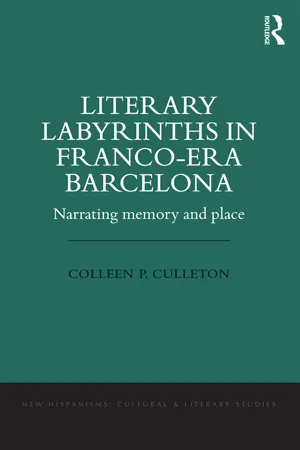
Literary Labyrinths in Franco-Era Barcelona
Narrating Memory and Place
- 186 pages
- English
- ePUB (mobile friendly)
- Available on iOS & Android
eBook - ePub
About this book
Information
1
In the labyrinth
The uses of place in the construction of memory
Minos plans to remove the shame from his house, enclose it in complicated hidden maze; Daedalus, most famous architect for skill, does the job, confounds the lines, misleads eye down various wrong paths; like Phrygia’s playful Meander waters flowing any which way & flowing back again, turning to meet coming on its own, now toward source, now open sea, unsure waters; so Daedalus installs countless wrong ways, can barely himself get back to the entrance, so tricky the maze.
– Ovid’s Metamorphoses
Overview
Since the year 2000 and the first public investigations of Franco-era mass graves, the approach to Spain’s history through memory has emerged in an explosive way in Spanish cultural production, as well as in the academic work that takes memory as its object of study. The authors included in Literary Labyrinths: Narrating Memory and Place in Franco-Era Barcelona anticipate this phenomenon by three decades or more and show, as Francisco Ferrándiz puts it, that “[…] these memories never stopped roaming the scarce spaces left for them to articulate and evolve during the dictatorship” (309). The recent trend in scholarship has been to look at memory-based cultural production that has been generated since the death of the dictator, Francisco Franco, in 1975.1 Literary Labyrinths focuses on earlier works (published between 1960 and 1978, the year in which Spain’s democratic constitution was promulgated) and proposes a kind of memory that emerges from within and inseparable from its own institutionalized repression. During the beginnings of the now infamous pacto del olvido (pact of forgetting or pact of oblivion)2 and even before the end of the dictatorship, these novels showed characters who struggled to produce narratives of the remembered past that entered into immediate conflict with the official, dominant version of Spain’s historical narrative, which had been formulated to cover over the horrors of the Civil War (1936–1939) and to legitimate the fascist regime (1939–1975).
The control of cultural memory under the dictatorship took myriad forms.3 Along with tens of thousands of executions that definitively silenced members of the opposition while terrorizing the general public, the Franco regime controlled the mass media and education, destroyed or manipulated public records, and buried thousands in unmarked mass graves, in many instances, without any documentation of their deaths. With every erasure, a void in memory was left but then was quickly filled in by a proliferation of grandiose public speeches, communications, ceremonies, and symbols that proclaimed the victory of Franco and the unity of Spain. “The new order, founded on the ruins of Republicanism, would completely eliminate all signs of the society that came before it” (Casanova 90). Historical and autobiographical accounts of life in Barcelona after Franco’s army took the city describe the ways in which the urban landscape was changed, both symbolically and materially. Changing place names, the removal or revision of monuments, the appearance and behavior of people in the streets, and the erasure of the Catalan language from the city’s visual field all conspired to prevent the maintenance of a historical narrative that was different from Franco’s and, in the long term, to erase any memory that might diverge from the narrative that was sanctioned by the State.
Barcelona is an exemplary environment in which to study memory, since that is what Francoist policies there after the Civil War were aiming to eliminate. As the Catalan capital, Barcelona symbolized the separatism that, for Franco, had been one of the motivators for the military uprising in 1936 and was an affront to the concept of national unity that defined Franco’s thinking and policies (Colomines 214). As soon as the National Army took the city, it was placed under the control of the “Servicios de Ocupación de Barcelona” (Occupation Services of Barcelona) under the leadership of General Eliseo Álvarez Arenas. This authoritarian structure would stay in place until August of that year. A revision of the urban landscape in Barcelona was part of a “policy of blanket cultural repression” that characterized the Francoist approach to Catalonia (Richards, Time 78). The assumption seemed to be that if the city’s residents, or their children, were to come to remember the Civil War and its early aftermath as “Spaniards” rather than Catalans, they would remember it as the heroic “revolution” that the Francoist historiographers portrayed it to be, rather than as the attack on the political and cultural ideals that Barcelona represented. The reality, though, was that silenced memory is not the same as forgetting, and instead of a revised image of the past, the regime’s policies produced a narrative dissonance about it that emerges in literary representations.
What I have called “dissonance,” I will more often refer to as “disorientation” in narratives that demonstrate a problematic relationship with the past and at the same time deploy narrative strategies that lose the reader in a maze of anachronisms and confused referentiality. I will argue that the disorientation characteristic of and caused by these narratives acts out the manipulation of space as a framework for memory that transpired in Barcelona under the fascist regime. In insisting on the significance of the remembered moment, and not just the moment of remembering, I go against the grain of presentism that marks most cultural criticism of memory. In doing so, I follow some of the thinking that Paul Ricoeur outlines in Memory, History, Forgetting and consider how it dialogues with other approaches to social memory in the Spanish context and beyond. As a starting point, Ricoeur sets aside the questions that most often drive memory studies, and also most often lead to conceptual quagmires, what he calls the “who” and the “how” of memory (3–4). Instead he proposes to begin with the “what” of memory, the object of remembrance, constantly returning to what he terms “the aporia of memory,” or “the aporia of the presence of absence” (10). For Literary Labyrinths, the “what” of memory is a Barcelona that was suffering a radical and ideologically driven revision of its public spaces. Understanding the landscape to be a visual medium, I propose that this revision had an impact (although qualitatively not the same impact) for anyone who lived there and considered the city a familiar space.
Since all of the texts in this study, regardless of the gender, economic standing, political position, or language choice of the author, make use of the laberinto, in Spanish, or laberint, in Catalan (translated as labyrinth or maze) as an image or narrative device, I turn to that figure as a way of thinking about the interaction of memory and historiography in narratives of the past. This labyrinthine framework is at work in novels written by five authors from (but not necessarily writing in) Barcelona – Salvador Espriu, Mercè Rodoreda, Esther Tusquets, Juan Goytisolo, and Juan Marsé – during the 1960s and ’70s. Of primary interest are the points where fragments of memory burst through the walls constructed by official historiography and from which narrative arises. Inasmuch as these novels’ narrators attempt to hold on to or recuperate their memories through an articulation of them, they show themselves to be at odds with the discourse that controlled the ways in which the community was able to relate, and relate to, its collective past.
The labyrinth serves more than one purpose in this study. First, it is a fairly simple metaphor for the narrative complexities of these novels. It is also a rich intertext that often alludes to Classical Greek mythology, as well as the Christian tradition, and by inserting the Western literary canon into these novels, it posits a sort of polyphony that, in and of itself, opposes the notion of a single, dominant historical discourse. Most importantly, through the interplay of labyrinth and maze, both of which resonate in the Spanish and Catalan laberinto or laberint, I articulate the inescapability of Francoist historiography as part of memory-based narratives of the postwar period. In doing so, I respond to one of the most significant objections to the usefulness of memory-based narratives in the present work of recovering Spain’s past: its vulnerability to the influences of the discourses that surround it. While my analysis is anchored by the specificities of Barcelona as place, and the overt referencing of labyrinths in these novels, the book’s epilogue, which opens up the analysis to texts from outside of Barcelona and outside of Spain, shows the broader relevance of this model and invites continued study and discussion.
The model for reading the past that I propose depends on the distinction between a maze and a labyrinth and the different mindsets or skills that each one calls upon for its navigation. In the crossing paths of a maze, I perceive a means of understanding memory-based narratives in constant interaction with and divergent from institutionalized historical discourse, in this case, the official history perpetuated by the Franco regime. A maze is a multicursal form: it has many paths, intersections, and dead ends. A labyrinth is a unicursal form, one, single path that leads from an entrance to a central point, the constant turning of which cuts off spatial perspective and leads to a disorientation that is similar to that which is felt in a maze. Throughout this volume, I will use the Spanish laberinto or Catalan laberint (depending on the language of the author I am discussing) to refer to the combined valence of the two. While both structures result in disorientation, navigating a (multicursal) maze forces one to make choices, remember, and sometimes turn back or go past the same point twice, characteristics typical of the narratives included in this volume. In a (unicursal) labyrinth, on the other hand, one must exercise patience, perseverance, and faith – qualities portrayed as desirable by Franco during the postwar era and summed up in the verb aguantar (to endure). The novels in this study all demonstrate maze-like qualities that require a high level of active participation from, and often cause a good deal of frustration for, their readers. In each and every case, however, the labyrinth and its unicursal demands are ever present. In other words, the Francoist narrative and social structure, even if they are to some extent subverted or contested by the memory-based narratives, always continue to assert themselves. The effort that these texts require of their readers is a reflection of, or preparation for, the work of being an interlocutor for troubled memory.
I posit that the revision of Barcelona under Franco is present in these literary texts as an “absent cause,” to borrow a term from Fredric Jameson. The trend toward presentism in memory studies, which understands memory as a construct that reveals more about the present of the remembering than about the remembered past, means that discourses that we call “memory” are not considered reliable representations of past events. This is Ricoeur’s “aporia of memory.” To my thinking, the historical reality of the spatial havoc that Franco’s representatives wreaked on Barcelona is the “absent cause” of the disorientation in these memory-based narratives that try to reach back and represent the past of that particular place. It is an event that is accessed through the narrative strategies, the clash of discourses, and the effect of disorientation that are present in these texts. Jameson points out
[…] that history is not a text, not a narrative, master or otherwise, but that as an absent cause, it is inaccessible to us except in textual form, and that our approach to it and to the Real itself necessarily passes through its prior textualization, its narrativization in the political unconscious.
(35, emphasis in original)
Jameson would have us read the “underside” of the text, where we will find that which cannot be spoken, that which the text has repressed, which, to his thinking, is the “implicit ideological system” that may not be visible on the text’s surface, but which is present nonetheless (48–9). The historical reality of a literary text is always only available after the fact in a process of rewriting: “[…] the literary work or cultural object, as though for the first time, brings into being that very situation to which it is also, at one and the same time, a reaction” (82). In the fictions of memory that occupy this volume, the laberinto/laberint does speak to the struggle to find or build memory in the present, but it also points to the material conditions of the past.
“We are but an echo”: space and memory
It has become commonplace to begin an analysis of social memory in Spain with a look at either Pierre Nora or Maurice Halbwachs, if not both. This work will be no exception. It will be worthwhile to underline the role of space in their thinking and to express some concerns about recent approaches to memory to which I try to respond.
Addressing the mimetic nature of “fictions of memory,” Birgit Neumann suggests that
Space may not only provide a cue triggering individual, often repressed, past experiences; it may also conjure up innumerable echoes and undertones of a community’s past. Hence, space serves to symbolically mediate past events, underlining the constant, physical presence of the multilayered cultural past, which is even inscribed in the landscape and in the architecture.
(340)
The most obvious case of memory’s reliance on space and its articulation through spatial metaphors is Pierre Nora’s Les lieux de mémoire (Realms of Memory, 1981–92). As Nora explains it, the idea (most often called “sites of memory” or “memory places” in English) came from Frances Yates’s 1966 study called The Art of Memory in which she describes the ancient mnemonic technique of placing symbolic objects in imagined spaces as a tool for remembering narratives before technologies existed for recording them. Renate Lachmann understands ancient mnemonics “[…] as a combination of the experience of order and the invention of images” (302). The remembering subject imagines a space in its every detail and then places symbolic objects within that space to represent the elements of a narrative in such a way that a revisiting of those images in that space can help to recall the narrative. So then, memory is tied to narrative and also to imagination: the selection of images in a revisiting of events performs the narrative function of lending a sense of order and meaning to that which occurred spontaneously. In fact, as Paul Ricoeur will later emphasize, mnemotechnics, in all of its purposefulness, could not be a tool for spontaneous regeneration of unadulterated events, but is, in fact, a facilitator of constructed and selectively recalled narratives. This notion of purposeful construction, as well as the association between memory and imagination, point toward some of the reasons why memory is suspect as a source of information about the past.
What started, for Nora, as a look at places of commemoration where national memory “crystallized” (monuments, memorials, etc.) blossomed into a recognition that memory is crystallized in any number of ways, often quite quotidian and unassuming in appearance, and sometimes not material at all (like a national anthem or the celebration of a national holiday, for example). It is important to note that Nora did not mean to imply that sites of memory embody the solidity of national memory through their very concreteness, although that is sometimes how the term is used.4 On the contrary, memory places, for Nora, come into being because memory threatens not to endure. Correspondingly, the work of memory in Barcelona under Franco was not that of consolidation, but rather of tentative survival. More in keeping with Nora’s intent, the memory places apparent in this literature, some of which are personal rather than national, are evocative of a memory that is struggling to hold itself up against the crashing waves of (Franco’s) history. One manifestation of these forces of history in Barcelona was the removal, revision, or destruction of monuments that stood for a Catalan identity or shared national past. A notable register of these erasures is to be found in Volem les nostres estàtues (We Want Our Statues), published by the Patronat de Cultura Catalana Popular in Geneva in 1963, which claims that “Després de la guerra civil, làpides, monuments i estàtues commemoratives van desapareixer de Barcelona i de tot Catalunya arranats per la fúria del vencedor” (After the Civil War plaques, monuments, and commemorative statues disappeared from Barcelona and all of Catalonia, razed by the fury of the victor) (5). One example is the large and ornate monument to Dr. Bartomeu Robert, Mayor of Barcelona at the turn of the last century, who in 1899 resigned his position to protest State economic policies that undermined Catalonia’s move toward autonomy. The monument was removed from the square in front of the Un...
Table of contents
- Cover
- Title
- Copyright
- Contents
- Acknowledgements
- 1 In the labyrinth: the uses of place in the construction of memory
- 2 The Minotaur in the middle: encounters with death and oblivion in Salvador Espriu’s La pell de brau and Juan Goytisolo’s Señas de identidad
- 3 The architect and the prisoner: the (im)possible articulation of memory in Mercè Rodoreda’s La plaça del Diamant
- 4 Splitting the thread: games, rituals, and the reader’s expectations in Esther Tusquets’s El mismo mar de todos los veranos
- 5 Echoes in the maze: Juan Marsé’s Si te dicen que caí
- Epilogue: What’s outside the labyrinth? El laberinto del Fauno, the rest of Spain, the threat of forgetting, and the work of remembrance
- Works cited
- Index
Trusted by 375,005 students
Access to over 1.5 million titles for a fair monthly price.
Study more efficiently using our study tools.
Frequently asked questions
Yes, you can cancel anytime from the Subscription tab in your account settings on the Perlego website. Your subscription will stay active until the end of your current billing period. Learn how to cancel your subscription
No, books cannot be downloaded as external files, such as PDFs, for use outside of Perlego. However, you can download books within the Perlego app for offline reading on mobile or tablet. Learn how to download books offline
Perlego offers two plans: Essential and Complete
- Essential is ideal for learners and professionals who enjoy exploring a wide range of subjects. Access the Essential Library with 800,000+ trusted titles and best-sellers across business, personal growth, and the humanities. Includes unlimited reading time and Standard Read Aloud voice.
- Complete: Perfect for advanced learners and researchers needing full, unrestricted access. Unlock 1.5M+ books across hundreds of subjects, including academic and specialized titles. The Complete Plan also includes advanced features like Premium Read Aloud and Research Assistant.
We are an online textbook subscription service, where you can get access to an entire online library for less than the price of a single book per month. With over 1.5 million books across 990+ topics, we’ve got you covered! Learn about our mission
Look out for the read-aloud symbol on your next book to see if you can listen to it. The read-aloud tool reads text aloud for you, highlighting the text as it is being read. You can pause it, speed it up and slow it down. Learn more about Read Aloud
Yes! You can use the Perlego app on both iOS and Android devices to read anytime, anywhere — even offline. Perfect for commutes or when you’re on the go.
Please note we cannot support devices running on iOS 13 and Android 7 or earlier. Learn more about using the app
Please note we cannot support devices running on iOS 13 and Android 7 or earlier. Learn more about using the app
Yes, you can access Literary Labyrinths in Franco-Era Barcelona by Colleen P. Culleton in PDF and/or ePUB format, as well as other popular books in Literature & Literary Criticism. We have over 1.5 million books available in our catalogue for you to explore.